
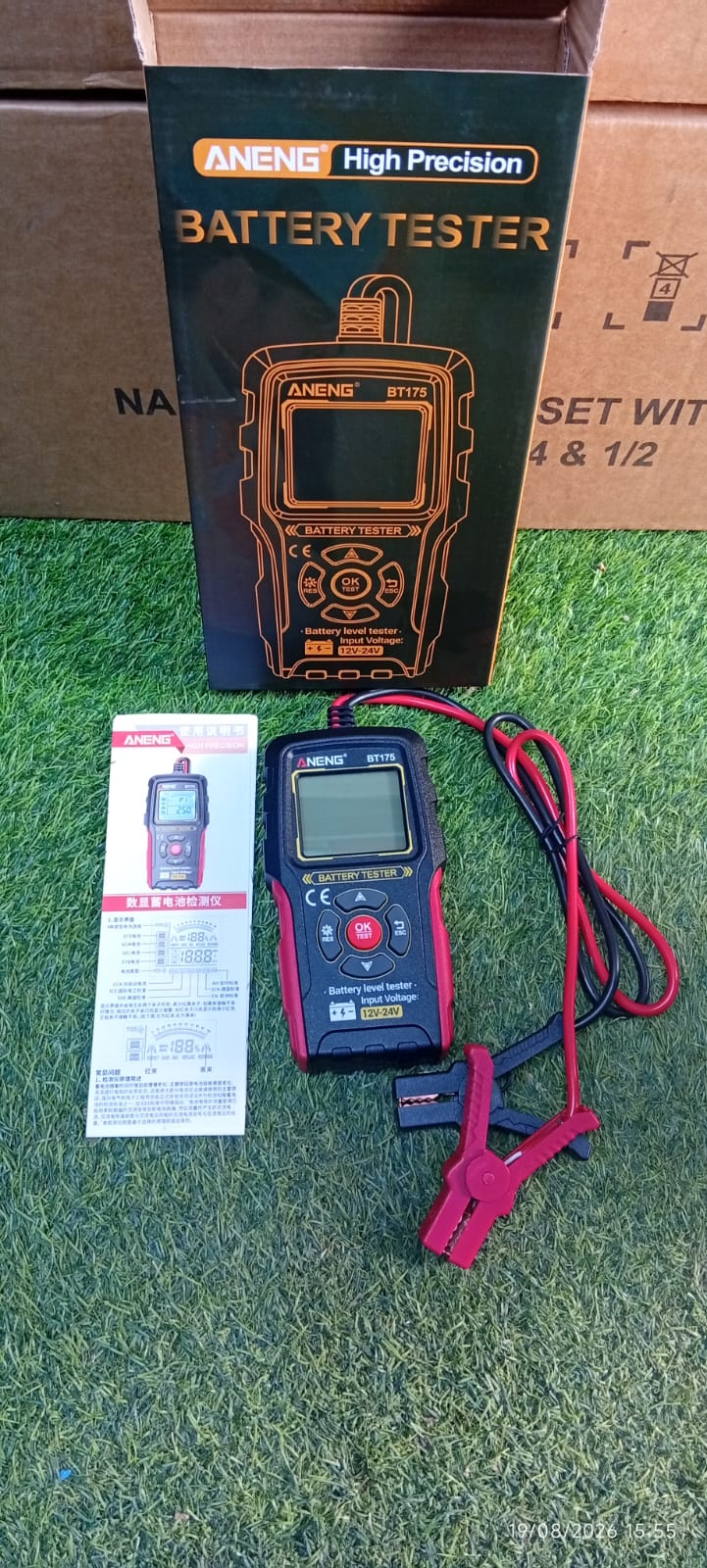
Description
An ANENG Battery Tester is a portable automotive diagnostic tool used to check the condition of vehicle batteries, starting systems and alternator charging performance. It is useful for mechanics, garages, battery shops, fleet operators and vehicle owners who want to identify weak batteries before they cause starting problems.
ANENG produces several battery tester models, including simple 12V voltage testers and more advanced 12V/24V lead-acid battery analyzers. A higher-spec model such as the ANENG BT175 can test battery voltage, internal resistance, Cold Cranking Amps (CCA), state of charge and battery health. It supports common lead-acid battery types including STD, AGM, GEL and EFB batteries.
This makes an ANENG battery tester more useful than a basic voltmeter when diagnosing car, motorcycle, pickup and commercial-vehicle battery problems.
Quick Specifications
| Feature | Typical ANENG Battery Tester Specification |
|---|---|
| Product Name | ANENG Battery Tester |
| Common Models | BT171, BT172, BT175, BT81, BT82 |
| Battery Systems | 12V and 24V, model dependent |
| Voltage Range | Up to 8V–36V on BT175 |
| Battery Type | Lead-Acid |
| Supported Types | STD, AGM, GEL, EFB |
| CCA Test Range | 50–1999 CCA on BT175 |
| Battery Capacity | 3Ah–200Ah on BT175 |
| Display | LED or Backlit LCD |
| Battery Required | No on many models |
| Test Leads | Red and Black Alligator Clips |
| Main Tests | Voltage, Battery Health, Starting and Charging |
| Suitable For | Cars, Motorcycles, Pickups, Vans and Selected Trucks |
Specifications vary considerably between models. A simple BT172 is a 12V voltage and alternator tester, while a BT175 offers much deeper battery-health analysis.
ANENG BT175 Advanced Battery Analyzer
The ANENG BT175 is one of the more capable models in the range.
It supports:
- 12V batteries
- 24V batteries
- Voltage measurement from 8V to 36V
- CCA testing from 50 to 1999
- Battery capacities from 3Ah to 200Ah
- STD batteries
- AGM batteries
- GEL batteries
- EFB batteries
It can display battery condition information including voltage, internal resistance, available starting current, state of charge and estimated battery health.
Cold Cranking Amps Testing
Cold Cranking Amps, commonly written as CCA, indicate how much starting current a battery can provide under specified cold conditions.
A weak battery may still show acceptable open-circuit voltage but fail to deliver enough current to start the engine.
The ANENG BT175 tests approximately 50 to 1999 CCA, making it suitable for a broad range of automotive lead-acid starting batteries.
This feature helps determine whether a battery is:
- Healthy
- Aging
- Weak
- In need of charging
- Near replacement
Battery State of Health
Advanced ANENG testers can estimate State of Health (SOH).
SOH gives an indication of how well the battery performs compared with its original condition.
A battery can be fully charged but still have poor health because of:
- Aging plates
- Sulphation
- Internal damage
- High internal resistance
- Repeated deep discharge
This is why a battery analyzer can provide more useful information than voltage alone.
State of Charge
The tester can also indicate the State of Charge (SOC).
SOC tells you approximately how much electrical charge is currently available in the battery.
This helps distinguish between:
- A good battery that simply needs charging
- A fully charged but worn-out battery
- A weak battery that may need replacement
Internal Resistance Measurement
Battery internal resistance increases as many lead-acid batteries age and deteriorate.
The BT175 includes internal resistance measurement as part of its diagnostic functions.
Higher resistance can contribute to:
- Slow cranking
- Voltage drop
- Poor starting
- Reduced available current
Internal resistance should be interpreted together with CCA, voltage and battery condition rather than used alone.
12V and 24V Compatibility
More advanced ANENG testers support both 12V and 24V lead-acid systems.
This makes them suitable for:
12V Systems
- Cars
- Motorcycles
- SUVs
- Pickups
- Small vans
- Generators
24V Systems
- Trucks
- Buses
- Commercial vehicles
- Selected construction equipment
The simpler ANENG BT171 and BT172 are designed primarily for 12V systems, so model selection matters.
Supported Lead-Acid Battery Types
The ANENG BT175 supports several common battery constructions.
Standard Flooded Battery
Traditional serviceable or maintenance-free lead-acid starting batteries.
AGM Battery
Absorbent Glass Mat batteries are common in modern vehicles and start-stop systems.
GEL Battery
Gel-electrolyte batteries are used in some automotive and standby applications.
EFB Battery
Enhanced Flooded Batteries are often used in entry-level start-stop vehicles.
ANENG specifies compatibility with STD, AGM, GEL and EFB batteries on the BT175.
It is not intended for lithium batteries.
Multiple Battery Standards
Battery labels do not all use the same testing standard.
The ANENG BT175 supports several common standards, including:
- CCA
- IEC
- SAE
- EN
- DIN
- Ah
This allows the user to enter the rating printed on many different battery brands.
Alternator Charging Test
A battery tester can also help check whether the alternator is charging correctly.
The simpler ANENG BT172 provides a dedicated alternator mode. It displays real-time charging voltage and uses indicator lights to classify the charging system condition.
This can help identify:
- Undercharging
- Normal charging
- Excessively high charging voltage
- Alternator or regulator problems
Cranking System Test
Selected advanced models such as the ANENG BT82 can perform a starting-system or cranking test.
This checks the voltage behaviour when the starter motor turns the engine.
A large voltage drop during cranking may indicate:
- Weak battery
- Poor terminals
- High cable resistance
- Starter problems
The BT82 also supports charging-system and load testing.
Real-Time Voltage Display
Even the simpler ANENG BT171 and BT172 models display battery voltage directly.
The BT172 is specifically designed for 12V systems and uses a clear digital display together with coloured indicators.
This makes it easy to perform a quick battery check without setting up a multimeter.
Colour-Coded Battery Indicators
Simple ANENG models use colour-coded lights to make battery condition easier to understand.
The BT172 provides indicators for conditions such as:
- Full
- Medium
- Low
- Empty
It also has alternator indicators such as:
- High
- Good
- Fault
This design is useful for users who do not want to interpret electrical readings manually.
Reverse Polarity Warning
Connecting battery tester clamps backwards can cause incorrect readings and potentially damage some equipment.
The ANENG BT172 includes a reverse connection warning. If the clamps are connected incorrectly, a warning light and buzzer indicate the mistake.
Correct connection is:
- Red clamp to positive (+)
- Black clamp to negative (-)
Overvoltage Protection
Selected ANENG models also include overvoltage indication or protection.
The BT172 provides an overvoltage warning as part of its safety features.
This is useful when checking charging systems where regulator failure may produce excessive voltage.
No Internal Battery Required
Many ANENG battery testers obtain their operating power directly from the battery under test.
The BT172, for example, does not require a separate internal battery.
Advantages include:
- Always ready to use
- No AA or AAA battery replacement
- Lower maintenance
- Easy vehicle storage
Strong Alligator Clips
The tester connects directly to the battery terminals using red and black clamps.
The BT175 uses approximately 62.5 cm test leads and compact alligator clips.
Good clamp contact is important because dirty or corroded terminals can affect test results.
Backlit LCD Display
The ANENG BT175 features a backlit display for clearer readings in garages, engine bays and other low-light environments.
The screen can display more information than a simple LED battery checker, making it more suitable for professional diagnostic work.
Compact Portable Construction
Automotive testers need to be easy to carry.
The BT175 weighs about 270 g, while the simpler BT172 weighs only about 78 g.
This compact size makes them easy to keep in:
- Garage toolboxes
- Service vehicles
- Battery shops
- Recovery vehicles
- Car boots
Applications of an ANENG Battery Tester
Car Battery Testing
Useful for checking battery condition before:
- Long trips
- Vehicle servicing
- Battery replacement
- Buying a used vehicle
Battery Shops
A battery seller can quickly demonstrate whether a battery is healthy, weak or discharged.
Automotive Garages
Mechanics can use it during diagnosis of:
- Hard starting
- Slow cranking
- Battery warning lights
- Charging problems
Motorcycle Maintenance
Compatible models can test suitable motorcycle lead-acid batteries.
Fleet Maintenance
Useful for periodically checking several vehicle batteries before failures occur.
Trucks and Commercial Vehicles
A 24V-capable model such as the BT175 is more suitable for commercial fleets using 24V battery systems.
ANENG Battery Tester vs Multimeter
| Feature | ANENG Battery Tester | Digital Multimeter |
|---|---|---|
| Battery Voltage | Yes | Yes |
| CCA Measurement | Advanced Models | No |
| Battery Health | Yes | No |
| Internal Resistance | Advanced Models | Limited/No |
| Alternator Test | Yes | Voltage Check Only |
| State of Charge | Yes | Requires Interpretation |
| General Electrical Testing | Limited | Excellent |
A multimeter is more versatile for general electrical work, while a battery analyzer gives more specialized information about automotive battery condition.
ANENG Battery Tester vs Load Tester
| Feature | Electronic ANENG Tester | Traditional Load Tester |
|---|---|---|
| Size | Compact | Larger |
| Heat Generation | Low | High |
| CCA Analysis | Yes on Advanced Models | Model Dependent |
| Battery Health Estimate | Yes | Basic |
| Easy Digital Reading | Yes | Model Dependent |
An electronic tester is convenient for fast diagnostics, while professional workshops may still use load testing for additional confirmation.
How to Use an ANENG Battery Tester
Step 1: Switch Off the Vehicle
Turn off lights, radio, air conditioning and other electrical loads.
Step 2: Locate the Battery
Access the positive and negative terminals.
Step 3: Check the Terminals
Remove excessive dirt or corrosion if necessary.
Step 4: Connect the Red Clamp
Attach it firmly to the battery positive terminal.
Step 5: Connect the Black Clamp
Attach it to the negative terminal.
Step 6: Select Battery Voltage
Choose 12V or 24V where required.
Step 7: Select Battery Type
On advanced models, choose the correct battery type such as AGM, EFB, GEL or standard flooded.
Step 8: Enter the Battery Rating
Enter the CCA or other rating printed on the battery label.
Step 9: Run the Test
Allow the tester to analyze the battery.
Step 10: Read the Result
Check voltage, CCA, SOH, SOC and other available values.
Testing the Charging System
Start the engine after completing the basic battery test if the tester’s procedure requires it.
Select charging-system testing.
The tester checks alternator output and can indicate whether charging voltage is:
- Too low
- Normal
- Too high
The BT172 uses LEDs to indicate alternator status, while more advanced models display more detailed results.
Battery Tester Results Explained
Good Battery
The battery has adequate health and starting ability.
Good, Recharge
The battery may still be healthy but requires charging.
Replace
Battery capacity or starting performance has deteriorated significantly.
Low Voltage
The battery may be discharged.
Charging Fault
Alternator output may be outside the expected operating range.
Exact wording varies by tester model.
Important Safety Tips
Car batteries can release explosive gases and contain corrosive acid.
For safer testing:
- Wear safety glasses.
- Keep flames and cigarettes away.
- Test in a ventilated area.
- Connect positive and negative correctly.
- Do not allow the clamps to touch each other.
- Keep metal tools away from both terminals at the same time.
- Do not test a visibly swollen or leaking battery.
- Follow the battery manufacturer’s instructions.
Do Not Test Lithium Batteries Unless Supported
The ANENG BT175 is specified for lead-acid batteries and is not suitable for lithium batteries.
Do not assume that a 12V lithium battery can be tested simply because the voltage looks similar.
Maintenance
ANENG battery testers require little maintenance.
After use:
- Wipe the tester clean.
- Clean the clamps.
- Inspect test cables.
- Keep terminals free of corrosion.
- Store in a dry place.
- Avoid dropping the display.
- Keep the cables loosely coiled.
Replace the tester if the cables become badly damaged.
How to Choose the Best ANENG Battery Tester
Choose according to the level of diagnosis you need.
For Simple Battery Checks
A model such as BT171 or BT172 is suitable for:
- 12V voltage checks
- Battery charge indication
- Alternator status
For Professional Battery Analysis
Choose a model such as BT175 or BT82 if you need:
- 12V and 24V support
- CCA testing
- Battery health
- Internal resistance
- Cranking tests
- Charging-system tests
The BT175 supports 50–1999 CCA and 3–200Ah batteries, while the BT82 offers starting and charging-system diagnostic functions.
Why Buy an ANENG Battery Tester?
An ANENG Battery Tester allows you to find battery problems before a vehicle refuses to start.
Instead of checking voltage alone, an advanced model can provide information about:
- CCA
- Battery health
- State of charge
- Internal resistance
- Starting performance
- Alternator charging condition
This makes it useful for professional garages, battery dealers, car owners and fleet maintenance operations.
Frequently Asked Questions
What does an ANENG Battery Tester do?
It checks vehicle battery and charging-system condition. Advanced models can measure voltage, CCA, internal resistance, state of charge and battery health.
Can it test 12V batteries?
Yes. ANENG models such as BT171 and BT172 are specifically designed for 12V automotive battery systems.
Can it test 24V batteries?
Yes, selected models such as the ANENG BT175 support both 12V and 24V lead-acid batteries.
What CCA range does the BT175 support?
The ANENG BT175 supports approximately 50 to 1999 CCA.
What battery capacity can it test?
The BT175 is specified for approximately 3Ah to 200Ah batteries.
Which battery types are supported?
The BT175 supports STD, AGM, GEL and EFB lead-acid batteries.
Can it test lithium batteries?
The BT175 is specifically stated as unsuitable for lithium batteries. It is intended for lead-acid batteries.
Does it check the alternator?
Yes. Models such as the BT172 include alternator charging-system analysis, while advanced models provide broader charging diagnostics.
Does it require batteries?
Many ANENG testers do not require their own battery because they are powered by the vehicle battery being tested. The BT172 is one example.
What happens if I connect it backwards?
The BT172 includes reverse-polarity indication and an audible warning for incorrect connection.
Is the ANENG Battery Tester suitable for garages?
Yes. It is useful for garages, battery shops, mechanics and fleet workshops because it provides faster battery diagnosis than checking voltage alone.
Reviews
There are no reviews yet.