
Description
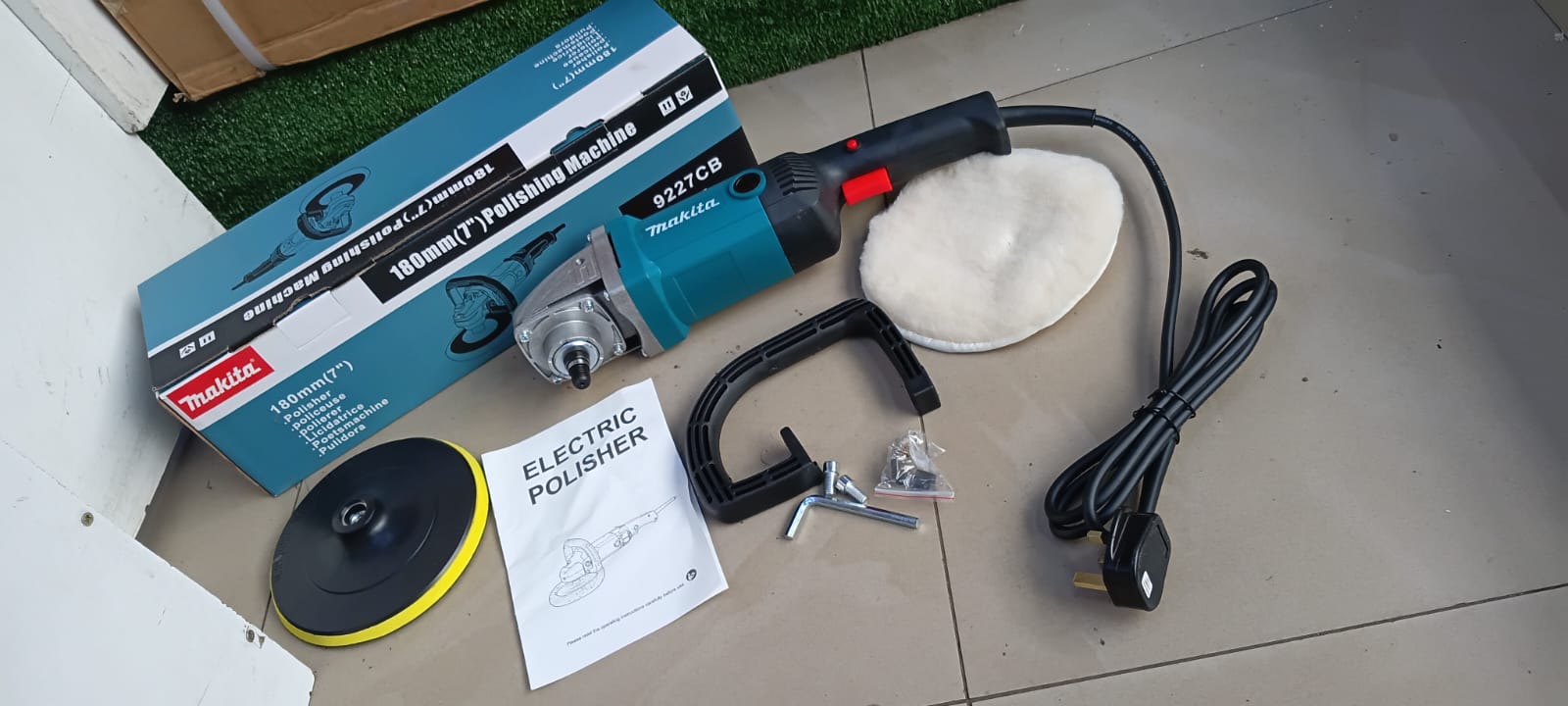
The Makita polisher is a professional power tool designed for car detailing, paint correction, buffing, waxing and surface finishing. One of Makita’s best-known full-size polishing machines is the Makita 9237CB, a 180mm rotary polisher with a powerful 1,200W motor and adjustable speed from 0 to 3,200rpm.
Its large 7-inch polishing pad, variable speed control, soft-start system and constant-speed electronics make it suitable for professional garages, car wash businesses, body shops and serious detailing work.
The 9237CB is especially useful when correcting paint defects, removing oxidation, polishing painted surfaces and restoring shine on cars, boats and other smooth surfaces.
Makita Polisher Specifications
| Feature | Specification |
|---|---|
| Brand | Makita |
| Model | 9237CB |
| Product Type | Rotary Sander / Polisher |
| Motor Power | 1,200W |
| Pad Diameter | 180mm / 7 Inches |
| Polishing Speed | 0–3,200rpm |
| Sanding Speed | 600–3,200rpm |
| Voltage | 230V on current reference model |
| Spindle Thread | M14 on applicable version |
| Arbor Diameter | 22.23mm |
| Overall Length | 431mm |
| Approx. Dimensions | 431 × 198 × 187mm |
| Net Weight | About 3.4kg |
| Power Cable | 2.5m |
| Speed Control | Variable |
| Constant Speed Control | Yes |
| Soft Start | Yes |
| Double Insulation | Yes |
| Main Applications | Car Polishing, Buffing, Paint Correction, Surface Finishing |
Makita’s current published specifications confirm a 1,200W motor, 180mm pad, 0–3,200rpm polishing speed, 230V supply, 2.5m power cable and approximately 3.4kg weight.
Powerful 1200W Motor
The Makita 9237CB uses a 1,200W electric motor.
This gives the machine enough power for demanding polishing and buffing jobs without needing a battery.
It is suitable for users who regularly work on:
- Cars
- Pickups
- SUVs
- Vans
- Trucks
- Boats
- Painted metal surfaces
- Workshop projects
The high-powered motor is especially useful during paint correction, where the polishing pad must maintain useful speed while working against the surface.
Makita also uses constant-speed electronics to help reduce speed loss under load.
Large 180mm Polishing Pad
The polisher accepts a:
180mm / 7-inch pad
This larger pad helps cover wide vehicle panels quickly.
It is useful when polishing:
- Bonnets
- Roofs
- Doors
- Boot lids
- Side panels
- Large commercial vehicles
A 180mm polisher can finish large surfaces faster than small 125mm or 150mm machines.
Makita specifies both a 180mm wool pad and 180mm wool bonnet for the 9237CB platform.
Variable Speed from 0 to 3,200rpm
A major benefit of the Makita polisher is its wide speed range.
The polishing speed is:
0–3,200rpm
while Makita lists sanding operation at approximately:
600–3,200rpm.
Variable speed is important because one speed is not ideal for every polishing job.
Lower speed can be useful when:
- Spreading polish
- Applying compound
- Working around sensitive areas
- Starting a polishing pass
Higher speed may be used where suitable for more aggressive polishing or sanding applications.
Always match machine speed to the pad, compound and surface being worked on.
Pre-Set Speed Dial
The Makita 9237CB uses a stepped variable-speed dial.
This allows the user to select a suitable maximum speed before polishing.
Makita specifically describes the system as useful for very slow polishing and applications requiring controlled speed.
This gives the operator more control than a basic single-speed buffing machine.
Constant Speed Electronics
When a polisher is pressed against a vehicle panel, motor speed can fall under load.
The 9237CB uses electronic constant-speed control to help maintain the selected speed while polishing.
This helps provide:
- More even polishing
- Better control
- More predictable correction
- Consistent pad movement
It is especially useful during professional detailing where a consistent finish is important.
Soft Start
The Makita polisher also includes soft-start technology.
Instead of instantly jumping to full speed, the tool starts more smoothly.
This can help reduce:
- Sudden tool movement
- Polish splatter
- Compound being thrown from the pad
- Loss of operator control
For vehicle detailing, soft start makes the machine easier to handle when beginning each polishing section.
Rubberised Gear Housing
The 9237CB has a rubberised or elastomer-covered gear housing.
Makita designed this feature to help protect delicate surfaces such as vehicle paint if the tool body accidentally touches the workpiece.
This is useful when working around:
- Bonnet edges
- Door panels
- Curved bodywork
- Bumpers
- Narrow areas
The protective covering does not replace careful handling, but it adds useful protection during professional polishing.
Comfortable Loop Handle
Makita supplies a loop handle with rubberised soft grip on the 9237CB.
The loop handle gives the operator a second grip point.
This improves control when:
- Moving across wide panels
- Applying consistent pressure
- Polishing vertical surfaces
- Working for longer periods
Two-handed control is important on a rotary polisher because the pad produces rotational force as it contacts the surface.
M14 Spindle Thread
Makita lists an M14 spindle thread for applicable versions of the 9237CB.
This is a common accessory connection on larger polishers and grinders.
However, Makita also notes that spindle specifications can vary by country, so always confirm the actual spindle on the machine before purchasing backing pads or accessories.
2.5-Metre Power Cable
The machine comes with an approximately:
2.5m power supply cord.
The cable gives reasonable working reach around a vehicle.
For larger workshops, a properly rated extension cable may still be required.
Avoid using a thin extension lead that can cause excessive voltage drop under the 1,200W motor load.
Approximate 3.4kg Weight
The Makita 9237CB weighs approximately:
3.4kg.
This is heavier than small cordless detailing polishers, but the weight is typical for a powerful 180mm professional rotary machine.
Correct two-handed handling helps reduce fatigue and improves polishing control.
Suitable for Car Paint Correction
A rotary polisher can be used for removing or reducing paint defects such as:
- Oxidation
- Light scratches
- Swirl marks
- Water spots
- Faded paint
- Sanding marks
The final result depends on the condition of the paint and the combination of pad, compound and polishing technique.
A rotary machine can correct paint quickly, but it can also generate significant heat if held in one place too long.
Compounding
A cutting compound can be paired with a suitable polishing pad to remove heavier paint defects.
Wool and cutting foam pads are commonly used for aggressive correction.
The 1,200W motor and 180mm pad make the 9237CB particularly suitable for professional compounding work.
After heavy cutting, a finer polish may be needed to improve gloss and remove polishing haze.
Final Polishing
The machine can also be used with a softer pad and fine polish for finishing.
For final polishing:
- Use a clean pad.
- Select a suitable lower or medium speed.
- Use light controlled pressure.
- Keep the machine moving.
- Avoid overheating the paint.
For users who need an easier finishing machine with less aggressive rotary action, Makita also produces random-orbit polishers.
Wax Application
A compatible soft pad may also be used for applying suitable wax or finishing products.
Use low speed for wax spreading where recommended by the product manufacturer.
The goal is to apply a thin and even layer rather than aggressively cut into the paint.
Rotary vs Random Orbit Makita Polisher
Makita offers both rotary and random-orbit polishing machines.
| Feature | Makita 9237CB | Makita PO6000C |
|---|---|---|
| Polisher Type | Rotary | Random Orbit |
| Motor | 1,200W | 900W |
| Pad Size | 180mm | 150mm |
| Max Rotation | 3,200rpm | 780rpm |
| Orbit | None | 5.5mm |
| Max Orbits | None | 6,800opm |
| Paint Correction | Strong | Strong but more controlled |
| Fine Finishing | Good with skill | Excellent |
| Beginner Friendly | Requires more care | Easier |
The PO6000C uses two selectable modes, including forced rotation for correction and free random-orbit operation for fine finishing. It has a 900W motor, 150mm pad and 5.5mm orbit.
Makita 9237CB vs Cordless Makita Polisher
Makita also produces cordless polishing machines.
For example, the DPO600Z is an 18V LXT brushless random-orbit polisher with a 150mm pad and 5.5mm orbit.
| Feature | 9237CB Corded | DPO600Z Cordless |
|---|---|---|
| Power Source | 230V Mains | 18V Battery |
| Pad | 180mm | 150mm |
| Motor | Corded | Brushless |
| Runtime | Continuous | Battery Limited |
| Maximum Mobility | Good | Excellent |
| Large-Panel Work | Excellent | Good |
| Battery Needed | No | Yes |
| Workshop Use | Excellent | Excellent |
The corded 9237CB is ideal where uninterrupted polishing time is more important than cordless mobility.
Makita 9237CB vs Angle Grinder
A polisher and an angle grinder may look similar, but they are designed for different jobs.
A typical grinder runs much faster than a vehicle polisher.
The Makita 9237CB has a controlled maximum speed of 3,200rpm, making it suitable for polishing operations.
Do not simply fit a polishing pad to any high-speed grinder unless the grinder, pad and accessory are specifically approved for that use.
Excessive speed can damage the pad, paint or accessory and create a safety risk.
Polishing Pads You Can Use
Depending on the polishing job and backing system, suitable accessories may include:
Wool pads for stronger cutting.
Foam cutting pads for paint correction.
Medium foam pads for general polishing.
Soft finishing pads for fine polish or wax.
Makita lists a wool pad as standard equipment with the 9237CB in some markets.
Sanding Capability
The 9237CB is also described as a sander polisher.
Makita lists compatible 180mm abrasive discs in grits including 40, 80 and 120 for suitable sanding applications.
Sanding a vehicle finish is a skilled process.
Do not use coarse abrasives on automotive paint without understanding paint thickness and the refinishing process.
How to Use a Makita Polisher
Start by washing and drying the surface thoroughly.
Inspect the paint and choose the correct pad and compound.
Fit the pad securely.
Apply a small amount of compound.
Spread the product over the working area before using higher speed.
Hold the machine with both hands.
Work across a small section at a time.
Keep the pad reasonably flat and keep the machine moving.
Inspect the paint regularly and stop if excessive heat develops.
Avoid Excessive Pressure
A polisher should not be forced heavily into the paint.
Too much pressure can:
- Create excess heat
- Slow the pad
- Wear the pad faster
- Tire the operator
- Damage sensitive paint
Let the motor, pad and polishing compound perform the work.
Check Pad Speed Rating
Any wool, foam, sanding or backing accessory fitted to the tool should be suitable for the polisher’s size and operating speed.
The 9237CB can reach 3,200rpm, so accessories should be appropriately rated for that speed or higher.
Never use a damaged backing pad or polishing accessory.
Noise and Vibration
Makita publishes a sound-pressure level of approximately 86dB(A) and sound-power level of 94dB(A) for the 9237CB.
Published polishing vibration is approximately 2.5m/s² or less, depending on the test specification.
Hearing protection can be appropriate during prolonged workshop use.
Standard Accessories
Depending on market and package, Makita lists the following equipment with the 9237CB:
| Accessory | Purpose |
|---|---|
| 180mm Pad | Supports polishing accessory |
| Wool Pad | Compounding and polishing |
| Loop Handle | Improved control |
| Hex Wrench | Accessory installation |
Makita notes that supplied equipment can vary by country or region.
Makita Polisher Maintenance
Good maintenance helps keep the machine performing properly.
Keep the ventilation openings clean.
Remove polishing dust and wool fibres from the machine after use.
Inspect the power cable regularly.
Replace damaged pads.
Keep polishing accessories clean and separate according to compound type.
The 9237CB also uses removable vent dust covers designed to reduce wool fibres entering the motor.
How to Choose a Makita Polisher
Choose according to the type of work you do.
For fast correction and larger panels, the 180mm 9237CB rotary polisher is a strong professional option.
For users focused on paint finishing and a more forgiving polishing action, a random-orbit model such as the PO6000C may be better.
For mobile detailers who want freedom from electrical cables, an 18V or 40V cordless Makita model may be more suitable.
Makita Polisher Price in Kenya
Makita polisher prices in Kenya vary greatly depending on whether the machine is an original professional Makita model, a marketplace listing, a random-orbit machine or a cordless model.
A current Kenya-facing Microless listing shows the Makita 9237CB 180mm 240V professional polisher at about KSh 37,336, reduced from approximately KSh 38,746.
Jumia Kenya also currently shows products advertised as Makita 180mm polishers from approximately KSh 6,499 to KSh 10,000, while the PO6000C is listed near KSh 24,890 to KSh 25,000. These marketplace listings vary significantly in stated specifications, so buyers should verify the exact model number, authenticity and warranty before purchase.
| Makita Polisher Type | Approx. Current Kenya Listing Price |
|---|---|
| Marketplace 180mm Makita-Labelled Polishers | KSh 6,500–10,000 |
| PO6000C Random Orbit Listings | Around KSh 24,900–25,000 |
| Genuine-Spec 9237CB Professional Listing | Around KSh 37,300 |
| Cordless Professional Models | Depends on battery and kit |
A very low price should not automatically be compared with an official-spec 9237CB because some marketplace listings use different motors, specifications or unverified branding.
Why Buy a Makita Polisher?
A Makita polisher in Kenya is a strong option for professional detailers, garages and body shops that need controlled polishing power.
The 9237CB combines a 1,200W motor, 180mm polishing pad, variable 0–3,200rpm speed, soft start and constant-speed control in a professional corded machine.
Its rubberised gear housing, comfortable loop handle and large polishing pad also make it well suited to long vehicle-detailing jobs.
For heavy paint correction and regular garage work, the 9237CB remains a more purpose-built choice than using an ordinary angle grinder as a polishing machine.
Frequently Asked Questions
What is the power of the Makita 9237CB polisher?
The Makita 9237CB has a 1,200W continuous input rating.
What size polishing pad does it use?
It uses a 180mm or 7-inch polishing pad.
What is the maximum speed?
The maximum no-load polishing speed is approximately 3,200rpm.
Does the Makita polisher have variable speed?
Yes. The 9237CB uses variable speed control and a pre-set stepped speed dial.
Does it have soft start?
Yes. The current 9237CB specification includes soft start for smoother starting.
Does it maintain speed under load?
Yes. Makita uses electronic constant-speed control to help maintain polishing speed under load.
What voltage does the Makita 9237CB use?
The current reference model is rated at 230V. Specifications may differ by market.
What spindle size does it use?
Makita lists M14 for applicable versions, although spindle thread can vary by country.
How heavy is the Makita polisher?
The 9237CB weighs approximately 3.4kg.
How long is the power cable?
The standard reference specification lists a 2.5m cable.
Can it polish cars?
Yes. The 9237CB is designed for polishing and is particularly suitable for car paint correction, compounding and finishing.
Can it remove scratches?
It can reduce many light and moderate paint defects when used with the correct compound and pad. Deep scratches that have penetrated the paint may require repainting rather than polishing.
Can I use it for waxing?
Yes. Use a compatible soft pad and suitable low speed according to the wax manufacturer’s instructions.
Is the Makita 9237CB a rotary or random-orbit polisher?
The 9237CB is a rotary polisher. The Makita PO6000C is a separate random-orbit model.
What accessories come with it?
Depending on the market, Makita lists a pad, wool pad, loop handle and hex wrench among the standard equipment.
What is the price of a Makita polisher in Kenya?
Current prices vary widely. Marketplace models advertised under the Makita name are around KSh 6,500 to KSh 10,000, while a current Kenya-facing listing for the professional Makita 9237CB is about KSh 37,336. Verify the exact model and authenticity before comparing prices.
Reviews
There are no reviews yet.