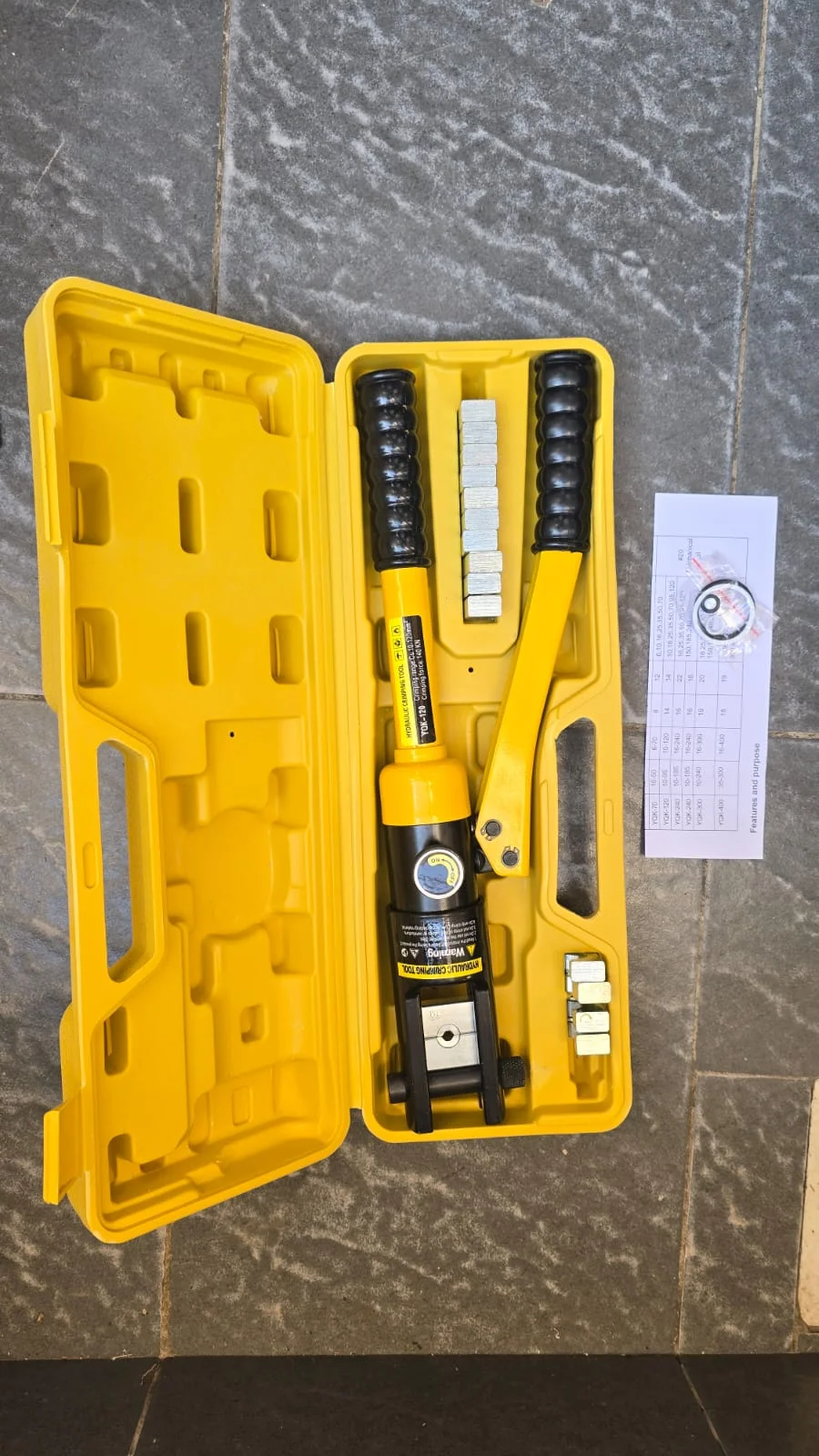
A hyraulic crimping tool in Kenya is a heavy-duty hand tool used to compress cable lugs and terminals firmly onto electrical cables. It uses hydraulic pressure to produce much more crimping force than ordinary manual crimping pliers.
In 2026, one of the best choices for electricians, solar installers and electrical workshops is the INGCO HHCT01240. It handles copper cable sizes from 16mm² to 300mm², produces 70kN crimping force, uses hexagonal crimping, and has an 18mm hydraulic stroke.
For smaller cables, a 4–70mm² hydraulic crimper is cheaper and easier to carry. For large solar, inverter, battery and industrial cables, a 16–240mm² or 16–300mm² model gives a much wider working range.
Hyraulic Crimping Tool in Kenya Summary
| Model | Crimping Range | Force | Crimp Type | Approx. 2026 Price | Best For |
|---|---|---|---|---|---|
| Kashemano Hydraulic Crimper | 4–70mm² | Model dependent | Hexagonal dies | KSh 4,390–4,797 | Budget Use |
| Tolsen Industrial Hydraulic Crimper | Model dependent | 5 ton | Hydraulic | About KSh 8,349 | General Electrical Work |
| TOTAL THCT070 | 4–70mm² | 45kN | Hexagonal | KSh 8,340–13,400 | Small and Medium Cables |
| TOTAL THCT0240 | 16–240/300mm²* | 70kN | Hexagonal | KSh 9,500–16,280 | Heavy Electrical Work |
| INGCO HHCT0170 | 4–70mm² | 45kN | Hydraulic Crimping | KSh 9,999–13,450 | Electricians |
| INGCO HHCT01240 | 16–300mm² | 70kN | Hexagonal | KSh 10,999–14,000 | Best Overall |
*Current Kenyan listings for the TOTAL THCT0240 are inconsistent, with some describing the range as 16–240mm² and others as 16–300mm². Confirm the supplied dies and model label before buying.
1. INGCO HHCT01240 16–300mm² Hydraulic Crimping Tool
The INGCO HHCT01240 is our best overall hyraulic crimping tool in Kenya for users who regularly work with large electrical cables.
Its wide 16–300mm² range makes it suitable for many battery, solar, inverter, generator and electrical distribution installations.
INGCO HHCT01240 Specifications
| Feature | Specification |
|---|---|
| Brand | INGCO |
| Model | HHCT01240 |
| Crimping Range | Cu 16–300mm² |
| Crimping Force | 70kN |
| Crimping Type | Hexagonal |
| Hydraulic Stroke | 18mm |
| Length | Approx. 475mm |
| Tool Weight | Approx. 3.6kg |
| Case Weight | Approx. 1.8kg |
| Storage | BMC carrying case |
| Spare Seal | O-ring set included |
Current listings specify dies for 16, 25, 35, 50, 70, 95, 120, 150, 185, 240 and 300mm², although one older listing omits the 300mm² die from its accessory list despite stating a 300mm² maximum range. Confirm the exact dies supplied before purchase.
INGCO HHCT01240 Price in Kenya
Current Kenyan prices vary considerably by seller.
Wima Power Tools lists the model at approximately KSh 10,999, while current Jumia listings range from about KSh 11,590 to KSh 14,000.
Best For
- Solar installers
- Electricians
- Battery cables
- Inverter installations
- Generator cables
- Industrial electrical work
- Distribution boards
- Large copper cable lugs
2. TOTAL THCT0240 Heavy-Duty Hydraulic Crimper
The TOTAL THCT0240 is another strong choice for heavy electrical work.
Current Kenyan listings give it a 70kN crimping force, 18mm stroke and hexagonal crimping system.
TOTAL THCT0240 Specifications
| Feature | Specification |
|---|---|
| Brand | TOTAL |
| Model | THCT0240 |
| Cable Range | 16–240mm² on many listings |
| Other Listings | Up to 300mm² |
| Crimping Force | 70kN |
| Crimp Type | Hexagonal |
| Stroke | 18mm |
| Length | Approx. 475mm |
| Tool Weight | Approx. 3.6kg |
| Carrying Case | Yes |
A Kenyan hardware supplier currently lists the TOTAL tool at KSh 9,500, while Jumia listings range from about KSh 9,789 to KSh 16,280 depending on seller.
Important Specification Check
There is a noticeable difference between current seller descriptions.
Some call the THCT0240 a 16–240mm² tool, while other Kenyan listings advertise it as 16–300mm².
Before buying, check the model label and every die supplied in the case.
3. TOTAL THCT070 4–70mm² Hydraulic Crimping Tool
Not everyone needs a 300mm² crimper.
For normal electrical installations and smaller battery cables, the TOTAL THCT070 provides a more compact option.
Current listings specify:
- 4–70mm² crimping range
- 45kN force
- Hydraulic operation
- Multiple interchangeable dies
Current Kenya prices are approximately KSh 8,340 to KSh 13,400.
Best For
- Electricians
- Automotive battery cables
- Small solar installations
- Control panels
- Electrical maintenance
- Cable lug installation
4. INGCO HHCT0170 4–70mm² Hydraulic Crimper
The INGCO HHCT0170 is the smaller alternative to the HHCT01240.
Current Kenyan listings show a 4–70mm² range and 45kN crimping force, with prices ranging from around KSh 9,999 to KSh 13,450.
This model makes sense if most of your electrical work involves cables below 70mm².
Buying a large 16–300mm² machine for small cables adds unnecessary size and weight.
5. Tolsen Industrial Hydraulic Crimping Tool
Tolsen also has an industrial hydraulic crimper available in Kenya.
A current Jumia Kenya listing shows a 5-ton Tolsen Industrial hydraulic crimping tool with a 305mm or 12-inch body at approximately KSh 8,349.
Best For
- Electrical workshops
- General cable work
- Technicians
- Maintenance work
Check the exact die sizes supplied before ordering because the current listing does not provide the same detailed cable-range information as the INGCO HHCT01240.
6. Budget 4–70mm² Hydraulic Crimping Tool
For occasional work, a budget hydraulic crimper can save money.
Current Jumia listings include a Kashemano hand-operated hydraulic crimper covering 4–70mm² at around KSh 4,390 to KSh 4,797.
The kit is advertised with eight pairs of dies.
Best For
- DIY electrical work
- Occasional battery cable repair
- Small workshops
- Light electrical installations
For frequent professional work, a better-known tool platform may offer better long-term value.
Hydraulic Crimping Tool Prices in Kenya 2026
| Type | Approximate Price |
|---|---|
| Budget 4–70mm² Hydraulic Crimper | KSh 4,390–6,000 |
| Tolsen Industrial Hydraulic Crimper | Around KSh 8,349 |
| Generic 16–300mm² Crimper | KSh 7,999–12,000 |
| TOTAL THCT070 4–70mm² | KSh 8,340–13,400 |
| INGCO HHCT0170 4–70mm² | KSh 9,999–13,450 |
| TOTAL THCT0240 | KSh 9,500–16,280 |
| INGCO HHCT01240 16–300mm² | KSh 10,999–14,000 |
A generic 16–300mm² hydraulic crimper is currently listed by a Kenyan tool supplier at KSh 7,999, while the branded INGCO HHCT01240 starts around KSh 10,999.
Prices can change depending on the seller, die set, carrying case and promotion.
What Is a Hydraulic Crimping Tool Used For?
A hydraulic crimper joins a cable conductor and compatible lug by permanently compressing the lug around the cable.
It is commonly used for:
- Copper cable lugs
- Battery terminals
- Solar battery cables
- Inverter cables
- Generator connections
- Distribution cables
- Welding cables
- Industrial electrical connections
A correct crimp should provide strong mechanical retention and reliable electrical contact when the lug, conductor, die and crimping method are properly matched.
How a Hydraulic Crimping Tool Works
The tool contains a hydraulic pump.
When you move the handle, hydraulic pressure pushes the crimping ram forward.
The ram forces the dies around the cable lug.
Because hydraulic pressure multiplies the user’s hand force, the tool can compress large cable lugs that would be difficult to crimp using ordinary pliers.
Once the crimp is complete, the hydraulic pressure is released and the ram returns.
What Does 70kN Crimping Force Mean?
The INGCO HHCT01240 and TOTAL heavy-duty models are rated at 70kN.
kN means kilonewtons.
70kN corresponds to roughly 7.1 tonnes-force.
This does not mean the tool weighs seven tonnes. It describes the approximate maximum force produced by the hydraulic crimping mechanism.
45kN vs 70kN Hydraulic Crimper
| Feature | 45kN Crimper | 70kN Crimper |
|---|---|---|
| Typical Cable Range | Around 4–70mm² | Up to 240–300mm² on selected models |
| Size | Smaller | Larger |
| Weight | Lower | Higher |
| Portability | Better | Moderate |
| Small Cable Work | Excellent | Model dependent |
| Large Cable Lugs | Limited | Better |
| Typical User | Electrician | Solar/industrial electrician |
Do not choose crimping force alone.
The tool must have the correct approved die and cable range for the terminal being installed.
4–70mm² vs 16–300mm² Crimper
A 4–70mm² hydraulic crimper is ideal for smaller cable work.
It is useful for:
- Vehicle battery cables
- Small solar systems
- Electrical panels
- General electrical repairs
A 16–300mm² hydraulic crimper is better for:
- Large solar systems
- Commercial inverters
- Industrial batteries
- Generator installations
- Heavy electrical cables
- Large distribution connections
Choose according to the cable sizes you actually work with.
Hydraulic Crimping Die Sizes
The die determines how tightly the tool compresses the lug.
The INGCO HHCT01240 is currently supplied with dies covering:
- 16mm²
- 25mm²
- 35mm²
- 50mm²
- 70mm²
- 95mm²
- 120mm²
- 150mm²
- 185mm²
- 240mm²
- 300mm² on current complete listings
Never choose a die simply because the lug can physically fit inside it.
Use the die specified for the connector and conductor.
Why Hexagonal Crimping Is Popular
The INGCO HHCT01240 and TOTAL THCT0240 use hexagonal crimping.
A hex crimp compresses the lug around several sides.
When the correct connector, conductor and die are used, this provides a compact and strong connection.
Hex crimping is widely used for larger electrical cable lugs.
Best Hydraulic Crimping Tool for Solar Installation
Solar installations can involve large DC cables between:
- Solar charge controllers
- Batteries
- Inverters
- Combiner equipment
- Distribution systems
For large battery and inverter cables, the INGCO HHCT01240 16–300mm² provides a useful wide range.
For smaller solar cables, the 4–70mm² INGCO or TOTAL models may be easier to handle.
The correct choice depends on the cable and lug sizes specified for the solar system.

Best Hydraulic Crimper for Battery Cables
Battery cables need low-resistance, mechanically secure connections.
A hydraulic crimper can be useful for:
- Car batteries
- Truck batteries
- Solar batteries
- Inverter battery banks
- Generator batteries
- Backup power systems
Choose the crimper according to the cable cross-sectional area.
For example, if you regularly work with 35mm² and 50mm² battery cables, a 4–70mm² tool can cover those sizes if the dies and terminals are compatible.
Best Hydraulic Crimper for Inverter Installation
Large inverters can draw high current from batteries.
This often requires large cables.
A poor cable termination can increase electrical resistance and heat.
For professional inverter installations, use:
- Correct cable size
- Correct cable lug
- Correct die
- Proper crimping procedure
- Correct insulation or heat-shrink
- Manufacturer-specified terminal tightening torque
For larger battery cables, a 16–300mm² hydraulic tool provides more working range.
Hydraulic Crimping Tool vs Manual Crimping Pliers
| Feature | Hydraulic Crimper | Manual Crimping Pliers |
|---|---|---|
| Crimping Force | High | Lower |
| Large Cable Lugs | Excellent | Limited |
| Small Terminals | Model dependent | Excellent |
| Effort Required | Lower | Higher on large terminals |
| Hydraulic System | Yes | No |
| Interchangeable Large Dies | Common | Model dependent |
| Solar Battery Cables | Excellent | Limited on large sizes |
Manual crimping pliers remain better for many small terminals.
Hydraulic tools are mainly useful when cable and lug sizes become too large for ordinary hand crimpers.
Manual Hydraulic vs Battery Hydraulic Crimper
A manual hydraulic tool uses hand pumping to build pressure.
A battery hydraulic crimper uses an electric motor and hydraulic pump.
Manual Hydraulic Advantages
- Lower purchase price
- No battery required
- No charging
- Simple construction
- Good for occasional work
- Easy to transport
Battery Hydraulic Advantages
- Faster repeated crimps
- Less hand effort
- Better for high-volume work
- Useful for professional installation teams
For most electricians who only make a few large cable connections at a time, a manual hydraulic crimper offers excellent value.
How to Choose the Best Hyraulic Crimping Tool in Kenya
1. Check the Cable Range
Start with the largest and smallest cables you normally use.
If you mainly work between 16mm² and 300mm², choose a tool designed for that range.
2. Check the Crimping Force
Smaller hydraulic tools commonly provide around 45kN.
Larger models such as the INGCO HHCT01240 provide 70kN.
3. Check the Dies
Confirm every die included in the case.
Do not assume a 300mm² tool automatically comes with a 300mm² die.
4. Check the Crimp Shape
For large copper cable lugs, hexagonal crimping is common.
Make sure the crimp profile matches the connector manufacturer’s requirements.
5. Check the Hydraulic Stroke
The INGCO HHCT01240 and TOTAL THCT0240 have an 18mm stroke.
6. Check the Tool Length
A longer handle can make pumping easier.
Both major 70kN models covered here are approximately 475mm long.
7. Check the Carrying Case
Dies are easy to lose.
A moulded case keeps the tool, dies and seals together.
8. Check Spare Seals
Hydraulic tools contain seals that can wear over time.
The INGCO HHCT01240 includes a spare sealing O-ring set.
How to Use a Hydraulic Crimping Tool
Step 1: Disconnect the Power
Never work on an energized cable.
For battery systems, isolate the battery according to the equipment manufacturer’s procedure.
Step 2: Choose the Correct Lug
The lug must match the cable conductor material and cross-sectional area.
Step 3: Strip the Cable
Remove only enough insulation for the conductor to fit correctly into the lug barrel.
Do not cut conductor strands.
Step 4: Select the Correct Die
Install the die specified for the lug and conductor.
Step 5: Insert the Cable
Push the conductor fully into the lug barrel.
Step 6: Position the Lug
Place the lug correctly between the dies according to the connector manufacturer’s crimping instructions.
Step 7: Pump the Handle
Operate the hydraulic handle until the required crimp is completed.
Do not exceed the tool’s intended operating procedure.
Step 8: Release Hydraulic Pressure
Open the release mechanism and allow the ram to retract.
Step 9: Inspect the Crimp
Check for:
- Correct compression
- Correct cable position
- No exposed loose strands
- No cracked lug
- No damaged insulation
Follow the connector manufacturer’s inspection and pull-test requirements where applicable.
Common Hydraulic Crimping Mistakes
Using the Wrong Die
An oversized die can produce a loose crimp.
An undersized or incorrect die can damage the lug or conductor.
Using the Wrong Lug
Match the terminal to the conductor material, cable size and application.
Cutting Cable Strands
Damaged strands reduce conductor area.
Use a proper cable stripping tool.
Crimping Live Cables
Never use a metal hydraulic crimper on an energized conductor.
Isolate and verify the circuit first.
Buying by Maximum Size Alone
A 300mm² maximum does not mean the tool is ideal for every smaller cable.
Check its minimum range too.
Using Electrical Crimpers for Hydraulic Hoses
A cable-lug hydraulic crimper is not automatically a hydraulic-hose crimping machine.
Hydraulic hose assemblies require fittings, dies, crimp diameters and equipment specified for the particular hose system.
Hydraulic Crimper Maintenance
Keep the tool clean after use.
Inspect:
- Hydraulic cylinder
- Ram
- Release valve
- Handles
- Dies
- Seals
- Carrying case
Do not allow sand or metal particles into the hydraulic mechanism.
Store dies inside their correct positions in the case.
If the tool develops a hydraulic leak or cannot maintain pressure, stop using it until it is repaired.
Benefits of a Hyraulic Crimping Tool
A hyraulic crimping tool in Kenya provides several benefits:
- High crimping force
- Less hand effort
- Wide cable range
- Replaceable dies
- Strong cable terminations
- No electricity needed on manual models
- Portable design
- Useful for solar installations
- Good for battery cables
- Suitable for industrial electrical work
Who Should Buy a Hydraulic Crimping Tool?
A hydraulic crimper is useful for:
- Electricians
- Solar technicians
- Inverter installers
- Automotive electricians
- Generator technicians
- Battery technicians
- Electrical contractors
- Industrial maintenance teams
- Telecom technicians
- Workshop owners
Final Recommendation
For most professional users looking for the best hyraulic crimping tool in Kenya 2026, the INGCO HHCT01240 is our top overall choice.
It offers a 16–300mm² copper cable range, 70kN crimping force, hexagonal crimping, 18mm stroke, approximately 475mm length and a complete range of interchangeable dies in a BMC case.
Current Kenyan prices range from about KSh 10,999 to KSh 14,000, depending on the seller.
For smaller cables, consider the TOTAL THCT070 or INGCO HHCT0170, both of which cover approximately 4–70mm² and are easier to carry.
For buyers who want a lower-cost large-capacity tool, generic 16–300mm² hydraulic crimpers currently start at around KSh 7,999, while TOTAL’s heavy-duty range provides another branded alternative.

How much is a hyraulic crimping tool in Kenya?
A hyraulic crimping tool in Kenya costs from about KSh 4,390 for a basic 4–70mm² model to around KSh 16,000 or more for branded heavy-duty models.
Which is the best hydraulic crimping tool in Kenya?
The INGCO HHCT01240 is one of the best overall options for heavy cable work. It handles 16–300mm² copper cables and provides 70kN crimping force.
How much is the INGCO hydraulic crimping tool in Kenya?
The INGCO HHCT01240 currently sells for approximately KSh 10,999 to KSh 14,000 depending on the seller.
What cable sizes can the INGCO HHCT01240 crimp?
It is rated for copper cables from 16mm² to 300mm².
How much force does a hydraulic crimper produce?
It depends on the model. Smaller tools may produce around 45kN, while heavy-duty INGCO and TOTAL models covered here provide 70kN.
What is the best hydraulic crimper for solar installation?
For large solar battery and inverter cables, a 16–300mm² 70kN tool such as the INGCO HHCT01240 is a strong option. For cables below 70mm², a smaller 4–70mm² crimper may be more practical.
Can a hydraulic crimper be used for battery cables?
Yes. Hydraulic crimpers are commonly used for compatible battery cable lugs. Match the die, lug and conductor size correctly.
Can I use a hydraulic cable crimper for aluminium cable?
Only if the exact tool, die and connector system are approved for that aluminium conductor and terminal. Do not assume a tool marked for copper has the same approved range for aluminium.
What does 16–300mm² mean?
It refers to the cross-sectional area of the cable conductors the tool is designed to crimp when used with the correct dies and connectors.
What is hexagonal crimping?
Hexagonal crimping compresses the cable lug from several sides to form a roughly hexagonal shape around the conductor.
Is 70kN equal to 70 tonnes?
No. 70kN is approximately 7.1 tonnes-force, not 70 tonnes.
Is a 4–70mm² or 16–300mm² crimper better?
Choose 4–70mm² for smaller electrical and battery cables. Choose 16–300mm² when you regularly work with large solar, inverter, generator or industrial cables.
Does a manual hydraulic crimper need electricity?
No. A manual hydraulic crimping tool builds pressure using its hand-operated hydraulic pump.
Where can I buy a hydraulic crimping tool in Kenya?
Hydraulic crimpers are available from electrical suppliers, power-tool dealers, solar equipment shops and Kenyan online marketplaces. Before buying, check the cable range, crimping force, die sizes, crimp profile, carrying case and availability of replacement seals.