Description
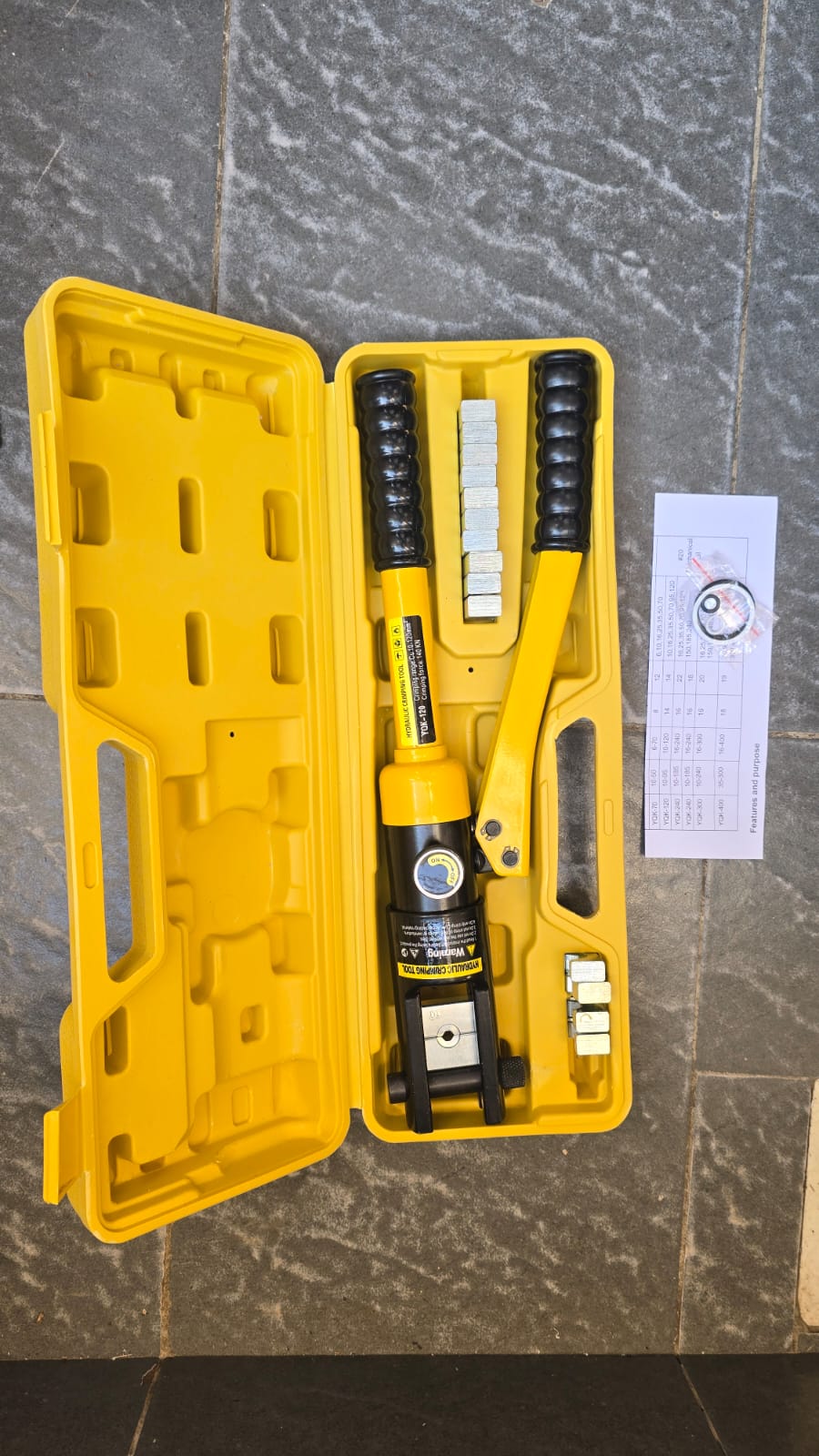
A 120mm² hydraulic crimping tool is a heavy-duty manual tool for joining large electrical cables to compatible copper and aluminium cable lugs. The popular YQK-120 design covers cable sizes from 10mm² to 120mm² and uses hydraulic pressure to make a strong hexagonal crimp.
Unlike ordinary hand crimping pliers, the hydraulic mechanism multiplies the force applied by the operator. A standard YQK-120 can produce approximately 8 tons of crimping force, making it suitable for large battery cables, generator wiring, solar installations, industrial electrical work and power distribution projects.
120mm² Hydraulic Crimping Tool Specifications
| Feature | Specification |
|---|---|
| Model | YQK-120 |
| Tool Type | Manual Hydraulic Crimper |
| Crimping Range | 10–120mm² |
| Maximum Cable Size | 120mm² |
| Crimping Force | 8 Tons / about 78kN |
| Crimping Shape | Hexagonal |
| Standard Stroke | About 14mm |
| Standard Dies | 10, 16, 25, 35, 50, 70, 95 & 120mm² |
| Number of Dies | 8 Sets |
| Typical Length | About 425mm |
| Typical Weight | About 4–4.8kg depending on version |
| Operation | Manual Hydraulic |
| Power Required | None |
| Storage | Plastic Carrying Case |
| Applications | Cable Lugs, Battery Cables, Power Cables, Generator and Solar Wiring |
A current YQK-120 manufacturer specification confirms a 10–120mm² range, 8-ton output, 14mm stroke and eight dies covering 10 to 120mm².
Heavy-Duty 120mm² Maximum Capacity
The biggest advantage of this hydraulic crimping tool is its ability to handle cables up to:
120mm²
This is a major increase over a 70mm² hydraulic crimper.
It makes the YQK-120 suitable for larger electrical installations where high-current conductors are required.
Common applications include large battery banks, industrial machines, generators, inverters, commercial solar systems and electrical distribution equipment.
Wide 10–120mm² Working Range
The standard YQK-120 works across approximately:
10mm² to 120mm²
This gives one tool the ability to handle several common large cable sizes.
The standard die configuration is:
| Die Size | Typical Matching Conductor Size |
|---|---|
| 10mm² | 10mm² |
| 16mm² | 16mm² |
| 25mm² | 25mm² |
| 35mm² | 35mm² |
| 50mm² | 50mm² |
| 70mm² | 70mm² |
| 95mm² | 95mm² |
| 120mm² | 120mm² |
This eight-die configuration is published for several current YQK-120 models.
Always follow the cable-lug manufacturer’s crimping instructions rather than selecting a die only because its number matches the conductor size.
Powerful 8-Ton Hydraulic Force
The standard YQK-120 produces approximately:
8 tons of crimping force
which is roughly:
78kN
of force.
This high pressure allows the dies to compress large cable terminals without requiring the operator to produce the same force directly by hand.
It is one of the main reasons a hydraulic crimper is much easier to use on 70mm², 95mm² and 120mm² conductors than an ordinary mechanical crimper.
Hexagonal Crimping Design
The YQK-120 uses hexagonal dies.
The dies compress the terminal around the conductor from several directions to form a tight connection.
Manufacturer information describes the hexagonal crimp as providing close contact and good electrical conductivity when the correct terminal, conductor and die are used.
A properly made crimp can provide both:
Mechanical strength
and
Low-resistance electrical contact.
14mm Hydraulic Stroke
A standard YQK-120 specification provides approximately:
14mm stroke.
The stroke refers to the movement available from the hydraulic ram as pressure closes the crimping dies.
Some versions are listed with 13mm or 16mm stroke, so check the specification of the exact YQK-120 supplied.
No Electricity or Battery Required
The 120mm² hydraulic crimper is completely hand operated.
You do not need:
Electricity
Rechargeable batteries
Air compressor
or
External hydraulic pump
for the standard self-contained model.
This makes it useful for electricians working at remote sites where electrical power may not yet be available.
How the Hydraulic Mechanism Works
The operating handle pumps hydraulic oil through the tool.
As pressure builds, the hydraulic piston moves the crimping dies together.
This produces much more compression force than the operator could conveniently achieve using ordinary hand pliers.
After the crimp is complete, the pressure-release valve is opened and the piston retracts.
The YQK-120 operating instructions describe the process as selecting the correct dies, closing the oil-return valve, pumping until the crimp is completed, then opening the valve to retract the dies.
180-Degree Rotating Head on Some Models
Some professional YQK-120 versions have a crimping head that can rotate through approximately:
180 degrees.
This makes it easier to position the tool around cables inside:
- Electrical panels
- Battery compartments
- Generator installations
- Machinery
- Tight cable spaces
A current DS-YQK-120 specification includes a freely rotating 180-degree head specifically for working in narrow spaces.
Confirm this feature on the exact unit before purchase because not every generic YQK-120 has identical construction.
Safety Pressure Relief on Selected Versions
Some professional 120mm² hydraulic crimpers include a pressure-relief or safety valve.
When hydraulic pressure reaches the tool’s designed limit, the valve helps protect the hydraulic system from excessive pressure.
This is a useful feature for technicians who regularly crimp large terminals.
The exact pressure-relief design varies between manufacturers.
Strong Steel Construction
Heavy-duty YQK-120 tools commonly use a steel body and steel operating components.
The dies also need to withstand repeated high-pressure compression.
A current manufacturer describes its YQK-120 as using a steel housing and handle, while other current hydraulic crimpers use hardened steel dies.
This makes the tool suitable for workshop and field use when correctly maintained.
Suitable for Copper Cable Lugs
The 120mm² hydraulic crimper can be used for suitable copper cable terminals.
Copper conductors are common in:
- Generator installations
- Solar systems
- Battery banks
- Inverter installations
- Electrical panels
- Machinery
- Commercial buildings
Some YQK-120 versions specify copper operation from 16–120mm², while other versions advertise a general 10–120mm² range.
For this reason, check the exact lug and die compatibility rather than assuming every terminal from 10mm² upward uses the same crimp specification.
Can It Crimp Aluminium Cable?
Some YQK-120 variants are designed for aluminium terminals as well.
One current YQK-120A specification gives:
Aluminium terminals: 10–120mm²
Copper terminals: 16–120mm².
This is important because copper and aluminium connectors can have different dimensions even when their conductor cross-sectional areas are similar.
Always check the terminal manufacturer’s requirements.
Excellent for Generator Installation
Large generators can require heavy power cables.
A 120mm² hydraulic crimper can help prepare suitable cable connections for:
- Generator output cables
- Battery cables
- Changeover systems
- Distribution panels
- Earthing connections
The wide cable range makes it useful for electricians installing both medium and larger generator systems.
Useful for Solar and Inverter Systems
Large solar installations can require much heavier cables than small home solar systems.
The YQK-120 can be useful for suitable connections between:
- Large inverters
- Battery banks
- Busbars
- Distribution equipment
- DC protection equipment
- Earthing systems
For smaller solar panel MC4 connectors, however, use a dedicated MC4 crimping tool.
A 120mm² hydraulic crimper is not a replacement for an MC4 crimper.
Battery Bank Connections
High-capacity battery systems can carry very large currents.
This makes good cable termination important.
The YQK-120 can be used to crimp suitable heavy battery cable lugs where the conductor and terminal fall within its specified range.
A poor battery connection can create resistance, voltage drop and unwanted heat.
Correct crimping helps produce a secure mechanical and electrical connection.
Industrial Electrical Installation
The tool is also suitable for technicians working on:
- Factory machinery
- Distribution boards
- Motor installations
- Commercial electrical systems
- Large UPS systems
- Power equipment
Its manual design makes it easy to carry to the equipment instead of bringing heavy cables back to a workshop.
120mm² vs 70mm² Hydraulic Crimper
| Feature | 70mm² Crimper | 120mm² Crimper |
|---|---|---|
| Maximum Size | 70mm² | 120mm² |
| Typical Minimum | 4mm² | 10mm² |
| Large Battery Cable | Good | Better |
| 95mm² Cable | No | Yes |
| 120mm² Cable | No | Yes |
| Tool Size | Smaller | Larger |
| Typical Weight | Lighter | About 4kg+ |
| Best For | Medium Cable Work | Heavy Electrical Cable Work |
The 120mm² model is the better option when your work regularly includes 95mm² or 120mm² conductors.
For mainly small cables, the smaller tool can be easier to carry and operate.
120mm² vs 240mm² Hydraulic Crimper
| Feature | YQK-120 | YQK-240 |
|---|---|---|
| Typical Range | 10–120mm² | 16–240mm² |
| Maximum Size | 120mm² | 240mm² |
| Standard Dies | 8 | Around 10 |
| Typical Force | 8 Ton | 10–12 Ton depending on model |
| Portability | Better | Heavier |
| 150mm² Cable | No | Yes |
| 185mm² Cable | No | Yes |
| 240mm² Cable | No | Yes |
A current product comparison lists the YQK-120 at 10–120mm² and the larger YQK-240 at 16–240mm².
Choose the smallest tool that comfortably covers the cable sizes you normally install.
How to Use a 120mm² Hydraulic Crimping Tool
First isolate the electrical system completely.
Identify the conductor cross-sectional area and confirm the correct cable lug.
Choose the die specified for the cable and terminal.
Install both die halves securely.
Strip the cable insulation to the correct length without damaging conductor strands.
Insert the conductor fully into the lug barrel.
Position the terminal correctly between the dies.
Close the hydraulic release valve.
Pump the handle until the required crimp is complete.
Open the release valve to retract the piston.
Remove the terminal and inspect the finished crimp.
Why Correct Die Selection Matters
Using the wrong die can create a poor electrical connection.
A die that is too large can leave the terminal under-compressed.
This may result in:
- Loose cable
- Increased resistance
- Heat generation
- Voltage drop
- Connection failure
A die that is too small can excessively deform the lug or damage conductor strands.
The cable, terminal and die must therefore work as a matched system.
One or More Crimps May Be Required
Do not assume every large lug needs only one compression.
The required number and location of crimps depend on the:
Lug design, barrel length, die system and connector manufacturer’s instructions.
Some long-barrel terminals may require more than one compression.
Follow the terminal manufacturer’s specified crimp pattern.
Inspect the Finished Connection
After crimping, inspect the terminal carefully.
The connection should be firm, correctly positioned and free from major cracks or abnormal deformation.
Also check that:
- The conductor is fully inserted.
- Strands have not been cut unnecessarily.
- Insulation has not entered the crimp zone.
- The lug is not loose.
- The crimp is centred correctly.
Professional installations may also require pull testing or other verification according to the applicable electrical standard.
Never Work on Live Cables
A hydraulic crimping tool should be treated as a mechanical tool, not as electrical shock protection.
Always isolate and verify the electrical circuit before:
- Cutting
- Stripping
- Positioning
- Crimping
Do not assume rubber or fiberglass-looking handles make a particular tool certified for live electrical work.
Do Not Exceed 120mm²
The standard maximum capacity is:
120mm²
Do not force 150mm² or larger terminals into the tool.
For larger conductors, choose a 240mm² or 300mm² hydraulic crimper.
Operating a crimper outside its designed capacity can damage the dies, hydraulic mechanism or terminal.
Hydraulic Crimper Maintenance
Keep the tool clean after every job.
Inspect the crimping head and dies for dirt and metal particles.
Check for hydraulic oil leakage.
Make sure the pressure-release valve works smoothly.
Inspect the seals periodically.
Store all dies inside the carrying case.
If the tool begins losing pressure, check the hydraulic oil level and sealing system according to the manufacturer’s instructions.
Current YQK-120 troubleshooting guidance identifies insufficient hydraulic oil, incorrect die selection and valve position as common causes of poor crimping performance.
Package Contents
A standard YQK-120 kit normally contains:
| Item | Quantity |
|---|---|
| YQK-120 Hydraulic Crimping Tool | 1 |
| 10mm² Die | 1 Set |
| 16mm² Die | 1 Set |
| 25mm² Die | 1 Set |
| 35mm² Die | 1 Set |
| 50mm² Die | 1 Set |
| 70mm² Die | 1 Set |
| 95mm² Die | 1 Set |
| 120mm² Die | 1 Set |
| Plastic Carrying Case | 1 |
This eight-die package is a standard configuration for current YQK-120 tools.
Easy Storage and Transportation
The YQK-120 is normally supplied in a strong plastic carrying case.
The case keeps the crimper and its eight dies organized.
This is particularly important for electricians moving between job sites because losing one die can prevent the tool from handling that particular cable size.
The case also protects the hydraulic mechanism from unnecessary dirt and impact during transportation.
Benefits of a 120mm² Hydraulic Crimping Tool
The YQK-120 offers a useful balance between heavy crimping capacity and portability.
Its main advantages are the 10–120mm² working range, 8-ton hydraulic force, eight interchangeable dies, hexagonal crimp profile and fully manual operation.
It can handle cables that are too large for a 70mm² crimper without becoming as bulky as some 240mm² and 300mm² tools.
How to Choose a 120mm² Hydraulic Crimper
Check the cable sizes you normally work with before buying.
For a YQK-120, look for a complete die set covering:
10, 16, 25, 35, 50, 70, 95 and 120mm².
Also check the crimping force, hydraulic stroke, head construction, pressure-release mechanism, case and availability of replacement seals.
Most importantly, check whether the tool and dies are suitable for the exact copper or aluminium terminals you intend to use.
120mm² Hydraulic Crimping Tool Price in Kenya
Current Kenyan prices show a wide range depending on brand and seller.
A YQK-120 is currently listed by Helwa Tools at approximately KSh 5,849, reduced from KSh 6,500. Another Nairobi listing for a 10–120mm² hydraulic crimper is approximately KSh 6,499.
A generic 10–120mm² heavy-duty hydraulic crimper is also listed on Jumia Kenya at approximately KSh 11,999.
| Type | Approx. 2026 Kenya Price |
|---|---|
| YQK-120 Budget Model | Around KSh 5,800–6,500 |
| Standard 10–120mm² Hydraulic Crimper | Around KSh 6,500–9,000 |
| Higher-Priced Marketplace Kit | Around KSh 10,000–12,000 |
| Larger 240mm² Branded Models | Around KSh 14,000+ |
Prices vary according to brand, build quality, supplied dies, warranty and seller.
Why Buy a 120mm² Hydraulic Crimping Tool?
A 120mm² hydraulic crimping tool in Kenya is a practical choice for electricians, solar technicians, generator installers, automotive electricians and industrial maintenance teams who regularly work with heavy power cables.
The standard YQK-120 combines an 8-ton hydraulic system with a 10–120mm² working range and eight interchangeable hexagonal dies.
It needs no battery, electricity or external hydraulic pump, making it convenient for both workshop and field installation.
Most importantly, its 95mm² and 120mm² dies give it much greater cable capacity than a standard 70mm² hydraulic crimper while keeping the tool portable enough for regular installation work.
Frequently Asked Questions
What is the maximum cable size of the hydraulic crimping tool?
The standard YQK-120 handles conductors up to 120mm².
What is the crimping range?
The common YQK-120 range is 10–120mm². Some versions specify different minimum sizes for copper and aluminium terminals.
How much crimping force does it produce?
The standard model produces approximately 8 tons, equal to roughly 78kN.
What dies come with a 120mm² hydraulic crimper?
The standard kit includes 10, 16, 25, 35, 50, 70, 95 and 120mm² dies.
What type of crimp does it make?
It uses a hexagonal crimping profile.
Does it require electricity?
No. The standard YQK-120 is a self-contained manual hydraulic tool.
Does it require a battery?
No. Hydraulic pressure is generated by pumping the handle manually.
Can it crimp 95mm² cable?
Yes. A 95mm² die is included in the standard die set.
Can it crimp 120mm² cable?
Yes. 120mm² is the maximum size for the standard YQK-120.
Can it crimp 150mm² cable?
No. For 150mm² cable, use a larger hydraulic crimper such as a suitable 240mm² model.
Can it be used for copper cables?
Yes. YQK-120 versions are available for copper cable lug crimping. Some models specify copper from 16–120mm², so check the exact terminal and tool combination.
Can it crimp aluminium lugs?
Selected YQK-120 versions support aluminium terminals from approximately 10–120mm². Confirm the exact tool, die and terminal specification before crimping.
Is it suitable for solar installation?
Yes. It is useful for heavy battery, inverter and power cable connections in larger solar systems when the cable and lug fall within its rated range.
Is it suitable for MC4 connectors?
No. MC4 solar connectors require a dedicated MC4 crimping tool with the correct die profile.
How heavy is the YQK-120?
Published versions vary from approximately 4kg to 4.8kg, depending on design.
Does it come with a carrying case?
Yes. Standard YQK-120 kits are commonly supplied in a protective plastic carrying case.
What is the price of a 120mm² hydraulic crimping tool in Kenya?
Current Kenyan listings put budget 10–120mm² hydraulic crimpers at roughly KSh 5,800 to KSh 6,500, while higher-priced marketplace kits can reach about KSh 12,000.

Reviews
There are no reviews yet.