
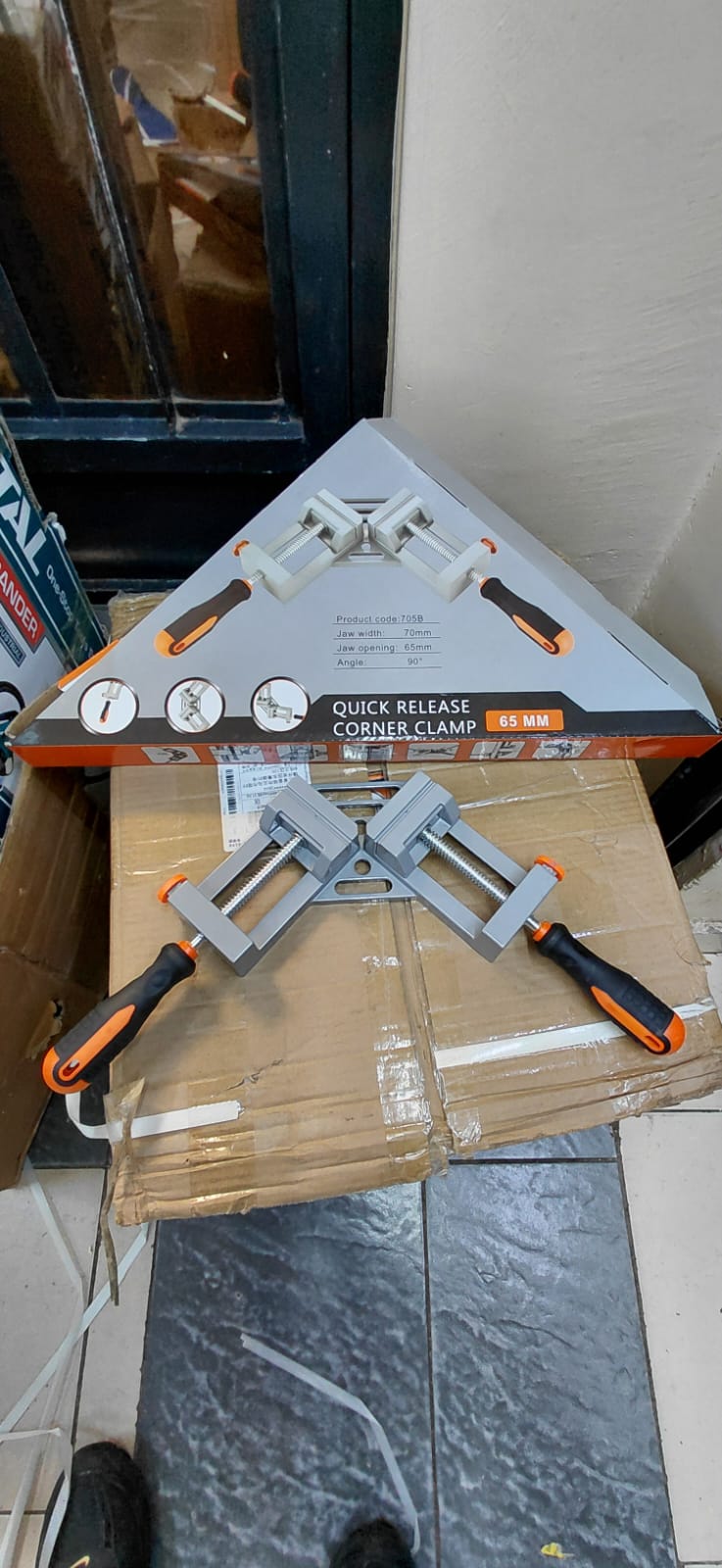
Description
An angle clamp is a specialised hand tool used to hold two pieces of material together at a fixed angle while they are being joined. The most common model is the 90-degree angle clamp, also known as a right-angle clamp, corner clamp, corner vice or frame clamp.
It keeps two workpieces square and stable during drilling, screwing, gluing, nailing or tack welding. This makes it useful for carpenters, cabinet makers, welders, metal fabricators, furniture makers, picture-frame installers and home DIY users.
Unlike an ordinary G-clamp, an angle clamp supports both workpieces at the same time. Its fixed corner body guides the materials into a right angle, while the threaded spindle pushes them firmly against the clamping faces.
Angle clamps are suitable for making:
- Cabinets and cupboards
- Wooden boxes
- Picture frames
- Tables and shelves
- Window and door frames
- Metal frames
- Welding projects
- Drawers
- Display stands
- Storage racks
A standard workshop corner clamp may provide a clamping capacity of approximately 55 to 60mm, while larger professional versions can hold pieces measuring up to about 100mm on each side. For example, the Bessey WS3 has two 55mm openings, while the larger WS6 offers two 100mm openings.
Quick Specifications
| Feature | Typical specification |
|---|---|
| Product name | Angle clamp |
| Alternative names | Corner clamp, right-angle clamp, 90-degree clamp |
| Holding angle | 90 degrees |
| Common jaw capacity | Approximately 55 to 60mm |
| Larger models | Up to approximately 100mm |
| Body material | Aluminium alloy, cast zinc, cast iron or steel |
| Spindle material | Threaded steel |
| Jaw type | Fixed and pivoting jaw |
| Handle | Rubber-coated, plastic or steel |
| Mounting holes | Available on selected models |
| Common use | Woodworking, framing, welding and cabinet assembly |
| Operation | Manual threaded spindle |
| Power required | None |
| Package | One clamp or a multi-piece set |
Specifications vary according to the model. A Stanley heavy-duty corner clamp, for example, uses a cast-zinc body and has a stated clamping capacity of 57mm.
Main Features of an Angle Clamp
Fixed 90-degree clamping position
The clamp body is shaped to hold two materials at a right angle.
This is useful when building square or rectangular products because even a small alignment error can cause:
- Uneven cabinet doors
- Poor-fitting drawers
- Twisted frames
- Visible gaps
- Weak joints
- Incorrect shelf alignment
The angle clamp keeps the workpieces positioned while the user installs screws, nails, dowels or welding tacks.
Adjustable clamping jaw
Most angle clamps have a movable jaw operated by a threaded screw.
Turning the handle moves the pressure jaw towards the workpieces. The jaw then presses both pieces against the fixed 90-degree faces.
Selected designs use a pivoting or swing jaw that adjusts automatically to different workpiece thicknesses. This allows a thin board to be joined to a thicker board without needing both materials to have equal dimensions. Bessey describes this feature as automatic adjustment to differently sized workpieces.
Strong cast body
The body may be made from:
- Aluminium alloy
- Cast zinc
- Cast iron
- Reinforced steel
Aluminium-alloy models are light and resistant to normal workshop corrosion. Cast-zinc or cast-iron clamps are generally heavier and can provide greater stability during demanding work.
The correct material depends on the job. A light aluminium clamp is convenient for cabinet assembly and mobile work, while a heavier clamp may be more suitable for frequent fabrication or bench use.
Threaded steel spindle
The spindle creates the pressure needed to hold the workpieces.
A coarse thread allows fast movement, while a well-machined screw provides smooth tightening. Some models use a copper-coloured or plated spindle to help reduce surface corrosion.
The user should tighten the clamp firmly but not excessively. Too much force can mark soft timber, crack thin boards or distort lightweight metal sections.
Comfortable handle
Many modern angle clamps have an ergonomic handle made from rubber or moulded plastic.
A comfortable grip provides:
- Better tightening control
- Reduced hand strain
- Easier operation with gloves
- Improved grip in a busy workshop
The Stanley heavy-duty model, for example, is specified with a soft-grip handle.
Open working area
Many corner clamps have an open section near the joint.
This gives the user access for:
- Drilling pilot holes
- Driving screws
- Applying glue
- Nailing
- Tack welding
- Inspecting joint alignment
A Bessey WS3 has a 30mm clear passage, while its larger WS6 has a 60mm passage.
Bench-mounting provision
Selected angle clamps have holes or slots that allow them to be mounted on a workbench.
Bench mounting provides greater stability, especially when:
- Working alone
- Handling long materials
- Repeating the same joint
- Drilling through thick timber
- Preparing several identical frames
Some professional clamps can also be secured using separate table clamps.
Independent workpiece positioning
A well-designed angle clamp allows the two materials to be positioned and adjusted before final tightening.
This is important when checking:
- Edge alignment
- Face alignment
- Joint spacing
- Screw position
- Frame dimensions
The user can make small corrections before applying full clamping pressure.
Technical Specifications
| Specification | Common workshop model | Larger professional model |
|---|---|---|
| Clamping angle | 90° | 90° |
| Opening per side | About 55–60mm | Up to about 100mm |
| Jaw height | Approximately 30mm | Approximately 36mm |
| Clear working passage | Approximately 30mm | Approximately 60mm |
| Body material | Aluminium alloy or cast zinc | Heavy cast metal |
| Spindle | Threaded steel | Heavy-duty threaded steel |
| Jaw adjustment | Manual or self-adjusting | Self-adjusting on selected models |
| Approximate weight | 0.5–1kg | About 1.9–2kg |
| Bench mounting | Model dependent | Common on professional models |
For reference, Bessey lists its WS3 at 0.96kg with two 55mm openings and its WS6 at 1.96kg with two 100mm openings.
Applications of an Angle Clamp
Cabinet making
Cabinet makers use angle clamps to join side panels, bases, tops and partitions.
The clamp helps keep the panels square while the user installs:
- Confirmat screws
- Wood screws
- Dowels
- Pocket-hole screws
- Nails
- Adhesive
Furniture assembly
The tool is suitable for making:
- Tables
- Chairs
- Bookshelves
- Wardrobes
- Bedside cabinets
- Office desks
- Kitchen units
It is especially useful when assembling furniture from MDF, plywood, blockboard or solid wood.
Picture-frame construction
Small 90-degree clamps can hold frame mouldings while glue, pins or staples are applied.
For a complete four-sided frame, several corner clamps may be used at the same time.
Box and drawer making
A square joint is important when making boxes and drawers. An out-of-square drawer may not slide correctly or fit inside its cabinet opening.
The clamp keeps the front, back and side pieces aligned during assembly.
Welding and metal fabrication
Heavy-duty angle clamps can hold:
- Square tubing
- Rectangular tubing
- Flat bars
- Angle iron
- Light steel channels
They are useful when preparing gates, shelves, tables, stands and small machine frames.
The clamp should be positioned away from excessive welding heat and spatter unless the manufacturer states that it is suitable for welding. Plastic handles and aluminium bodies can be damaged by direct heat.
Window and door frame work
The clamp can assist in assembling wooden or light-metal frames before permanent fixing.
Drilling and screw installation
Because the clamp holds the joint steady, the operator can drill pilot holes with less movement.
This improves screw alignment and lowers the risk of the drill bit wandering.
Home DIY repairs
Home users can use the tool when repairing:
- Broken drawers
- Loose cabinets
- Small shelves
- Wooden boxes
- Tables
- Frames
- Garden furniture
Materials That Can Be Held
An angle clamp may be used on:
- Solid timber
- Plywood
- MDF
- Particleboard
- Blockboard
- Plastic sections
- Aluminium profiles
- Mild-steel tubing
- Flat steel
- Light glass assemblies, with suitable protective pads
The clamp capacity and body strength must match the material. A small woodworking model should not be treated as a heavy industrial welding vice.
How to Use a 90-Degree Angle Clamp
Step 1: Prepare the workpieces
Cut both materials to the required length and confirm that the joining edges are straight.
Poorly cut edges may still leave gaps even when the clamp holds the materials at 90 degrees.
Step 2: Open the clamping jaw
Turn the handle anticlockwise until the opening is wide enough for both workpieces.
Do not force the spindle beyond its normal travel.
Step 3: Position the first workpiece
Place the first board or metal section against one fixed face of the clamp.
Ensure that its edge sits flat against the base.
Step 4: Position the second workpiece
Place the second piece against the other 90-degree face.
Align the edges according to the required joint.
Step 5: Check the joint
Before tightening, check:
- The ends are level
- The faces are flush
- The material is fully seated
- The screw or welding position is accessible
Step 6: Tighten the clamp
Turn the handle clockwise until the movable jaw holds both pieces.
Apply enough pressure to stop movement, but avoid crushing or marking the material.
Step 7: Confirm squareness
Use a reliable engineer’s square or carpenter’s square to confirm the angle, especially for precision furniture or fabrication work.
The clamp is designed for a right angle, but dirt, wear, poor positioning or excessive pressure can affect the final joint.
Step 8: Join the materials
Depending on the project, use:
- Screws
- Nails
- Dowels
- Glue
- Staples
- Tack welds
- Rivets
Step 9: Allow the joint to set
When using wood glue, keep the joint clamped for the time recommended by the adhesive manufacturer.
For welding, allow the tack welds to stabilise the joint before removing the clamp.
Step 10: Release the clamp
Support the workpiece, then turn the handle anticlockwise slowly.
Remove the finished assembly without dropping or twisting it.
Types of Angle Clamps
Single-spindle corner clamp
This is the common aluminium or cast-metal model.
One spindle moves a central or pivoting jaw that presses both materials into the fixed corner.
It is suitable for:
- Cabinets
- Frames
- Boxes
- General workshop assembly
Dual-handle angle clamp
Some models use separate tightening controls for each workpiece.
This provides more independent adjustment but takes longer to set up.
Spring-loaded corner clamp
A spring clamp opens using hand pressure and closes automatically around the materials.
It is fast and useful for light work, although it usually provides less clamping force than a threaded model.
Spring-loaded four-piece sets are commonly used to hold all corners of a lightweight wooden frame at the same time.
Welding angle clamp
A welding clamp normally has a heavier metal body and greater heat resistance.
It may have open sides to provide access for tack welding.
Mitre clamp
A mitre clamp is designed for mitred corners, commonly where two pieces cut at 45 degrees form a 90-degree finished corner.
It is often used for picture frames, decorative mouldings and trim work.
Multi-angle clamp
Some specialised clamps can hold materials at more than one angle. These may support 45-degree, 90-degree or adjustable joints.
For normal cabinet and frame work, a fixed 90-degree model is usually simpler and more stable.
Angle Clamp Versus Ordinary G-Clamp
| Feature | Angle clamp | G-clamp |
|---|---|---|
| Holds two pieces at 90° | Yes | Not by itself |
| Joint alignment | Built into clamp body | Requires separate square or jig |
| Workpiece support | Supports both pieces | Mainly presses two surfaces together |
| Cabinet assembly | Very convenient | Less convenient |
| General clamping | Limited to corner work | Highly versatile |
| Welding frames | Suitable models available | Useful but requires careful setup |
| Speed | Fast for repeated corners | Slower for corner alignment |
Both tools are useful. The angle clamp provides alignment, while the G-clamp is better for general holding and pressing.
Benefits of Using an Angle Clamp
Improves joint accuracy
The fixed clamping faces help maintain a clean 90-degree corner.
Allows one-person assembly
A user can hold two workpieces without needing another person to support them.
Saves working time
The tool combines holding and alignment in one operation.
Supports different material thicknesses
Pivoting jaws on selected models adapt to unequal workpieces.
Improves drilling and screwing
The materials remain stable while pilot holes and screws are installed.
Reduces movement during welding
The clamp helps prevent light metal sections from shifting before tack welding.
Produces cleaner frames
Better alignment reduces gaps and uneven corners.
Reusable workshop tool
A strong angle clamp can serve many furniture, framing and fabrication projects.
How to Choose the Best Angle Clamp in Kenya
Check the clamping capacity
Measure the thickness or width of the materials you normally use.
A 55 to 60mm capacity is enough for many boards and light profiles. Larger workpieces may require a clamp with a 100mm opening.
Choose the correct body material
For light woodworking, aluminium alloy is portable and practical.
For repeated heavy use, consider cast zinc, steel or cast iron.
Inspect the spindle
The screw should move smoothly without wobbling or jamming.
Look for a pivoting jaw
A pivoting jaw is useful when joining materials of different thicknesses.
Check the working passage
An open working area makes drilling, screwing and welding easier.
Consider bench mounting
Choose a model with mounting holes or table-clamp support when you need maximum stability.
Inspect the handle
A rubberised or soft-grip handle is more comfortable during regular use.
Check jaw protection
Non-marking pads help protect painted, polished or soft wooden surfaces.
Decide how many clamps you need
One clamp may be enough for a single joint. A set of two or four is better when building boxes, cabinets and picture frames.
Match the clamp to the job
Do not use a lightweight plastic spring clamp for heavy welding. Do not expose a woodworking clamp to intense heat unless it is rated for that application.
Angle Clamp Price in Kenya
Current Kenyan online listings show simple right-angle clamps from about KSh 899 to KSh 2,232, depending on the design and whether the package contains one clamp or several pieces. One current Jumia listing shows a four-piece woodworking set at about KSh 1,789.
| Angle-clamp type | Estimated price in Kenya |
|---|---|
| Basic plastic spring corner clamp | KSh 300–800 each |
| Basic aluminium 90-degree clamp | KSh 900–2,500 |
| Four-piece light woodworking set | KSh 1,700–4,000 |
| Heavy-duty cast angle clamp | KSh 2,500–6,000 |
| Professional branded clamp | KSh 6,000–15,000+ |
| Large welding angle clamp | Price depends on size and construction |
The price can vary based on:
- Jaw capacity
- Body material
- Brand
- Number of clamps
- Handle design
- Bench-mounting accessories
- Import and delivery charges
- Warranty
Buyers should confirm whether an advertised price covers one clamp or a complete set.
Package Contents
A standard package may contain:
- One 90-degree angle clamp
- Threaded spindle and handle
- Pivoting pressure jaw
- Manufacturer instructions
A set may contain:
- Two or four angle clamps
- Bench-mounting hardware
- Protective jaw pads
- Carrying box, on selected models
Package contents differ by supplier.
Common Angle-Clamping Mistakes
Tightening before alignment
Always align the material faces and edges before applying full pressure.
Applying too much force
Excess pressure may dent soft timber, damage MDF or distort thin metal.
Failing to check squareness
Confirm the finished angle with a separate square when accuracy is important.
Clamping dirty surfaces
Wood dust, welding scale and glue residue can prevent the material from sitting flat.
Using only one clamp on a large frame
Long materials may twist away from the joint. Extra support or several clamps may be needed.
Welding too close to the clamp
Heat and spatter may damage handles, protective pads or lightweight alloy bodies.
Using a damaged spindle
A bent or worn screw may apply pressure unevenly.
Removing the clamp too early
Glue must set sufficiently, and weld tacks must be strong enough to hold the joint.
Maintenance Tips
- Remove wood dust, glue and metal filings after use.
- Wipe the spindle with a clean cloth.
- Apply light machine oil to the screw threads occasionally.
- Keep oil away from wooden surfaces that will be painted or glued.
- Check the fixed corner for dents or damage.
- Do not use the clamp as a hammer.
- Avoid dropping it onto concrete.
- Store it in a dry toolbox.
- Protect steel parts from rust.
- Remove welding spatter before it hardens.
- Inspect the handle and pressure jaw regularly.
- Do not extend the handle with a pipe for extra force.
Safety Tips
- Wear eye protection when drilling or welding.
- Keep fingers away from the pressure jaw.
- Support long and heavy workpieces separately.
- Do not rely on a small angle clamp to support the full weight of a metal frame.
- Allow welded material to cool before touching it.
- Use protective pads on glass or fragile surfaces.
- Confirm that the clamp is stable before starting work.
- Do not exceed the stated jaw capacity.
- Replace cracked or badly worn clamps.
Why Choose an Angle Clamp?
An angle clamp makes right-angle assembly faster, easier and more accurate. It holds two separate workpieces securely while leaving the joint accessible for drilling, screwing, gluing or welding.
It is a valuable tool for:
- Carpenters
- Welders
- Cabinet makers
- Furniture installers
- Picture-frame makers
- Metal fabricators
- Technical students
- Home DIY users
A strong 90-degree clamp reduces the need to hold materials by hand and helps produce cleaner, more professional joints.
Frequently Asked Questions
What is an angle clamp used for?
It is used to hold two materials at a set angle, usually 90 degrees, during gluing, drilling, screwing, nailing or welding.
Is an angle clamp the same as a corner clamp?
Yes. The terms angle clamp, right-angle clamp and corner clamp are commonly used for the same type of tool.
What is the common clamping capacity?
Many standard models hold materials up to approximately 55 to 60mm wide or thick. Larger professional models can offer openings up to about 100mm.
Can I use an angle clamp for welding?
Yes, provided the model is strong and suitable for metalwork. Keep plastic parts and lightweight alloy bodies away from direct welding heat and spatter.
Can it hold two boards of different thicknesses?
Yes. Models with a pivoting or self-adjusting jaw can hold workpieces of different thicknesses.
Is it suitable for picture frames?
Yes. It can hold mitred or square-cut frame pieces during gluing, pinning or stapling.
Can I mount it on a workbench?
Some models include mounting holes or can be secured using table clamps. Check the product design before purchase.
How many angle clamps do I need?
One clamp is enough for one corner. Two or four clamps are more convenient when making complete boxes, drawers or frames.
Does the clamp guarantee a perfect 90-degree joint?
It helps maintain a right angle, but the user should still check the joint with a carpenter’s or engineer’s square. Dirt, poor cuts or incorrect positioning can affect accuracy.
What is the price of an angle clamp in Kenya?
Basic 90-degree corner clamps commonly cost about KSh 899 to KSh 2,500, while larger, heavier or professional models can cost considerably more. Multi-piece woodworking sets are also available.
Reviews
There are no reviews yet.