
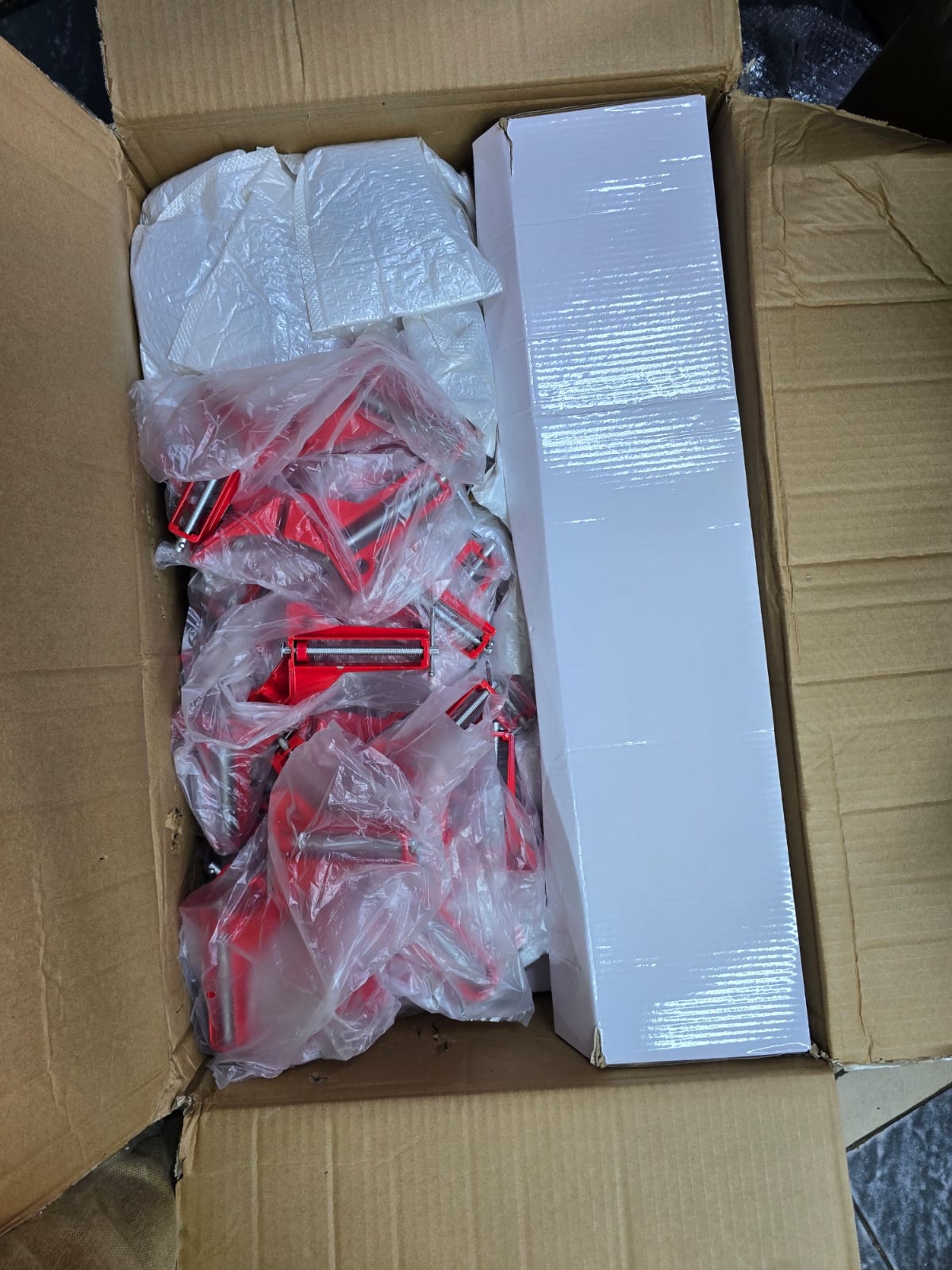
Description

A corner clamp is a special holding tool used to keep two pieces of material at a fixed 90-degree angle during joining, drilling, fastening, gluing or welding. It is also known as a right-angle clamp, 90-degree clamp, angle clamp or corner vice.
Unlike an ordinary G-clamp or F-clamp, a corner clamp holds two workpieces perpendicular to each other. This leaves the joint area accessible for screws, nails, dowels, staples, glue or welding.
Corner clamps are widely used by carpenters, furniture makers, welders, cabinet installers, picture-frame makers, fabricators and DIY users. They are suitable for assembling boxes, cabinets, shelves, drawers, door frames, window frames, steel frames and many other rectangular projects.
Common adjustable corner clamps have clamping capacities of approximately 57mm to 70mm, although smaller and larger models are available. The Stanley Bailey heavy-duty corner clamp, for example, has a stated 57mm clamping capacity, while many aluminium swing-jaw models open to about 68mm or 70mm.
Quick Specifications
| Feature | Typical specification |
|---|---|
| Product name | Corner clamp |
| Other names | Right-angle clamp, 90-degree clamp, angle vice |
| Holding angle | 90 degrees |
| Common clamping capacity | 50mm to 70mm |
| Typical jaw width | About 40mm to 95mm |
| Typical jaw depth | About 30mm to 35mm |
| Body material | Aluminium alloy, cast zinc, cast iron or steel |
| Spindle material | Threaded steel |
| Jaw type | Fixed, floating or independently adjustable |
| Handle | Rubber-coated or soft-grip screw handle |
| Workpiece materials | Wood, metal, plastic and selected glass panels |
| Mounting | Portable or bench-mounted |
| Main use | Holding corner and T-joints during assembly |
Exact specifications vary according to the model, brand and intended application.
Main Features of a Corner Clamp
Accurate 90-Degree Alignment
The main purpose of a corner clamp is to hold two workpieces at a right angle.
This helps when making:
- Square boxes
- Cabinets
- Drawers
- Picture frames
- Window frames
- Shelving units
- Metal frames
- Tables
- Wooden cases
- Rectangular structures
A good clamp reduces movement while the joint is being drilled, screwed, nailed, glued or welded. Corner clamps are specifically designed for wood joinery, box building and frame construction where a stable 90-degree joint is required.
However, a corner clamp should not replace a measuring square. Always check the work with a try square, combination square or engineer’s square before final tightening.
Adjustable Clamping Jaw
Many corner clamps have a floating or swivel jaw that adjusts to the thickness of the workpiece.
This design allows the clamp to hold:
- Two pieces of equal thickness
- Two pieces of different thicknesses
- Flat boards
- Square tubing
- Rectangular tubing
- Narrow frames
- Wide panels
Some Bessey angle clamps use a pivoting jaw that automatically adjusts to workpieces of different thicknesses. Other designs use independently adjustable spindles for greater control.
Single-Handle Operation
A common aluminium corner clamp uses one threaded handle to close the movable jaw.
As the handle is turned:
- The threaded spindle moves forward.
- The floating jaw contacts both workpieces.
- Pressure pulls the materials against the fixed 90-degree faces.
- The joint becomes stable for assembly.
Single-handle clamps are simple to set up and suitable for fast workshop jobs.
Wide Clamping Capacity
Many standard corner clamps accommodate materials up to approximately 57mm, 68mm or 70mm thick.
Examples include:
- Stanley Bailey heavy-duty clamp: 57mm capacity
- Common aluminium corner clamp: approximately 68mm capacity
- Larger swing-jaw versions: approximately 70mm opening
This range is suitable for common timber boards, plywood, MDF, steel tubes and furniture panels.
Strong Cast Body
Corner clamps are commonly made from:
- Die-cast aluminium alloy
- Cast zinc
- Cast iron
- Pressed steel
- Fabricated steel
Aluminium models are light and resistant to normal workshop corrosion. Cast-zinc and cast-iron clamps are usually heavier and may provide greater rigidity.
The Stanley Bailey heavy-duty model uses a cast-zinc body, while lighter Bailey designs are available with cast-aluminium construction.
Steel Threaded Spindle
The spindle transfers hand pressure to the movable jaw.
A quality spindle should have:
- Strong steel construction
- Smooth threading
- Good alignment
- Corrosion-resistant finish
- Minimal side movement
- A comfortable operating handle
Lubricating the spindle lightly can keep it moving smoothly.
Open Working Area
Many corner clamps have an open frame around the joint.
This provides room to:
- Drive screws
- Drill pilot holes
- Install dowels
- Fire staples
- Apply glue
- Tack weld the joint
- Check alignment
Bessey describes open corner-clamp designs as providing clearance for screwing, dowelling or stapling materials while the joint is held.
Bench-Mounting Holes
Selected corner clamps have slots or holes in the base.
These allow the clamp to be:
- Screwed to a workbench
- Bolted to a fabrication table
- Secured using table clamps
- Fixed temporarily to a jig
Mounting the clamp improves stability when handling long or heavy materials.
Some Bessey corner clamps include mounting holes, while selected larger models can be attached to a work surface using separate table clamps.
Comfortable Handle
A rubber-coated or soft-grip handle provides better control when applying pressure.
Benefits include:
- More comfortable tightening
- Better grip with oily hands
- Reduced hand fatigue
- Easier release after use
Stanley lists a soft-grip handle on its heavy-duty corner clamp.
Typical Corner Clamp Specifications
| Specification | Typical value |
|---|---|
| Fixed angle | 90 degrees |
| Clamping capacity | 50mm to 70mm |
| Common maximum opening | 57mm, 68mm or 70mm |
| Jaw width | Approximately 40mm to 95mm |
| Jaw depth | Approximately 30mm to 35mm |
| Body | Aluminium alloy, cast zinc or cast iron |
| Spindle | Steel |
| Handle | Plastic or rubber-coated |
| Weight | Approximately 0.5kg to 1kg for common handheld models |
| Mounting slots | Available on selected models |
| Suitable joints | Butt, mitre and T-joints |
| Number of handles | One or two, depending on the design |
One common aluminium clamp has an approximate 68mm opening, 95mm jaw width and 35mm jaw depth. The Stanley heavy-duty model has a 57mm capacity and weighs about 0.77kg.
Types of Corner Clamps
Single-Handle Aluminium Corner Clamp
This is one of the most common models for carpentry and DIY projects.
It normally features:
- Die-cast aluminium body
- One threaded handle
- Floating jaw
- 90-degree fixed frame
- Mounting slots
- Rubber grip
It is suitable for:
- Picture frames
- Cabinets
- Boxes
- Shelves
- Light welding
- Wooden furniture
The common jaw opening is about 68mm to 70mm.
Two-Spindle Corner Clamp
This design has separate screws for each workpiece.
The user can adjust the pieces independently, which is useful when joining materials of different widths or thicknesses.
Advantages include:
- Precise adjustment
- Firm individual control
- Suitable for uneven workpieces
- Easy alignment of mitre joints
- Good access to the joint
Bessey’s WS-1 design uses independently adjustable spindles and is suitable for 90-degree corner assembly.
Quick-Release Corner Clamp
A quick-release clamp uses a spring, trigger or automatic pressure mechanism.
It can often be operated with one hand.
This model is useful for:
- Fast furniture assembly
- Cabinet installation
- Pocket-hole joinery
- Repeated workshop production
- Temporary positioning
Some quick corner clamps can hold both end corners and T-joints.
Heavy-Duty Welding Corner Clamp
A welding corner clamp is designed for higher temperatures and stronger workpieces.
It may have:
- Steel or cast-iron construction
- Larger spindle
- Wider base
- Greater clamping force
- Replaceable copper or steel spindle pads
- Open joint access
It is suitable for:
- Square tubing
- Angle iron
- Flat bars
- Rectangular tubes
- Steel frames
- Gates and doors
Do not use a light plastic or soft aluminium clamp where welding heat or sparks can damage it.
Multi-Angle Welding Clamp
Some welding clamps can hold materials at:
- 45 degrees
- 90 degrees
- 135 degrees
This model is useful for fabrication work but may not provide the same rigidity as a dedicated heavy-duty 90-degree vice.
Spring Corner Clamp
Spring-loaded corner clamps are small and quick to fit.
They are mainly used for:
- Picture frames
- Light boards
- Thin wood
- Small craft projects
- Temporary glue holding
They do not usually provide as much pressure as a screw-operated corner clamp.
Four-Corner Frame Clamp
A four-corner or self-squaring frame clamp holds all four corners of a square or rectangular frame.
It is useful for:
- Cabinet doors
- Picture frames
- Window frames
- Boxes
- Drawers
It helps pull the complete frame into shape, while an ordinary corner clamp usually controls one corner at a time.
Materials a Corner Clamp Can Hold
Wood
Corner clamps are widely used with:
- Softwood
- Hardwood
- MDF
- Plywood
- Particleboard
- Laminated boards
- Furniture panels
Use protective pads on finished or soft surfaces to prevent marks.
Metal
Heavy-duty corner clamps can hold:
- Steel square tubing
- Aluminium profiles
- Angle iron
- Flat bars
- Stainless steel tubes
- Rectangular hollow sections
Make sure the clamp is rated for metal fabrication and welding.
Plastic
The tool can hold plastic boards and profiles during drilling, gluing or fastening.
Avoid applying too much pressure because plastic may crack or deform.
Glass
Some sellers describe aluminium corner clamps as suitable for thick glass. However, glass should only be clamped using suitable soft pads and very light, even pressure. Standard metal jaws can chip or break glass.
Applications of a Corner Clamp
Cabinet Making
Corner clamps help align cabinet sides, tops, bottoms and shelves before fixing them with screws or dowels.
They are useful when assembling:
- Kitchen cabinets
- Wardrobes
- Bathroom cabinets
- Display cabinets
- Storage cupboards
Furniture Assembly
The clamp holds table, stool, desk and shelf components while the joints are drilled or screwed.
Picture-Frame Making
A corner clamp keeps mitred frame pieces aligned while glue, nails or staples are applied.
Box and Drawer Construction
It can hold box sides and drawer components square before fastening.
Door and Window Frames
Corner clamps help maintain right angles while wooden or metal frames are assembled.
Welding and Fabrication
A heavy-duty version can hold steel pieces during:
- Tack welding
- MIG welding
- TIG welding
- Arc welding
- Frame fabrication
Always select a clamp that can tolerate welding heat.
Shelf Installation
The clamp can hold a shelf perpendicular to a cabinet side before drilling and fastening.
Pocket-Hole Joinery
Quick corner clamps are useful for holding two panels together when driving pocket-hole screws.
Drilling and Screw Installation
The clamp prevents the pieces from shifting while pilot holes or screws are installed.
Glue-Up Work
It keeps the corner aligned while wood glue dries.
However, additional clamps may be needed to apply enough closing pressure across large joints.
Common Joints Made Using a Corner Clamp
Butt Joint
The end of one piece meets the face or edge of another piece.
This is common in:
- Boxes
- Shelves
- Cabinets
- Simple frames
Mitre Joint
Two pieces are cut at approximately 45 degrees and joined to form a 90-degree corner.
Mitre joints are common in:
- Picture frames
- Decorative trim
- Cabinet doors
- Skirting boards
T-Joint
One workpiece meets the middle section of another at 90 degrees.
It is used for:
- Shelves
- Dividers
- Frame supports
- Cabinet partitions
Some corner-clamp designs can handle both corners and T-joints.
How to Use a Corner Clamp
Step 1: Prepare the Workpieces
Cut the materials to the required dimensions.
Ensure that the mating edges are:
- Straight
- Clean
- Smooth
- Correctly angled
- Free from excessive dust
Poorly cut pieces will not form a good square joint even when clamped.
Step 2: Check the Clamp
Inspect:
- The body
- Threaded spindle
- Movable jaw
- Handle
- Mounting slots
- Fixed angle faces
Do not use a cracked or badly bent clamp.
Step 3: Open the Jaw
Turn the handle anticlockwise until there is enough space for both workpieces.
Step 4: Position the First Piece
Place the first board or tube against one fixed side of the clamp.
Step 5: Position the Second Piece
Place the second workpiece against the other 90-degree face.
Bring the ends together at the planned joint.
Step 6: Tighten the Handle
Turn the handle clockwise until the movable jaw contacts the workpieces.
Continue tightening gradually until the pieces are held securely.
Do not use excessive force, especially with:
- MDF
- Softwood
- Plastic
- Hollow aluminium
- Thin metal tube
- Glass
Step 7: Check the Angle
Use a reliable square to confirm that the joint is exactly 90 degrees.
Make small adjustments before fully tightening.
Step 8: Join the Materials
Depending on the project, you can:
- Drill pilot holes
- Drive screws
- Insert dowels
- Apply staples
- Nail the joint
- Allow glue to dry
- Tack weld the metal
Step 9: Release the Clamp
Once the joint is secure, turn the handle anticlockwise and remove the workpiece carefully.
Using a Corner Clamp for Woodworking
For wooden projects:
- Dry-fit the joint first.
- Check that the cut edges meet properly.
- Apply wood glue where required.
- Place the materials in the clamp.
- Tighten the jaw gradually.
- Check for square.
- Remove excess glue.
- Install screws, dowels or nails.
- Allow the glue to cure according to its instructions.
Place a thin protective pad between the clamp and delicate finished surfaces.
Using a Corner Clamp for Welding
For welding work:
- Clean rust, paint, oil and scale from the joint.
- Position the steel pieces inside the clamp.
- Check the 90-degree angle.
- Tighten securely.
- Apply small tack welds.
- Allow the work to cool slightly.
- Recheck the angle.
- Complete the weld using a balanced sequence.
Welding heat can pull the joint out of square. Recheck the alignment after tack welding.
Use a steel or cast-iron corner clamp for high-temperature applications. Keep welding cables and electrodes away from the clamp screw and handle.
Benefits of a Corner Clamp
Improves Accuracy
It helps maintain a stable 90-degree joint during assembly.
Frees Both Hands
The clamp holds the materials while the operator drills, screws, glues or welds.
Speeds Up Work
It reduces the time spent asking another person to hold the workpieces.
Reduces Material Movement
The workpieces are less likely to slip when a fastener is driven.
Improves Finished Appearance
Better alignment produces cleaner corners and more professional projects.
Suitable for Different Trades
The same clamp may be useful for:
- Carpentry
- Joinery
- Cabinetry
- Welding
- Fabrication
- Framing
- DIY repairs
Compact and Portable
Most single-corner clamps fit easily inside a normal toolbox.
Limitations of a Corner Clamp
- It controls only one corner at a time.
- Small models cannot hold thick materials.
- Light aluminium clamps may not suit heavy welding.
- High pressure may damage soft materials.
- It cannot correct badly cut workpieces.
- Some models may not hold round pipes well.
- One clamp may not provide enough support for long boards.
- The fixed 90-degree design is unsuitable for other angles.
For large frames, use several corner clamps together with F-clamps, bar clamps or a four-corner frame clamp.
Corner Clamp Versus G-Clamp
| Feature | Corner clamp | G-clamp |
|---|---|---|
| Main angle | Fixed at 90 degrees | No fixed angle |
| Corner assembly | Excellent | Difficult without a jig |
| General clamping | Limited | Excellent |
| Holds two perpendicular pieces | Yes | Not directly |
| Welding use | Heavy-duty models | Steel models |
| Joint access | Usually open | May obstruct the joint |
| Best use | Frames, boxes and cabinets | General holding |
Corner Clamp Versus F-Clamp
| Feature | Corner clamp | F-clamp |
|---|---|---|
| Maintains 90 degrees | Yes | Only with a square or jig |
| Long workpieces | Limited support | Very suitable |
| Clamping capacity | Usually smaller | Often much larger |
| One-handed use | Available on some models | Available on trigger models |
| Cabinet assembly | Very useful | Useful for final pressure |
| Frame construction | Good | Needs an angle guide |
The best workshop setup normally includes both corner clamps and general-purpose clamps.
Corner Clamp Versus Magnetic Welding Holder
| Feature | Corner clamp | Magnetic holder |
|---|---|---|
| Holding method | Mechanical pressure | Magnetic force |
| Non-magnetic metals | Yes | No |
| Woodworking | Yes | No |
| Adjustment | Good | Limited |
| Strong welding setup | Better on suitable models | Useful for light positioning |
| Heat resistance | Model dependent | Magnet may weaken with excess heat |
| Precise pressure | Adjustable | Not adjustable |
A magnetic holder is quick for steel positioning, while a mechanical corner clamp gives stronger control and also works with wood and non-magnetic materials.
Common Mistakes When Using a Corner Clamp
Assuming the Clamp Is Perfectly Square
Manufacturing tolerances, dirt or damage can affect accuracy.
Always check with a square.
Tightening One Side Too Much
Uneven force can twist the workpiece or move the joint.
Tighten gradually and recheck alignment.
Using a Small Clamp for Heavy Steel
A light aluminium clamp may bend or become damaged during heavy welding.
Use a correctly rated welding clamp.
Clamping Finished Wood Directly
Metal jaws may leave pressure marks.
Use protective pads.
Ignoring Board Movement
Long boards can act as levers and pull a small clamp out of alignment.
Support long pieces using stands or additional clamps.
Welding Too Much Before Rechecking
Heat distortion may pull the joint out of square.
Start with small tack welds.
Using the Clamp as a Cutting Guide
A corner clamp is mainly a holding tool. It should not be exposed to saw blades or grinding discs unless the design permits it.
Safety Tips
- Wear safety glasses during drilling, fastening or welding.
- Wear suitable gloves when handling sharp metal.
- Keep fingers away from the moving jaw.
- Do not overtighten the spindle.
- Inspect the clamp before use.
- Do not use a cracked cast body.
- Support long or heavy workpieces separately.
- Keep the workbench stable.
- Use welding-rated clamps for welding.
- Keep plastic handles away from sparks and hot metal.
- Do not modify the fixed-angle surfaces.
- Do not use the clamp as a lifting device.
- Keep children away from the working area.
- Release pressure slowly after completing the joint.
Maintenance Tips
Clean After Use
Remove:
- Sawdust
- Wood glue
- Metal filings
- Welding spatter
- Paint
- Grease
- Dust
Dried glue around the fixed faces can affect the angle.
Lubricate the Spindle
Apply a small amount of light machine oil to the screw thread.
Do not use too much oil because it attracts dust and sawdust.
Protect Against Rust
Wipe steel parts with a lightly oiled cloth before storage.
Check the Jaw Alignment
Confirm that the floating jaw moves freely and contacts the workpieces evenly.
Remove Welding Spatter
Clean welding spatter carefully before it damages the screw or mating surfaces.
Store in a Dry Place
Keep the clamp in:
- A toolbox
- Workshop drawer
- Wall rack
- Dry cabinet
Avoid leaving it outdoors.
How to Choose the Best Corner Clamp
Check the Clamping Capacity
Measure the thickness of the materials you normally use.
A 57mm clamp may be enough for ordinary boards, while a 68mm or 70mm model provides more working space.
Choose the Correct Body Material
Aluminium alloy
Best for:
- Woodworking
- Cabinet making
- Picture framing
- DIY work
- Light fabrication
Cast zinc or cast iron
Best for:
- Frequent workshop use
- Heavier clamping
- Better rigidity
Steel welding clamp
Best for:
- Fabrication
- High-temperature work
- Square tubing
- Gate and frame construction
Inspect the Jaw Design
A floating jaw is useful for materials with different thicknesses.
Dual-spindle designs provide more independent control.
Check the Working Access
Choose an open design when you need to drill, screw, staple or weld while the material is clamped.
Look for Mounting Slots
Mounting slots allow the clamp to be fixed to a bench for improved stability.
Check Handle Comfort
A large rubber-coated handle is easier to tighten than a small hard-plastic grip.
Consider Buying More Than One Clamp
A single clamp controls one corner.
For cabinets, frames and boxes, two or four clamps can improve speed and alignment.
Check Spare Parts and Warranty
Ask whether the supplier provides:
- Replacement spindle
- Handle
- Movable jaw
- Jaw pads
- Warranty support
Corner Clamp Price in Kenya
Current Kenya marketplace listings show simple corner clamps starting near KSh 699, common adjustable woodworking models around KSh 1,200 to KSh 1,700, and larger welding-style corner clamps around KSh 3,200. Prices vary depending on size, material, brand and local availability.
| Type of corner clamp | Estimated price in Kenya |
|---|---|
| Small plastic or spring corner clamp | KSh 400–900 |
| Basic 3-inch corner clamp | KSh 700–1,500 |
| Aluminium adjustable 90-degree clamp | KSh 1,200–2,500 |
| Branded heavy-duty corner clamp | KSh 2,500–5,500 |
| Steel welding corner clamp | KSh 3,000–8,000 |
| Professional industrial angle clamp | KSh 8,000–30,000+ |
| Set of two or four clamps | KSh 1,500–6,000+ |
The final price may depend on:
- Brand
- Jaw capacity
- Body material
- Number of clamps
- Handle type
- Mounting design
- Welding suitability
- Warranty
- Delivery location
Package Contents
A normal package may include:
- One 90-degree corner clamp
- Threaded steel spindle
- Adjustable swing jaw
- Handle
- Mounted jaw pads on selected models
- User instructions
Multipacks may include two or four clamps. Confirm the package quantity before buying.
Why Buy a Corner Clamp?
A corner clamp makes it easier to build accurate wooden and metal structures. It keeps two materials at a right angle while the user drills, screws, glues, staples or welds the joint.
It is especially helpful when working alone because it acts like an extra pair of hands. The tool improves alignment, reduces movement and makes cabinet, frame, box and furniture assembly faster.
A light aluminium clamp is suitable for carpentry and general DIY work. A cast or steel model is better for demanding workshop and welding applications. Choosing the correct jaw opening and body material will help the clamp work safely and last longer.
Frequently Asked Questions
What is a corner clamp used for?
A corner clamp holds two pieces of material at a 90-degree angle during woodworking, welding, gluing, drilling or fastening.
Is a corner clamp the same as an angle clamp?
The names are often used for the same tool. Some angle clamps can hold several angles, while a standard corner clamp normally holds a fixed 90-degree joint.
What materials can it hold?
It can hold wood, metal, plastic and other suitable materials. The clamp type must match the workpiece and application.
What is the normal clamping capacity?
Many common models have a capacity of approximately 57mm to 70mm.
Can it hold two materials of different thicknesses?
Yes. Models with floating jaws or independent spindles can hold materials of different thicknesses.
Can a corner clamp be used for welding?
Yes, but it should be made from steel, cast iron or another material suitable for welding heat. Lightweight woodworking clamps may be damaged by sparks and high temperatures.
Does a corner clamp guarantee a perfect 90-degree joint?
No. It helps maintain the angle, but the user should check the joint using a reliable square before fastening or welding.
Can it make a T-joint?
Yes. Some corner clamps are designed to hold both corner joints and T-joints.
Can I mount it on a workbench?
Many models have mounting holes or slots that allow them to be fixed to a workbench.
How many corner clamps do I need?
One clamp is enough for a single small joint. Two or four clamps are more useful when assembling complete boxes, cabinets and frames.
Can I use it for picture frames?
Yes. Corner clamps are commonly used to hold mitred picture-frame sections while glue, nails or staples are applied.
Why does my joint move when I tighten the clamp?
The workpieces may not be seated correctly, the jaw may be tightening unevenly, or the long ends may lack support. Tighten slowly and use extra supports.
Can it damage wood?
Yes, if overtightened or used directly on soft or finished wood. Protective jaw pads can reduce pressure marks.
What is the price of a corner clamp in Kenya?
Basic models may cost about KSh 700 to KSh 1,500, while adjustable aluminium clamps commonly cost KSh 1,200 to KSh 2,500. Heavy-duty welding and professional clamps cost more. Current local marketplace examples range from approximately KSh 699 to KSh 3,200 for common models.

Reviews
There are no reviews yet.