
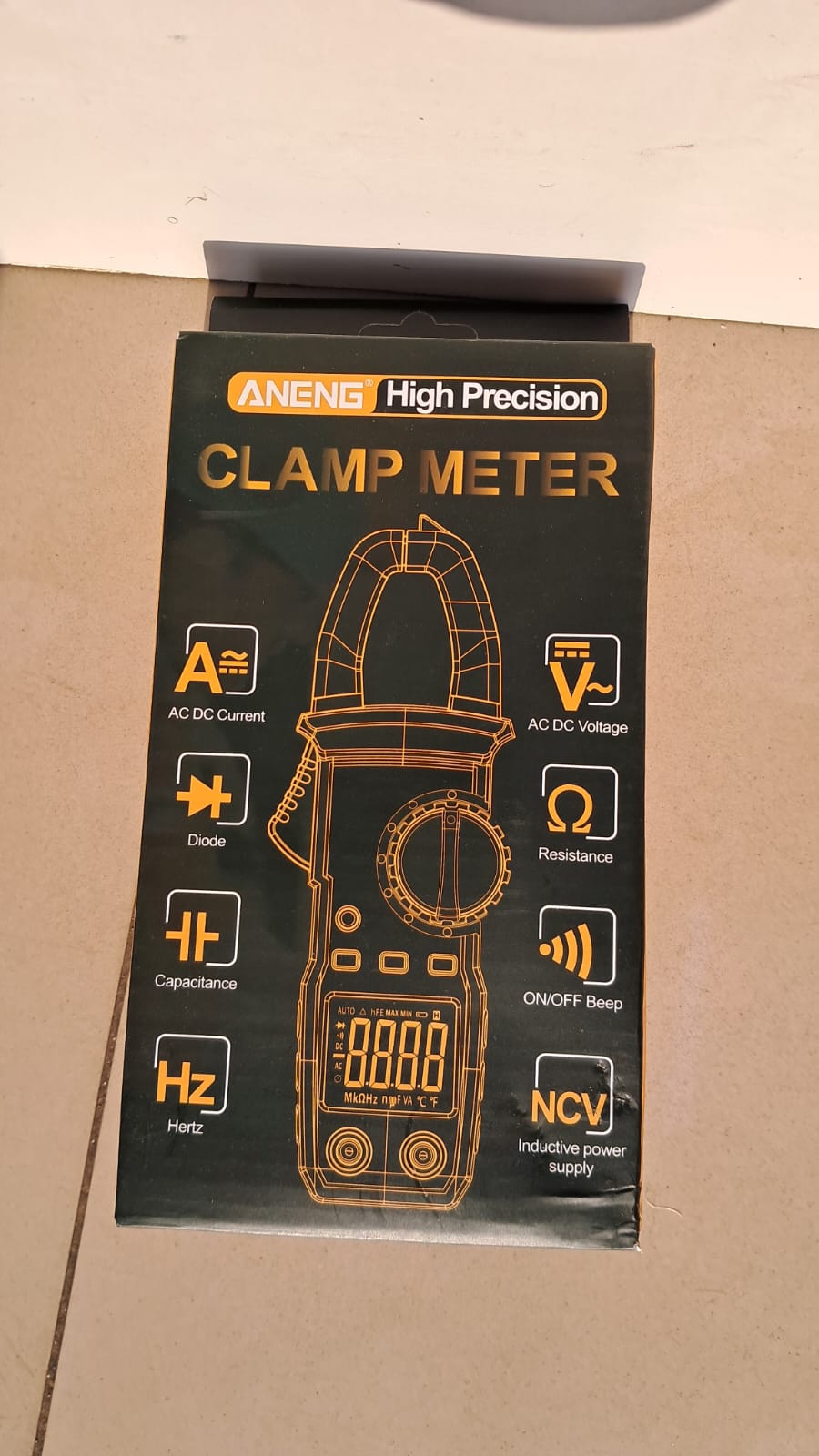
Description


The ANENG AC Clamp Meter is a portable digital measuring instrument used to safely measure AC current without disconnecting electrical wires. It is widely used by electricians, solar installers, maintenance engineers, HVAC technicians, industrial technicians, and DIY users for testing electrical systems.
Unlike a conventional multimeter, a clamp meter measures current by clamping its jaw around a single live conductor, eliminating the need to break the circuit. Most modern ANENG clamp meters also function as digital multimeters, allowing users to measure AC/DC voltage, resistance, continuity, frequency, capacitance, and perform non-contact voltage (NCV) detection.
Quick Specifications
| Feature | Typical Specification |
|---|---|
| Product | ANENG AC Clamp Meter |
| Current Measurement | AC Current |
| Maximum AC Current | 400A–1000A (model dependent) |
| AC Voltage | Up to 600V or 750V |
| DC Voltage | Up to 600V or 1000V |
| Resistance | Up to 20MΩ–60MΩ |
| Display | LCD Digital Display |
| Display Count | 1999–6000 Counts |
| Jaw Opening | Approximately 36–60mm |
| Auto Range | Available on selected models |
| NCV Detection | Yes on selected models |
| Data Hold | Yes |
| Backlight | Yes |
| Continuity Buzzer | Yes |
| Diode Test | Yes |
| Auto Power Off | Yes |
| Battery | 2 × AAA or 9V (model dependent) |
| Housing | High-impact ABS |
Specifications vary depending on the ANENG model, such as DT266, ST183, CM80, CM86, or PN108.
Main Features of the ANENG AC Clamp Meter
Non-Contact Current Measurement
The clamp jaw allows current measurement without disconnecting cables.
Advantages include:
- Faster testing
- Improved operator safety
- No circuit interruption
- Reduced troubleshooting time
- Suitable for live electrical systems
Only one conductor should be inside the clamp jaw during AC current measurement.
Large Clamp Jaw
Depending on the model, ANENG clamp meters have jaw openings from approximately 36mm to 60mm, making them suitable for:
- Distribution cables
- Solar cables
- Industrial wiring
- Generator cables
- Motor supply cables
Larger jaws allow measurement of thicker conductors.
AC Current Measurement
Different models support different current ranges.
Typical examples include:
- 400A
- 500A
- 600A
- 1000A
This makes the meter suitable for:
- Domestic wiring
- Commercial installations
- Solar systems
- Industrial maintenance
- Motor testing
AC and DC Voltage Testing
Most ANENG clamp meters also measure:
- AC voltage
- DC voltage
Typical voltage range:
- 0–600V
- 0–750V
- Up to 1000V on selected models
These functions are used when checking:
- Power outlets
- Distribution boards
- Solar systems
- Battery banks
- Inverters
- Generators
Resistance Measurement
Resistance measurement helps diagnose:
- Open circuits
- Faulty switches
- Heating elements
- Fuses
- Electrical components
- Wiring faults
Many ANENG clamp meters measure resistance up to 20MΩ or higher.
Non-Contact Voltage (NCV)
Many recent ANENG models include NCV.
NCV allows the meter to detect live voltage without touching exposed conductors.
Applications include:
- Finding live wires
- Checking sockets
- Detecting hidden wiring
- Confirming power before maintenance
This feature improves electrical safety.
True RMS Measurement
Selected ANENG models include True RMS technology.
True RMS provides more accurate readings when measuring:
- Inverter outputs
- Variable-speed drives
- Non-linear electrical loads
- Solar inverters
- Modern electronic equipment
True RMS is especially useful where the waveform is not a pure sine wave.
LCD Display
The digital LCD provides:
- Clear readings
- Easy viewing
- Large numbers
- Low battery indicator
- Function symbols
Many models also include:
- Backlight
- Data Hold
- Auto ranging
Continuity and Diode Testing
The continuity function includes an audible buzzer for quickly checking:
- Broken wires
- Cable continuity
- Switches
- PCB tracks
- Electrical connections
The diode test assists in checking:
- Rectifier diodes
- LEDs
- Semiconductor components
Capacitance and Frequency Measurement
Higher-end ANENG clamp meters can also measure:
- Capacitance
- Frequency
Useful for testing:
- Capacitors
- Power supplies
- Variable frequency drives
- Motor controllers
- Electrical equipment
Typical Technical Specifications
| Specification | Typical Value |
|---|---|
| AC Current | 400A–1000A |
| AC Voltage | Up to 600V–750V |
| DC Voltage | Up to 600V–1000V |
| Resistance | Up to 20MΩ–60MΩ |
| Frequency | Up to 99.99kHz or higher |
| Capacitance | Up to 60mF (selected models) |
| Display | 1999–6000 Counts |
| Jaw Size | 36–60mm |
| Battery | AAA ×2 or 9V |
| Auto Power Off | Yes |
| NCV | Yes on selected models |
| Backlight | Yes |
| Flashlight | Available on selected models |
Applications
The ANENG AC Clamp Meter is suitable for:
- Electrical installations
- Solar panel systems
- Inverter testing
- Generator maintenance
- Motor servicing
- Air-conditioner repairs
- Pump installations
- Industrial maintenance
- Home electrical inspections
- Workshop diagnostics
- School laboratories
- Technical training
Benefits of Using an ANENG AC Clamp Meter
Safe Current Measurement
Measure AC current without disconnecting wires.
Portable Design
Compact and lightweight for field work.
Multi-Function Instrument
Combines several measuring tools into one device.
Easy Operation
Simple controls make it suitable for beginners and professionals.
Fast Electrical Troubleshooting
Quickly identifies faults in motors, cables, breakers and electrical equipment.
Suitable for Solar Installations
Useful for checking:
- Solar PV strings
- Battery systems
- Charge controllers
- Hybrid inverters
- AC output circuits
How to Use an ANENG Clamp Meter
- Turn the selector to AC Current.
- Open the clamp jaw.
- Clamp around one conductor only.
- Close the jaw completely.
- Read the current value.
- Remove the clamp after measurement.
For voltage testing:
- Connect the test leads.
- Select AC or DC voltage.
- Touch the probes to the circuit.
- Read the display.
Safety Tips
- Never exceed the rated measurement range.
- Clamp only one conductor when measuring current.
- Do not measure damaged cables.
- Keep fingers behind the probe guards.
- Replace weak batteries promptly.
- Inspect the test leads before use.
- Store the meter in a dry location.
- Disconnect probes before opening the battery compartment.
- Follow the CAT safety rating marked on the instrument.
Maintenance Tips
To keep the ANENG clamp meter accurate:
- Wipe the housing with a dry cloth.
- Store inside its pouch.
- Replace batteries when the low-battery icon appears.
- Avoid dropping the meter.
- Keep the clamp jaw clean.
- Do not expose it to excessive moisture.
- Check probe insulation regularly.
- Calibrate periodically if used professionally.
How to Choose the Right ANENG Clamp Meter
Consider:
- Maximum current rating
- Jaw opening size
- True RMS capability
- NCV detection
- Auto-ranging
- Display count
- Backlight
- Temperature measurement
- Capacitance testing
- CAT safety rating
- Spare probe availability
Professional electricians often benefit from models with True RMS, 6000-count displays, and NCV detection.
ANENG Clamp Meter vs Traditional Multimeter
| Feature | ANENG Clamp Meter | Standard Multimeter |
|---|---|---|
| AC Current | Yes (without disconnecting wires) | Requires series connection |
| Voltage | Yes | Yes |
| Resistance | Yes | Yes |
| Continuity | Yes | Yes |
| NCV | Available on many models | Usually unavailable |
| Current Testing Speed | Faster | Slower |
| Safety | Higher for current testing | Lower for live current measurement |
Package Contents
A standard package may include:
- ANENG AC Clamp Meter
- Test leads
- User manual
- Storage pouch
- Temperature probe (selected models)
- Carrying box
Package contents depend on the model purchased.
ANENG AC Clamp Meter Price in Kenya
Prices vary according to the model, features, and measurement capabilities.
| Model Category | Estimated Price in Kenya |
|---|---|
| Basic AC Clamp Meter | KSh 2,000–3,500 |
| Mid-Range Digital Clamp Meter | KSh 3,500–6,000 |
| True RMS Clamp Meter | KSh 5,500–9,000 |
| Professional Clamp Meter | KSh 8,000–15,000+ |
Prices may vary depending on the supplier, warranty, accessories, and exchange rates.
Why Buy an ANENG AC Clamp Meter?
The ANENG AC Clamp Meter offers an affordable and reliable solution for electrical testing. Its combination of current measurement, voltage testing, resistance measurement, continuity testing, and advanced features such as NCV, True RMS, backlit display, and auto-ranging makes it suitable for electricians, maintenance engineers, solar technicians, automotive technicians, and DIY users. Its compact design, accurate measurements, and ease of use make it a valuable tool for everyday electrical diagnostics.
Frequently Asked Questions
What is an ANENG AC Clamp Meter used for?
It is used to measure AC current, voltage, resistance, continuity, and other electrical parameters without disconnecting wires.
Can it measure current without cutting the wire?
Yes. The clamp jaw measures current by surrounding a single conductor.
Does it measure DC voltage?
Yes. Most ANENG clamp meters measure both AC and DC voltage. (
Does it support True RMS?
Some models, such as the ST183, include True RMS measurement for improved accuracy on non-sinusoidal waveforms.
What is NCV?
NCV (Non-Contact Voltage) detects live electrical voltage without direct contact, improving safety during inspections.
Can it be used for solar installations?
Yes. It is suitable for checking solar systems, inverters, batteries, and AC output circuits.
Is it suitable for beginners?
Yes. ANENG clamp meters are easy to use while offering features suitable for both beginners and professionals.
What batteries does it use?
Depending on the model, it uses either 2 × AAA batteries or one 9V battery.
Can it test continuity?
Yes. Most models include an audible continuity buzzer and diode test function.
What is the price of an ANENG AC Clamp Meter in Kenya?
Depending on the model and features, prices generally range from KSh 2,000 to KSh 15,000 or more.

Reviews
There are no reviews yet.