
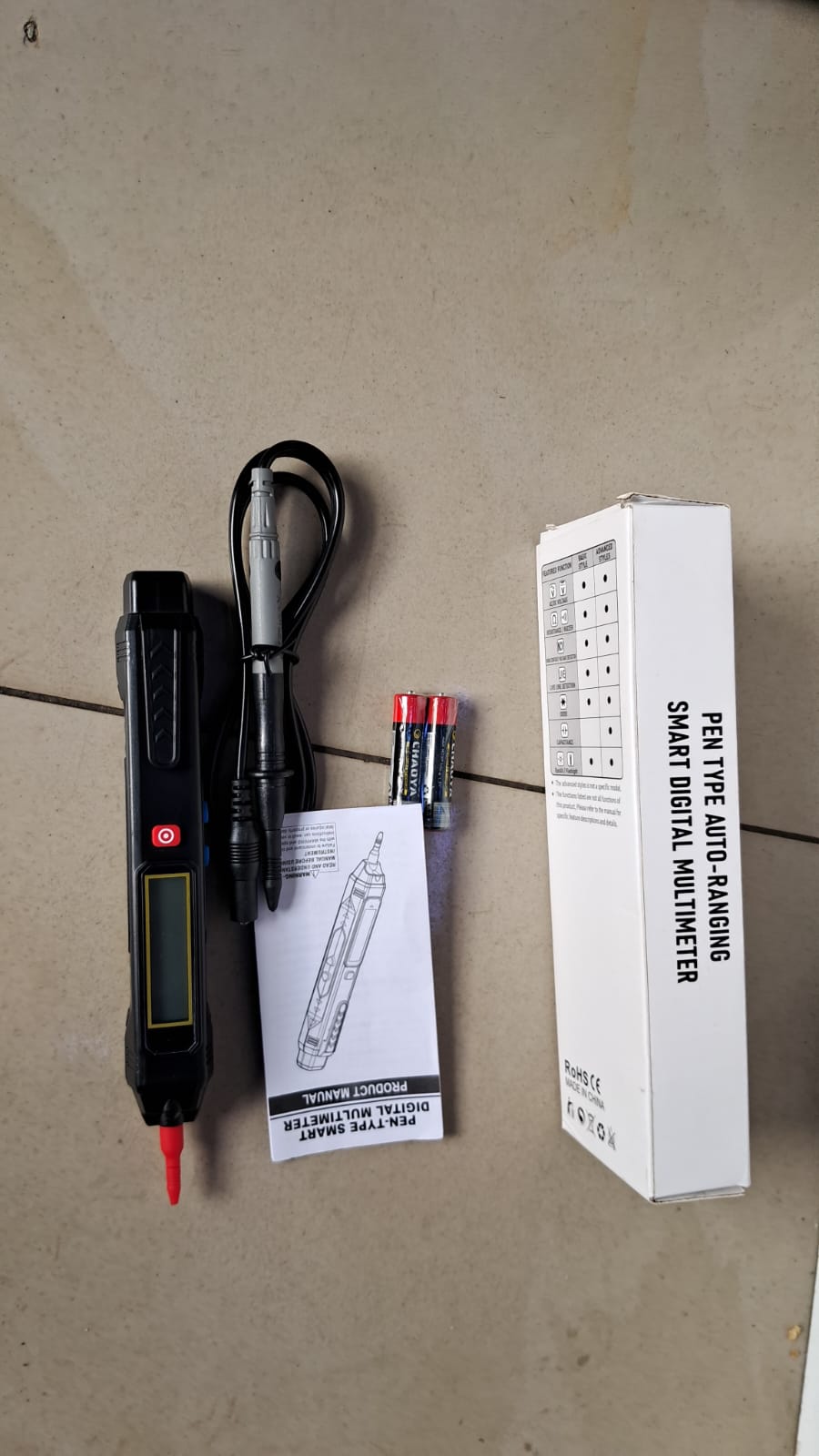
Description


A voltage detector tester is a handheld electrical safety tool used to detect the presence of AC voltage without making direct contact with a live conductor. It is one of the most important tools for electricians, maintenance technicians, engineers, contractors and DIY users because it helps identify live wires before electrical work begins.
Unlike a multimeter, a non-contact voltage detector (NCVT) senses the electric field around an energized conductor. When voltage is detected, the tester alerts the user using an LED light, an audible beep or vibration, depending on the model.
Most modern voltage detector testers detect AC voltages from 12V to 1000V, making them suitable for household, commercial and industrial electrical installations. Many quality models are rated CAT III 1000V for distribution circuits, while some also carry a CAT IV 600V safety rating for service entrances.
Quick Specifications
| Feature | Typical Specification |
|---|---|
| Product Name | Voltage Detector Tester |
| Type | Non-Contact AC Voltage Tester |
| Detection Range | 12V–1000V AC |
| Frequency | 50–60 Hz |
| Detection Method | Non-contact (NCV) |
| Indicators | LED light and audible alarm |
| Flashlight | Yes (selected models) |
| Sensitivity | High, Medium and Low (selected models) |
| Battery | 2 × AAA batteries |
| Auto Power Off | Yes |
| Low Battery Warning | Yes |
| Safety Rating | CAT III 1000V, CAT IV 600V (model dependent) |
Main Features
Wide AC Voltage Detection Range
Most modern testers detect AC voltage between 12V and 1000V, making them suitable for:
- Home wiring
- Distribution boards
- Power sockets
- Circuit breakers
- Extension cables
- Electrical appliances
- Lighting circuits
- Industrial equipment
Non-Contact Detection
The detector identifies live conductors without exposing metal probes to the electrical conductor.
Benefits include:
- Improved operator safety
- Faster inspection
- No wire stripping
- Reduced risk of accidental shock
- Easier testing in confined spaces
LED and Audible Alarm
Most voltage detector testers provide two warning methods:
- Flashing LED indicator
- Audible beeping alarm
Higher voltage levels generally produce faster flashing and quicker alarm sounds.
High and Low Sensitivity Modes
Selected professional models include multiple sensitivity levels.
These help detect:
- Buried cables
- Low-voltage wiring
- Standard household circuits
- Industrial power cables
- Hidden electrical conductors
Automatic sensitivity adjustment is available on some models.
Built-in LED Flashlight
Many voltage testers include an LED flashlight for:
- Ceiling work
- Distribution boards
- Electrical cabinets
- Dark plant rooms
- Night maintenance
Auto Power-Off
To conserve battery life, many testers switch off automatically after a period of inactivity.
Low Battery Indicator
The tester warns the user when battery power becomes low, helping maintain reliable operation.
Compact Pocket Design
The slim pen-style body easily fits into:
- Shirt pocket
- Tool pouch
- Electrician’s bag
- Toolbox
A pocket clip keeps the tester secure during work.
Durable ABS Housing
Most testers use impact-resistant ABS plastic that provides:
- Electrical insulation
- Lightweight construction
- Good durability
- Resistance to workshop conditions
Applications
A voltage detector tester is suitable for:
Electrical Installation
Checking:
- Live wires
- Circuit breakers
- Distribution boards
- Consumer units
- Electrical sockets
Home Maintenance
Testing:
- Wall outlets
- Switches
- Extension leads
- Light fittings
- Ceiling fans
Commercial Buildings
Inspecting:
- Office wiring
- Power distribution
- Emergency lighting
- Electrical panels
Industrial Maintenance
Used on:
- Motor control panels
- Distribution cabinets
- Manufacturing equipment
- Electrical machinery
HVAC Systems
Checking power to:
- Air conditioners
- Compressors
- Thermostats
- Control panels
Solar Installations
Useful for verifying AC output wiring and inverter connections before further testing.
How a Voltage Detector Tester Works
The tester senses the electric field generated by an energized AC conductor.
When the tip approaches a live wire:
- The internal sensor detects the alternating electric field.
- The electronic circuit processes the signal.
- The tester activates its LED, buzzer or vibration alert.
Because it works without direct contact, it provides a quick indication of live voltage. However, it does not measure the exact voltage value.
Types of Voltage Detector Testers
Basic Non-Contact Voltage Tester
Features:
- LED indicator
- Audible alarm
- Battery powered
- Compact size
Digital Voltage Detector
Additional features:
- LCD display
- Voltage indication
- Higher sensitivity
- Battery status
Dual-Range Voltage Detector
Supports:
- Low-voltage detection
- Standard mains voltage detection
- Automatic sensitivity adjustment
Professional Voltage Tester
Often includes:
- CAT III/CAT IV safety ratings
- Flashlight
- Vibration alert
- Water and dust resistance
- Rugged housing
How to Use a Voltage Detector Tester
Step 1
Install fresh batteries.
Step 2
Switch on the tester.
Step 3
Verify operation by testing a known live outlet.
Step 4
Hold the insulated handle only.
Step 5
Bring the tip close to the wire, outlet or terminal.
Step 6
Observe the LED and listen for the alarm.
Step 7
Confirm the result using an approved contact tester or multimeter before beginning work on critical circuits.
Professional electrical safety practice recommends a live-dead-live verification: test the detector on a known live source, test the target circuit, then test the detector again on a known live source to confirm it is still functioning.
Advantages
- Fast voltage detection
- No direct contact required
- Portable design
- Easy operation
- Audible and visual alarms
- Suitable for electricians
- Safe for routine inspections
- Battery powered
- Lightweight
- Reliable for preliminary testing
Voltage Detector Tester vs Multimeter
| Feature | Voltage Detector | Digital Multimeter |
|---|---|---|
| Detects live AC | Yes | Yes |
| Measures exact voltage | No | Yes |
| Measures resistance | No | Yes |
| Measures current | No | Yes |
| Non-contact operation | Yes | No |
| Easy for quick checks | Excellent | Good |
A voltage detector is ideal for quickly identifying energized circuits, while a multimeter is needed when exact voltage or current measurements are required.
Common Mistakes
Avoid:
- Using the tester on DC circuits if it is AC-only.
- Assuming “no indication” guarantees a circuit is safe.
- Ignoring low-battery warnings.
- Using damaged testers.
- Skipping a known-live test before use.
- Using the tester beyond its rated voltage range.
Safety Tips
- Always verify the tester on a known live source before and after testing.
- Hold only the insulated handle.
- Do not use on damaged cables.
- Replace weak batteries promptly.
- Keep the probe clean.
- Store in a dry place.
- Do not rely solely on a non-contact tester before touching conductors.
- Wear appropriate personal protective equipment (PPE).
Maintenance
- Clean with a dry cloth.
- Replace batteries when indicated.
- Inspect the housing for cracks.
- Check the tip for damage.
- Store in the protective pouch or toolbox.
- Keep away from moisture and excessive heat.
How to Choose the Best Voltage Detector Tester
Before buying, consider:
- Detection range (12V–1000V recommended)
- CAT III or CAT IV safety rating
- LED and audible alarms
- Built-in flashlight
- Auto power-off
- Low-battery warning
- Adjustable sensitivity
- Durable ABS housing
- Reliable brand
- Warranty
Package Contents
A standard package normally includes:
- 1 × Voltage Detector Tester
- 2 × AAA batteries (selected models)
- User manual
- Pocket clip
- Protective packaging
Voltage Detector Tester Price in Kenya
Current Kenyan prices vary depending on the features and brand.
| Type | Estimated Price |
|---|---|
| Basic Non-Contact Voltage Tester | KSh 700–1,500 |
| 12V–1000V AC Voltage Detector | KSh 1,300–2,000 |
| Digital Voltage Detector | KSh 1,800–3,500 |
| Professional CAT III/CAT IV Tester | KSh 3,500–8,000 |
| Premium Industrial Voltage Tester | KSh 8,000–20,000+ |
Recent Kenyan listings include:
- Tolsen 12–1000V Non-Contact Voltage Detector: approximately KSh 1,799–2,350
- Total 12–1000V High-Sensitivity Voltage Detector: approximately KSh 1,898
- Professional two-pole voltage tester: approximately KSh 5,200
Why Buy a Voltage Detector Tester?
A voltage detector tester is an essential electrical safety tool for quickly identifying live AC circuits before maintenance or installation work. Its non-contact operation, audible and visual alerts, compact design and ease of use make it suitable for electricians, technicians, maintenance teams and homeowners.
While it is excellent for detecting the presence of voltage, it should be used as a preliminary safety tool and not as the only method of proving a circuit is de-energized. For critical work, always confirm with an approved contact voltage tester or multimeter.
Frequently Asked Questions
What is a voltage detector tester used for?
It detects the presence of AC voltage without touching the conductor directly.
Does it measure the exact voltage?
No. A standard non-contact voltage detector indicates the presence of voltage but does not provide an exact voltage reading.
What voltage range can it detect?
Most modern models detect 12V to 1000V AC.
Can it detect wires inside walls?
Yes. High-sensitivity models can often detect live wires behind walls, but detection depth depends on wall material and installation conditions.
Can it test DC voltage?
Most non-contact voltage detectors are designed for AC voltage only. Check the product specifications before use.
Is it safe to use?
Yes, when used correctly and within its voltage rating. Always test it on a known live source before and after checking a circuit.
What batteries does it use?
Many models use 2 × AAA batteries.
What is the price of a voltage detector tester in Kenya?
Basic models generally cost KSh 700–1,500, while professional CAT III/CAT IV testers range from KSh 3,500 upwards, depending on the brand and features.
Reviews
There are no reviews yet.