
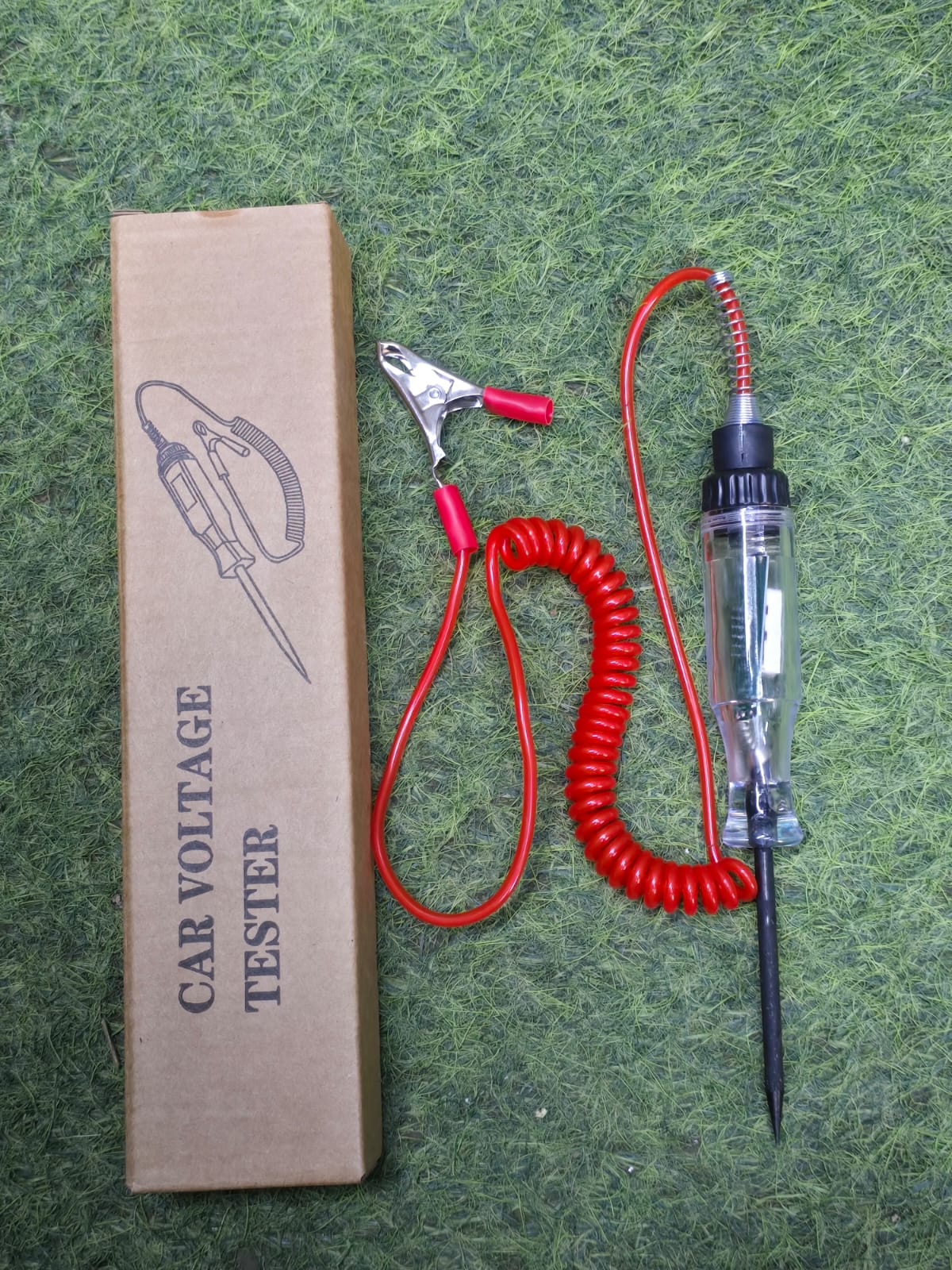
Description
A car fuse detector is a handheld electrical testing tool used to check automotive fuses, wires, switches, sockets and other low-voltage vehicle circuits. It helps a mechanic identify whether electricity is reaching a component without removing many parts from the vehicle.
The tool is also called a car fuse tester, automotive circuit tester, car voltage tester, test light or electrical probe tester.
Most simple models consist of a pointed metal probe, an indicator light and a cable fitted with a crocodile clip. The clip connects to the vehicle ground or battery negative terminal. The pointed probe is then touched on a fuse terminal, wire connector or electrical contact.
Many common automotive testers work on 6V, 12V and 24V DC systems, making them useful for motorcycles, cars, SUVs, pickups, trucks, generators and other battery-powered equipment. Digital models may cover a wider range, such as 3V to 48V, and display the actual voltage instead of only showing whether power is present.
Quick Specifications
| Feature | Typical specification |
|---|---|
| Product name | Car Fuse Detector |
| Other names | Car fuse tester, circuit tester, voltage test pen |
| Common voltage range | 6V, 12V and 24V DC |
| Digital model range | Approximately 3V to 48V |
| Indicator | LED, bulb or LCD display |
| Probe material | Hardened steel |
| Cable connection | Insulated lead with crocodile clip |
| Main power source | Vehicle circuit being tested |
| Polarity detection | Available on selected digital models |
| Fuse compatibility | Mini, standard and maxi blade fuses |
| Main use | Detecting power, blown fuses and open circuits |
| Suitable vehicles | Motorcycles, cars, pickups, vans and trucks |
| Body material | Insulated plastic and metal probe |
| Portability | Small handheld design |
Exact features depend on whether the product is a basic test light, LED fuse tester or advanced digital automotive tester.
What Is a Car Fuse Detector?
A car fuse detector is a simple diagnostic tool that shows whether voltage is present at a selected point in a vehicle electrical system.
It can be used to check:
- Blade fuses
- Fuse boxes
- Battery terminals
- Vehicle lights
- Relays
- Ignition circuits
- Horn wiring
- Radio connections
- Trailer sockets
- Charging ports
- Switches
- Ground connections
- Broken wires
- Electrical accessories
A basic car fuse tester normally gives an on or off indication. The internal lamp or LED illuminates when electrical power reaches the probe.
A digital model may show the measured voltage on a small screen. This makes it easier to identify low voltage, poor battery supply or voltage drop.
How a Car Fuse Detector Works
The tester requires two contact points to complete the electrical circuit.
One side is connected through the crocodile clip. The other side is touched using the pointed probe.
For a normal positive voltage test:
- Connect the crocodile clip to the battery negative terminal or a clean metal ground.
- Turn on the electrical circuit being tested.
- Touch the probe to the fuse terminal or wire.
- Watch the indicator.
- A light or voltage reading shows that power is present.
A traditional automotive test light draws a small amount of current from the tested circuit to illuminate its bulb. These test lights are commonly designed for low-voltage automotive systems near 12V and must never be used on household mains electricity.
Main Features of a Car Fuse Detector
6V, 12V and 24V compatibility
Many automotive tester pens support common vehicle electrical systems.
6V systems
These may be found in:
- Older motorcycles
- Classic cars
- Small battery equipment
- Selected agricultural machines
12V systems
These are common in:
- Cars
- SUVs
- Pickups
- Motorcycles
- Small vans
- Generators
- Boats
- Solar battery systems
24V systems
These are commonly used in:
- Trucks
- Buses
- Heavy construction machines
- Large commercial vehicles
- Selected tractors
A tester advertised for 6V, 12V and 24V DC should only be used within its stated limit.
Pointed steel probe
The sharp probe allows the tester to reach:
- Fuse test points
- Electrical connectors
- Small terminals
- Wire joints
- Socket contacts
- Relay terminals
It may also pierce light wire insulation during fault tracing. However, unnecessary insulation piercing should be avoided because the hole can later allow water and corrosion into the cable.
Whenever possible, use the exposed terminal or back-probe the connector instead of damaging the wire insulation.
Crocodile ground clip
The insulated cable normally ends with a crocodile clip.
It provides a stable connection to:
- Battery negative
- Engine ground
- Chassis ground
- Clean metal brackets
- Positive supply during ground testing
The clip teeth should be clean and strong enough to hold securely.
Indicator light
Basic models use either:
- Incandescent bulb
- LED indicator
- Dual-colour LED
An illuminated indicator shows that electricity is present.
Selected dual-colour testers can also show polarity. One colour may indicate positive voltage while another indicates ground or negative polarity.
Digital voltage display
Advanced car fuse detectors display the actual voltage.
A digital model may help identify:
- 12.6V battery voltage
- Low battery voltage
- Charging voltage
- Voltage drop
- Poor ground connection
- Weak power supply
- Unstable voltage
A digital automotive tester currently available in Kenya is advertised with a 3V to 48V working range and bidirectional voltage testing for cars, recreational vehicles and trucks.
Long insulated cable
A longer cable allows the user to reach different parts of the engine bay, cabin or vehicle body while remaining connected to the battery or chassis.
Check the lead for:
- Strong insulation
- Flexible construction
- Secure connection
- Adequate length
- No exposed copper
Insulated handle
The handle protects the operator from accidental contact with the tested circuit.
It also provides:
- Comfortable grip
- Better probe control
- Reduced slipping
- Easier use in narrow spaces
The handle must remain dry and free from cracks.
Compact design
A car fuse detector is small enough to store inside:
- Vehicle toolbox
- Garage tool cabinet
- Glove compartment
- Motorcycle repair kit
- Mobile mechanic bag
It provides a fast first check before using a digital multimeter or advanced diagnostic machine.
Types of Car Fuse Detectors
Basic automotive test light
This is the simplest and most affordable design.
It normally includes:
- Clear or coloured handle
- Small internal bulb
- Sharp metal probe
- Ground cable
- Crocodile clip
The bulb lights when voltage is present.
It is suitable for checking simple circuits such as lights, horns, fuses and switches.
LED fuse tester
An LED model uses a light-emitting diode instead of a normal bulb.
Benefits may include:
- Lower current draw
- Bright indication
- Longer indicator life
- Compact design
- Polarity indication on selected models
Because LED testers draw less current, they may sometimes show weak or unwanted voltage that cannot operate the actual component. Further testing may be needed.
Digital voltage tester
A digital car voltage tester displays the measured voltage on an LCD or LED screen.
It is better for checking:
- Battery voltage
- Alternator charging output
- Voltage drop
- Sensor power supply
- Low-voltage circuits
- 12V and 24V vehicle systems
Digital testers may measure a wider range than ordinary test lights.
Fuse tester and puller
A fuse tester and puller combines two functions.
It can:
- Check whether a fuse is complete
- Remove the fuse from the fuse box
One documented 4-in-1 automotive fuse tester has adjustable probes that fit mini, standard and maxi blade fuses. A green LED illuminates when the fuse is good.
Fuse current tester
A current tester replaces the vehicle fuse temporarily and measures the electrical current flowing through that circuit.
This type is useful when diagnosing:
- Excessive current draw
- Battery drain
- Overloaded circuits
- Faulty electrical accessories
- Blowing fuses
One automotive fuse current tester measures approximately 0.01A to 19.99A through standard blade-fuse circuits. Another model supports circuits up to 30A and includes ATC, mini and micro fuse adapters.
Short-circuit finder
A short-circuit detector is a more advanced tool designed to locate:
- Shorted wires
- Open circuits
- Broken cables
- Intermittent connections
- Blown-fuse causes
Some models use a transmitter and receiver to trace the cable without opening the entire wiring harness.
A simple fuse detector should not be confused with a full wire-tracing short-circuit finder.
Automotive Fuse Types That Can Be Tested
Mini blade fuse
Mini fuses are commonly found in modern cars where space is limited.
Standard blade fuse
Standard blade fuses are widely used in cars, pickups, vans and other vehicles.
Maxi blade fuse
Maxi fuses protect higher-current circuits such as:
- Cooling fans
- ABS systems
- Main fuse boxes
- Electric power steering
- Large vehicle accessories
Micro blade fuse
Micro fuses are used in many newer vehicles.
A tester with small adjustable probes or a sharp circuit probe is useful for checking them.
Glass tube fuse
Glass fuses may be found in:
- Older vehicles
- Radios
- Accessories
- Classic cars
- Small electrical devices
Some combined fuse testers can check both glass and blade fuses.
Cartridge fuse
High-current cartridge fuses are common near vehicle batteries and main power distribution boxes.
These should be tested carefully at the accessible test points.
Applications of a Car Fuse Detector
Testing a blown car fuse
The detector can test both sides of a blade fuse while it remains installed.
A good powered fuse should normally show voltage on both test points.
If voltage appears on one side only, the fuse is probably blown.
Checking vehicle lights
The tool can check power reaching:
- Headlights
- Brake lights
- Indicators
- Fog lights
- Number-plate lights
- Interior lights
- Reverse lights
Testing horn circuits
It can confirm whether voltage reaches:
- Horn fuse
- Horn relay
- Horn connector
- Steering-wheel switch circuit
Checking fuel-pump power
A technician may use the tester to confirm power at the fuel-pump fuse, relay or connector.
Fuel systems require extra care because sparks near fuel vapour can cause fire.
Testing trailer wiring
The tester can identify output at a trailer socket for:
- Indicators
- Brake lights
- Tail lights
- Reverse lights
- Auxiliary power
Checking battery power
A digital tester can show whether battery voltage is present at a selected component.
Diagnosing charging circuits
Some digital models can help check:
- Battery resting voltage
- Alternator charging voltage
- Voltage at the starter
- Power at the fuse box
A simple test light only shows whether power is present. It does not provide a complete alternator or battery health test.
Testing ignition circuits
The tool may be used to check low-voltage power at:
- Ignition switch
- Ignition relay
- Coil supply wire
- Starter-solenoid terminal
- Engine control fuses
Do not use a standard fuse tester directly on high-voltage ignition leads.
Checking electrical accessories
It is useful for diagnosing:
- Car radio
- Dash camera
- USB charger
- Alarm system
- Electric windows
- Central locking
- Auxiliary lights
- Air compressor
- Car refrigerator
- Inverter
How to Test a Car Fuse Without Removing It
Step 1: Park safely
Switch off the engine unless the circuit must be active during testing.
Apply the parking brake and keep loose clothing away from moving parts.
Step 2: Locate the fuse box
Car fuse boxes may be found:
- Under the dashboard
- Beside the steering column
- Inside the glove box
- In the engine compartment
- Near the battery
- Inside the luggage area
Use the vehicle manual or fuse-box diagram.
Step 3: Identify the correct fuse
Locate the fuse for the component that is not working.
The diagram may identify circuits such as:
- HORN
- HEAD
- ECU
- FUEL
- RADIO
- WIPER
- ACC
- STOP
- A/C
Step 4: Activate the circuit
Some fuses only receive power when:
- The ignition is on
- The engine is running
- The light switch is on
- The accessory switch is active
- A relay has operated
Turn on the relevant circuit.
Step 5: Connect the ground clip
Attach the crocodile clip to:
- Battery negative
- Clean engine metal
- Unpainted chassis point
Confirm the connection is secure.
Step 6: Test the detector first
Touch the probe to the battery positive terminal or another known powered point.
The indicator should illuminate.
This confirms that the tester and ground connection are working.
Step 7: Touch the first fuse test point
Most blade fuses have two small exposed test points at the top.
Touch the first test point with the probe.
Step 8: Test the second point
Move the probe to the second test point.
Step 9: Read the result
| Test result | Likely condition |
|---|---|
| Light on at both points | Fuse is likely good and powered |
| Light on at one point only | Fuse is likely blown |
| No light at either point | Circuit is off, has no supply or ground clip is poor |
| Weak or unstable light | Low voltage or poor connection may be present |
Step 10: Confirm the diagnosis
Remove and inspect the fuse when necessary.
A multimeter continuity test can provide further confirmation.
How to Check a Fuse After Removing It
A combined fuse tester may test the fuse away from the vehicle.
- Remove the fuse using a fuse puller.
- Position the detector contacts on both fuse blades.
- Press the test button where provided.
- Watch the indicator.
- A green light commonly shows continuity on simple fuse testers.
One 4-in-1 tester uses adjustable probes and indicates a good blade fuse using a green LED.
How to Check for Power in a Wire
- Connect the clip to a good chassis ground.
- Turn on the circuit.
- Touch the probe to the exposed wire terminal.
- Check whether the indicator lights.
- Move along the circuit until power disappears.
The fault may be located between the final powered point and the first point without power.
Avoid piercing sealed vehicle wiring unless necessary.
How to Test a Vehicle Ground Connection
The same tool can check a ground circuit.
- Connect the crocodile clip to battery positive.
- Touch the probe to the suspected ground point.
- A light indicates that the point is connected to ground.
- Compare the brightness with a known good ground.
- Clean and tighten a weak or corroded connection.
Only reverse the tester connection when the model and instructions permit it.
Common Problems Detected
Blown fuse
A fuse may blow because of:
- Short circuit
- Overloaded accessory
- Damaged wire insulation
- Incorrect wiring
- Failed electrical component
- Wrong fuse size
- Water inside a connector
Replacing the fuse without repairing the fault may cause it to blow again.
Open circuit
An open circuit means electricity cannot complete its path.
Possible causes include:
- Broken wire
- Disconnected plug
- Burnt terminal
- Faulty switch
- Blown fuse
- Failed relay
Short circuit
A short circuit happens when power reaches ground through an unintended low-resistance path.
It may cause:
- Blown fuses
- Hot wires
- Smoke
- Melted insulation
- Battery drain
- Fire risk
Disconnect the battery when investigating damaged high-current wiring.
Poor ground connection
A poor ground can cause:
- Dim lights
- Slow motors
- False warning lights
- Intermittent operation
- Low voltage readings
- Starting problems
Low voltage
Low voltage can result from:
- Weak battery
- Corroded terminals
- Loose connectors
- Damaged cable
- Excessive resistance
- Alternator problem
- Heavy circuit load
A digital fuse detector or multimeter is more useful than a simple lamp when measuring low voltage.
Parasitic battery drain
A fuse-slot current tester can help identify the circuit drawing power when the vehicle is switched off.
The tester replaces the fuse and displays current flowing through the selected circuit. Always observe the current limit of the tester.
Car Fuse Detector Versus Digital Multimeter
| Feature | Car fuse detector | Digital multimeter |
|---|---|---|
| Detects power quickly | Excellent | Yes |
| Displays exact voltage | Digital models only | Yes |
| Measures resistance | Normally no | Yes |
| Checks continuity | Selected models | Yes |
| Measures current | Fuse-current models only | Yes |
| Ease of use | Very easy | Requires more knowledge |
| Speed | Fast | Moderate |
| Cost | Lower | Usually higher |
| Best use | Fast vehicle circuit checks | Detailed electrical diagnosis |
A car fuse detector is excellent for quick checks. A multimeter is better when exact measurements are required.
Car Fuse Detector Versus OBD2 Scanner
| Feature | Fuse detector | OBD2 scanner |
|---|---|---|
| Checks physical voltage | Yes | No |
| Reads engine fault codes | No | Yes |
| Tests fuses | Yes | No |
| Tests wiring | Yes | Limited |
| Works on lights and accessories | Yes | Limited |
| Requires diagnostic socket | No | Yes |
| Cost | Lower | Higher |
The two tools perform different jobs. An OBD2 scanner reads electronic control-unit data, while a fuse detector checks the actual electrical circuit.
Car Fuse Detector Versus Continuity Tester
| Feature | Fuse detector | Continuity tester |
|---|---|---|
| Tests powered circuit | Yes | Normally no |
| Has internal battery | Not always | Usually |
| Finds voltage | Yes | No |
| Checks broken wire | Indirectly | Yes |
| Safe on live circuit | Within rating | Usually not |
| Best use | Automotive voltage detection | Unpowered circuit continuity |
A continuity tester should generally be used only after electrical power has been removed.
Safety Precautions
- Use the tester only within its stated voltage range.
- Do not use an automotive tester on 240V household electricity.
- Wear eye protection near batteries.
- Keep the probe away from rotating belts and fans.
- Avoid creating a short between positive and ground.
- Do not touch two terminals with the probe shaft.
- Inspect the cable insulation before use.
- Do not use the tester with wet hands.
- Keep sparks away from fuel and battery gases.
- Never replace a fuse with a higher rating without manufacturer approval.
- Do not hold the exposed metal probe during testing.
- Disconnect the battery before repairing damaged wires.
- Use extra care around airbags and electronic control modules.
- Do not probe orange high-voltage cables in hybrid or electric vehicles.
- Use manufacturer-approved EV testing equipment for high-voltage systems.
- Keep the protective cap over the probe during storage.
Automotive test lights are intended for low-voltage vehicle circuits. Applying one to mains electricity can destroy the tester and create a serious short-circuit or shock hazard.
Important Warning for Modern Vehicles
Modern vehicles contain sensitive electronics, including:
- Airbag control modules
- Engine control units
- Body control modules
- CAN bus networks
- Electronic sensors
- Hybrid systems
A traditional incandescent test light may draw more current than an LED or digital tester.
Avoid using a high-current test light on:
- Airbag circuits
- ECU signal wires
- Sensor signal wires
- CAN bus wires
- Electronic ignition triggers
- Hybrid high-voltage circuits
Use a high-impedance digital multimeter or manufacturer-approved diagnostic tool on sensitive circuits.
Common Mistakes When Using a Car Fuse Detector
Testing a circuit that is switched off
Some fuses only receive power when the ignition or accessory is on.
Activate the circuit before concluding that there is no voltage.
Using a poor ground point
Paint, rust and dirt can prevent the crocodile clip from making contact.
Connect to clean bare metal or battery negative.
Assuming every fuse should have power
Some fuses are only powered under certain conditions.
Check the wiring diagram.
Replacing a fuse with a larger one
A larger fuse can allow the wiring to overheat before the fuse blows.
Always replace it with the specified rating.
Piercing too many wires
Probe holes can admit moisture and cause corrosion.
Use terminal back-probing whenever possible.
Ignoring a repeatedly blown fuse
A fuse that blows again indicates an unresolved electrical fault.
Using a simple light for precise diagnosis
A test light may show voltage without revealing whether the supply can operate the component.
Use voltage-drop and load testing for difficult problems.
Maintenance Tips
Clean the probe
Remove:
- Grease
- Corrosion
- Dirt
- Adhesive
- Metal particles
A dirty probe may give an unreliable result.
Inspect the cable
Check for:
- Cuts
- Exposed copper
- Broken insulation
- Loose connections
- Heat damage
Replace a damaged tester.
Clean the crocodile clip
The clip teeth should remain free from rust and oil.
Protect the sharp point
Fit the probe cover after every use.
This prevents injury and protects the tip.
Store in a dry toolbox
Keep the detector away from:
- Rain
- Battery acid
- Brake fluid
- Fuel
- Excessive heat
Check operation before use
Test the tool on a known live point before and after an important diagnosis.
This helps confirm that the indicator and lead are still working.
How to Choose the Best Car Fuse Detector
Check the voltage range
For normal vehicle repairs, choose at least:
- 6V
- 12V
- 24V DC
A 3V to 48V digital model provides more versatility for cars, trucks and selected equipment.
Choose between indicator and digital display
Indicator-light model
Best for:
- Quick power checks
- Basic fuse testing
- Simple wiring diagnosis
- Budget use
Digital model
Best for:
- Exact voltage readings
- Battery diagnosis
- Alternator checks
- Voltage-drop investigation
- Professional workshop work
Check fuse compatibility
For direct fuse testing, choose adjustable contacts suitable for:
- Mini blade
- Standard blade
- Maxi blade
- Micro blade
Look for polarity indication
A dual-colour LED or digital display can help distinguish positive and negative connections.
Check the probe insulation
Only the pointed end should be exposed.
A long bare shaft increases the risk of accidental short circuits.
Choose a strong cable
The cable should be flexible, well insulated and securely attached.
Check the clip quality
The crocodile clip should grip battery terminals and chassis points firmly.
Consider a current-measuring model
A fuse-slot current tester is useful when diagnosing:
- Battery drain
- Overloaded circuits
- Blowing fuses
- Accessory current consumption
Confirm its maximum amperage before use. Common examples measure up to about 20A or 30A.
Confirm the warranty
Ask whether the supplier covers:
- Defective display
- Broken cable connection
- Faulty indicator
- Manufacturing defects
Car Fuse Detector Price in Kenya
Current Kenya marketplace listings show a basic car voltage tester or car fuse detector at approximately KSh 1,650. A more advanced imported digital model covering 3V to 48V is listed at about KSh 4,927 before possible delivery charges.
| Type of car fuse detector | Estimated price in Kenya |
|---|---|
| Basic 6V to 24V test light | KSh 500–1,500 |
| LED car fuse tester | KSh 800–2,000 |
| Car voltage tester and fuse detector | KSh 1,500–3,000 |
| Digital 3V to 48V automotive tester | KSh 3,500–7,000 |
| Fuse tester and puller | KSh 1,500–4,000 |
| Fuse-slot current tester | KSh 3,500–9,000 |
| Short-circuit wire finder | KSh 5,000–18,000 |
| Professional power-probe tester | KSh 10,000–40,000+ |
Prices vary depending on:
- Voltage range
- LED or digital display
- Cable length
- Polarity testing
- Fuse-size compatibility
- Current-measuring function
- Brand
- Warranty
- Import charges
- Delivery location
Package Contents
A normal package may include:
- One car fuse detector
- Pointed test probe
- Insulated connecting cable
- Crocodile clip
- Probe protection cap
- User instructions
Selected models may also include:
- Fuse puller
- Mini-fuse adapter
- Micro-fuse adapter
- Standard blade adapter
- Maxi-fuse contact
- Carrying pouch
- Replacement probe
- Internal battery
Confirm the package details before buying.
Why Buy a Car Fuse Detector?
A car fuse detector provides a quick and affordable way to diagnose common vehicle electrical problems.
It can help identify:
- Blown fuses
- Missing power supply
- Broken wires
- Faulty grounds
- Failed switches
- Poor connections
- Electrical accessory faults
The tool is easier and faster to use than a multimeter for basic power checks. It is useful for mechanics, electricians, car owners, motorcycle technicians, fleet operators and mobile repairers.
For basic work, a 6V to 24V LED tester is normally sufficient. For professional diagnosis, a digital model with a wide voltage range provides more useful information.
Always confirm that the tester is suitable for the vehicle circuit. Avoid using an ordinary test light on sensitive control modules, airbag wires or high-voltage hybrid systems.
Frequently Asked Questions
What is a car fuse detector?
A car fuse detector is a low-voltage electrical tester used to check whether power is present at a fuse, wire, switch or connector.
Is a car fuse detector the same as a voltage tester?
The names are often used for the same automotive tool. Some voltage testers also display the actual voltage.
What voltage does it test?
Many models test 6V, 12V and 24V DC circuits. Digital versions may cover approximately 3V to 48V.
Can it test a fuse without removing it?
Yes. Touch the probe to the two small test points on top of the blade fuse while the circuit is powered.
How do I know whether the fuse is blown?
A powered good fuse normally shows voltage on both sides. Voltage on only one side normally indicates a blown fuse.
Why is there no light on either side of the fuse?
The circuit may be switched off, the fuse may have no incoming power, or the tester may have a poor ground connection.
Can it test mini fuses?
Yes. A pointed probe can test mini fuses. Adjustable fuse testers may support mini, standard and maxi blade fuses.
Can it test glass fuses?
Selected combined fuse testers can check glass and blade fuses. Confirm the model before buying.
Can I use it on trucks?
Yes, when the tester is rated for 24V vehicle circuits.
Can I use it on a motorcycle?
Yes. Most motorcycles use 6V or 12V electrical systems.
Can it check battery voltage?
A digital model can show battery voltage. A basic test light only confirms whether electrical power is present.
Can it test an alternator?
A digital tester may show charging voltage, but a complete alternator test may require a multimeter, battery tester or charging-system analyser.
Can it find a short circuit?
A basic tester can help trace the circuit, but a dedicated short-circuit finder is better for locating hidden wiring faults.
Can I use it on household electricity?
No. Automotive fuse detectors are designed for low-voltage DC systems. They should never be used on 240V household electricity.
Is it safe for vehicle computers?
Use an LED or high-impedance digital tester for sensitive electronic circuits. Do not use a high-current test light on ECU, airbag or communication wires.
Can it measure current?
A normal fuse detector does not measure current. A fuse-slot amperage tester is required. Common models measure up to about 20A or 30A.
What is the price of a car fuse detector in Kenya?
A basic car fuse detector commonly costs about KSh 500 to KSh 3,000. One current Kenya listing shows a car fuse detector and voltage tester at approximately KSh 1,650, while advanced digital models cost more.
I can also adjust this into a shorter WooCommerce product description with a meta title, meta description and focus keyword.
Reviews
There are no reviews yet.