Description
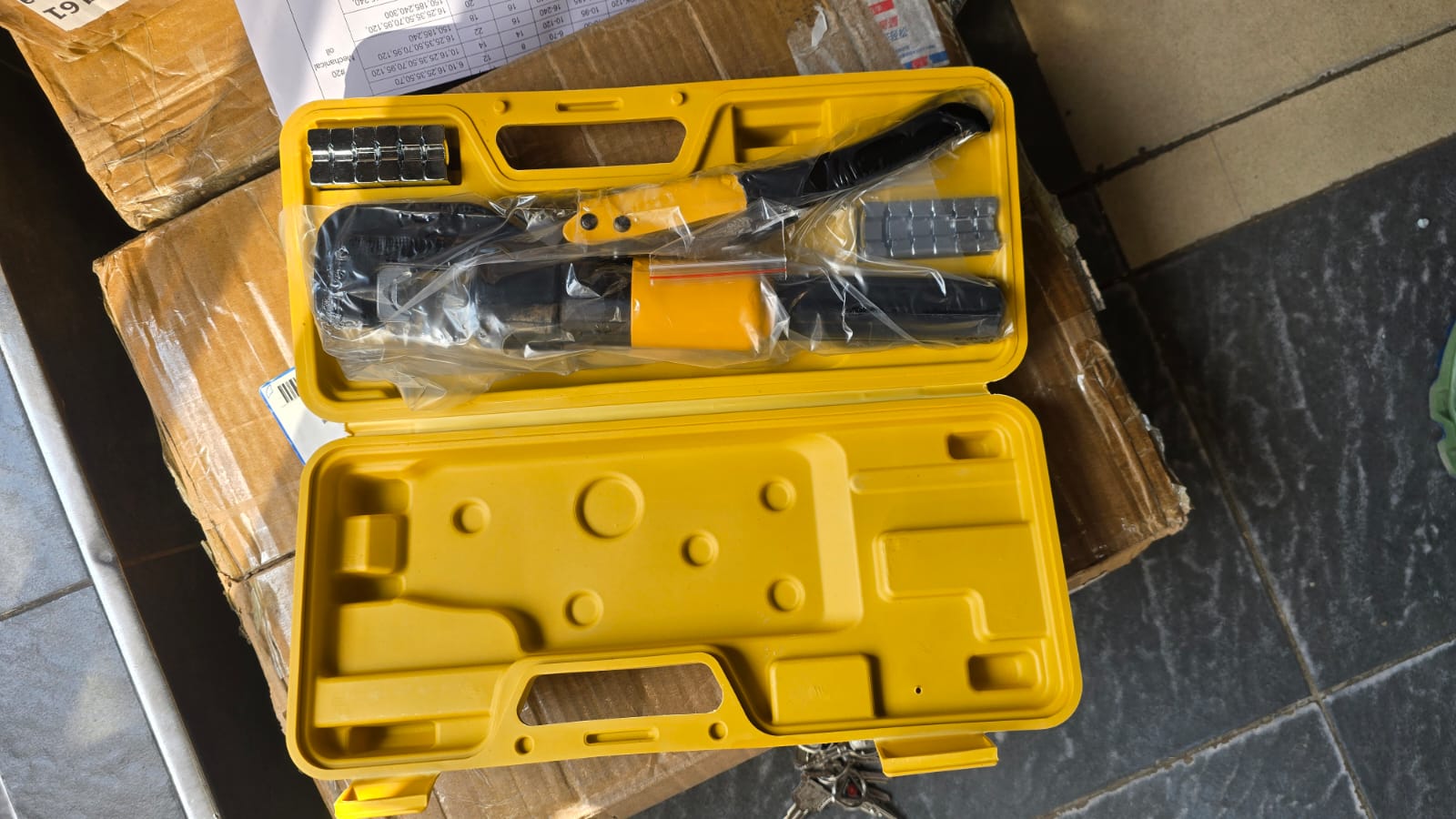
A 70mm² hydraulic crimping tool is a heavy-duty hand-operated tool designed to make strong electrical connections between cables and compatible cable lugs or terminals. Instead of depending only on hand strength, it uses hydraulic pressure to compress the connector firmly around the conductor.
A common professional model covers 4mm² to 70mm² copper cable, produces approximately 45kN of crimping force, and forms a hexagonal crimp. Current INGCO HHCT0170 and TOTAL THCT070 models sold in Kenya use this specification.
The tool is supplied with multiple interchangeable dies, allowing one crimper to handle cable sizes from small 4mm² conductors up to heavy 70mm² cables.
70mm² Hydraulic Crimping Tool Specifications
| Feature | Specification |
|---|---|
| Product | Manual Hydraulic Crimping Tool |
| Crimping Range | 4–70mm² Copper Cable |
| Maximum Die Size | 70mm² |
| Crimping Force | 45kN |
| Approx. Force | About 4.6 tonnes-force |
| Crimp Type | Hexagonal Crimp |
| Hydraulic Operation | Manual |
| Stroke | 11mm on current INGCO/TOTAL models |
| Tool Length | Approx. 310mm |
| Tool Weight | Approx. 1.8kg |
| Number of Die Sizes | 9 |
| Die Sizes | 4, 6, 8, 10, 16, 25, 35, 50 & 70mm² |
| Spare Seal | O-Ring Set Included |
| Storage | Blow-Moulded Carrying Case |
| Electricity Required | No |
| Battery Required | No |
| Main Application | Cable Lug and Terminal Crimping |
These specifications match the current INGCO HHCT0170 and TOTAL THCT070. Both are rated for Cu 4–70mm² conductors, 45kN force, hexagonal crimping and approximately 310mm overall length.
4–70mm² Wide Crimping Range
The tool covers cable sizes from:
4mm² up to 70mm²
This wide working range means electricians do not need a separate crimper for every common cable size.
It is suitable for properly matched electrical cables and terminals used in:
- Solar installations
- Distribution boards
- Battery systems
- Inverters
- Generators
- Industrial machines
- Automotive electrical work
- Control panels
- Electrical maintenance
- Commercial wiring
Always match the die to both the conductor and the lug manufacturer’s crimp requirements.
Nine Interchangeable Crimping Dies
One of the main advantages of this hydraulic crimper is the large die set.
Current 4–70mm² models include:
| Die | Typical Cable Cross-Section |
|---|---|
| 4 | 4mm² |
| 6 | 6mm² |
| 8 | 8mm² |
| 10 | 10mm² |
| 16 | 16mm² |
| 25 | 25mm² |
| 35 | 35mm² |
| 50 | 50mm² |
| 70 | 70mm² |
Both INGCO and TOTAL list these nine die sizes with their current 70mm² hydraulic crimpers.
The dies are removable, making it quick to change the tool for different cable sizes.
Powerful 45kN Crimping Force
The hydraulic mechanism generates approximately:
45kN of crimping force
This is roughly equivalent to 4.6 tonnes-force.
That amount of compression is difficult to produce consistently with ordinary hand crimping pliers.
The hydraulic system multiplies the force applied at the handle, allowing the dies to compress larger cable lugs with less operator effort.
INGCO and TOTAL both specify 45kN for their current 4–70mm² models.
Hexagonal Crimping
The tool produces a hexagonal crimp.
During crimping, the dies compress the connector from several sides to form a tight connection around the conductor.
Hex crimping is commonly used for electrical cable lugs because it can provide good mechanical retention and electrical contact when the correct lug, conductor, die and procedure are used.
Current HHCT0170 and THCT070 specifications confirm hexagonal crimping.
Manual Hydraulic Operation
This tool does not require:
Electricity, batteries or an air compressor.
The hydraulic pump is operated manually using the handle.
This makes the crimper especially convenient for:
- Construction sites
- Solar installations
- Remote farms
- Outdoor electrical work
- Mobile technicians
- Emergency repairs
- Locations without electricity
You can carry the tool directly to the job and begin working.
How the Hydraulic System Works
The hydraulic system uses oil pressure to move a piston.
When the operator pumps the handle, hydraulic pressure pushes the crimping die against the cable lug.
The dies continue closing until the required compression is achieved.
After the crimp is completed, pressure is released so the piston can return and the finished cable can be removed.
A YQK-70 manual describes the release screw as the component used to return the piston and release hydraulic pressure.
11mm Hydraulic Stroke
Current INGCO and TOTAL 4–70mm² hydraulic crimpers specify an approximately:
11mm stroke.
The stroke is the movement available to the hydraulic piston during crimping.
Some generic YQK-70 versions have slightly different published stroke figures, so the specification should be checked when comparing brands.
Compact 310mm Length
Despite its high crimping force, the tool is only about:
310mm long
or approximately:
31cm.
This compact size makes it easier to carry than large separate-pump hydraulic crimping systems.
It can fit comfortably inside the supplied carrying case for transport between jobs.
Approximately 1.8kg Tool Weight
The current INGCO and TOTAL models weigh approximately:
1.8kg
excluding some packaging components.
The weight gives the tool a strong heavy-duty feel while remaining portable enough for electricians and technicians working at different sites.
Heavy-Duty Carrying Case
The hydraulic crimper is supplied in a BMC or blow-moulded carrying case on current INGCO and TOTAL models.
The case keeps the:
- Hydraulic crimper
- Crimping dies
- Spare seals
organized together.
This is especially useful because small dies can easily become misplaced when carried loose inside a normal toolbox.
Spare Sealing O-Rings Included
A set of sealing O-rings is also supplied with current 4–70mm² crimpers.
O-rings form part of the hydraulic sealing system.
Having replacement seals available can be useful during future maintenance if an original seal becomes damaged or worn.
Suitable for Copper Cable Lugs
The official INGCO and TOTAL specification gives the crimping range as:
Cu 4–70mm²
where Cu refers to copper.
The tool is therefore well suited to properly matched copper conductors and compatible cable lugs.
Do not assume that every 70mm² die is automatically approved for every lug material or terminal design.
The connector manufacturer’s instructions should take priority.
What Is a 70mm² Cable?
The 70mm² figure refers to the cross-sectional area of the conductor.
It does not mean the cable is 70mm wide.
A 70mm² conductor is a heavy electrical cable commonly found in higher-current installations.
The actual outside diameter varies depending on:
- Conductor construction
- Insulation thickness
- Cable standard
- Manufacturer
- Number of conductor strands
This is why cables and crimping dies should be selected using conductor cross-sectional area rather than simply measuring outside cable diameter.
Suitable for Solar Installation
A hydraulic cable crimper is useful during larger solar and inverter installations.
It can help terminate suitable larger conductors connecting equipment such as:
- Battery banks
- Inverters
- Distribution equipment
- DC isolators
- Earthing systems
- Large power cables
However, this tool should not be confused with a small MC4 solar connector crimper.
MC4 connectors normally use much smaller solar cable sizes and require a dedicated MC4-compatible crimping tool.
Useful for Battery Cables
Heavy battery and inverter systems can use large cable lugs.
The 4–70mm² range makes this hydraulic tool useful for preparing suitable:
- Battery cables
- Inverter cables
- Generator battery leads
- Automotive power cables
A correctly crimped connection is important because a poor high-current connection can create resistance and excessive heat.
Distribution Board Installation
Electricians can also use the crimper when installing suitably sized cable lugs in:
- Main distribution boards
- Sub-distribution boards
- Industrial panels
- Generator changeover systems
- Commercial electrical installations
The hydraulic action helps create repeatable compression without requiring extreme hand strength.
Generator Installation
Large generators often use heavy cables between:
- Alternator systems
- Batteries
- Distribution panels
- Changeover equipment
A 70mm² hydraulic crimper can be useful when the specified cable and terminals fall within its working range.
Automotive and Truck Electrical Work
The tool can also be useful for high-current automotive wiring.
Applications may include:
- Battery cables
- Starter cables
- Earth cables
- Winch wiring
- Truck electrical systems
Smaller automotive terminals normally require a different precision crimper.
Hydraulic Crimper vs Ordinary Hand Crimper
| Feature | Ordinary Hand Crimper | Hydraulic Crimper |
|---|---|---|
| Maximum Cable Capacity | Usually Smaller | Up to 70mm² |
| Force | Hand Leverage | 45kN Hydraulic |
| Large Cable Lugs | Difficult | Much Easier |
| Power Required | No | No |
| Hydraulic System | No | Yes |
| Interchangeable Dies | Model Dependent | 9 Sizes |
| Best Application | Small Terminals | Heavy Cable Lugs |
The hydraulic model becomes especially useful as conductor size increases.
Hydraulic Crimper vs Battery Crimping Tool
A battery hydraulic crimper can complete repeated crimps faster, but it is considerably more expensive.
The manual 70mm² tool has several advantages:
- No battery charging
- No electricity
- Lower purchase cost
- Simple operation
- Easy transportation
- Fewer electronic parts
For technicians making occasional or moderate numbers of large cable connections, a manual hydraulic crimper can offer very good value.
How to Choose the Correct Die
Before crimping, identify the conductor size and connector requirements.
For example, a 35mm² conductor will commonly require the appropriately marked 35mm² die when the lug system specifies that die size.
Do not choose a die simply because the cable appears to fit.
Using the wrong die can result in:
Under-crimping, where the conductor remains loose.
Or:
Over-crimping, where the lug or conductor becomes damaged.
How to Use a 70mm² Hydraulic Crimping Tool
First make sure the electrical circuit is isolated and safe.
Select the correct die for the cable and lug.
Install both die halves securely into the crimping head.
Strip the conductor to the correct length without cutting conductor strands.
Insert the conductor fully into the correct lug.
Position the lug inside the crimping dies.
Close the hydraulic release valve.
Pump the handle until the dies complete the required crimp.
Release hydraulic pressure and remove the finished connection.
Inspect the crimp before installation.
Correct Cable Preparation
A strong crimp starts with correct cable preparation.
When stripping insulation:
- Do not cut conductor strands.
- Do not remove more insulation than required.
- Keep the conductor clean.
- Insert the conductor fully into the lug barrel.
- Use the correct terminal size.
Damaged or missing conductor strands reduce the effective conductor area.
Inspect the Finished Crimp
After crimping, check that:
- The lug is firmly attached.
- The conductor is fully inserted.
- The crimp is centred correctly.
- The lug is not cracked.
- No excessive conductor damage is visible.
Where an installation standard or manufacturer requires a pull test or other inspection method, follow that requirement.
Do Not Crimp Live Electrical Cables
This is a mechanical hydraulic tool.
It is not an insulated live-line tool unless the exact model carries the required electrical safety certification.
Always isolate the circuit before cutting, stripping or crimping conductors.
Do Not Exceed 70mm²
The maximum specified range is:
70mm²
Do not attempt to force a larger cable lug into the 70mm² die.
For larger conductors such as:
- 95mm²
- 120mm²
- 150mm²
- 185mm²
- 240mm²
use a hydraulic crimper designed for that range.
Hydraulic Oil
The YQK-70 manual specifies T 15# hydraulic oil for its hydraulic system.
Do not randomly mix hydraulic oils.
When servicing the tool, follow the manufacturer’s recommended oil specification and keep dirt out of the hydraulic system.
Contaminated hydraulic oil can damage seals and affect tool performance.
Operating Temperature
A YQK-70 manual gives a working temperature range of approximately:
-20°C to 40°C.
Exact temperature limits can vary between manufacturers, so check the manual supplied with your particular crimper.
Hydraulic Crimper Maintenance
Maintenance is simple but important.
Keep the dies clean after use.
Remove dust and metal particles from the crimping head.
Check the hydraulic system for oil leakage.
Inspect the handle and release mechanism.
Keep the seals clean.
Store the dies inside their case.
If hydraulic pressure becomes weak, inspect the oil level, seals and system according to the manufacturer’s instructions.
Avoid Dirt Inside the Hydraulic System
Hydraulic systems depend on clean oil and good seals.
The YQK-70 instructions warn that dust or air entering the hydraulic system can damage sealing components and cause the tool to lose function.
Keep the tool clean during maintenance and never leave hydraulic components open in a dusty workshop.
Package Contents
A typical 70mm² hydraulic crimping tool package contains:
| Item | Quantity |
|---|---|
| Hydraulic Crimping Tool | 1 |
| 4mm² Die | 1 Set |
| 6mm² Die | 1 Set |
| 8mm² Die | 1 Set |
| 10mm² Die | 1 Set |
| 16mm² Die | 1 Set |
| 25mm² Die | 1 Set |
| 35mm² Die | 1 Set |
| 50mm² Die | 1 Set |
| 70mm² Die | 1 Set |
| Replacement O-Ring Set | 1 |
| Carrying Case | 1 |
This matches the accessory package supplied with current INGCO HHCT0170 and TOTAL THCT070 models.
Benefits of a 70mm² Hydraulic Crimping Tool
The biggest advantage is the ability to crimp large electrical terminals without needing electricity or a battery.
Its 45kN hydraulic force, 4–70mm² range and nine interchangeable dies make it useful for electricians working on many different conductor sizes.
The compact 310mm body and carrying case also make it convenient for technicians who move between installation sites.
How to Choose a Hydraulic Crimping Tool
Before buying, check the required cable sizes first.
For general electrical work up to 70mm², look for:
4–70mm² crimping range, 45kN hydraulic force, hexagonal dies, replaceable seals and a strong carrying case.
Also check that replacement dies and seals are available.
If most of your work involves conductors larger than 70mm², buy a larger hydraulic crimper rather than operating this model outside its rated capacity.
70mm² Hydraulic Crimping Tool Price in Kenya
Current Kenyan prices vary by brand and supplier.
INGCO Kenya currently lists its HHCT0170 at KSh 7,800, while the TOTAL THCT070 is listed by Kenyan sellers from around KSh 7,425 to KSh 12,100. A generic 4–70mm² model is listed at about KSh 5,500.
| Type | Approx. Current Kenya Price |
|---|---|
| Generic 4–70mm² Hydraulic Crimper | Around KSh 5,500 |
| TOTAL THCT070 | Around KSh 7,425–12,100 |
| INGCO HHCT0170 | Around KSh 7,800 |
| Deli 6–70mm² 45kN | Around KSh 7,999 |
A current Deli EDL-YQ70 with a 6–70mm² range and 45kN force is also listed in Kenya at approximately KSh 7,999.
Prices can change according to brand, seller, die set, case quality and warranty.
Why Buy a 70mm² Hydraulic Crimping Tool?
A 70mm² hydraulic crimping tool in Kenya is a practical investment for electricians, solar technicians, mechanics and maintenance teams working with medium and large electrical cables.
It handles 4–70mm² copper conductors, produces approximately 45kN of hydraulic force, and creates strong hexagonal crimps using interchangeable dies.
Unlike an electric crimper, it requires no battery or mains power. This makes it easy to carry to construction sites, farms, solar installations and remote repair locations.
Current professional models from INGCO and TOTAL confirm a 4–70mm² range, 45kN force, 11mm stroke, 310mm body length, approximately 1.8kg tool weight and nine interchangeable dies.
Frequently Asked Questions
What is the maximum cable size for the hydraulic crimping tool?
The maximum specified conductor size is 70mm² on current INGCO and TOTAL models.
What is the minimum cable size?
The standard crimping range starts at 4mm² for the referenced INGCO and TOTAL models.
How much crimping force does it produce?
It produces approximately 45kN of crimping force, equal to roughly 4.6 tonnes-force.
How many dies come with the crimper?
Current 4–70mm² models come with nine die sizes: 4, 6, 8, 10, 16, 25, 35, 50 and 70mm².
What type of crimp does it make?
It produces a hexagonal crimp.
Does it need electricity?
No. It is a manual hydraulic tool and does not require mains electricity.
Does it need a battery?
No. Hydraulic pressure is produced manually using the operating handle.
Can it crimp copper cable?
Yes. Current INGCO and TOTAL specifications give the working range as Cu 4–70mm².
Can it crimp aluminium cable?
Some generic YQK-70 tools are marketed for both copper and aluminium applications, but the current INGCO and TOTAL specifications specifically state Cu 4–70mm². Confirm compatibility with the exact aluminium lug and tool before use.
Is it suitable for solar installations?
Yes. It is useful for larger solar, inverter and battery cable lugs where the conductor and connector fall within its rated crimping range.
Can I use it for MC4 solar connectors?
Not as a substitute for a proper MC4 crimping tool. MC4 contacts require the correct dedicated crimper and die profile.
What is the hydraulic stroke?
Current INGCO HHCT0170 and TOTAL THCT070 models have an approximately 11mm stroke.
How long is the crimping tool?
It is approximately 310mm or 31cm long.
How much does it weigh?
The tool itself weighs approximately 1.8kg on the referenced INGCO and TOTAL models.
Does it come with a carrying case?
Yes. Current INGCO and TOTAL models are supplied in a BMC carrying case.
Does it come with replacement seals?
Yes. The current packages include one set of sealing O-rings.
What is the price of a 70mm² hydraulic crimping tool in Kenya?
Current prices start at about KSh 5,500 for generic models, while branded INGCO, TOTAL and Deli models generally appear around KSh 7,400 to KSh 12,100, depending on the seller and package.

Reviews
There are no reviews yet.