
Description
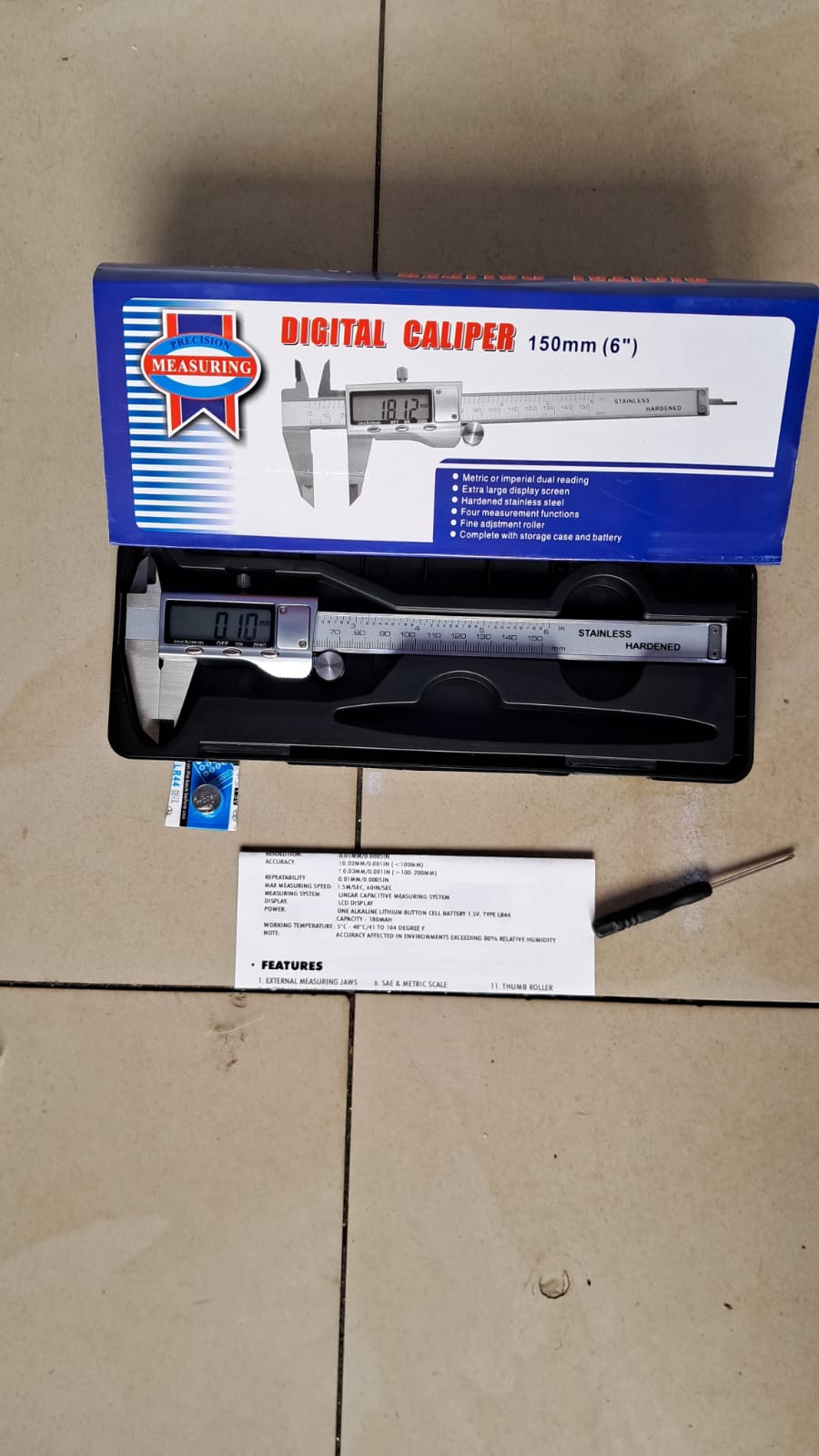
A 150mm digital vernier caliper is a precision measuring tool used to check outside dimensions, inside dimensions, depth and steps. Its digital LCD screen gives a direct measurement, making it faster to read than a traditional manual vernier caliper.
The common 150mm model has a measuring range of 0–150mm or 0–6 inches with a resolution of 0.01mm or 0.0005 inch. Current professional models commonly provide accuracy around ±0.02mm to ±0.03mm, depending on the manufacturer.
This size is useful for mechanics, machinists, welders, engineers, technicians, fabricators, students and workshops that need quick and accurate measurements.
150mm Digital Vernier Caliper Specifications
| Feature | Specification |
|---|---|
| Product | Digital Vernier Caliper |
| Measuring Range | 0–150mm / 0–6 inches |
| Resolution | 0.01mm / 0.0005 inch |
| Typical Accuracy | ±0.02mm to ±0.03mm |
| Display | Digital LCD |
| Measurement Units | mm / inch |
| External Measurement | Yes |
| Internal Measurement | Yes |
| Depth Measurement | Yes |
| Step Measurement | Yes |
| Zero Function | Yes |
| Material | Stainless steel on common professional models |
| Adjustment | Thumb roller |
| Position Lock | Locking screw |
| Battery | Commonly LR44/SR44 or CR2032, model dependent |
| Storage | Protective plastic case on many models |
| Main Uses | Engineering, automotive, machining and fabrication |
A professional Mitutoyo 500-196-30, for example, measures 0–150mm with 0.01mm resolution and ±0.02mm accuracy, while other DIN 862 digital calipers are rated around ±0.03mm.
Four Types of Measurement in One Tool
One major advantage of a digital caliper is that one instrument can perform several measurements.
A standard 150mm model can measure:
- Outside dimensions
- Inside dimensions
- Depth
- Step dimensions
These four measurement functions are confirmed on current professional 150mm digital calipers.
This makes the caliper much more versatile than a normal ruler or tape measure.
0–150mm Measuring Range
The maximum measuring capacity is:
150mm
which is equivalent to approximately:
6 inches.
This is the most popular general-purpose caliper size because it is large enough for many workshop components while remaining compact and easy to handle.
You can use it to measure items such as:
- Bolts
- Nuts
- Shafts
- Bearings
- Pipes
- Bushes
- Drill bits
- Metal plates
- Brake components
- Electrical parts
- Machine components
For parts larger than 150mm, use a 200mm, 300mm or larger caliper.
Fine 0.01mm Resolution
The digital display reads in increments as small as:
0.01mm
or:
0.0005 inch.
This is the resolution published for current INGCO, Mitutoyo and other professional 150mm digital calipers.
Resolution should not be confused with accuracy.
A tool displaying two decimal places does not automatically mean every measurement is accurate to ±0.01mm.
Accuracy vs Resolution
This difference is important when buying a digital caliper.
Resolution is the smallest change displayed by the instrument.
Accuracy tells you how close the displayed result should be to the actual dimension under specified conditions.
For example, the Mitutoyo 500-196-30 has:
Resolution: 0.01mm
Accuracy: ±0.02mm.
Another DIN 862 150mm digital caliper has 0.01mm resolution with an error limit of approximately ±0.03mm.
For professional inspection work, always check the manufacturer’s stated accuracy rather than looking only at the number of digits on the LCD.
Large Digital LCD Display
The digital screen makes measurements easy to read.
Instead of interpreting small engraved vernier lines, the measurement appears directly on the LCD.
This is particularly useful when:
- Taking many measurements
- Working quickly
- Training new technicians
- Comparing several components
- Measuring in poor workshop lighting
Current 150mm digital models commonly use a large LCD with simple control buttons.
Millimetre and Inch Conversion
A 150mm digital vernier caliper can switch between metric and imperial measurements.
With the unit button, you can change from:
mm to inch
without manually converting the measurement.
INGCO’s HDCD01150 specifically supports metric/inch conversion at any measuring position.
This is useful in Kenyan workshops because machinery, vehicles and spare parts can use either metric or imperial dimensions.
Zero Setting at Any Position
Many digital calipers include a ZERO function.
You can close the jaws and set the display to zero before measuring.
The function can also be used at another position for comparative measurements.
Mitutoyo’s ZERO/ABS function, for example, allows its 150mm digital caliper to be zero-set at any slider position for comparison measurements.
This is useful when checking the difference between a reference part and another component.
Outside Measurement
The large lower jaws measure external dimensions.
They can check:
- Shaft diameter
- Bolt diameter
- Plate thickness
- Pipe outside diameter
- Bearing width
- Block thickness
- Component length
Close the jaws gently around the component and read the result from the screen.
Do not squeeze excessively because too much force can affect the reading.
Inside Measurement
The smaller upper jaws measure internal dimensions.
They are useful for checking:
- Hole diameter
- Pipe inside diameter
- Bush internal diameter
- Slots
- Grooves
- Recesses
Open the inside jaws until both measuring surfaces contact the internal walls.
Keep the caliper correctly aligned to avoid an incorrect reading.
Depth Measurement
A depth rod extends from the end of the caliper as the slider moves.
It can measure:
- Hole depth
- Recess depth
- Slot depth
- Container depth
- Counterbore depth
Mitutoyo’s 150mm model uses a blade-type depth bar, while other standard digital calipers use similar depth-measuring arrangements.
This means a separate depth ruler is not needed for many everyday workshop measurements.
Step Measurement
A digital caliper can also measure a step or shoulder.
This is useful when inspecting:
- Machined components
- Shafts
- Housings
- Metal blocks
- Automotive parts
Step measurement is one of the four standard functions offered by current stainless-steel digital calipers.
Stainless Steel Construction
Professional digital calipers commonly use hardened or corrosion-resistant stainless steel for the frame and measuring surfaces.
Stainless steel provides:
- Good rigidity
- Smooth movement
- Wear resistance
- Better workshop durability
- Stable measuring surfaces
Mitutoyo and several other current 150mm professional calipers specify stainless-steel construction.
Some budget models use more plastic around the housing, so check the exact construction before buying.
Smooth Thumb Roller
Many 150mm digital calipers have a thumb roller beneath the display.
The roller helps move the slider smoothly when taking fine measurements.
This is especially useful when you need the jaws to contact a component gently rather than closing suddenly.
Current Mitutoyo and stainless-steel generic professional models include a thumb roller.
Locking Screw
A locking screw can hold the slider in position after a measurement is taken.
This allows you to:
Measure the component.
Lock the caliper.
Remove it carefully.
Read or compare the measurement.
A locking screw is particularly useful when measuring parts in awkward positions.
Battery Powered Operation
Digital calipers use a small replaceable battery.
The exact battery depends on the model.
Examples include:
SR44 on the Mitutoyo 500-196-30.
LR44 1.5V on some general-purpose stainless-steel digital calipers.
CR2032 on some professional 150mm models.
Always check the existing battery or manufacturer’s specification before buying a replacement.
Auto Power-Off on Selected Models
Some digital calipers automatically switch off when left unused.
One current DIN 862 150mm model has automatic power-off after approximately five minutes.
This helps extend battery life.
Auto-off is model dependent, so do not assume every low-cost digital caliper has this feature.
IP54 Protection on Selected Models
Some digital calipers include protection against dust and splashing water.
For example, the current TOTAL TMT311501 is sold in Kenya with an IP54 housing, while Freemans also specifies IP54 for its 150mm digital caliper.
Higher-grade models can provide stronger protection. A current Haas 150mm digital caliper, for example, is rated IP67.
However, IP ratings vary significantly.
Never advertise a generic digital caliper as waterproof unless its exact model carries a confirmed IP rating.
Useful for Mechanics
A digital vernier caliper is useful in automotive repair.
Mechanics can use it to check:
- Bolt diameter
- Shaft diameter
- Brake component dimensions
- Bearing sizes
- Bushes
- Spacers
- Washers
- Seals
- Small engine components
It provides much finer measurements than a tape measure.
Suitable for Machining
Machinists can use a 150mm caliper for quick inspection of manufactured components.
It is useful around:
- Lathes
- Milling machines
- Drilling machines
- CNC equipment
- General machine shops
For very tight tolerances requiring higher precision, a suitable micrometer or calibrated measuring instrument may be required.
Useful for Welding and Fabrication
Fabricators can use the tool to check:
- Metal thickness
- Tube diameter
- Rod diameter
- Hole diameter
- Component spacing
- Machined fittings
The digital readout makes repeated checks quick during fabrication.
Electrical and Electronics Work
The 150mm size is also useful for electrical and electronics technicians.
It can measure:
- Cable diameter
- Connectors
- Terminals
- Components
- PCB parts
- Enclosures
- Screws
- Shafts
Digital calipers are commonly used for checking electronic component and PCB dimensions.
Digital Caliper vs Manual Vernier Caliper
| Feature | Digital Caliper | Manual Vernier |
|---|---|---|
| Display | LCD | Engraved Scale |
| Reading Speed | Fast | Slower |
| Resolution | Commonly 0.01mm | Model dependent |
| mm/Inch Change | Button | Separate Scale |
| Zero Function | Yes | No Digital Zero |
| Battery | Required | Not Required |
| Easy for Beginners | Yes | Needs Practice |
| Electronics | Yes | No |
A digital model is easier and faster to read.
A traditional vernier has the advantage of working without batteries.
Digital Caliper vs Micrometer
| Feature | 150mm Digital Caliper | Micrometer |
|---|---|---|
| External Measurement | Yes | Yes |
| Internal Measurement | Yes | Requires Internal Micrometer |
| Depth | Yes | Separate Type Needed |
| Step | Yes | Limited |
| Typical Resolution | 0.01mm | Often 0.001–0.01mm |
| Measuring Range | 0–150mm | Usually Narrower Per Tool |
| General Workshop Use | Excellent | Precision Specific |
A digital caliper is more versatile.
A micrometer is normally preferred when a job requires tighter dimensional accuracy than a general-purpose caliper can provide.
How to Use a Digital Vernier Caliper
Before measuring, wipe the jaws clean.
Close the jaws gently.
Check whether the display reads:
0.00mm
If necessary, press the zero button.
Select mm or inch.
Open the jaws.
Position the component correctly.
Close the jaws gently until the measuring surfaces touch the part.
Keep the caliper straight.
Read the measurement from the LCD.
Repeat the measurement when accuracy is important.
Do Not Apply Excessive Pressure
A caliper is a precision instrument.
It should not be clamped onto a component with excessive force.
Heavy pressure can:
- Flex the caliper
- Damage delicate parts
- Affect the reading
- Wear measuring surfaces
Use light and consistent measuring pressure.
Keep the Measuring Jaws Clean
Small particles between the jaws can affect the reading.
Before precision work, clean away:
- Metal chips
- Oil
- Dust
- Grinding particles
- Dirt
The measuring faces should meet cleanly when the jaws are closed.
Check Zero Before Measuring
Close the outside jaws and check the display.
A properly functioning tool should return to zero or very close to its specified tolerance.
If it repeatedly gives different zero readings, inspect the jaws for dirt, check the battery and test the caliper against a known standard.
Avoid Measuring Moving Parts
Never use the caliper on a rotating shaft, spinning drill or moving machine component.
Stop and isolate machinery before taking measurements.
This protects both the operator and the precision measuring tool.
Operating Temperature
Precision measurements can change with temperature.
Mitutoyo specifies an operating temperature of:
0°C to 40°C
for its 150mm ABSOLUTE digital caliper.
Another general-purpose 150mm digital model specifies approximately 5°C to 40°C.
For accurate inspection, avoid measuring very hot components immediately after machining.
Protective Storage Case
Many digital calipers are supplied in a plastic case.
The case protects the:
- Measuring jaws
- LCD
- Depth rod
- Slider
- Electronics
INGCO’s HDCD01150 is packed in a plastic box, and the Mitutoyo 500-196-30 is also supplied with protective storage.
Store the caliper in its case rather than throwing it loose into a toolbox with heavy spanners and hammers.
Package Contents
A typical 150mm digital caliper package includes:
| Item | Quantity |
|---|---|
| 150mm Digital Vernier Caliper | 1 |
| Button Battery | 1 |
| Protective Storage Case | 1 |
| User Instructions | Model dependent |
Premium packages may also include an inspection or calibration certificate.
The Mitutoyo 500-196-30, for example, includes an SR44 battery, inspection certificate, warranty documentation and user manual.
Benefits of a 150mm Digital Vernier Caliper
The biggest advantage is versatility.
One compact instrument can measure outside, inside, depth and step dimensions up to 150mm.
The 0.01mm digital reading, large LCD and instant mm/inch conversion also make everyday workshop inspection faster.
For mechanics, engineers, machinists and fabricators, it is one of the most useful precision measuring tools to keep in a toolbox.
How to Choose a 150mm Digital Caliper
Start by checking the stated accuracy, not only the 0.01mm display resolution.
For professional work, look for:
- 0–150mm range
- 0.01mm resolution
- Published accuracy
- Stainless-steel construction
- Large LCD
- mm/inch conversion
- Zero function
- Thumb roller
- Locking screw
- Depth measurement
- Protective case
- Confirmed IP rating if working around coolant or moisture
For higher-precision inspection, choose a reputable calibrated model with a published standard or inspection certificate.
150mm Digital Vernier Caliper Price in Kenya
Current Kenya prices depend heavily on brand and accuracy.
The INGCO HDCD01150 is currently listed by Toolmania Kenya at about KSh 2,640. It provides a 0–150mm range, 0.01mm reading, mm/inch conversion and plastic storage box.
The TOTAL TMT311501 is currently listed at approximately KSh 1,870, with a 0–150mm range, 0.01mm reading, IP54 housing, 3V battery and mm/inch conversion.
| 150mm Digital Caliper | Approx. Current Kenya Price |
|---|---|
| Basic Generic Models | Around KSh 1,000–2,000 |
| TOTAL TMT311501 | Around KSh 1,870 |
| INGCO HDCD01150 | Around KSh 2,640 |
| Better Stainless-Steel Models | Around KSh 2,500–5,000+ |
| Professional Precision Brands | Can cost considerably more |
Price should not be the only buying factor. For precision work, accuracy, repeatability, build quality and calibration are more important than simply choosing the cheapest caliper.
Why Buy a 150mm Digital Vernier Caliper?
A 150mm digital vernier caliper in Kenya gives mechanics, engineers, students and technicians a fast way to measure components with much greater detail than an ordinary ruler.
The standard 0–150mm range and 0.01mm resolution cover most everyday workshop measurements.
Its ability to measure external dimensions, internal dimensions, depth and steps makes it useful across automotive repair, machining, fabrication, electrical work and general maintenance.
For professional work, choose a stainless-steel model with a clearly published accuracy rating. Premium models such as the Mitutoyo 500-196-30 reach ±0.02mm stated accuracy, while good general-purpose DIN 862 models are commonly around ±0.03mm.
Frequently Asked Questions
What is the measuring range of a 150mm digital vernier caliper?
It measures from 0 to 150mm, equivalent to approximately 0 to 6 inches.
What is the resolution?
A standard digital model reads in increments of 0.01mm or 0.0005 inch.
Is 0.01mm the same as accuracy?
No. 0.01mm is normally the display resolution. Actual accuracy may be around ±0.02mm to ±0.03mm on good models.
Can it measure inches?
Yes. Most digital calipers allow instant conversion between millimetres and inches.
Can it measure internal diameter?
Yes. The smaller upper jaws are used for measuring holes and other internal dimensions.
Can it measure outside diameter?
Yes. The larger jaws measure outside dimensions such as shafts, bolts and pipe diameter.
Can a digital caliper measure depth?
Yes. Standard 150mm models have a depth rod or blade for measuring holes, slots and recesses.
Can it measure steps?
Yes. Step measurement is one of the standard four measuring functions of a full digital caliper.
Does it have a zero button?
Yes. Common digital calipers allow the display to be reset to zero, including at different slider positions for relative measurements.
What battery does a digital caliper use?
It depends on the model. Common batteries include LR44, SR44 and CR2032.
Is a digital caliper waterproof?
Not automatically. Some models have IP54 protection, while selected professional models reach IP67. Check the exact IP rating before using a caliper around water or coolant.
Is stainless steel better than plastic?
For regular workshop and precision use, a stainless-steel frame generally provides better rigidity, wear resistance and durability.
Is a digital caliper suitable for mechanics?
Yes. It is useful for checking bolts, bearings, shafts, bushes, brake parts and many other automotive components.
Is a digital caliper better than a micrometer?
It is more versatile, but a micrometer may provide higher precision for specific measurements. Many workshops use both.
Does it come with a storage box?
Many models do. INGCO’s current HDCD01150 is supplied in a plastic box.
What is the price of a 150mm digital vernier caliper in Kenya?
Current branded options include the TOTAL TMT311501 at about KSh 1,870 and INGCO HDCD01150 at about KSh 2,640. Generic and professional precision models can cost less or considerably more depending on quality and accuracy.
Reviews
There are no reviews yet.