Description


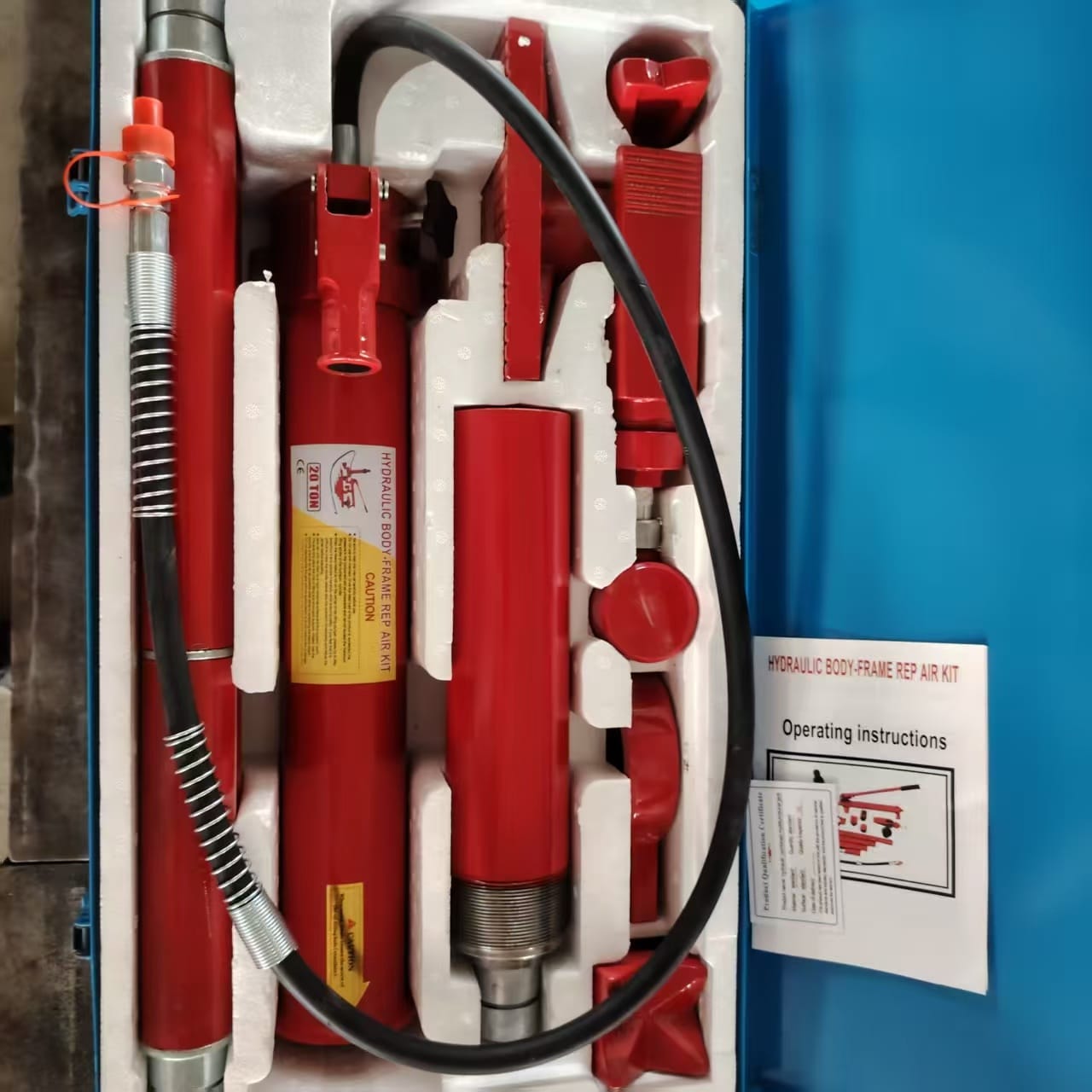
A 20 Ton Body Jack is a heavy-duty hydraulic repair system designed for straightening vehicle frames, pushing damaged body sections, spreading metal structures and carrying out demanding collision repairs. It is also commonly called a 20 ton porta power kit, hydraulic body frame repair kit or hydraulic ram kit.
Compared with a 10-ton body jack, the 20-ton model provides substantially greater hydraulic force. This makes it better suited to trucks, buses, 4×4 vehicles, commercial vehicles, agricultural equipment and heavily damaged vehicle frames.
Current professional 20-ton kits use a separate hydraulic hand pump, high-pressure hose and hydraulic ram together with extension tubes and several interchangeable heads. A common industrial configuration provides approximately 145 mm ram stroke, while heavier workshop models can operate at pressures around 90 MPa.
Quick Specifications
| Feature | Typical Specification |
|---|---|
| Product | 20 Ton Body Jack |
| Other Name | 20 Ton Porta Power Kit |
| Main Ram Capacity | 20 Ton / about 44,000 lb |
| Operation | Manual Hydraulic |
| Common Ram Stroke | About 145 mm |
| Working Pressure | Model dependent, up to about 90 MPa on some kits |
| Hydraulic Hose | Around 1.4 m on common models |
| Extension Tubes | 3–4 depending on model |
| Pump | High-Pressure Hand Pump |
| Construction | Heavy-Duty Steel |
| Storage | Heavy-Duty Carrying Case |
| Main Use | Body and Frame Straightening |
Specifications vary significantly between manufacturers, so the rating plate and manual supplied with the exact machine should always be followed.
Powerful 20 Ton Hydraulic Ram
The main advantage is its 20-ton hydraulic capacity, equivalent to roughly 44,000 lb of force on commonly advertised models.
This makes the kit suitable for demanding jobs involving:
- Truck frames
- 4×4 chassis
- Commercial vehicles
- Accident-damaged vehicles
- Agricultural machinery
- Heavy equipment
- Fabricated steel components
The 20-ton capacity applies to the rated main ram under the manufacturer’s specified conditions. Do not assume every attachment supplied with the kit can withstand the full 20 tons.
Approximately 145 mm Ram Stroke
Many 20-ton porta power kits use a hydraulic cylinder with approximately 145 mm or 5.7 inches of travel.
The ram stroke is only part of the total working reach. Extension tubes are used to bridge larger gaps before hydraulic pressure is applied.
Heavy-Duty Extension Tubes
A body jack needs to work inside vehicle frames and between damaged structures of different sizes.
For this reason, extension tubes are an important part of the kit.
One current 20-ton system includes:
- 100 mm extension
- 300 mm extension
- 500 mm extension
Another professional kit includes four extension tubes, showing that the exact number and lengths depend on the manufacturer.
High-Pressure Hydraulic Hose
The hose allows the hand pump to remain away from the ram while hydraulic pressure is applied.
A common 20-ton configuration uses approximately 1.4 metres of hydraulic hose.
This provides more freedom when positioning the ram:
- Inside a chassis
- Under a damaged frame
- Between body structures
- Around large machinery
Never substitute an ordinary hose for a properly pressure-rated hydraulic hose.
Manual Hydraulic Pump
A standard 20 Ton Body Jack does not need electricity.
The hand-operated hydraulic pump generates the pressure required to extend the cylinder.
Advantages include:
- Portable operation
- Precise pressure control
- No electricity required
- Easy workshop setup
- Controlled frame movement
A long pump handle also helps the operator generate high hydraulic pressure with less effort.
Common Accessories Included
A complete 20-ton body jack kit can include:
- 20-ton hydraulic ram
- Hydraulic hand pump
- High-pressure hose
- Extension tubes
- V-shaped head
- Wedge head
- Flat base
- Rubber head
- Serrated saddle
- Male connector
- Ram toe
- Plunger toe
- Spreader
- Carrying case
A current Kenya-listed 20-ton kit includes extension tubes plus a serrated saddle, spread wedge, rubber head, flat base, ram toe, plunger toe, wedge head, V-base, connector and hydraulic hose.
V-Shaped Head
The V-head provides a better contact point when pushing against:
- Corners
- Chassis rails
- Round sections
- Angled structural components
Its shape helps reduce unwanted movement during hydraulic pushing.
Wedge Head
The wedge head concentrates hydraulic force into a narrow working area.
It can be useful for starting separation between damaged metal components where a larger attachment cannot initially fit.
Flat Base
The flat base distributes force over a larger contact area.
It provides a more stable support point when the ram is pushing against a suitable flat structural section.
Rubber Head
A rubber-covered attachment provides a less aggressive contact surface where direct steel-to-steel contact could mark the workpiece.
Toe Attachments
Ram and plunger toes allow the body jack to apply force where space is limited.
They are useful in accident repair because damaged vehicle structures do not always provide enough room for the standard ram arrangement.
Applications of a 20 Ton Body Jack
Heavy Accident Repair
The 20-ton capacity is particularly useful where severe collision damage has pushed vehicle structures significantly out of alignment.
Truck Frame Repair
The extra hydraulic capacity makes it more suitable than smaller porta power systems for many commercial vehicle repair operations.
4×4 and Pickup Repairs
Useful when working on heavier vehicle chassis and body structures.
Chassis Straightening
The ram can provide controlled force to assist with returning damaged frame sections toward their correct position.
Professional chassis repairs should always use proper anchoring and measuring equipment alongside the hydraulic system.
Panel Beating Workshops
The body jack performs the heavier correction work before smaller tools are used for finishing.
Farm Equipment Repairs
A 20-ton hydraulic repair kit can also be useful when straightening or aligning suitable components on agricultural machinery.
Construction and Fabrication
Some manufacturers also specify their porta power kits for selected construction, bending, pushing and metal alignment work.
10 Ton vs 20 Ton Body Jack
| Feature | 10 Ton Body Jack | 20 Ton Body Jack |
|---|---|---|
| Main Ram Capacity | 10 Ton | 20 Ton |
| Passenger Cars | Excellent | Excellent |
| 4×4 Repair | Good | Excellent |
| Truck Repair | Limited/Model Dependent | Better Suited |
| Heavy Chassis Work | Moderate | Excellent |
| Portability | Easier | Heavier |
| Workshop Space | Smaller | Larger |
| Professional Collision Repair | Good | Excellent |
A 10-ton kit is often sufficient for ordinary passenger-car body work. A 20 Ton Body Jack is a better option where heavier commercial and accident repair jobs are common.
20 Ton Body Jack vs Trolley Jack
These tools should not be confused.
| Feature | Body Jack | Trolley Jack |
|---|---|---|
| Main Job | Frame and Body Repair | Raising Vehicles |
| Horizontal Pushing | Yes | No |
| Extension Tubes | Yes | No |
| Interchangeable Heads | Yes | No |
| Chassis Straightening | Yes | No |
| Normal Vehicle Lifting | Not Its Main Purpose | Yes |
A trolley jack raises a vehicle from the floor. A porta power body jack directs hydraulic force into damaged structures.
20 Ton Body Jack vs Hydraulic Press
A hydraulic press is a fixed workshop machine that applies force between its press bed and ram.
A body jack is portable and can be positioned directly inside or around a damaged vehicle.
This makes the body jack much more flexible for collision repair, while a hydraulic press is better for controlled workshop pressing operations such as bearings and bushings.
How to Use a 20 Ton Body Jack
Step 1: Inspect the Equipment
Check:
- Ram
- Hose
- Pump
- Couplings
- Extension tubes
- Attachments
Do not use damaged hydraulic components.
Step 2: Assess the Repair
Determine the direction in which the damaged structure needs to move.
Step 3: Choose a Strong Contact Point
Both ends of the hydraulic setup must rest against structurally suitable points.
Step 4: Select the Attachment
Choose the head that best matches the surface.
Step 5: Add Extensions
Use extension tubes to position the hydraulic cylinder correctly.
Step 6: Connect the Hydraulic Hose
Ensure the couplings are completely secured.
Step 7: Apply Pressure Slowly
Pump gradually while watching the body or frame movement.
Step 8: Stop and Measure
Do not rely only on visual judgment when straightening structural vehicle components.
Step 9: Release Pressure Gradually
Open the release valve slowly when the correction is complete.
Alignment Is Critical
Hydraulic force should travel as straight as possible through the ram and extensions.
Poor alignment can cause the system to:
- Slip
- Bend
- Kick sideways
- Damage extensions
- Damage the vehicle
- Injure the operator
Never use loosely positioned extensions simply to obtain extra reach.
Important Safety Tips
A 20-ton hydraulic ram produces extremely high force.
- Wear eye protection and gloves.
- Never exceed rated capacity.
- Keep people away from the force path.
- Never stand directly in front of a loaded hydraulic setup.
- Inspect hoses before every use.
- Never use leaking hydraulic equipment.
- Keep couplings clean.
- Do not modify extensions.
- Use structurally strong contact points.
- Keep the ram correctly aligned.
- Release hydraulic pressure before disconnecting components.
- Use individual attachments only within their stated ratings.
A 20-ton porta power manual also stresses correct PPE, careful operation and inspection because of the forces involved.
Body Jack Weight and Portability
A 20-ton kit is significantly heavier than smaller systems.
For example, one 20-ton kit weighs approximately 34.5 kg, while another complete system has a gross weight of about 39.8 kg. A larger professional MAC AFRIC system is listed at 67 kg net weight.
This is why some large kits use wheeled carrying cases.
Maintenance
Proper maintenance helps protect the hydraulic system.
After use:
- Fully retract the ram.
- Clean exposed hydraulic surfaces.
- Inspect the hose.
- Clean the couplings.
- Check for oil leaks.
- Inspect extension tubes for bending.
- Clean all heads and bases.
- Maintain hydraulic oil according to the manual.
- Return the accessories to the case.
- Store the kit somewhere dry.
Never allow dirt to enter an open hydraulic connector.
How to Choose the Best 20 Ton Body Jack
Check more than the advertised 20-ton capacity.
Look for:
- Genuine rated capacity
- Ram stroke
- Working pressure
- Hose length
- Extension tube lengths
- Attachment selection
- Pump quality
- Overload protection
- Case quality
- Replacement hydraulic seals
- Spare hose availability
- Warranty
For professional panel beating, a complete kit is normally more useful than purchasing only a pump and ram.
20 Ton Body Jack Price in Kenya
Current Kenyan listings show 20 Ton Body Jack prices of roughly KSh 37,000 to KSh 46,000 for several available kits.
Examples found include a Toller 20-ton kit at KSh 42,520, a JIETE kit at KSh 42,999, another hydraulic body jack at KSh 44,499, and a 20-ton porta power kit at KSh 45,000.
| 20 Ton Body Jack Type | Current/Typical Kenya Price |
|---|---|
| Entry-Level 20 Ton Kit | Around KSh 37,000–40,000 |
| Heavy-Duty Complete Kit | Around KSh 42,000–46,000 |
| Premium Professional Kit | KSh 46,000+ |
Prices depend on brand, case construction, accessories, hydraulic components and warranty.
Why Buy a 20 Ton Body Jack?
A 20 Ton Body Jack in Kenya is a strong choice for workshops dealing with serious accident damage and heavier vehicles.
Its 20-ton hydraulic ram, extension tubes, high-pressure hose and interchangeable pushing attachments allow mechanics and panel beaters to apply controlled force in positions where an ordinary hydraulic jack or workshop press cannot work effectively.
For garages repairing trucks, pickups, 4x4s, buses and heavily damaged passenger vehicles, the higher capacity can provide greater flexibility than a standard 10-ton porta power kit.
Frequently Asked Questions
What is a 20 Ton Body Jack used for?
It is used for pushing, spreading, straightening, bending and aligning damaged vehicle body and frame components. It is commonly used in panel beating and collision repair.
Is it also called a porta power?
Yes. 20 ton body jack, porta power kit, hydraulic ram kit and body frame repair kit are common names for this type of equipment.
How much force does it produce?
The main hydraulic ram is rated at 20 tons, approximately 44,000 lb, under the manufacturer’s specified operating conditions.
What is the ram stroke?
A common 20-ton porta power configuration has approximately 145 mm or 5.7 inches of ram travel.
Does it use electricity?
No. Standard models use a manual hydraulic hand pump.
Does it come with extension tubes?
Yes. Most complete kits include several extension tubes. Common configurations have three or four extensions of different lengths.
Can I use it for trucks?
Yes. Current 20-ton porta power kits are marketed for automotive, truck, farm and heavy-equipment repair.
Is a 20 Ton Body Jack better than a 10 Ton Body Jack?
For heavy chassis and commercial vehicle repair, the 20-ton model provides greater hydraulic capacity. A 10-ton model may be easier to transport and adequate for many lighter passenger-vehicle repairs.
Does every attachment support 20 tons?
No. The 20-ton figure normally refers to the main hydraulic ram. Individual spreaders, toes, bases and other attachments may have lower ratings. Always follow the rating supplied for each component.
What is the price of a 20 Ton Body Jack in Kenya?
Current Kenyan listings place many 20 Ton Body Jack kits between approximately KSh 37,000 and KSh 46,000. A Toller model is currently listed at KSh 42,520, while other current Nairobi listings are around KSh 42,999 to KSh 46,000.

Reviews
There are no reviews yet.