
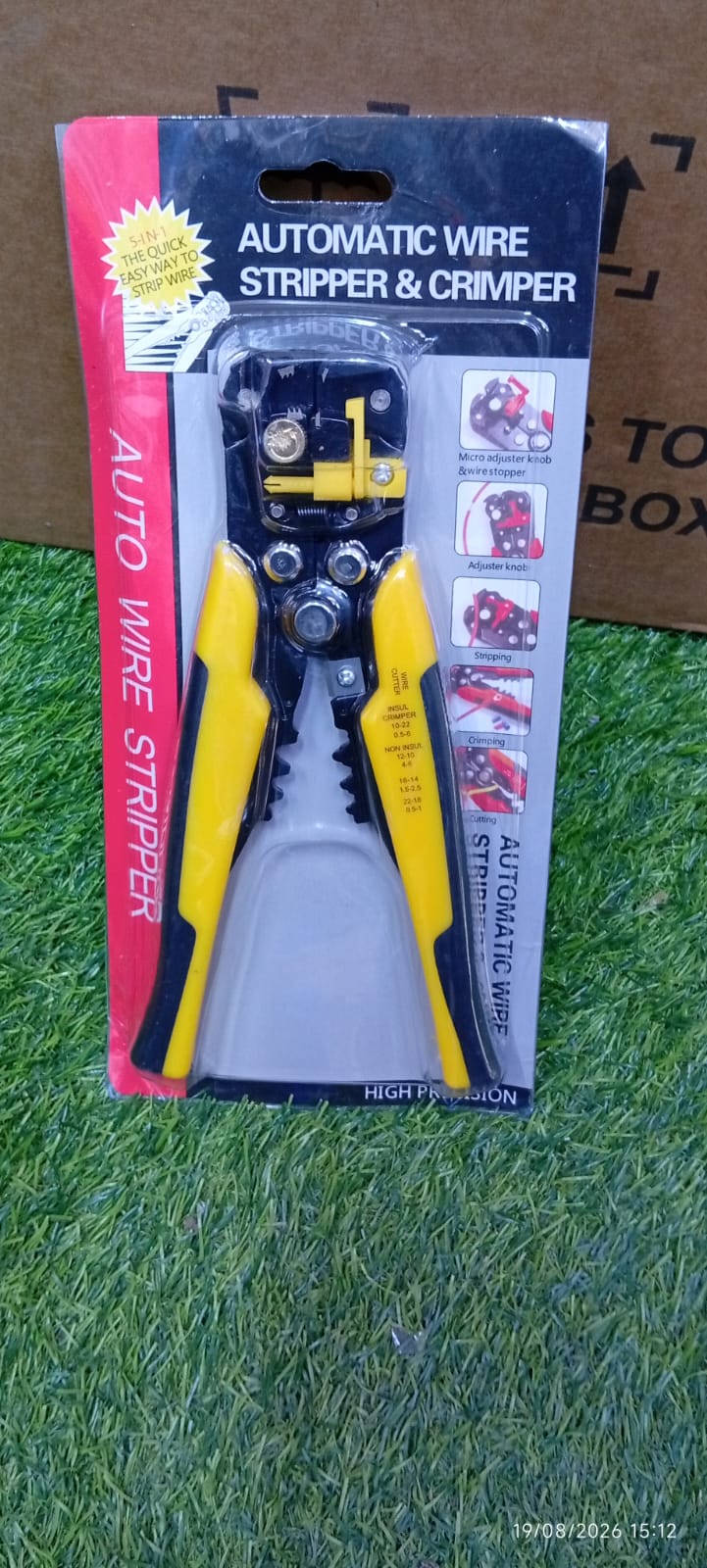
Description

An Automatic Wire Stripper and Crimper is a multi-function electrician’s hand tool designed to strip insulation, cut wire and crimp electrical terminals without changing between several separate tools.
A common professional model handles wires from 0.2mm² to 6mm², or approximately 24 to 10 AWG. It can also crimp insulated and non-insulated terminals from around 0.5mm² to 6mm², while selected models provide an additional section for 7 to 8mm² automotive ignition terminals.
The self-adjusting jaws are the main advantage. Instead of selecting a different stripping hole for every wire size, the mechanism automatically grips the insulation and removes it when the handles are squeezed.
Quick Specifications
| Feature | Typical Specification |
|---|---|
| Product | Automatic Wire Stripper and Crimper |
| Functions | Strip, Cut and Crimp |
| Tool Length | About 200–210mm |
| Stripping Range | 0.2–6mm² |
| AWG Range | 24–10 AWG |
| Insulated Terminal Crimping | 0.5–6mm² |
| Non-Insulated Crimping | 0.5–6mm² on suitable models |
| Ignition Terminal Crimping | 7–8mm² on selected models |
| Cutting | Copper and Aluminium Wire |
| Adjustment | Self-Adjusting Jaws |
| Fine Adjustment | Tension/Pressure Knob |
| Stripping Length | Adjustable Stop |
| Handle | Non-Slip Comfort Grip |
| Main Users | Electricians, Technicians, Mechanics and Installers |
A current INGCO 210mm model confirms the 0.2–6mm² stripping range together with copper/aluminium cutting and several terminal crimping functions.
3-in-1 Multi-Function Design
The biggest advantage is having three commonly used electrical functions in one tool.
Wire Stripping
Removes insulation without manually cutting around the conductor.
Wire Cutting
Cuts suitable copper and aluminium wires to length.
Terminal Crimping
Compresses compatible electrical terminals around stripped conductors.
For electricians who repeatedly prepare cables, this can reduce the number of separate tools carried in a toolbox.
Automatic Self-Adjusting Stripping
Traditional wire strippers usually have several fixed holes for different conductor sizes.
An automatic stripper works differently.
Insert the wire into the jaws and squeeze the handles. One section grips the cable while the other pulls the insulation away.
This makes repetitive stripping faster when working with different wire sizes.
A current professional automatic stripper specifies a working range from 10 to 24 AWG, equivalent to approximately 0.2 to 6mm².
0.2–6mm² Stripping Range
The wide stripping range makes the tool useful for many electrical applications.
Common compatible sizes include:
- 0.2mm²
- 0.5mm²
- 0.75mm²
- 1mm²
- 1.5mm²
- 2.5mm²
- 4mm²
- 6mm²
Actual stripping performance depends on the insulation material, conductor construction and individual tool.
24–10 AWG Capacity
Users working with American Wire Gauge can use the approximate 24–10 AWG range.
| AWG | Approximate Metric Area |
|---|---|
| 24 AWG | 0.20mm² |
| 22 AWG | 0.33mm² |
| 20 AWG | 0.52mm² |
| 18 AWG | 0.82mm² |
| 16 AWG | 1.31mm² |
| 14 AWG | 2.08mm² |
| 12 AWG | 3.31mm² |
| 10 AWG | 5.26mm² |
AWG and metric cable sizes are different systems, so these figures are approximate conversions rather than exact interchangeable sizes.
Built-In Wire Cutter
A cutting section allows the user to shorten wires before stripping.
Current 3-in-1 models specify cutting capability for suitable copper and aluminium wires.
This is useful for:
- House wiring
- Control-panel assembly
- Automotive electrical work
- Appliance repair
- CCTV installation
- Electronics
- Low-voltage systems
Do not use the cutter on hardened steel wire unless the manufacturer specifically approves it.
Insulated Terminal Crimping
The integrated crimping section can handle common insulated terminals.
A typical range is:
0.5–6mm² or approximately 22–10 AWG.
Compatible terminal styles may include suitable:
- Ring terminals
- Fork terminals
- Butt connectors
- Blade terminals
- Spade terminals
Always match the crimp section to the terminal and conductor size.
Non-Insulated Terminal Crimping
Many models also provide dies for non-insulated terminals.
INGCO specifies 0.5–6mm² capacity for non-insulated terminals on its current multi-function stripper.
A proper crimp should hold the conductor securely without cutting through it.
Automotive Ignition Terminal Crimping
Selected automatic strippers provide an additional larger crimping section for 7–8mm² ignition terminals.
This makes the tool useful for automotive electrical workshops as well as normal electrical installation.
Adjustable Stripping Length Stop
A useful feature on better models is an adjustable length stop.
This determines how much insulation is removed from the end of each wire.
It is particularly helpful when preparing many identical wires for:
- Terminal blocks
- Relays
- Switchgear
- Control panels
- Connectors
Instead of estimating each stripping length, the stop provides more repeatable results.
Fine Adjustment Knob
Different insulation materials behave differently.
A fine adjustment or tension control allows the user to increase or reduce stripping pressure.
This can help when working with:
- Thin insulation
- Thick insulation
- Soft PVC
- Smaller conductors
If the jaws fail to remove the insulation cleanly, adjust the tool gradually rather than applying excessive force.
Heavy-Duty Steel Construction
Quality automatic wire strippers use hardened steel components to withstand repeated gripping, cutting and crimping.
One current Kenyan model specifies drop-forged and heat-treated steel construction for improved hardness and durability.
The mechanism has more moving parts than a basic manual stripper, so build quality is important for professional use.
Comfortable Non-Slip Handles
Automatic stripping requires the handles to be squeezed repeatedly.
Comfortable grips help reduce fatigue during large wiring jobs.
Current models use plastic, cushioned or patterned handles to improve grip and leverage.
4-in-1 Models with Voltage Detection
Some newer automatic wire stripper and crimper models add a fourth function: non-contact voltage detection.
For example, the INGCO HWSP102429 combines:
- Stripping
- Cutting
- Crimping
- Non-contact voltage detection
It also includes two LR44 batteries to power the voltage-detection function.
This can be convenient for electricians, but a built-in detector should not replace the proper procedure and test equipment required to prove a circuit is de-energized.
Applications
House Wiring
Useful when installing:
- Lighting
- Switches
- Sockets
- Distribution boards
- Junction boxes
Automotive Wiring
Suitable for preparing compatible wires used with:
- Lights
- Relays
- Accessories
- Sensors
- Audio systems
Solar Installation
Useful for general low-voltage wiring and control cables.
For MC4 solar PV contacts, use a dedicated MC4 crimping tool rather than the general-purpose crimping section.
Control Panels
The adjustable stripping length is useful when preparing many wires for:
- Contactors
- Relays
- Terminal blocks
- Control switches
CCTV Installation
Can help prepare suitable power and low-voltage conductors during CCTV work.
Appliance Repair
Useful for repairing wiring in compatible electrical appliances and equipment.
Automatic vs Manual Wire Stripper
| Feature | Automatic Stripper | Manual Stripper |
|---|---|---|
| Self-Adjusting | Yes | No |
| Speed | Fast | Moderate |
| Repetitive Work | Excellent | Good |
| Different Wire Sizes | Easy | Requires Correct Slot |
| Cutting | Usually | Usually |
| Crimping | Common on Multi-Function Models | Model Dependent |
| Mechanism | More Complex | Simple |
An automatic model is especially useful for repetitive wiring jobs, while a simple manual stripper remains useful for precision work and unusual cable types.
Automatic Wire Stripper vs Crimping Pliers
| Feature | Automatic Stripper & Crimper | Dedicated Crimper |
|---|---|---|
| Wire Stripping | Excellent | Usually No |
| Cutting | Yes | Model Dependent |
| Basic Terminal Crimping | Yes | Yes |
| Specialized Terminals | Limited | Better |
| Speed | Excellent | Good |
| One-Tool Convenience | Excellent | Limited |
For ordinary insulated terminals, the combined tool is convenient. For ferrules, MC4 contacts, large cable lugs and specialized terminals, use the correct dedicated crimper.
How to Strip a Wire
Place the wire between the stripping jaws.
Adjust the stripping-length stop.
Position the end of the cable against the stop.
Squeeze the handles fully.
The jaws grip the insulation and separate it from the conductor.
Release the handles and inspect the stripped wire.
A good result should have:
- Cleanly removed insulation
- No cut copper strands
- Correct exposed conductor length
How to Crimp a Terminal
Strip the correct amount of insulation.
Select a terminal suitable for the conductor size.
Insert the conductor completely into the terminal barrel.
Place the terminal into the correct crimping section.
Squeeze the handles firmly.
Remove the terminal and perform a gentle pull test.
The conductor should remain firmly secured.
Common Mistakes to Avoid
Do not:
- Strip wire outside the tool’s capacity.
- Cut hardened steel with a copper-wire cutter.
- Use the wrong crimping die.
- Remove too much insulation.
- Cut conductor strands while stripping.
- Crimp over insulation incorrectly.
- Use the tool for live electrical work.
- Use the general crimper for specialized MC4 contacts.
- Force the mechanism if a wire becomes trapped.
Correct adjustment normally gives a cleaner result than simply squeezing harder.
Important Electrical Safety
Before stripping or cutting electrical wire:
- Isolate the electrical supply.
- Confirm the circuit is de-energized.
- Use appropriate test equipment.
- Wear suitable PPE.
- Keep the tool dry.
- Inspect the handles before use.
Unless specifically certified and marked for live electrical work, an automatic stripper should be treated as a normal hand tool rather than an insulated live-working tool.
Maintenance
To keep the mechanism working correctly:
- Remove insulation pieces from the jaws.
- Clean the cutter.
- Keep the stripping jaws free of dirt.
- Inspect the return spring.
- Check the adjustment mechanism.
- Lightly lubricate moving pivots when appropriate.
- Store the tool somewhere dry.
Do not grind the stripping jaws unless specifically permitted by the manufacturer.
How to Choose the Best Automatic Wire Stripper and Crimper
Look for:
- 0.2–6mm² stripping range
- Self-adjusting jaws
- Adjustable stripping-length stop
- Fine tension adjustment
- Copper and aluminium wire cutter
- Insulated terminal crimper
- Non-insulated terminal crimper
- Strong steel construction
- Comfortable handles
For electricians who want extra functionality, a 4-in-1 model with non-contact voltage detection is also available.
Automatic Wire Stripper and Crimper Price in Kenya
Current Kenyan listings show a broad price range depending on brand and features. Basic automatic stripper/crimper models are listed around KSh 1,050 to KSh 2,500, while branded 210mm models can cost around KSh 2,450 to KSh 3,550. More advanced automatic sets can exceed KSh 5,000.
| Type | Typical Current Kenya Price |
|---|---|
| Basic Automatic Stripper/Crimper | KSh 1,000–1,800 |
| Heavy-Duty Automatic Model | KSh 1,800–2,500 |
| Branded 3-in-1 210mm Model | KSh 2,450–3,550 |
| Advanced Multi-Function Model/Kit | KSh 4,000–5,500+ |
A current UYUSTOOLS 7-inch automatic model is listed at KSh 2,200, while an INGCO 210mm stripper/crimper is listed at KSh 2,450.
Why Buy an Automatic Wire Stripper and Crimper?
An Automatic Wire Stripper and Crimper in Kenya combines three of the most frequently used cable-preparation functions into one compact tool.
Its 0.2–6mm² self-adjusting stripping range, built-in wire cutter and terminal crimping sections make it particularly useful for electricians, mechanics, solar installers, CCTV technicians and maintenance workers.
For repetitive electrical work, the automatic mechanism can save time while helping produce consistent stripping lengths without manually selecting a different stripping slot for every cable.
Frequently Asked Questions
What does an automatic wire stripper and crimper do?
It combines wire stripping, cutting and terminal crimping in one hand tool.
What wire sizes can it strip?
A common professional model strips 0.2–6mm² or approximately 24–10 AWG wire.
Can it cut copper wire?
Yes. Current multi-function models specify cutting for suitable copper and aluminium wires.
What size insulated terminals can it crimp?
A common range is 0.5–6mm², approximately 22–10 AWG.
Can it crimp non-insulated terminals?
Yes, compatible models can crimp non-insulated terminals up to approximately 0.5–6mm².
Can it crimp automotive ignition terminals?
Selected models provide a separate section for approximately 7–8mm² ignition terminals.
Does it automatically adjust to wire size?
Yes. The self-adjusting mechanism accommodates different compatible wire sizes, although fine adjustment may still be necessary for different insulation types.
Can it crimp MC4 solar connectors?
A dedicated MC4 crimping tool is recommended for MC4-type photovoltaic contacts because it has the correct crimp die profile.
Are models with voltage detection available?
Yes. The INGCO HWSP102429 combines automatic stripping, cutting and crimping with non-contact voltage detection.
What is the price of an Automatic Wire Stripper and Crimper in Kenya?
Current Kenyan prices generally range from about KSh 1,000 to KSh 3,500 for standard models, with advanced multi-function tools and complete kits costing more.
Reviews
There are no reviews yet.