
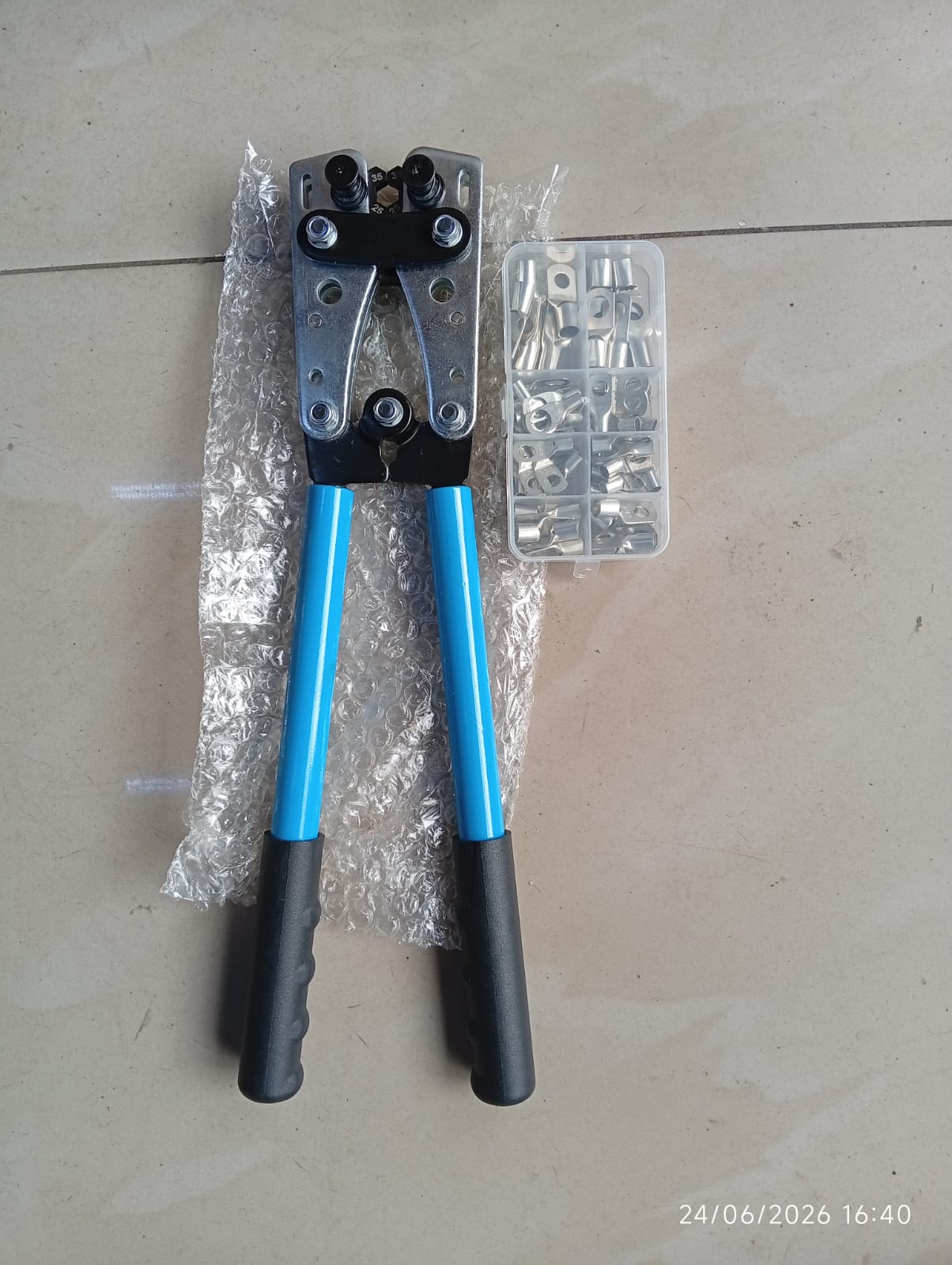
Description

A cable lug crimping tool is used to create a strong electrical connection between a power cable and a cable lug or terminal. The tool compresses the metal barrel of the lug tightly around the cable conductor, forming a secure joint that can carry electrical current safely.
Cable lug crimpers are commonly used by electricians, solar installers, automotive technicians, generator technicians, industrial maintenance teams and electrical panel builders. They are suitable for terminating cables used in solar systems, batteries, inverters, generators, welding machines, pumps, distribution boards and industrial equipment.
Cable lug crimping tools are available in manual mechanical, hand-hydraulic, battery-hydraulic and electric-hydraulic designs. A common manual model covers cable sizes from 6mm² to 50mm², while larger hydraulic models can handle cable lugs from approximately 16mm² to 300mm².
Quick Specifications
| Feature | Typical specification |
|---|---|
| Product name | Cable lug crimping tool |
| Tool types | Manual, hydraulic or battery powered |
| Common manual range | 6mm² to 50mm² |
| Medium-duty range | 10mm² to 120mm² |
| Heavy-duty hydraulic range | 16mm² to 300mm² |
| Common crimp profile | Hexagonal crimp |
| Suitable lug material | Copper and aluminium, model dependent |
| Typical hydraulic force | 10 to 16 tonnes |
| Common die sizes | 16, 25, 35, 50, 70, 95, 120, 150, 185, 240 and 300mm² |
| Head style | Fixed, open C-head or rotating head |
| Handle | Non-slip manual or hydraulic pumping handle |
| Storage | Carrying case on hydraulic models |
| Main application | Terminating heavy electrical cables |
The correct crimping range, die set and terminal material must be confirmed from the tool specifications before use.
Main Features of a Cable Lug Crimping Tool
Strong crimping pressure
A cable lug crimper applies controlled pressure to the cable terminal.
This pressure compresses:
- The cable lug barrel
- The copper or aluminium conductor
- The individual cable strands
When the correct die and lug are used, the compression creates a firm mechanical connection with low electrical resistance.
Heavy-duty hydraulic models may produce around 10 to 16 tonnes of pressing force, depending on the tool. A 16mm² to 300mm² YQK-style hydraulic crimper is commonly supplied with up to 120kN of pressure and several interchangeable dies.
Wide crimping range
Different crimping tools cover different conductor sizes.
Common ranges include:
| Tool category | Common cable range |
|---|---|
| Small terminal crimper | 0.5mm² to 10mm² |
| Manual cable lug crimper | 6mm² to 50mm² |
| Medium mechanical crimper | 10mm² to 120mm² |
| Hydraulic cable lug crimper | 16mm² to 240mm² |
| Heavy hydraulic crimper | 16mm² to 300mm² |
A Kenyan supplier currently lists a 6mm² to 50mm² manual cable lug crimping tool, while another offers a 10mm² to 120mm² crimper for larger electrical conductors.
Hexagonal crimping profile
Most large cable lug crimping tools produce a hexagonal compression.
The hex shape applies pressure around several sides of the lug barrel. This helps:
- Distribute pressure evenly
- Reduce empty spaces between cable strands
- Improve mechanical strength
- Create a compact termination
- Reduce the risk of the cable pulling out
Hexagonal crimping is commonly used on copper tube lugs, aluminium lugs and heavy power cable connectors.
Interchangeable crimping dies
Hydraulic cable crimping kits usually come with several removable dies.
A typical 16mm² to 300mm² kit may include dies marked:
- 16mm²
- 25mm²
- 35mm²
- 50mm²
- 70mm²
- 95mm²
- 120mm²
- 150mm²
- 185mm²
- 240mm²
- 300mm²
The die number should match the conductor cross-sectional area and lug manufacturer’s instructions. Some kits include nine dies, while larger kits may include eleven pairs.
Manual hydraulic operation
A hand-hydraulic crimper uses a built-in hydraulic pump.
The user moves the handle repeatedly to build pressure. Hydraulic force then drives the piston and closes the dies around the cable lug.
Benefits include:
- Less physical effort
- High compression force
- Easier crimping of large cables
- Consistent terminations
- No electricity required
The hydraulic release valve is opened after crimping to retract the piston and remove the cable lug.
Rotating or swivel head
Some hydraulic models have a head that can rotate up to approximately 180 degrees. This allows the operator to position the tool more easily inside control panels, battery rooms and tight machinery spaces.
Open C-shaped head
Many hydraulic cable crimpers have an open or C-shaped crimping head.
This design allows the user to insert the cable and lug from the side instead of feeding the entire cable through a closed head. It is useful when working with long or already installed cables.
Long non-slip handles
Manual cable lug crimpers use long handles to increase leverage.
A common 6mm² to 50mm² mechanical tool is made from hardened steel and weighs about 1.5kg. Its long handles and non-slip grips make it easier to create sufficient crimping pressure.
Hydraulic models normally have:
- A fixed main body handle
- A movable pumping handle
- Rubber or plastic grips
- A pressure release control
Hardened steel construction
Quality cable crimping tools are manufactured from hardened or heat-treated steel.
This improves:
- Jaw strength
- Die durability
- Resistance to deformation
- Tool life
- Crimp consistency
The handles may have rubber sleeves to improve grip and operator comfort.
Pressure release valve
Hydraulic crimpers have a release valve used to return hydraulic oil to the reservoir.
After completing the crimp:
- Open the valve slowly.
- Allow the piston to retract.
- Separate the dies.
- Remove and inspect the finished cable lug.
Do not force the dies apart using screwdrivers or metal bars.
Portable storage case
Most hydraulic kits are supplied in a moulded carrying case.
The case stores:
- Hydraulic crimping tool
- Interchangeable dies
- Operating instructions
- Small accessories
The case protects the dies from dirt, loss and moisture during transport.
Common Types of Cable Lug Crimping Tools
Manual rotary-die crimping tool
A manual rotary crimper normally covers approximately 6mm² to 50mm².
The operator rotates the built-in die wheels until the correct size markings are aligned, inserts the lug and closes the handles.
It is suitable for:
- Battery cables
- Solar cables
- Small inverter systems
- Automotive wiring
- Generator connections
- Workshop repairs
The main advantages are low maintenance, portability and no hydraulic oil.
Mechanical crimper with adjustable die
This model may cover approximately 10mm² to 120mm² or 10mm² to 150mm².
It uses long handles and an adjustable crimping head to create pressure. It is suitable for electricians who regularly terminate medium-sized power cables but do not want a hydraulic tool.
Hand-hydraulic crimper
This is the most common choice for larger cable lugs.
Typical ranges include:
- 4mm² to 70mm²
- 10mm² to 120mm²
- 16mm² to 240mm²
- 16mm² to 300mm²
A hand-hydraulic model is suitable for solar installation, industrial wiring, generator connections and heavy battery cables.
Battery-powered hydraulic crimper
A battery hydraulic crimper uses an electric motor and hydraulic pump.
Professional versions may cover cables from around 6mm² to 300mm² and may include automatic pressure detection and piston retraction. They are useful where many crimps must be completed each day.
The main benefit is reduced operator fatigue. However, battery-powered units cost more and require charging.
Manual Versus Hydraulic Cable Lug Crimper
| Feature | Manual crimper | Hydraulic crimper |
|---|---|---|
| Operating method | Long handles | Hydraulic pumping |
| Physical effort | Higher | Lower |
| Common range | 6mm² to 50mm² | 16mm² to 300mm² |
| Speed | Fast on small cables | Better for large cables |
| Weight | Lighter | Heavier |
| Maintenance | Low | Requires oil and seal inspection |
| Carrying case | Not always included | Commonly included |
| Best use | Light and medium work | Heavy-duty cable termination |
| Price | Lower | Higher |
A manual tool is practical for small battery cables and occasional jobs. A hydraulic crimper is better for large cables and regular professional work.
Applications of a Cable Lug Crimping Tool
Solar power installation
Cable lug crimpers are used when connecting:
- Solar batteries
- Hybrid inverters
- Charge controllers
- DC isolators
- Distribution boxes
- Solar pumping inverters
- Earthing cables
Large solar battery banks commonly use heavy cables that require secure compression lugs.
Automotive and truck repair
The tool can terminate:
- Battery cables
- Starter motor cables
- Alternator cables
- Earthing straps
- Winch cables
- Auxiliary power connections
A weak battery cable termination can cause difficult starting, voltage drop and overheating.
Generator installation
Cable crimpers are used to prepare output and battery cables for:
- Petrol generators
- Diesel generators
- Welding generators
- Automatic transfer switches
- Generator control panels
Electrical panel building
Panel technicians use crimping tools for:
- Distribution boards
- Motor control centres
- Switchgear
- Busbar connections
- Circuit breakers
- Contactors
- Industrial control panels
Welding cable preparation
Heavy welding cables require strong copper lugs.
A hydraulic crimper helps create reliable connections for:
- Electrode holders
- Earth clamps
- Welding machine terminals
- Extension welding cables
Water pump installation
The tool is useful when terminating cables for:
- Borehole pumps
- Booster pumps
- Solar water pumps
- Pump control panels
- Motor starters
- Pumping inverters
Telecommunications and backup systems
Cable lug crimpers can prepare battery and grounding connections for:
- UPS systems
- Telecom battery banks
- Server rooms
- Backup power systems
- Communication towers
How to Use a Cable Lug Crimping Tool
Step 1: Switch off the power
Never crimp a live cable.
Disconnect batteries, inverters, generators or mains power before starting.
Step 2: Select the correct cable lug
The cable lug must match:
- Cable conductor size
- Cable material
- Stud or bolt size
- Operating voltage
- Installation environment
For example, a 50mm² copper cable normally requires a lug designed for a 50mm² conductor.
Step 3: Strip the cable insulation
Remove enough insulation to allow the conductor to enter the lug barrel fully.
Do not:
- Cut cable strands
- Twist off strands
- Strip excessive insulation
- Leave insulation inside the lug barrel
Step 4: Inspect and clean the conductor
Check that the strands are clean and undamaged.
Oxidized aluminium conductors may require cleaning and a suitable jointing compound according to the cable and lug manufacturer’s instructions.
Step 5: Select the correct die
Install the die matching the cable and lug size.
Do not assume that all 50mm² lugs need exactly the same compression. Follow the lug or connector manufacturer’s tool and die recommendation where available. Correct matching of the lug, conductor, tool and die is important for a dependable termination.
Step 6: Insert the cable into the lug
Push the conductor completely into the lug barrel.
The end of the conductor should reach the closed end or inspection window where provided.
Step 7: Position the lug in the die
Place the lug barrel centrally between the dies.
Do not crimp:
- The palm of the lug
- The bolt hole
- The insulation
- The edge of the barrel
Step 8: Apply pressure
For a manual tool, close the handles firmly.
For a hydraulic model, pump the handle until the die closes correctly or the pressure relief system activates.
Avoid continuing to pump after the full crimp has been achieved.
Step 9: Release the tool
Open the hydraulic release valve slowly or release the manual mechanism.
Remove the crimped lug.
Step 10: Inspect the crimp
Check for:
- Correct die impression
- No barrel cracks
- No loose cable strands
- Full conductor insertion
- Firm mechanical grip
- No sharp metal edges
A simple pull test can help identify an obviously loose termination, although professional installations may require formal inspection or electrical testing.
Step 11: Seal the connection
Where required, fit:
- Heat-shrink tubing
- Lug boots
- Insulation tape
- Cable gland protection
- Corrosion-resistant coating
Common Crimping Mistakes
Using the wrong die size
An oversized die may leave the conductor loose. An undersized die may damage the lug, conductor or tool.
Using pliers or a hammer
Ordinary pliers and hammers do not provide controlled compression.
They may create a weak joint with high resistance.
Crimping the wrong lug material
A copper cable should normally use a suitable copper lug. Aluminium and copper connections may require approved bimetallic terminals.
Leaving cable strands outside the lug
All strands should enter the barrel.
Cutting away strands reduces the conductor area and current capacity.
Crimping over insulation
The main power crimp should compress the metal conductor, not the cable insulation.
Making only one crimp on a long barrel
Large lugs may need more than one compression along the barrel. Follow the terminal manufacturer’s crimping pattern.
Using mismatched cable measurements
Do not confuse:
- Cable diameter
- Conductor cross-sectional area
- Lug hole size
- American Wire Gauge
- Metric square millimetres
A cable measuring 10mm across the insulation is not automatically a 10mm² conductor.
Safety Precautions
- Disconnect all electrical power before crimping.
- Wear safety glasses.
- Wear suitable work gloves.
- Keep fingers away from the dies.
- Use only the correct die size.
- Do not exceed the tool’s rated range.
- Inspect hydraulic hoses, seals and handles before use.
- Never modify the pressure-release system.
- Do not use damaged or cracked dies.
- Keep the tool away from water.
- Do not crimp explosive or pressurized components.
- Keep children and untrained people away.
- Do not use handle extensions for extra pressure.
- Store dies securely after use.
Maintenance Tips
Clean the tool
Remove metal pieces, dust and grease after each job.
Protect against rust
Wipe exposed metal surfaces with a lightly oiled cloth before storage.
Inspect the dies
Replace dies that are:
- Cracked
- Chipped
- Severely worn
- Deformed
- Missing size markings
Check hydraulic oil
If the tool loses power or fails to complete a crimp, it may have low oil, trapped air or damaged seals.
Use only the hydraulic oil recommended by the manufacturer.
Store in the carrying case
Keep the tool and dies dry and arranged in their correct positions.
Do not drop the tool
Impact can damage:
- Hydraulic seals
- Die alignment
- Release valve
- Pump handle
- Crimping head
How to Choose the Best Cable Lug Crimping Tool
Check the cable size range
Choose a tool covering the smallest and largest cables you normally install.
For example:
- 6mm² to 50mm² for vehicle and small solar cables
- 10mm² to 120mm² for electrical installations
- 16mm² to 300mm² for industrial and heavy battery cables
Choose manual or hydraulic operation
Select manual for occasional smaller jobs.
Choose hydraulic for frequent work or cables above approximately 50mm².
Check the crimp profile
Hexagonal crimping is a common option for power cable lugs.
However, the crimp profile must be compatible with the terminal.
Confirm copper and aluminium compatibility
Not every tool and die is approved for every terminal material.
Confirm whether it supports:
- Copper lugs
- Aluminium lugs
- Bimetallic lugs
- Tubular terminals
- Compression connectors
Inspect the die sizes
Ensure the required die sizes are included. Buying extra dies later may be difficult when the tool uses a unique design.
Check the crimping force
Large cable lugs require greater pressure.
A 10-tonne or 12-tonne hydraulic tool is widely used for medium to heavy cable termination, while some larger kits provide up to 16 tonnes.
Consider head rotation
A swivel head makes the tool easier to use inside electrical panels and tight installations.
Look for spare parts
Ask whether you can obtain:
- Hydraulic seals
- Release valve
- Dies
- Pump handle
- Hydraulic oil
- Carrying case
Cable Lug Crimping Tool Price in Kenya
Prices vary according to the crimping range, tool type, brand and number of dies.
| Type of crimping tool | Estimated Kenya price |
|---|---|
| Small terminal crimping pliers | KSh 1,500–3,500 |
| Manual cable lug crimper, 6–50mm² | KSh 4,500–7,500 |
| Manual heavy-duty crimper, 10–120mm² | KSh 8,000–15,000 |
| Hydraulic crimper, 4–70mm² | KSh 6,500–12,000 |
| Hydraulic crimper, 16–240mm² | KSh 10,000–20,000 |
| Hydraulic crimper, 16–300mm² | KSh 12,000–28,000 |
| Battery hydraulic crimper | KSh 45,000–150,000+ |
A Kenyan retailer lists a manual 6mm² to 50mm² cable lug crimper at approximately KSh 4,999, while a 10mm² to 120mm² model is listed near KSh 8,140. Prices can change according to availability, brand and accessories.
Package Contents
A typical hydraulic crimping kit may include:
- One hydraulic cable lug crimping tool
- Pumping handle
- Pressure-release valve
- Interchangeable crimping dies
- Plastic carrying case
- User instructions
A 16mm² to 300mm² kit commonly includes nine or eleven die sets, depending on the manufacturer.
Manual 6mm² to 50mm² models may use built-in rotating dies and may not require a separate carrying case.
Why Buy a Cable Lug Crimping Tool?
A cable lug crimping tool is an important tool for creating safe and durable power cable connections. It helps form a tight joint between the conductor and cable lug, reducing looseness, voltage drop, overheating and connection failure.
It is useful for solar installations, batteries, inverters, generators, welding machines, vehicles, water pumps and industrial electrical systems. Manual crimpers are practical for smaller cables, while hydraulic models offer the pressure needed for large copper and aluminium cable lugs.
Choosing the correct tool, die and terminal size is essential. A powerful crimper cannot produce a reliable connection when the cable, lug and die are mismatched.
Frequently Asked Questions
What is a cable lug crimping tool used for?
It is used to compress cable lugs and terminals around electrical conductors, creating a strong mechanical and electrical connection.
What sizes can a cable lug crimper handle?
Small manual models commonly cover 6mm² to 50mm². Large hydraulic models may cover 16mm² to 300mm².
Can it crimp battery cables?
Yes. It is suitable for battery cables used in vehicles, solar systems, UPS installations and generators.
Can it crimp copper and aluminium lugs?
Many models can crimp both copper and aluminium terminals, but the correct die and terminal type must be used.
What is a hydraulic cable lug crimper?
It is a crimping tool that uses hydraulic pressure to close the dies around a cable lug. It requires less physical effort than a long-handle manual crimper.
What is a hexagonal crimp?
It is a compression shape with six sides. It applies pressure around the lug barrel and is commonly used for power cable termination.
Is a cable crimper the same as an RJ45 crimper?
No. A cable lug crimper is designed for electrical power terminals. An RJ45 crimper is used for network cable plugs.
Can I crimp a cable lug using ordinary pliers?
No. Ordinary pliers do not apply the correct pressure or compression shape required for a dependable power connection.
How do I select the correct die?
Match the die marking to the conductor size and follow the cable lug manufacturer’s recommendation.
Does a 16–300mm² hydraulic crimper include all the dies?
Most kits include several dies covering common sizes, but the exact number and markings vary by supplier. Some have nine sets, while others have eleven pairs.
Can it be used on live cables?
No. Always isolate and confirm the circuit is dead before cutting, stripping or crimping a cable.
Why does a crimped lug become hot?
Possible causes include an incorrect lug size, poor crimp pressure, loose mounting bolt, damaged conductor, corrosion or excessive electrical current.
What is the price of a cable lug crimping tool in Kenya?
A manual 6mm² to 50mm² model may cost approximately KSh 4,500 to KSh 7,500. Heavy-duty hydraulic sets may cost around KSh 10,000 to KSh 28,000, depending on the range, dies and brand.
Reviews
There are no reviews yet.