
Description
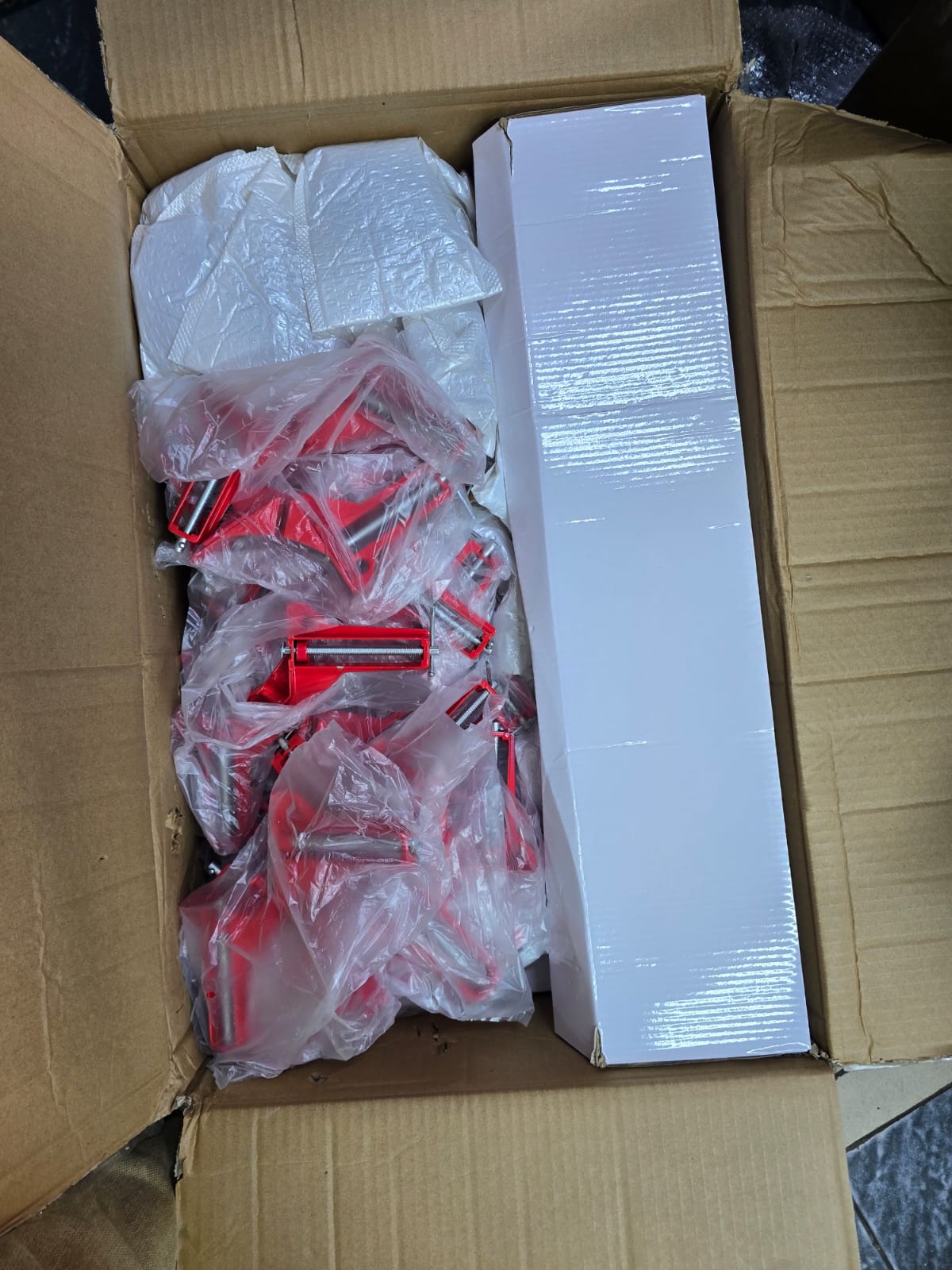
A corner clamp in Kenya is a hand tool designed to hold two workpieces together at a 90-degree angle during assembly, drilling, gluing, screwing or light fabrication. It is commonly called a 90 degree clamp, right angle clamp, woodworking corner clamp, mitre clamp or angle clamp.
One of the most useful workshop versions is the 75mm or 3-inch corner clamp. Current models use an aluminium-alloy body with adjustable screw clamping and fixed 90-degree alignment. Smaller spring-loaded corner clamps are also available for furniture, picture frames and light woodworking.
A corner clamp acts like an extra pair of hands. It holds the materials in position while you concentrate on drilling, fastening or joining them.
Corner Clamp Specifications
| Feature | Common Specification |
|---|---|
| Product | Corner Clamp |
| Clamp Type | Right Angle / Corner Clamp |
| Working Angle | 90 Degrees |
| Common Size | 75mm / 3 Inches |
| Body Material | Aluminium Alloy on common heavy-duty models |
| Alternative Material | Nylon on lightweight models |
| Adjustment | Threaded Screw |
| Jaw Design | Swivelling / Adjustable Jaw |
| Mounting | Bench mounting holes on selected models |
| Handle | Screw handle |
| Application | Woodworking, framing, cabinet assembly |
| Suitable Materials | Wood, board, plastic and suitable metal |
| Joint Types | Corner joints and selected T-joints |
| Operation | Manual |
| Power Required | None |
Current Kenyan listings include 75mm/3-inch aluminium-alloy corner clamps, while spring-loaded nylon versions are sold for boards around 5–22mm thick.
Fixed 90-Degree Corner Alignment
The main purpose of a corner clamp is to hold two materials at approximately:
90°
This is a right angle.
Accurate right angles are important when making:
- Cabinets
- Drawers
- Boxes
- Shelves
- Cupboards
- Picture frames
- Furniture
- Small tables
- Wooden frames
Without a clamp, one workpiece can move while you insert a screw or drill a hole.
The corner clamp keeps the two pieces together while the joint is being completed.
75mm or 3-Inch Clamping Capacity
A popular metal corner clamp size is:
75mm / 3 inches.
Current Kenyan listings include 75mm industrial and aluminium-alloy corner clamps for workshop and woodworking applications.
This size is useful for many common timber, board and frame projects.
It can handle thicker materials than many small spring-loaded corner clips.
Always check the actual jaw opening of the model because the stated clamp size and usable material thickness can differ between designs.
Aluminium Alloy Construction
Many heavy-duty corner clamps use an aluminium-alloy body.
Aluminium alloy offers several advantages:
- Strong construction
- Relatively low weight
- Corrosion resistance
- Easy handling
- Good dimensional stability
The body provides a rigid 90-degree reference while the screw applies pressure to the workpieces.
Professional corner clamps can also combine steel mechanisms with cast aluminium clamping surfaces. For example, Kreg’s professional 90° clamp uses steel construction with cast-aluminium clamping pads.
Adjustable Screw Mechanism
A screw-type corner clamp allows the user to control the pressure manually.
Turn the handle clockwise to tighten.
Turn it in the opposite direction to release.
The threaded screw gradually moves the jaw towards the workpiece.
This controlled adjustment is useful when working with different material thicknesses.
It also allows you to tighten the joint carefully rather than applying sudden spring pressure.
Swinging Jaw Design
Many corner clamps use a movable or swinging jaw.
The jaw can adjust to the workpiece as the screw is tightened.
This helps the clamp hold materials of different thicknesses.
Current Kenyan listings include a 68mm swing-jaw 90-degree corner clamp as well as 75mm screw-type designs.
The exact jaw design varies, so check the model if you plan to clamp two pieces with very different thicknesses.
Holds the Workpiece While You Drill
Drilling can cause materials to move.
A corner clamp keeps the workpiece in position while you make pilot or fixing holes.
This is useful when making:
- Cabinets
- Boxes
- Shelves
- Frames
- Furniture
Clamp the pieces first.
Check the angle.
Then drill the required holes.
This can improve consistency when several identical joints are required.
Easier Screw Installation
Installing a screw through one board into another can be difficult when you also have to hold both boards at 90 degrees.
The corner clamp removes much of this problem.
Once the pieces are secured, both hands are available to control the drill or screwdriver.
Professional 90-degree clamps are designed around this principle. Kreg’s corner clamp, for example, holds corner and T-joints while leaving access for driving screws or other fasteners.
Useful for Gluing Wood
Wood glue needs the joint surfaces to remain correctly positioned while the adhesive starts to set.
A corner clamp can hold the pieces at the required angle.
A simple process is:
- Prepare the mating surfaces.
- Apply the correct amount of wood glue.
- Position the two pieces.
- Fit the corner clamp.
- Check the angle with a square.
- Tighten the clamp.
- Remove excess glue.
- Allow the adhesive to cure as directed.
Do not overtighten.
Excessive clamping pressure can squeeze out too much glue or damage soft timber.
Cabinet Making
Cabinet making is one of the main applications for a right angle clamp.
It can help assemble:
- Kitchen cabinets
- Wardrobes
- Cupboards
- Drawer units
- Storage cabinets
- Bathroom cabinets
Large cabinet panels can be difficult to hold square by hand.
Using several corner clamps can keep multiple corners aligned while screws or other fasteners are installed.
Drawer Assembly
Drawers need square corners if they are going to slide correctly.
A corner clamp helps position the front, back and side panels.
After clamping, check the diagonals of the drawer.
If both diagonal measurements are equal, the rectangular assembly is much more likely to be square.
This extra check is important because a 90-degree clamp helps align the local joint but does not automatically guarantee that an entire large assembly is perfectly square.
Picture Frame Making
Corner clamps are also useful for picture and photo frames.
A frame requires neat corner alignment.
Small spring clamps are especially popular for:
- Photo frames
- Artwork frames
- Decorative frames
- Small wooden boxes
Current Kenyan listings specifically market spring-loaded corner clamps for picture frames, cabinets, furniture and DIY projects.
Furniture Assembly
A corner clamp can assist with many furniture projects.
Typical examples include:
- Tables
- Shelves
- Cupboards
- Cabinets
- Desks
- Storage boxes
- Drawers
- Bookcases
The tool is especially helpful when working alone.
Instead of asking another person to hold the board upright, the clamp supports the joint while you work.
T-Joint Assembly
Some corner clamps can also hold T-shaped joints.
A T-joint is formed when the end or edge of one piece meets another piece at approximately 90 degrees.
Professional designs such as the Kreg 90° Corner Clamp are specifically designed for both 90-degree corner joints and T-joints.
T-joints are common when installing:
- Dividers
- Shelves
- Internal cabinet supports
- Box sections
- Furniture partitions
Check whether the exact clamp design supports this arrangement.
Corner Clamp for Welding
Some heavy-duty metal corner clamps can also assist with light fabrication and welding preparation.
They can hold suitable:
- Square tubing
- Angle iron
- Flat bar
- Small frames
at 90 degrees while the parts are positioned.
However, a woodworking spring clamp should not be used close to welding heat.
For fabrication, use a metal clamp specifically suitable for the work.
Also remember that a corner clamp is mainly a positioning device. Check the final angle with an engineering square before welding.
Woodworking vs Welding Corner Clamp
| Feature | Woodworking Clamp | Metal/Fabrication Clamp |
|---|---|---|
| Main Material | Nylon or aluminium | Metal |
| 90° Holding | Yes | Yes |
| Wood | Excellent | Good |
| Cabinet Work | Excellent | Good |
| Welding | No for nylon models | Suitable models only |
| Heat Resistance | Limited | Better |
| Weight | Lighter | Heavier |
| Clamping Pressure | Light to medium | Medium to heavy |
Choose the clamp according to the job rather than using a lightweight furniture clamp for hot metal fabrication.
Spring-Loaded Corner Clamp
Not all corner clamps use a threaded screw.
Small woodworking versions can use a strong spring.
Current JADEVER 90-degree corner clamps sold in Kenya use a nylon body and spring-loaded design. They are listed for materials approximately 5–22mm thick.
Spring clamps are useful because they are:
- Fast to fit
- Lightweight
- Easy to remove
- Convenient for repeated work
They are particularly useful for small furniture and frame projects.
Screw Clamp vs Spring Corner Clamp
| Feature | Screw-Type Clamp | Spring Clamp |
|---|---|---|
| Adjustment | Excellent | Automatic spring |
| Clamping Pressure | More controllable | Fixed by spring |
| Thick Material | Better | Limited |
| Fast Setup | Good | Excellent |
| Aluminium Body | Common | Less common |
| Nylon Body | Less common | Common |
| Cabinet Work | Excellent | Good |
| Small Frames | Good | Excellent |
| Workshop Use | Very Good | Light/medium |
For professional cabinet and workshop jobs, a screw-type aluminium corner clamp is often the more versatile option.
For repetitive light frame assembly, spring clamps can be faster.
One-Handed Corner Clamps
Some modern clamps use plier-style handles.
These can be quicker than turning a traditional screw.
A good example is the Kreg 90° Corner Clamp. It uses Automaxx technology to adjust automatically to materials up to 25mm thick, while a thumbwheel controls the clamping pressure.
This type is useful where speed matters.
Traditional screw clamps remain popular because they are simple and provide direct manual pressure adjustment.
Bench Mounting Holes
Selected aluminium corner clamps include mounting holes in the base.
These allow the clamp to be fixed to a workbench.
Bench mounting can improve stability during repetitive jobs such as:
- Frame production
- Cabinet assembly
- Box making
- Small fabrication
- Repeated drilling
A current 75mm Kenyan listing describes pre-drilled mounting holes for securing the clamp to a workbench.
You do not have to permanently mount the clamp if portability is more important.
How to Use a Corner Clamp
Place the clamp on a stable workbench.
Open the jaw far enough for the material.
Place the first workpiece against one 90-degree face.
Place the second workpiece against the other face.
Align the edges.
Turn the screw until the movable jaw contacts the materials.
Tighten gradually.
Check the corner with a square.
Make any necessary adjustments.
Drill, glue, screw or fasten the joint.
Release the clamp after the joint is secure.
Check With a Carpenter’s Square
A corner clamp helps position workpieces at 90 degrees, but it is good practice to verify important work.
Use a:
- Carpenter’s square
- Combination square
- Engineer’s square
before final fastening.
This is especially important for large cabinets, doors and frames.
Small alignment errors at one corner can become more noticeable across a large structure.
Protect Finished Wood
Metal jaws can leave marks on soft timber or finished furniture.
If the clamp does not have protective jaw pads, place a thin piece of scrap wood between the clamp and finished surface.
This helps prevent:
- Dents
- Scratches
- Pressure marks
- Finish damage
Do not use thick packing that changes the intended alignment of the joint.
Avoid Excessive Pressure
More pressure does not always produce a better joint.
Overtightening can:
- Dent soft wood
- Damage MDF
- Crack thin boards
- Mark finished surfaces
- Distort lightweight material
- Damage clamp threads
Tighten only enough to keep the materials firmly positioned.
Use More Than One Clamp for Large Work
One clamp may be enough for a small picture frame or box.
Large panels may require two or more clamps.
Using several clamps can improve alignment along the full length of the joint.
For example, when assembling a tall cabinet side, one clamp can hold the top while another controls the bottom.
Corner Clamp vs F-Clamp
| Feature | Corner Clamp | F-Clamp |
|---|---|---|
| Holds 90° Joint | Excellent | Difficult alone |
| Straight Clamping | Limited | Excellent |
| Cabinet Corners | Excellent | Good with setup |
| Gluing Boards Flat | Limited | Excellent |
| Frame Assembly | Excellent | Moderate |
| Long Reach | Limited | Better |
| Automatic Angle Alignment | Yes | No |
An F-clamp and a corner clamp do different jobs.
A well-equipped woodworking shop can benefit from having both.
Corner Clamp vs G-Clamp
A G-clamp is excellent for holding a workpiece firmly against another surface.
However, it does not automatically position two boards at 90 degrees.
The corner clamp is designed specifically for this task.
For furniture assembly, the corner clamp can therefore save considerable setup time.
How to Choose a Corner Clamp
Check these features before buying:
- Maximum jaw opening
- Material thickness capacity
- Body material
- 90-degree accuracy
- Screw quality
- Jaw movement
- Handle design
- Protective pads
- Bench mounting holes
- Weight
- Intended application
For general woodworking, a 75mm aluminium-alloy screw-type corner clamp is a versatile choice.
For small picture frames and light DIY projects, spring-loaded clamps can be more convenient.
Corner Clamp Price in Kenya 2026
Current corner clamp prices in Kenya vary according to construction, size and quantity.
Basic individual 90-degree woodworking clamps currently start at about KSh 899. Four-piece adjustable sets are available around KSh 1,499 to KSh 1,899, while two-piece JADEVER sets are around KSh 1,499 to KSh 1,999.
Current 75mm aluminium-alloy corner clamps are listed at around KSh 2,050 to KSh 2,800, while a 68mm swing-jaw model is around KSh 4,637.
| Corner Clamp Type | Approx. Kenya Price |
|---|---|
| Basic Single Right Angle Clamp | From KSh 899 |
| 4pc Spring Corner Clamp Set | KSh 1,499–1,899 |
| 2pc JADEVER Corner Clamp Set | KSh 1,499–1,999 |
| 75mm / 3″ Aluminium Clamp | KSh 2,050–2,800 |
| 68mm Swing-Jaw Clamp | Around KSh 4,637 |
Prices can change depending on brand, seller and construction quality.
Benefits of a Corner Clamp
A 90 degree corner clamp makes assembly easier by holding materials in the correct position.
Its main benefits include:
- Holds workpieces at 90 degrees
- Improves corner alignment
- Leaves your hands free
- Helps during drilling
- Useful when inserting screws
- Supports glued joints
- Makes cabinet assembly easier
- Useful for picture frames
- Suitable for boxes and drawers
- Available in different sizes
- Requires no electricity
- Compact and easy to store
For anyone regularly making furniture, cabinets or frames, it is a simple tool that can save time.
Why Buy a Corner Clamp in Kenya?
A corner clamp in Kenya is useful for carpenters, cabinet makers, furniture manufacturers, framers, fabricators and DIY users who need accurate right-angle joints.
The popular 75mm screw-type version provides a strong aluminium-alloy body and adjustable clamping action. Smaller spring-loaded sets offer faster clamping for lighter boards, frames and furniture projects.
The best model depends on the size and material you normally work with.
For general workshop use, choose a strong adjustable model with enough jaw capacity for your boards. For light frame assembly, a set of several spring corner clamps can allow you to hold multiple corners at the same time.
Frequently Asked Questions
What is a corner clamp used for?
A corner clamp holds two workpieces at approximately 90 degrees while you glue, drill, screw or assemble the joint.
Is a corner clamp the same as a 90 degree clamp?
Yes. It is commonly called a 90 degree clamp, right angle clamp, angle clamp or mitre corner clamp.
What is a common corner clamp size?
A common screw-type workshop model has a 75mm or 3-inch clamp size.
What is a corner clamp made from?
Heavy-duty models commonly use aluminium alloy or metal construction. Lightweight spring clamps can use a nylon body.
Can I use a corner clamp for woodworking?
Yes. Woodworking is one of its main applications. It is useful for cabinets, boxes, drawers, shelves, furniture and picture frames.
Can I use it for cabinet making?
Yes. A corner clamp keeps cabinet panels aligned while you drill, glue or install screws.
Can I use it for picture frames?
Yes. Small spring-loaded and screw-type corner clamps are both useful for frame assembly.
Can a corner clamp hold a T-joint?
Some models can. Professional clamps such as the Kreg 90° Corner Clamp are specifically designed for both corner joints and T-joints.
Can I use a corner clamp for welding?
Metal corner clamps designed for fabrication can help position suitable workpieces before tack welding. Do not use nylon woodworking clamps near welding heat.
How thick can the material be?
It depends on the clamp. Current spring-loaded JADEVER models are specified for approximately 5–22mm material, while the Kreg professional corner clamp handles material up to 25mm thick.
Does a corner clamp guarantee a perfect 90-degree joint?
It helps align the joint, but important work should still be checked with a carpenter’s or engineer’s square before final fastening.
Can I clamp two materials of different thicknesses?
Some adjustable and self-adjusting designs can handle different material thicknesses. Check the jaw design and stated capacity of the exact model.
Can it be fixed to a workbench?
Selected 75mm corner clamps have mounting holes that allow them to be secured to a workbench.
Is a corner clamp better than an F-clamp?
They serve different purposes. A corner clamp is better for positioning a 90-degree joint. An F-clamp is better for general straight clamping and larger workpieces.
How many corner clamps do I need?
One may be enough for a small joint. For boxes, cabinets and frames, having two or four clamps makes it easier to hold several corners during assembly.
What is the price of a corner clamp in Kenya?
Current prices start at about KSh 899 for basic models. Common sets are around KSh 1,499 to KSh 1,999, while 75mm aluminium-alloy models are around KSh 2,050 to KSh 2,800. Higher-grade swing-jaw models can cost around KSh 4,637.
Reviews
There are no reviews yet.