
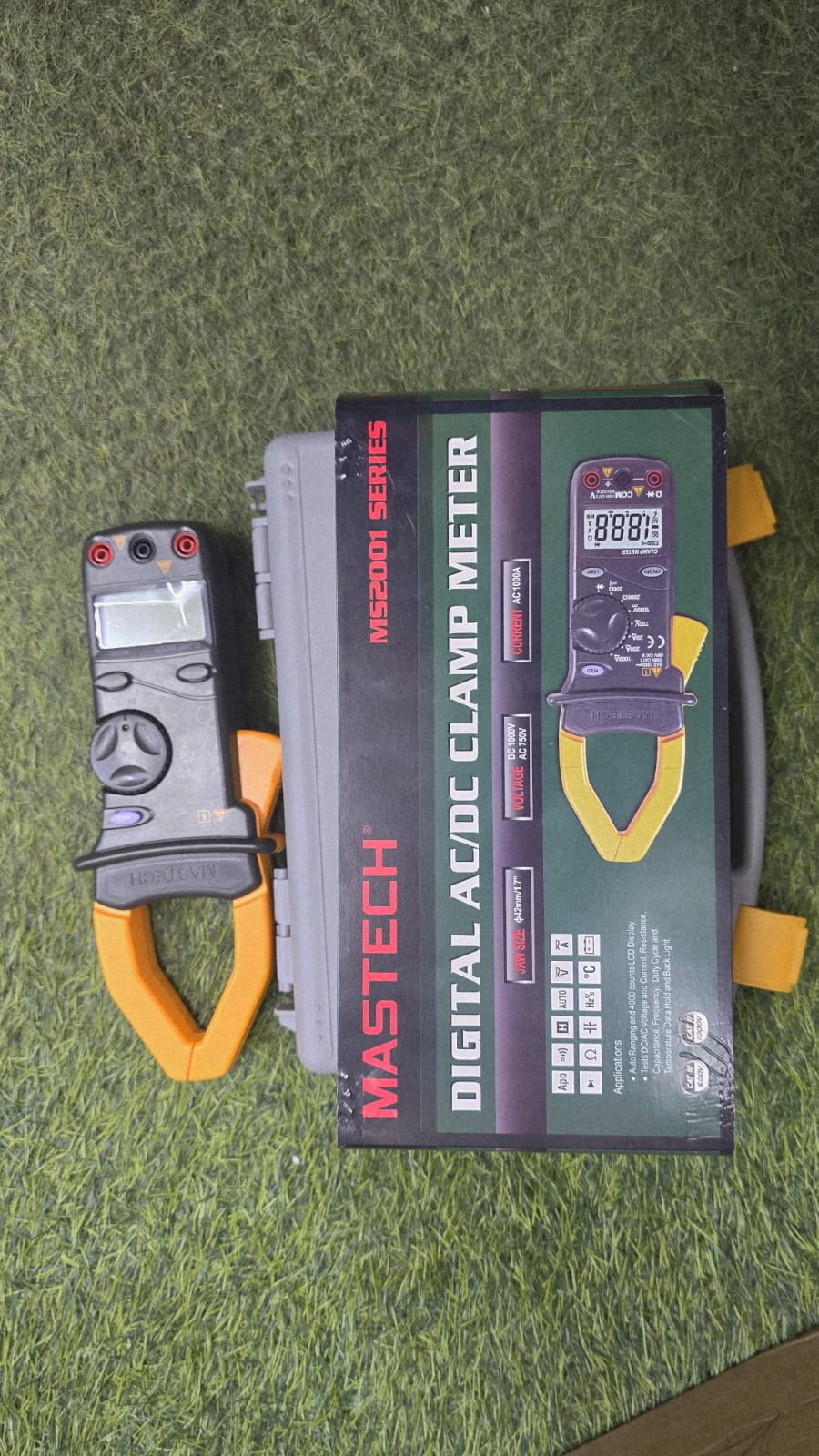
Description
A Mastech AC/DC clamp meter is a professional electrical testing instrument used to measure alternating current and direct current without disconnecting the conductor. It combines the functions of a clamp ammeter and digital multimeter in one portable device.
It is suitable for electricians, solar installers, automotive technicians, refrigeration specialists, maintenance teams and electrical engineering students. Depending on the exact model, a Mastech clamp meter can test current, voltage, resistance, capacitance, frequency, duty cycle, continuity and diodes.
This product guide uses the widely available Mastech MS2108A AC/DC clamp meter as the main reference model. Buyers should confirm the model number printed on the meter because measurement ranges and features may differ between Mastech models such as the MS2108A, MS2109A, MS2101 and MS2115A. Mastech currently produces several AC/DC clamp-meter models with different current capacities and functions.
Quick Specifications
| Feature | Typical Mastech MS2108A Specification |
|---|---|
| Product type | Digital AC/DC clamp meter |
| Display | 4,000-count LCD |
| Current measurement | AC and DC |
| AC/DC current ranges | 40A and 400A |
| DC voltage | Up to 600V or 1,000V depending on version |
| AC voltage | Up to 600V or 750V depending on version |
| Resistance | Up to 40MΩ |
| Capacitance | Up to 4,000µF |
| Frequency | Supported |
| Duty cycle | Supported |
| Continuity buzzer | Yes |
| Diode test | Yes |
| Auto-ranging | Yes |
| Display backlight | Yes |
| Data hold | Yes |
| Relative measurement | Yes |
| Minimum and maximum reading | Yes |
| Safety category | CAT III 600V |
| Power supply | Three 1.5V AAA batteries |
| Approximate dimensions | 208–218 × 77–78 × 35mm |
| Recommended use | Electrical, solar, automotive and maintenance testing |
The MS2108A manual identifies it as an AC/DC clamp meter designed around the IEC 61010 safety standard with a CAT III 600V rating. Product listings describe a 4,000-count display, 40A and 400A current ranges, auto-ranging and several multimeter functions.
Main Features of the Mastech AC/DC Clamp Meter
Measures AC and DC current
One of the main advantages of this clamp meter is its ability to measure both AC and DC current.
AC current is common in:
- Household wiring
- Commercial buildings
- Generators
- Water pumps
- Electric motors
- Welding machines
- Air conditioners
DC current is commonly found in:
- Solar panel systems
- Battery banks
- Vehicle electrical systems
- DC water pumps
- Inverters
- Charge controllers
- UPS systems
The MS2108A commonly provides 40A and 400A AC/DC current ranges. This makes it useful for general electrical diagnosis, although technicians working on circuits above 400A should choose a higher-capacity model.
Non-contact current measurement
The clamp jaw allows current to be measured without cutting the wire or opening the circuit.
The user places one conductor inside the jaw and reads the current on the screen. This is faster and more convenient than connecting a conventional multimeter in series.
Only one conductor should normally be placed inside the clamp. Clamping around both live and neutral wires together can cause the magnetic fields to cancel, producing a very low or zero reading.
Digital voltage testing
The supplied test leads allow the clamp meter to measure AC and DC voltage.
This is useful when checking:
- Electrical sockets
- Distribution boards
- Solar batteries
- Inverter output
- Alternators
- Generators
- Motor terminals
- Power supplies
The MS2108A documentation and product listings show maximum voltage ranges that may vary by production version. Some versions are marked up to 600V DC and 750V AC, while other listings show a 1,000V DC maximum input. The rating printed on the specific meter should always be treated as the final limit.
Auto-ranging function
Auto-ranging allows the meter to select the correct measurement range automatically.
This helps reduce setup time and makes the meter easier to operate, especially when the approximate current, voltage or resistance is unknown.
The user still needs to select the correct function, such as AC current, DC current, voltage, resistance or capacitance.
4,000-count LCD display
The digital screen provides readings of up to approximately 3,999 or 4,000 counts.
A higher display count gives better resolution than a basic 2,000-count meter. For example, the instrument can display smaller changes within its selected measurement range.
The MS2108A also uses an analogue-style bar graph on some versions, which helps the technician see rapid changes that may be harder to follow using digits alone.
Backlit display
The screen backlight improves visibility when working:
- Inside electrical panels
- Under vehicles
- In machine rooms
- During power failures
- In poorly lit workshops
- Around solar battery cabinets
Some versions also include a work light near the clamp jaw.
Resistance measurement
Resistance testing helps identify damaged components, poor connections and incorrect resistor values.
The MS2108A can measure resistance up to approximately 40MΩ, depending on the exact version.
Resistance must only be measured on a de-energized circuit. Testing resistance on a live circuit can damage the meter and expose the user to electric shock.
Continuity buzzer
The continuity function produces an audible signal when a low-resistance electrical path is detected.
It is useful for checking:
- Fuses
- Switches
- Wires
- Extension cables
- Motor windings
- Circuit-board tracks
- Earthing conductors
- Broken connections
Power should be switched off before carrying out a continuity test.
Capacitance measurement
Capacitance testing is useful when diagnosing:
- Motor capacitors
- Pump capacitors
- Air-conditioning capacitors
- Power-supply capacitors
- Electronic components
Common MS2108A listings show capacitance ranges extending to about 4,000µF.
A capacitor must be fully discharged before testing. Large capacitors can retain a dangerous charge even after equipment has been disconnected.
Frequency and duty-cycle measurement
Frequency testing can help technicians inspect:
- Generator output
- Inverter output
- Variable-frequency drives
- Electronic control signals
- Pulse-width-modulated circuits
The duty-cycle function measures how long a signal remains active during each cycle.
Diode test
The diode-test mode can be used to check semiconductor junctions and identify shorted or open diodes.
This is helpful when repairing:
- Rectifiers
- Chargers
- Inverters
- Power supplies
- Solar control equipment
- Electronic boards
Data-hold function
The hold button freezes the displayed reading.
This is convenient when the screen cannot be viewed directly while the clamp is positioned around a conductor.
Minimum and maximum readings
The MIN/MAX function records the lowest and highest measured values.
It can help identify:
- Motor starting current
- Changing battery load
- Voltage fluctuations
- Intermittent current changes
- Equipment startup behaviour
Relative measurement
The relative function allows the user to set the present reading as a reference point.
This is especially helpful when measuring DC current because the meter may need to be zeroed before clamping around a conductor.
Technical Specification Table
| Measurement | Typical Range |
|---|---|
| DC current | 40A and 400A |
| AC current | 40A and 400A |
| DC voltage | 400mV to 600V or 1,000V |
| AC voltage | Up to 600V or 750V |
| Resistance | 400Ω to 40MΩ |
| Capacitance | About 40nF to 4,000µF |
| Frequency | Supported |
| Duty cycle | Supported |
| Display count | 4,000 counts |
| Operating temperature | Approximately 0°C to 40°C |
| Safety rating | CAT III 600V |
| Battery | 3 × 1.5V AAA |
| Auto power off | Yes |
| Over-range indication | Yes |
| Low battery warning | Yes |
Specifications differ by model, production version and regional certification. The meter label and supplied manual should be checked before measuring high voltage or current.
Applications of a Mastech AC/DC Clamp Meter
Solar installation and maintenance
The meter can help solar technicians measure:
- Solar-array current
- Battery charging current
- Battery discharge current
- Inverter DC input
- Inverter AC output
- Solar-pump current
- Charge-controller output
- Continuity in solar cables
When measuring solar DC current, the technician should clamp around either the positive or negative cable, not both together.
The clamp meter’s maximum voltage and CAT rating must be suitable for the solar array being tested. Large series-connected photovoltaic strings can exceed the safe input limit of a general-purpose 600V meter.
Automotive electrical testing
An AC/DC model is useful for:
- Battery discharge checks
- Alternator charging current
- Starter-system diagnosis
- Accessory current
- Parasitic drain investigation
- Vehicle wiring tests
- DC voltage checks
A clamp meter is especially convenient because high current can be inspected without disconnecting thick battery cables.
Electric motor testing
Technicians can compare current on motor conductors to identify:
- Overloading
- Phase imbalance
- Mechanical resistance
- Undervoltage
- Bearing problems
- Winding faults
The MS2108A’s 400A maximum range is suitable for many general applications, but very large motors may require a 600A or 1,000A clamp meter.
Water-pump maintenance
The instrument can be used to check borehole pumps, booster pumps, surface pumps and solar pumps.
A current reading that is much higher than the motor nameplate value may point to overload, low voltage, a blocked impeller, bearing damage or another fault. A low current reading may indicate dry running, loss of load or a supply problem.
Air-conditioning and refrigeration
The clamp meter can measure compressor and fan-motor current. Its capacitance function can also help assess start and run capacitors.
Generator and inverter testing
Technicians can test voltage, current and frequency on compatible systems.
Extra care is needed with modified-waveform inverters. The MS2108A is generally described as an average-responding meter rather than a True RMS instrument, so readings on distorted waveforms may be less accurate than readings from a suitable True RMS clamp meter.
Domestic and commercial electrical work
The meter is suitable for checking:
- Lighting circuits
- Socket circuits
- Distribution boards
- Electrical appliances
- Extension cables
- Commercial machinery
- Office equipment
Mastech AC/DC Clamp Meter Versus a Basic Multimeter
| Feature | Clamp meter | Basic digital multimeter |
|---|---|---|
| Current measurement | Without opening the circuit | Usually connected in series |
| High-current testing | More convenient | Often limited |
| Voltage testing | Yes | Yes |
| Resistance testing | Yes | Yes |
| Capacitance testing | Available on selected models | Model dependent |
| Solar and automotive work | Very suitable when AC/DC capable | Useful but less convenient for current |
| Safety around current conductors | Better when used correctly | Requires more circuit contact |
| Small electronic current | May have limited resolution | Often better for low current |
A clamp meter is not always a replacement for a precision multimeter. It is especially valuable where current must be measured quickly without disconnecting cables.
Important Safety Information
Confirm the meter rating
Check the CAT rating, maximum voltage and maximum current printed on the meter.
The MS2108A is commonly rated CAT III 600V, meaning it is intended for suitable fixed-installation applications within that category when used correctly. The safety category is not permission to exceed the input limits printed beside the terminals.
Inspect the test leads
Do not use leads with cracked insulation, exposed wire, damaged tips or loose plugs.
Use the correct input terminals
Voltage, resistance and continuity measurements use the test-lead terminals. Clamp current is measured using the jaw, not through the voltage input.
Avoid touching exposed conductors
Keep fingers behind the protective guards on the probes and clamp body.
Do not exceed the current range
A 400A meter should not be used on a conductor expected to carry more than its rated maximum.
De-energize before resistance testing
Resistance, continuity, diode and capacitance tests should be performed on circuits that have been switched off and safely discharged.
Clamp one conductor only
For ordinary load-current measurement, clamp around one live conductor. Do not clamp around an entire twin cable containing both outgoing and return conductors.
Select AC or DC correctly
The user must confirm whether the circuit carries alternating or direct current and select the correct mode.
Zero the meter before DC testing
Residual magnetic fields can cause an offset when measuring DC current. Close the jaw, keep it away from conductors and use the zero or relative function before measuring.
How to Use the Clamp Meter to Measure Current
- Inspect the meter and clamp jaw for damage.
- Select AC current or DC current.
- Choose the appropriate range or use auto-ranging.
- Zero the meter when measuring DC current.
- Open the jaw using the trigger.
- Place one conductor in the centre of the jaw.
- Close the jaw completely.
- Read the value from the display.
- Use data hold where the screen is difficult to see.
- Remove the clamp safely after testing.
For a DC reading with an unexpected negative sign, the conductor direction may be opposite to the arrow or polarity marking on the jaw. Reverse the conductor direction or interpret the sign correctly.
How to Choose the Right Mastech Clamp Meter
Confirm AC and DC capability
Some clamp meters measure AC current only. Choose a clearly marked AC/DC clamp meter for solar, battery and vehicle work.
Check maximum current
A 400A model is suitable for many general electrical and solar jobs. Larger installations may require a 600A or 1,000A meter.
Check True RMS capability
Choose a True RMS model when testing variable-speed drives, modern electronic equipment, distorted generator output or non-sinusoidal inverter waveforms.
The commonly advertised MS2108A is not normally sold as a True RMS meter. Buyers who need True RMS should confirm this feature on the exact model before purchase.
Compare jaw opening
A larger jaw is needed for thick cables and busbars. Confirm that the conductor can fit freely inside the clamp without forcing the jaw.
Look for NCV where required
Non-contact voltage detection is available on some newer Mastech models, including the MS2109A, but it should not be assumed to be present on every MS2108A.
Confirm temperature testing
Some clamp meters include a thermocouple input. The standard MS2108A feature set should not be assumed to include temperature measurement unless it is stated on the specific product.
Check local accessory availability
Choose a model for which test leads, batteries, carrying cases and replacement parts are easy to obtain.
Package Contents
A typical Mastech AC/DC clamp meter package may include:
- Mastech clamp meter
- Red and black test leads
- Carrying pouch
- User manual
- AAA batteries, depending on the package
Package contents vary. Some listings exclude batteries, while other models are supplied with three AAA cells. Confirm the package before buying.
Benefits of the Mastech AC/DC Clamp Meter
Measures current without disconnecting cables
This speeds up testing and reduces unnecessary circuit disturbance.
Suitable for AC and DC systems
The meter can support domestic electricity, solar installations, batteries and automotive systems.
Multiple tools in one device
It combines current, voltage, resistance, capacitance, frequency, continuity and diode-testing functions.
Portable design
The compact body fits easily into an electrician’s toolbox or carrying pouch.
Easy-to-read screen
The 4,000-count backlit display supports work in dark panels and machine spaces.
Automatic range selection
Auto-ranging makes setup easier for both professionals and learners.
Protective rubber housing
The outer casing improves grip and helps protect the instrument from normal workshop handling.
Mastech AC/DC Clamp Meter Price in Kenya
Online Kenya listings for the MS2108A show imported base prices of approximately KSh 9,569 to KSh 12,470, before shipping and customs charges. Availability may be limited, and some listings are marked out of stock.
| Product category | Estimated Kenya price |
|---|---|
| Basic AC-only Mastech clamp meter | KSh 4,500–8,000 |
| Mastech 400A AC/DC clamp meter | KSh 8,500–14,000 |
| Higher-current AC/DC model | KSh 12,000–22,000 |
| True RMS professional model | KSh 15,000–30,000+ |
The final price depends on the model, maximum current, True RMS capability, included accessories, warranty, import costs and supplier availability. Buyers should compare the full model number rather than relying only on the Mastech brand name.
Maintenance Tips
- Keep the clamp jaw clean and ensure it closes fully.
- Wipe the casing using a soft, dry cloth.
- Do not use solvents or spray water onto the meter.
- Replace weak batteries promptly.
- Remove batteries before long-term storage.
- Keep the test leads neatly stored.
- Do not drop the meter or expose it to strong magnetic fields.
- Store it in its protective pouch.
- Arrange periodic calibration when measurements are used for professional certification or critical maintenance.
Why Choose a Mastech AC/DC Clamp Meter?
A Mastech AC/DC clamp meter is a useful choice for technicians who need one portable instrument for current and general electrical measurements. It is especially valuable for solar work, automotive diagnosis, water-pump maintenance, electrical installation and workshop repairs.
The MS2108A offers a practical combination of 400A AC/DC current measurement, auto-ranging, a 4,000-count display and several multimeter functions. For distorted waveforms, higher-current circuits or advanced industrial work, buyers should consider a suitable True RMS or higher-capacity Mastech model.
Frequently Asked Questions
What does a Mastech AC/DC clamp meter measure?
It can measure AC current, DC current, AC/DC voltage, resistance, capacitance, frequency, duty cycle, continuity and diodes, depending on the model.
Can it measure solar-panel current?
Yes. An AC/DC model can measure DC current in solar cables, charge controllers and battery systems, provided the current and voltage remain within the meter’s ratings.
Can it test vehicle batteries?
It can test battery voltage and measure charging or load current using the clamp. It does not replace a dedicated battery capacity or load tester.
What is the maximum current of the MS2108A?
The commonly listed maximum is 400A AC or DC, with 40A and 400A ranges.
Is the Mastech MS2108A True RMS?
The commonly available MS2108A is generally described as a non-True-RMS or average-responding meter. Choose a model that clearly states True RMS when testing distorted electrical waveforms.
Does it have auto-ranging?
Yes. The MS2108A is commonly supplied with automatic range selection.
Does it use batteries?
Yes. It normally uses three 1.5V AAA batteries.
Can it measure current through an insulated wire?
Yes. The jaw detects the magnetic field around the conductor, so the insulation does not need to be removed.
Why does the meter show zero when clamped around a complete cable?
The cable may contain both outgoing and returning conductors. Their magnetic fields cancel each other. Clamp around one conductor only.
What is the price of a Mastech AC/DC clamp meter in Kenya?
A 400A Mastech AC/DC model commonly falls around KSh 8,500 to KSh 14,000, while imported MS2108A listings show base prices of about KSh 9,569 to KSh 12,470 before shipping and customs.
Reviews
There are no reviews yet.