
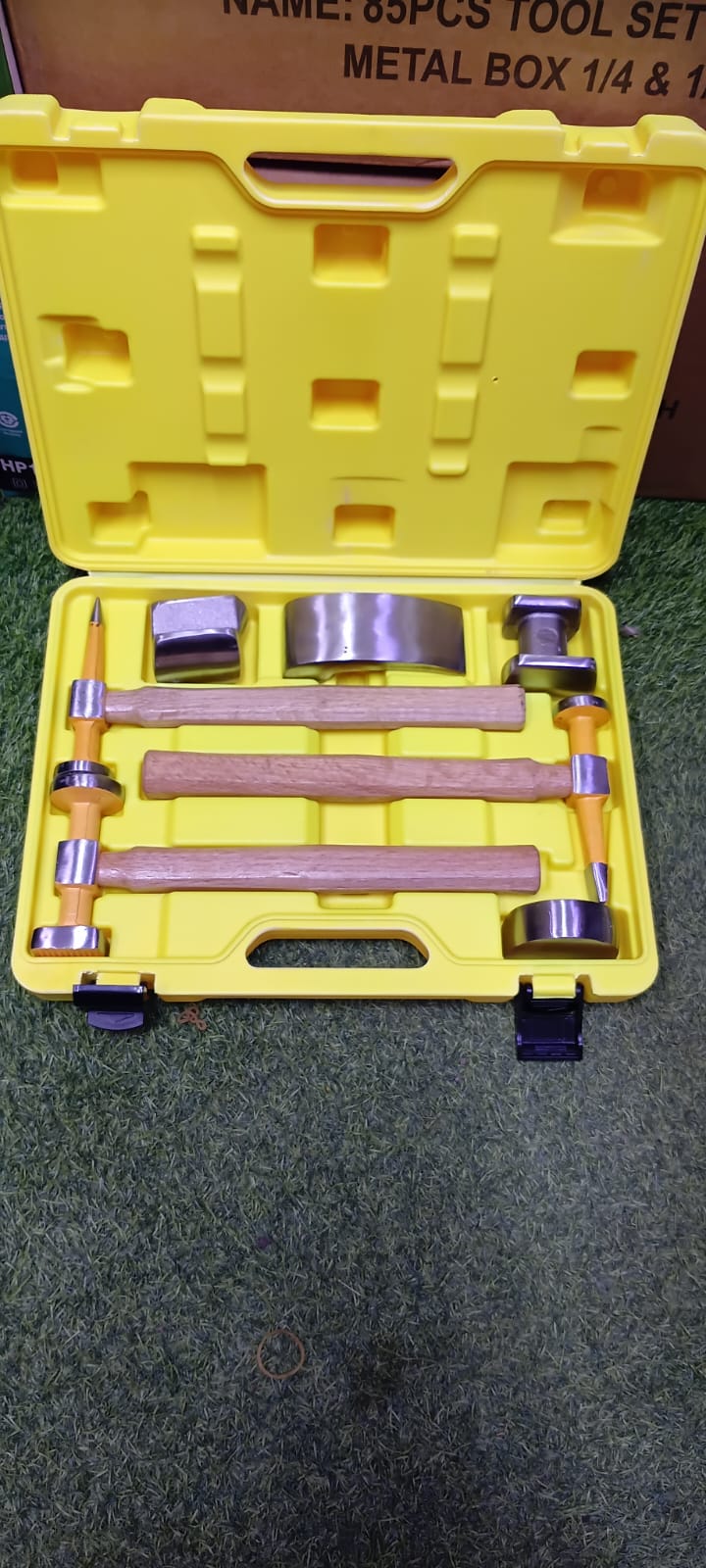
Description


A Panel Beating Hammer Set is a professional auto body repair kit used for removing dents, straightening damaged panels, shaping sheet metal and restoring vehicle body contours. It combines specialized panel beating hammers with solid steel dollies that support the metal from behind while it is being worked.
A common professional configuration is a 7-piece panel beating hammer and dolly set containing 3 specialized hammers and 4 dollies. Current professional sets include bumping, pick/finishing and shrinking hammers together with utility, curved, toe and heel dollies.
The set is suitable for panel beaters, automotive garages, vehicle restoration shops, mechanics, metal fabricators and DIY users who need better control than an ordinary workshop hammer can provide.
Quick Specifications
| Feature | Typical Specification |
|---|---|
| Product Name | Panel Beating Hammer Set |
| Set Size | 7 Pieces |
| Hammers | 3 Pieces |
| Dollies | 4 Pieces |
| Hammer Material | Drop-Forged / Heat-Treated Steel |
| Dolly Material | Forged or Heat-Treated Steel |
| Handle | Fibreglass Rubber Grip or Hardwood, model dependent |
| Hammer Types | Bumping, Pick/Finish, Shrinking |
| Dolly Types | Utility, Curved, Heel and Toe |
| Storage | Blow-Moulded Carry Case |
| Main Application | Automotive Body Repair |
| Suitable For | Dent Removal, Panel Shaping and Metal Finishing |
Professional sets differ slightly in their hammer profiles and handle materials. For example, GEARWRENCH uses flame-treated hickory handles, while other current sets use fibreglass shafts with rubber grips.
What’s Included in a 7-Piece Panel Beating Hammer Set?
A typical set contains:
- 1 × Standard bumping hammer
- 1 × Pick and finishing hammer
- 1 × Shrinking hammer
- 1 × Utility dolly
- 1 × Curved dolly
- 1 × Heel dolly
- 1 × Toe dolly
- 1 × Blow-moulded storage case
This three-hammer and four-dolly layout is used by several professional auto-body tool manufacturers.
Standard Bumping Hammer
The bumping hammer is one of the main tools used during panel beating.
Its broad striking face is designed for working larger areas of sheet metal. It can help raise low spots, flatten uneven areas and restore the general shape of damaged panels.
It is useful for:
- Doors
- Bonnets
- Fenders
- Quarter panels
- Vehicle body panels
Rather than hitting the panel with excessive force, controlled light blows usually give better results.
Pick and Finishing Hammer
The pick and finishing hammer combines a narrow pointed end with a finishing face.
The pick side is useful when working on:
- Small low spots
- Tight dents
- Difficult corners
- Localized panel damage
The finishing face can then help smooth the repaired area.
This makes the pick hammer particularly useful during the later stages of dent repair when greater precision is required.
Shrinking Hammer
When sheet metal is badly dented, it can become stretched.
A shrinking hammer has a specialized striking surface intended to help control stretched metal while reshaping the panel.
It is commonly used with a suitable dolly during metal finishing.
Shrinking work requires skill. Excessive hammering can make the panel more difficult to repair, so controlled strikes are important.
Utility Dolly
The utility dolly is the general-purpose support block in the kit.
Its different faces and curves allow it to support many common vehicle panel shapes.
It can be used for:
- Flattening
- Contouring
- Edge repair
- General dent removal
Curved Dolly
The curved dolly is useful for body panels with rounded profiles.
It provides a solid backing surface when restoring curved areas such as fenders and body contours.
Heel Dolly
The heel dolly has a broad curved profile that is useful for working larger rounded sections.
Its weight also provides resistance behind the panel as the hammer strikes from the opposite side.
Toe Dolly
The narrower shape of a toe dolly makes it useful where a larger dolly cannot fit easily.
It can help when repairing:
- Tight corners
- Narrow contours
- Edges
- Difficult body sections
The combination of utility, curved, heel and toe dollies allows one kit to support a wide range of panel shapes.
How a Hammer and Dolly Work Together
Panel beating normally involves more than simply hammering a dent.
The dolly is positioned behind the damaged metal while the hammer works from the opposite side.
The dolly provides resistance and helps control how the sheet metal moves.
There are two common techniques.
Hammer-On-Dolly
The hammer strikes the metal directly over the dolly.
This technique can help smooth and finish the panel but can also stretch metal if overused.
Hammer-Off-Dolly
The dolly supports a nearby low area while the hammer works on an adjacent high spot.
This technique can help move metal back toward its original shape while limiting unnecessary stretching.
Learning when to use each technique is an important part of professional panel beating.
Heat-Treated Steel Construction
Quality panel beating tools are designed to withstand repeated impact.
Professional sets use forged and heat-treated steel for the hammers and dollies. One current professional set uses drop-forged medium-carbon SAE/AISI 1045 and 1055 steel, while other kits use heat-treated alloy or carbon steel.
This construction provides:
- High impact strength
- Good wear resistance
- Long working life
- Consistent striking surfaces
Fibreglass Handles with Rubber Grip
Many modern panel beating hammer sets use fibreglass handles.
Fibreglass provides a good combination of strength and vibration resistance, while a rubber grip helps improve comfort and control.
A current professional 7-piece set combines heat-treated alloy-steel heads with fibreglass handles and soft grips.
Other professional kits use hardwood or hickory handles, so handle material depends on the manufacturer.
Polished Working Surfaces
A smooth hammer or dolly surface is important when finishing automotive sheet metal.
Rough or damaged striking surfaces can transfer marks onto the panel.
Professional sets therefore commonly use polished hammer and dolly faces. GEARWRENCH, for example, specifies finely polished dolly surfaces in its 7-piece auto body kit.
Applications of a Panel Beating Hammer Set
Car Dent Repair
Ideal for correcting small and medium dents where access is available to the back of the panel.
Fender Repair
Curved dollies can support the rounded shape of vehicle fenders while the hammer restores damaged sections.
Door Panel Repair
Useful for repairing dents and deformation on suitable steel door panels.
Vehicle Restoration
An essential tool set when restoring older vehicles where body panels may need extensive manual reshaping.
Sheet Metal Fabrication
The hammers and dollies can also help form and finish compatible sheet-metal components.
Motorcycle Bodywork
Suitable for selected motorcycle tanks, mudguards and other metal body components when used by an experienced technician.
Panel Beating Hammer vs Ordinary Hammer
| Feature | Panel Beating Hammer | Ordinary Hammer |
|---|---|---|
| Designed for Sheet Metal | Yes | No |
| Specialized Faces | Yes | Usually No |
| Dent Repair | Excellent | Poor |
| Panel Finishing | Excellent | Limited |
| Works with Dollies | Yes | Not Designed For It |
| Body Shop Use | Excellent | General Purpose |
An ordinary hammer can easily leave deep marks in thin vehicle panels. A panel beating hammer provides more appropriate faces and better control.
Panel Beating Hammer Set vs Dent Puller
| Feature | Hammer & Dolly Set | Dent Puller |
|---|---|---|
| Requires Rear Panel Access | Often | Not Always |
| Metal Shaping | Excellent | Limited |
| Removing Low Spots | Excellent | Excellent |
| Finishing Panel Shape | Excellent | Requires Other Tools |
| Power Required | No | Model Dependent |
Professional panel beaters often use both systems rather than choosing only one.
How to Use a Panel Beating Hammer Set
Step 1: Inspect the Damage
Identify the high and low spots before beginning.
Step 2: Gain Access Behind the Panel
Remove interior trim where necessary and safe to do so.
Step 3: Choose the Correct Dolly
Select a dolly whose curve closely matches the original panel contour.
Step 4: Position the Dolly
Hold it firmly behind the damaged section.
Step 5: Start with Controlled Strikes
Use light hammer blows instead of heavy strikes.
Step 6: Work the Damage Gradually
Large dents often need to be worked progressively rather than being forced out in one hit.
Step 7: Check the Surface
Use your hand and reflected light to identify remaining high and low areas.
Step 8: Finish the Panel
Continue with lighter finishing blows until the surface is ready for the next repair stage.
Important Panel Beating Tips
Do not hit automotive panels as hard as possible.
Successful panel beating depends more on control, hammer selection, dolly position and understanding how the metal has stretched.
For better results:
- Start gently.
- Work gradually.
- Match the dolly to the panel curve.
- Keep hammer faces clean.
- Avoid concentrating too many strikes in one place.
- Check panel shape regularly.
Safety Tips
Always wear appropriate personal protective equipment when carrying out body repairs.
Use:
- Safety glasses
- Work gloves
- Suitable footwear
- Hearing protection when required
Also make sure the vehicle is stable before starting repair work.
Do not use a hammer with a loose or cracked handle.
Maintenance
Panel beating tools can last many years when properly maintained.
After use:
- Wipe hammer heads clean.
- Remove grease from the dollies.
- Check handles for cracks.
- Inspect hammer heads for looseness.
- Keep polished working faces free from deep scratches.
- Apply light rust protection where appropriate.
- Return each tool to its case.
- Store the set somewhere dry.
Blow-Moulded Carry Case
Most complete panel beating sets come in a fitted storage case.
A professional 7-piece HANSTOOL set, for example, uses a 410 × 310 × 100 mm blow case and has a listed set weight of 7.8 kg.
Other 7-piece sets are lighter, so weight varies considerably according to hammer and dolly construction.
The case helps:
- Prevent lost tools
- Protect working surfaces
- Keep the workshop organized
- Make transportation easier
How to Choose the Best Panel Beating Hammer Set
Before buying, check:
- Number of hammers
- Number and shapes of dollies
- Hammer head material
- Heat treatment
- Handle quality
- Surface finish
- Overall weight
- Storage case
- Replacement handle availability
For general automotive repair, a 7-piece set with three hammers and four differently shaped dollies provides a good balance between versatility and portability.
Panel Beating Hammer Set Price in Kenya
Prices vary significantly according to brand, number of tools and steel quality.
One current Kenyan retailer lists a panel beating hammer and dolly set at KSh 8,499, while another Nairobi listing prices a 7-piece set at KSh 17,500. A larger 9-piece professional-style kit is currently listed at around KSh 20,000.
| Panel Beating Set | Current/Typical Kenya Price |
|---|---|
| 7-Piece Hammer & Dolly Set | From about KSh 8,499 |
| Better Quality 7-Piece Set | Around KSh 10,000–17,500 |
| 9-Piece Body Repair Set | Around KSh 20,000 |
| Premium Professional Sets | Price varies by brand |
Prices can change depending on supplier and availability.
Why Buy a Panel Beating Hammer Set?
A Panel Beating Hammer Set in Kenya gives automotive technicians the specialized tools needed to repair vehicle sheet metal more accurately than an ordinary hammer.
With bumping, finishing and shrinking hammers plus several dolly profiles, one compact set can handle dent removal, metal shaping, contour restoration and final panel finishing.
For panel beaters, garages, car restoration businesses and automotive workshops, a quality hammer and dolly set is a valuable long-term addition to the toolbox.
Frequently Asked Questions
What is a panel beating hammer set used for?
It is used for removing dents, straightening automotive panels, shaping sheet metal and restoring vehicle body contours.
How many pieces are in a standard set?
A common professional kit contains 7 pieces: 3 hammers and 4 dollies.
What hammers are normally included?
Typical sets include a bumping hammer, pick/finishing hammer and shrinking hammer. Exact profiles vary by manufacturer.
What are the dollies used for?
Dollies support the back of the panel while it is being hammered. Different dolly shapes match flat, curved, narrow and contoured sections of vehicle bodywork.
Are the hammers made from steel?
Yes. Quality models use forged or heat-treated steel. Some professional sets use drop-forged medium-carbon steel for durability.
Are fibreglass handles better?
Fibreglass handles provide good durability and vibration resistance. Rubber grips can also improve comfort and control. Some professional manufacturers instead use hardwood or hickory handles.
Can I use the set for removing car dents?
Yes. Dent removal and panel shaping are the main applications of a hammer and dolly set.
Does the set come with a storage case?
Many 7-piece sets include a blow-moulded carrying case to organize and protect the hammers and dollies.
What is the price of a Panel Beating Hammer Set in Kenya?
Current Kenyan listings range from approximately KSh 8,499 for a hammer and dolly set to around KSh 17,500 for some 7-piece kits. Larger 9-piece sets are listed at about KSh 20,000.
Reviews
There are no reviews yet.