
Description


A Torque Wrench is a precision hand tool used to tighten nuts and bolts to a specific torque value. It is especially important when working on vehicle wheel nuts, engine components, motorcycles, machinery and equipment where over-tightening or under-tightening can cause damage or unsafe operation.
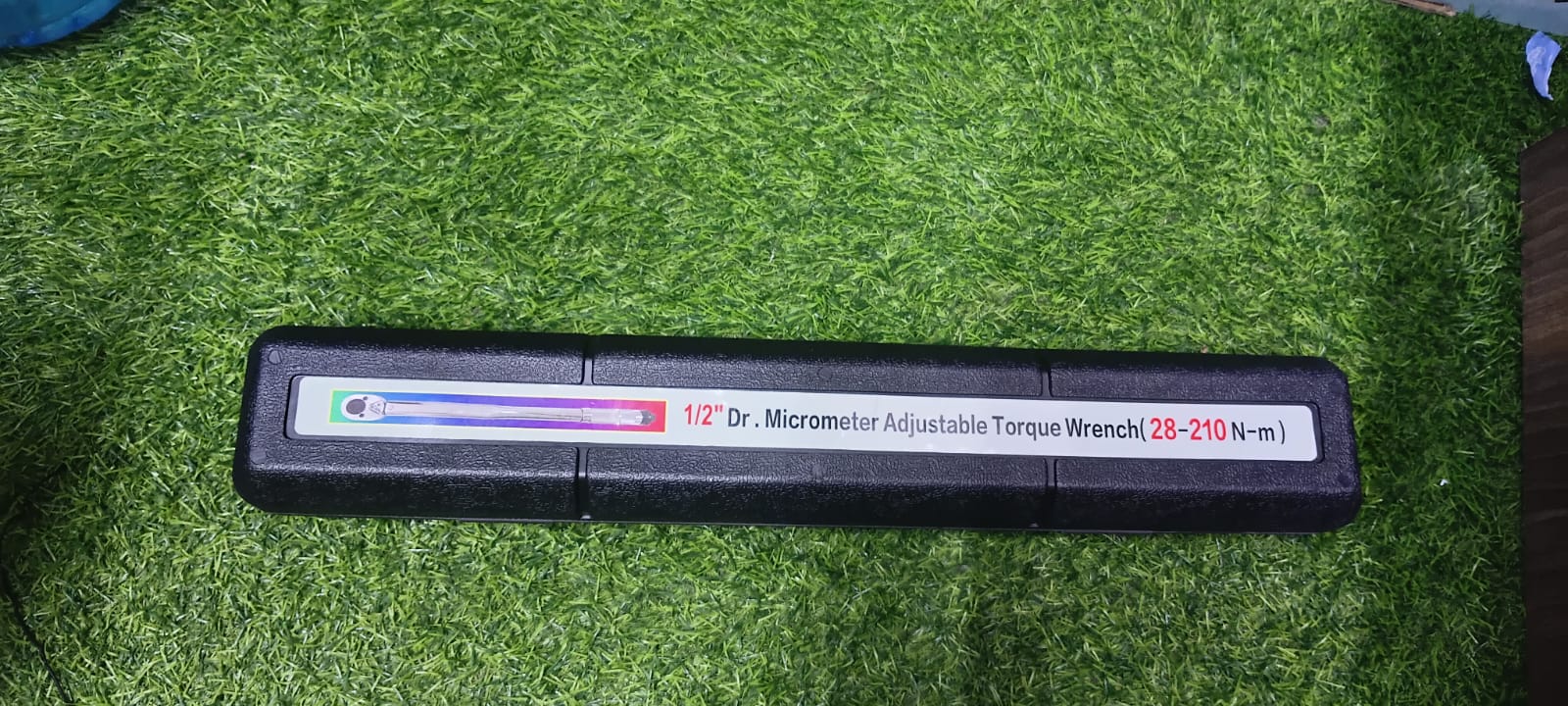
One of the most useful general-purpose options is the 1/2-inch drive click-type torque wrench with a 28–210 Nm adjustment range. Current models in this range typically feature a micrometer adjustment handle, reversible ratchet, engraved Nm scale and an audible or tactile click when the selected torque has been reached.
This makes it a practical tool for professional mechanics, garages, tyre shops, equipment technicians and serious DIY users in Kenya.
Quick Specifications
| Feature | Typical Specification |
|---|---|
| Product Name | Torque Wrench |
| Type | Manual Click-Type |
| Drive Size | 1/2 Inch / 12.7 mm |
| Torque Range | 28–210 Nm |
| Equivalent Range | About 20–155 ft-lb |
| Accuracy | Typically ±4% |
| Ratchet | Reversible |
| Material | Chrome Vanadium Steel |
| Adjustment | Micrometer-Type Handle |
| Torque Indicator | Audible and Tactile Click |
| Scale | Nm and/or ft-lb |
| Length | Approximately 45–48 cm |
| Handle | Knurled Anti-Slip Grip |
| Storage | Protective Carry Case |
A current 28–210 Nm model specifies a 1/2-inch drive, Cr-V construction and factory calibration within 4% tolerance.
28–210 Nm Adjustable Torque Range
The broad 28 to 210 Nm range makes this torque wrench useful for many medium and heavy fastening applications.
It can be used for suitable:
- Wheel nuts
- Engine components
- Suspension fasteners
- Motorcycle parts
- Machinery
- Agricultural equipment
- Generators
- Pumps
- Workshop equipment
Always use the torque value specified by the vehicle or equipment manufacturer.
Accurate ±4% Torque Control
Accuracy is the main reason to use a torque wrench instead of an ordinary ratchet.
Many 1/2-inch click-type models are factory calibrated to approximately ±4% accuracy. Current 28–210 Nm models sold for automotive work also advertise this level of precision.
Correct torque helps prevent two major problems:
Under-tightening: The fastener may work loose.
Over-tightening: Threads, bolts, wheels or other components may become damaged.
Click-Type Torque Mechanism
Once the required torque has been selected, the wrench operates like a normal ratchet until the preset torque is reached.
At the target value, the mechanism produces a noticeable click.
That click tells the operator to stop applying force.
Do not continue pulling after the wrench clicks, as doing so can over-tighten the fastener.
1/2-Inch Square Drive
The 1/2-inch drive is one of the most common sizes used for automotive and mechanical work.
It accepts compatible 1/2-inch sockets and accessories.
This size is particularly useful for jobs requiring more torque than a small 1/4-inch drive tool can comfortably handle.
Chrome Vanadium Steel Construction
Quality torque wrenches commonly use Chrome Vanadium steel, also known as Cr-V.
This provides:
- High strength
- Good wear resistance
- Corrosion resistance
- Long working life
- Reliable workshop performance
A current VITO 28–210 Nm professional model specifies a Chrome Vanadium steel body and corrosion-resistant construction.
Micrometer Adjustment Handle
The handle rotates to select the required torque.
A typical wrench combines a main scale on the shaft with a finer micrometer scale around the handle. This lets the operator set a more precise torque rather than choosing only large fixed increments.
After selecting the value, the adjustment should be locked before tightening.
Reversible Ratchet Head
The reversible ratchet lets the operator change the direction of rotation.
This makes the wrench easier to position and use during mechanical work. Some manufacturers specify controlled operation in both directions, while others calibrate accuracy primarily in the tightening direction. Follow the instructions supplied with your exact model.
Easy-to-Read Torque Scale
Quality models use engraved or laser-marked scales so the required torque can be selected accurately.
Common units include:
- Newton metres (Nm)
- Foot-pounds (ft-lb)
A high-contrast scale is especially useful in busy garages and workshops.
Applications of a Torque Wrench
Car Wheel Nuts
One of the most common applications is tightening wheel nuts after changing tyres.
Using an ordinary wheel wrench can make it difficult to know whether each nut has been tightened correctly.
A torque wrench lets you tighten every wheel nut to the vehicle manufacturer’s specified value.
Engine Repairs
Precision torque is important for many engine components, including suitable:
- Cylinder head fasteners
- Covers
- Engine brackets
- Pulleys
- Mounting bolts
Some engine fasteners require specialised procedures such as torque-plus-angle tightening, so always follow the manufacturer’s service information.
Suspension Work
Suitable for correctly torquing compatible suspension and chassis fasteners where the required specification falls within the wrench’s range.
Motorcycle Maintenance
A torque wrench can be useful for:
- Axle nuts
- Engine components
- Brake assemblies
- Suspension parts
Smaller motorcycle fasteners may require a lower-range 1/4-inch or 3/8-inch torque wrench.
Machinery Maintenance
Useful for assembling and servicing:
- Pumps
- Generators
- Agricultural equipment
- Industrial machines
- Workshop equipment
Torque Wrench vs Normal Ratchet
| Feature | Torque Wrench | Normal Ratchet |
|---|---|---|
| Measures Applied Torque | Yes | No |
| Adjustable Torque | Yes | No |
| Click at Preset Value | Yes | No |
| General Tightening | Excellent | Excellent |
| Precision Assembly | Excellent | Limited |
| Final Wheel Nut Tightening | Recommended | Cannot Verify Torque |
A normal ratchet is useful for quickly installing and removing fasteners. The torque wrench should be used for the final controlled tightening where a specified torque is required.
Torque Wrench vs Impact Wrench
| Feature | Torque Wrench | Impact Wrench |
|---|---|---|
| Operation | Manual Precision Tool | Powered Impact Tool |
| Main Purpose | Accurate Final Tightening | Fast Removal/Tightening |
| Torque Control | Precise | Less Precise Unless Specially Controlled |
| Wheel Removal | Slow | Excellent |
| Final Wheel Tightening | Excellent | Torque Wrench Preferred |
A good workshop can use both. Remove and initially install wheel nuts with an impact wrench, then perform the final tightening with a calibrated torque wrench.
How to Set a Torque Wrench
Step 1: Check the Required Torque
Find the correct torque specification from the vehicle or equipment manufacturer.
Step 2: Unlock the Handle
Release the locking mechanism at the end of the wrench.
Step 3: Set the Main Scale
Rotate the handle until you approach the required Nm value.
Step 4: Fine-Tune the Setting
Use the micrometer scale to reach the exact required value.
Step 5: Lock the Handle
Secure the adjustment so it cannot move while tightening.
Step 6: Install the Socket
Fit the correct 1/2-inch socket onto the square drive.
How to Use a Torque Wrench Correctly
Position the socket completely over the fastener.
Hold the wrench at its intended grip area.
Pull the handle slowly and steadily.
Avoid sudden jerking movements.
When you hear or feel the click, stop applying force immediately.
Move to the next fastener and repeat the procedure.
Correct Wheel Tightening Pattern
When tightening vehicle wheels with several nuts, use the sequence recommended by the vehicle manufacturer, commonly a cross or star pattern where applicable.
This helps seat the wheel evenly.
Do not guess the required torque based on vehicle size. Different manufacturers and wheel designs use different torque specifications.
Important Torque Wrench Safety Tips
- Never exceed the wrench’s maximum torque rating.
- Use the correct socket size.
- Do not continue pulling after the click.
- Apply force smoothly.
- Do not use damaged sockets.
- Do not use the wrench as a hammer.
- Avoid dropping the wrench.
- Have it recalibrated if accuracy is questionable.
- Follow the manufacturer’s tightening specification.
Do Not Use a Torque Wrench as a Breaker Bar
A torque wrench is a precision measuring instrument.
Using it to loosen heavily seized bolts can overload the internal calibration mechanism.
For stubborn bolts, use:
- Breaker bar
- Impact wrench
- Heavy-duty ratchet
Then use the torque wrench for final tightening.
Store It at the Minimum Setting
After completing your work, reduce an adjustable click-type wrench to its minimum specified setting, rather than leaving it at a high torque.
VITO specifically recommends returning its adjustable wrench to minimum torque after use to help preserve calibration.
Do not force the adjustment below the manufacturer’s minimum scale value.
Torque Wrench Maintenance
A torque wrench requires more careful handling than an ordinary spanner.
For longer service life:
- Wipe it clean after use.
- Keep it dry.
- Store it in its protective case.
- Do not drop it.
- Keep the ratchet head clean.
- Return it to its minimum setting after use.
- Periodically check calibration.
- Avoid modifying the handle.
When Should a Torque Wrench Be Recalibrated?
Calibration frequency depends on usage, tool manufacturer and the accuracy required.
Consider checking or recalibrating the wrench after:
- Heavy professional use
- A significant drop
- Suspected overloading
- Long periods of use
- Noticeable accuracy problems
If the wrench stops clicking normally or produces inconsistent tightening results, stop using it for critical work until it has been checked.
Typical Package Contents
A common 28–210 Nm torque wrench set may include:
- 1 × 1/2-inch Torque Wrench
- 1 × 5-inch Extension Bar
- 1 × 17 mm Socket
- 1 × 19 mm Socket
- 1 × Protective Carrying Case
One current Kenyan 28–210 Nm set includes the wrench, a 5-inch extension, 17 mm and 19 mm sockets and a storage case.
Package contents vary, so confirm the included accessories before purchase.
How to Choose the Best Torque Wrench in Kenya
Before buying, check:
- Torque range
- Drive size
- Accuracy
- Calibration
- Scale readability
- Ratchet quality
- Cr-V construction
- Handle grip
- Locking mechanism
- Storage case
- Warranty
For general automotive work, a 1/2-inch 28–210 Nm torque wrench provides a useful range for many medium-to-high torque applications.
For small engine and motorcycle fasteners requiring low torque, consider adding a smaller-range wrench.
Torque Wrench Price in Kenya
Current Kenyan listings show that basic 1/2-inch 28–210 Nm torque wrenches generally fall around KSh 3,800 to KSh 8,000, while branded and professional models can cost considerably more. For example, current listings include KSh 3,800, KSh 4,200, KSh 5,499 and KSh 5,800 examples in this torque range.
| Torque Wrench Type | Typical Kenya Price |
|---|---|
| Basic 1/2″ 28–210 Nm | KSh 3,800–5,500 |
| Better Quality 1/2″ Click Type | KSh 5,500–8,500 |
| Branded Professional Model | KSh 8,500–20,000+ |
| Electronic/Digital Professional Model | KSh 20,000+ |
Prices depend on brand, calibration, accuracy, included accessories and seller.
Why Buy a Torque Wrench?
A Torque Wrench in Kenya is an important investment for mechanics and technicians who need more than simply making a bolt “tight.”
Correct torque helps ensure that fasteners are tightened according to the equipment manufacturer’s specification. This is important for wheel installation, engine work, suspension repairs and machinery assembly.
A 1/2-inch 28–210 Nm click-type torque wrench provides a particularly useful balance of torque range, accuracy and ease of use for automotive garages, tyre shops, workshops and equipment maintenance.
Frequently Asked Questions
What is a torque wrench used for?
A torque wrench tightens nuts and bolts to a specified torque value. It is commonly used for vehicle wheel nuts, engine components, motorcycles and machinery.
What is the torque range?
A popular general-purpose model has an adjustable range of 28–210 Nm.
What does the click mean?
The click tells you that the preset torque has been reached. Stop applying force when you hear or feel it.
What is the drive size?
The common automotive model uses a 1/2-inch square drive, compatible with suitable 1/2-inch sockets.
How accurate is a torque wrench?
Many quality click-type models in this range are specified to approximately ±4% accuracy when properly calibrated and used according to instructions.
Can I use a torque wrench to remove wheel nuts?
It is better to use a breaker bar or impact wrench for removal. Keep the torque wrench for controlled final tightening.
Can I use an extension bar?
Yes, a straight socket extension can be used where necessary. Extensions that change the effective lever length, such as certain crowfoot arrangements, may require a torque calculation.
Should I leave the wrench at 210 Nm after use?
No. Adjustable click-type models should generally be returned to their manufacturer’s recommended storage setting, commonly the minimum marked torque.
Is a 28–210 Nm torque wrench suitable for wheel nuts?
Yes, provided the vehicle manufacturer’s specified wheel-nut torque falls within the wrench’s range.
What is the price of a Torque Wrench in Kenya?
A standard 1/2-inch 28–210 Nm torque wrench currently sells for roughly KSh 3,800 to KSh 8,000 in the Kenyan market, while branded, calibrated and electronic professional models can cost more.


Reviews
There are no reviews yet.