
Description
A manual torque wrench is a precision hand tool used to tighten nuts and bolts to a specified torque. Unlike an ordinary ratchet or spanner, it helps the user stop tightening when the required force has been reached.
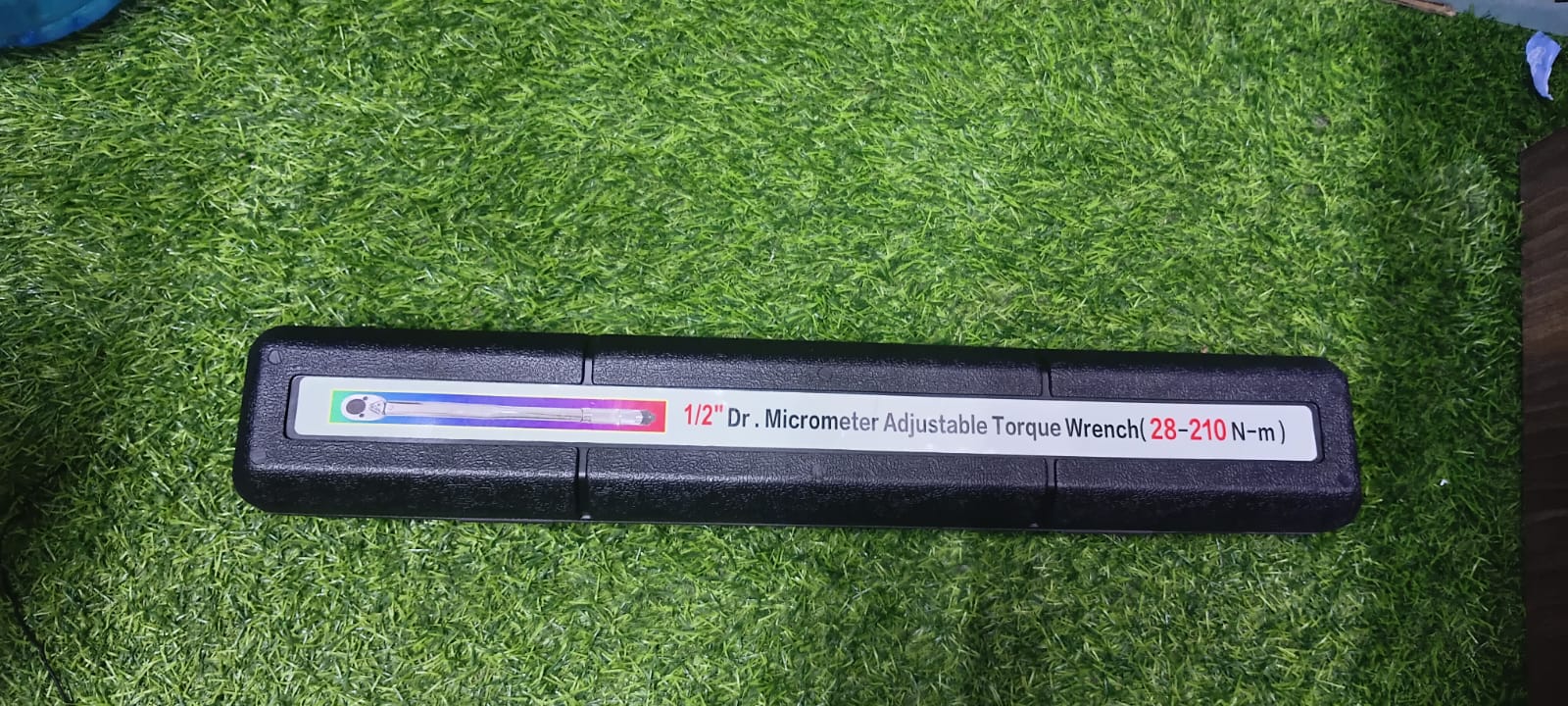
A popular model for Kenyan garages is the 1/2-inch drive adjustable click-type torque wrench with a 28–210Nm range. Current models in this class use a micrometer-style adjustment, reversible ratchet head, engraved torque scale and Chrome Vanadium steel construction. Many are factory calibrated to approximately ±4% accuracy.
This makes the wrench useful for wheel nuts, vehicle servicing, suspension work, machinery maintenance, generators, agricultural equipment and other jobs where correct bolt tightening matters.
Manual Torque Wrench Specifications
| Feature | Specification |
|---|---|
| Product | Manual Torque Wrench |
| Type | Click-Type / Micrometer Adjustable |
| Drive Size | 1/2 Inch / 12.7mm |
| Torque Range | 28–210Nm |
| Approx. Imperial Range | 20–155 ft-lb |
| Accuracy | Approximately ±4% on comparable models |
| Ratchet | Reversible |
| Material | Chrome Vanadium Steel |
| Adjustment | Rotating Micrometer Handle |
| Torque Alert | Audible and Tactile Click |
| Scale | Engraved / Laser-Marked |
| Typical Length | About 45cm / 18 Inches |
| Handle | Knurled Anti-Slip Grip on comparable models |
| Storage | Protective Carry Case |
| Main Use | Controlled Fastener Tightening |
| Best For | Automotive, Garage, Machinery and Maintenance |
A current VITO 1/2-inch model confirms the 28–210Nm range, Cr-V construction, reversible ratchet, engraved scale, storage box and factory calibration within a 4% tolerance.
Wide 28–210Nm Torque Range
The adjustable 28 to 210Nm range gives this manual torque wrench enough flexibility for many medium and heavy fastening jobs.
It can be used for suitable:
- Car wheel nuts
- Suspension bolts
- Engine fasteners
- Motorcycle components
- Generators
- Water pumps
- Farm machinery
- Workshop machines
- Construction equipment
- General mechanical maintenance
The correct torque must always come from the vehicle, machine or component manufacturer.
What Does Nm Mean?
Nm means Newton-metre, the standard unit commonly used to specify tightening torque.
Torque describes the turning force applied to a fastener.
For example, if a manufacturer specifies that a wheel nut should be tightened to 110Nm, the torque wrench can be adjusted to 110Nm before final tightening.
This is more controlled than tightening the nut until it simply feels tight.
Approximately 20–155 ft-lb Range
The 28–210Nm range is approximately equivalent to:
20–155 ft-lb
This is useful when working with service manuals that specify torque in foot-pounds rather than Newton-metres.
Some current 1/2-inch torque wrench listings show both scales directly on the wrench.
Click-Type Torque Mechanism
The main feature of this wrench is its click mechanism.
You first select the required torque.
As you tighten the fastener, the wrench applies increasing torque.
When the selected value is reached, the mechanism produces a noticeable:
CLICK
You may both hear and feel it.
Once the wrench clicks, stop applying force.
A current 28–210Nm micrometer wrench listing confirms that the click alerts the operator when the preset torque has been reached.
Why Correct Torque Matters
Correct tightening helps prevent two opposite problems.
Under-Tightening
A bolt that is too loose may:
- Vibrate loose
- Cause leakage
- Allow parts to move
- Damage components
- Create a safety risk
Over-Tightening
Too much torque can:
- Stretch bolts
- Strip threads
- Damage wheel studs
- Crack components
- Distort parts
- Make later removal difficult
A torque wrench gives the mechanic a measurable tightening target instead of relying only on hand feel.
±4% Accuracy on Comparable Models
Accuracy is one of the most important specifications when buying a manual torque wrench.
Current 28–210Nm models are available with approximately ±4% factory-calibrated accuracy.
For example, if a wrench is set to 100Nm, a ±4% specification represents a tolerance of approximately 4Nm under the stated calibration conditions.
The exact accuracy direction and calibration standard depend on the individual manufacturer.
1/2-Inch Square Drive
The wrench uses a standard:
1/2-inch / 12.7mm square drive
This is one of the most common socket sizes in automotive workshops.
It accepts compatible 1/2-inch sockets for different bolt and nut sizes.
This drive size is especially practical for:
- Car wheel nuts
- Light trucks
- Suspension work
- Large engine fasteners
- Machinery
- Agricultural equipment
For very small fasteners, a 1/4-inch or 3/8-inch torque wrench is normally more suitable.
Chrome Vanadium Steel Construction
Comparable manual torque wrenches use Chrome Vanadium steel, commonly shortened to Cr-V.
VITO’s current 28–210Nm wrench specifically uses a Cr-V steel body.
This material provides good strength and resistance to normal workshop wear.
It is widely used for:
- Spanners
- Sockets
- Ratchets
- Torque wrenches
- Other hand tools
Reversible Ratchet Head
A reversible ratchet allows the wrench head to rotate in either direction for positioning and suitable tightening operations.
A direction lever on the head changes ratchet direction.
The VITO 28–210Nm model specifically provides a reversible ratchet for clockwise and counter-clockwise operation.
However, do not assume the wrench’s stated torque accuracy is identical in both directions unless the manufacturer specifically certifies it for both.
Micrometer Adjustment Handle
The torque setting is adjusted from the handle.
A typical micrometer wrench has:
- Main torque scale
- Rotating handle scale
- Centre reference line
- Locking mechanism
The user unlocks the handle, rotates it until the required torque is shown and then locks the setting.
This prevents the setting from changing easily during use.
Easy-to-Read Engraved Scale
A good manual torque wrench has a permanent torque scale engraved or laser-marked onto the tool.
VITO’s current model uses an engraved torque scale, while other current 28–210Nm models use laser-marked scales.
Permanent markings are preferable to printed labels that can wear away after regular workshop use.
How to Set a Manual Torque Wrench
Suppose you need 100Nm.
First unlock the handle.
Rotate the handle until the main scale approaches the required value.
Then use the micrometer scale on the handle for fine adjustment.
One 28–210Nm wrench manual gives an example where the main scale is set to 98Nm and the rotating scale adds 2Nm:
98Nm + 2Nm = 100Nm.
Lock the handle after setting the value.
How to Use the Torque Wrench
Fit the correct 1/2-inch socket onto the square drive.
Set the torque recommended by the manufacturer.
Place the socket fully onto the nut or bolt.
Hold the wrench by its proper handle area.
Pull smoothly and steadily.
When you feel or hear the click, stop pulling.
Do not keep tightening repeatedly after the first clear click.
Best for Wheel Nut Tightening
One of the most common applications is final tightening of vehicle wheel nuts.
A mechanic may initially fit and lightly tighten the wheel nuts, then use the torque wrench for final tightening according to the vehicle manufacturer’s specification.
This provides more controlled tightening than relying on an impact wrench alone.
Torque Wrench vs Impact Wrench
| Feature | Manual Torque Wrench | Impact Wrench |
|---|---|---|
| Main Purpose | Accurate final tightening | Fast tightening/removal |
| Power Source | Manual | Electric, Battery or Air |
| Adjustable Torque | Precise on calibrated model | Less precise for final torque |
| Click Feedback | Yes | No |
| Wheel Removal | Slow | Fast |
| Final Wheel Tightening | Excellent | Torque wrench preferred |
| Battery Required | No | Cordless models do |
| Calibration | Important | Different operating principle |
The tools work well together.
An impact wrench can quickly remove and initially install nuts. The torque wrench can then provide controlled final tightening.
Torque Wrench vs Ordinary Ratchet
An ordinary ratchet is designed to turn nuts and bolts.
It does not accurately tell you when a specific tightening torque has been reached.
A torque wrench adds a calibrated mechanism that responds at a preset value.
This makes it the better tool when a service manual gives an exact torque specification.
Suitable for Car Mechanics
A 1/2-inch manual torque wrench is particularly useful in automotive workshops.
Applications can include:
- Wheel nuts
- Suspension bolts
- Brake components
- Engine mounts
- Selected engine fasteners
- Axle components
Always check the correct tightening specification for the exact vehicle.
Do not copy a torque value from a different vehicle simply because the bolt appears similar.
Suitable for Motorcycles
The wrench can also be useful for larger motorcycle fasteners.
However, many motorcycle and engine bolts require torque below 28Nm.
For these smaller fasteners, use a lower-range:
1/4-inch or 3/8-inch torque wrench.
A wrench is generally most useful when the required value sits comfortably within its operating range.
Suitable for Machinery
A manual torque wrench can also be used during servicing and assembly of:
- Generators
- Water pumps
- Compressors
- Farm machinery
- Construction machines
- Workshop equipment
Correct bolt torque can be especially important on equipment exposed to vibration.
45cm Handle on Common Models
A current 28–210Nm model sold in Kenya has a length of approximately:
18 inches / 45cm.
The longer handle provides leverage when tightening higher-torque fasteners.
This helps the operator reach values above 150Nm without needing an extremely short, difficult pull.
Knurled Anti-Slip Handle
Some models use an all-steel knurled handle.
The textured surface improves grip, especially when the user’s hands or gloves are slightly oily.
A current 28–210Nm Kenyan listing specifies a steel knurled non-slip handle.
Protective Carry Case
A protective case is commonly included.
The case protects the torque wrench during:
- Storage
- Transportation
- Mobile repair work
- Workshop organization
VITO’s 28–210Nm model is supplied with a storage box.
Because a torque wrench is a calibrated measuring tool, it should not be thrown loosely into a toolbox with hammers and heavy equipment.
Available Kit with 17mm and 19mm Sockets
Some 28–210Nm torque wrench packages include useful automotive accessories.
A current Kenyan kit contains:
1 × 1/2-inch torque wrench
1 × 5-inch extension
1 × 17mm socket
1 × 19mm socket
1 × carry case
The 17mm and 19mm sockets are useful for many vehicle applications, although actual wheel-nut size varies by vehicle.
Straight Extension Bar
A straight extension can help reach recessed fasteners.
A current Kenyan 28–210Nm package includes a 5-inch extension bar.
A straight inline socket extension generally does not change the effective lever arm in the same way as an offset crowfoot adapter.
Offset adapters require more care because they can change the effective wrench length and therefore the applied torque.
Do Not Use It as a Breaker Bar
A torque wrench is a measuring tool.
It should not normally be used to break extremely tight or rusted bolts loose.
For stubborn fasteners, use a:
- Breaker bar
- Strong ratchet
- Impact wrench
Then use the torque wrench when tightening the fastener to its final specified value.
This helps protect the torque wrench’s internal calibration mechanism.
Do Not Use It as a Hammer
Never strike another object with a torque wrench.
Do not hit the wrench with a hammer to increase force.
Shock loading can damage the internal mechanism and affect accuracy.
Do Not Use a Cheater Pipe
Avoid putting a long pipe over the handle to create extra leverage.
If the required torque is above 210Nm, use a torque wrench with a higher rated range.
Heavy-duty models are available for applications requiring 300Nm, 500Nm or more.
Store It at the Minimum Setting
After using an adjustable click-type torque wrench, reduce the setting to the manufacturer’s recommended storage position.
For the current VITO model, the manufacturer instructs users to return the wrench to its minimum torque setting after use to help preserve calibration.
Do not force the handle below its lowest marked setting.
Why You Should Not Leave It at 210Nm
Leaving an adjustable click wrench at a high setting for long periods can keep its internal spring under unnecessary compression.
Returning it to the manufacturer’s specified minimum setting helps maintain the mechanism.
This is particularly important when the wrench will remain unused for weeks or months.
Calibration Matters
Torque wrenches can lose accuracy over time.
Calibration should be checked according to:
- Manufacturer instructions
- Frequency of use
- Workshop quality procedures
- Calibration standard
- Tool condition
A calibration check is also wise if the wrench:
- Is dropped
- Is overloaded
- Stops clicking consistently
- Gives questionable results
Professional workshops should maintain suitable calibration records where controlled torque is critical.
Manual vs Digital Torque Wrench
| Feature | Manual Click Wrench | Digital Torque Wrench |
|---|---|---|
| Power | No Battery Required | Battery |
| Torque Alert | Click | Beep/Light/Vibration |
| Display | Mechanical Scale | Digital Screen |
| Ease of Use | Simple | Very Easy |
| Electronics | None | Yes |
| Workshop Durability | Very Good | Good |
| Price | Lower | Higher |
| Data Storage | No | Available on Some Models |
A manual wrench remains popular because it is simple, durable and does not depend on batteries.
1/2-Inch vs 3/8-Inch Torque Wrench
| Feature | 3/8-Inch | 1/2-Inch |
|---|---|---|
| Typical Jobs | Light/Medium | Medium/Heavy |
| Engine Work | Excellent | Good for Larger Bolts |
| Motorcycle Work | Excellent | Larger Fasteners |
| Wheel Nuts | Limited on Some Models | Excellent |
| Heavy Machinery | Limited | Better |
| Typical Torque Range | Lower | Higher |
For general car garages, the 1/2-inch drive is one of the most useful sizes.
28–210Nm vs 40–200Nm Torque Wrench
Both ranges are common.
| Feature | 28–210Nm | 40–200Nm |
|---|---|---|
| Minimum Setting | 28Nm | 40Nm |
| Maximum Setting | 210Nm | 200Nm |
| Range Width | Wider | Narrower |
| Wheel Nuts | Excellent | Excellent |
| Medium Fasteners | More Flexible | Good |
| General Garage Use | Excellent | Excellent |
The 28–210Nm model provides slightly more range at both ends.
Manual Torque Wrench Package Contents
A basic package commonly contains the torque wrench and protective case.
A more complete automotive set may include:
- 1/2-inch manual torque wrench
- 17mm socket
- 19mm socket
- 5-inch extension bar
- Protective storage case
Current Kenyan 28–210Nm sets are available with exactly this combination.
Benefits of a Manual Torque Wrench
The main benefits include controlled bolt tightening, no batteries, easy adjustment, wide 28–210Nm range, standard 1/2-inch socket compatibility and approximately ±4% accuracy on calibrated models.
Its simple mechanical construction also makes it convenient for garages, mobile mechanics, farms and workshops.
How to Choose a Manual Torque Wrench
Before buying, check the torque range, drive size, stated accuracy, calibration information, ratchet direction, scale readability and supplied accessories.
For general automotive work, a 1/2-inch click-type model covering around 28–210Nm offers a useful range.
For low-torque engine and motorcycle work, add a smaller torque wrench rather than attempting to use a large 1/2-inch model below its rated range.
Manual Torque Wrench Price in Kenya
Current Kenyan prices vary according to brand, accuracy and included accessories.
A basic 1/2-inch 28–210Nm micrometer torque wrench is currently listed at about KSh 4,200, while Nairobi listings for comparable models are around KSh 5,499 to KSh 5,999. A complete set with extension and 17mm/19mm sockets is listed at about KSh 8,049.
| Manual Torque Wrench Type | Approx. 2026 Kenya Price |
|---|---|
| Basic 1/2″ Adjustable Wrench | KSh 3,800–5,000 |
| 28–210Nm Micrometer Wrench | KSh 4,200–6,000 |
| Wrench with Extension & Sockets | Around KSh 5,800–8,100 |
| Higher-Priced 28–210Nm Listings | KSh 8,000–11,500 |
| Professional Branded Models | KSh 10,000+ |
Prices vary by seller, calibration, material, brand and accessories. One current Kilimall listing for a 28–210Nm wrench with 5-inch extension and 17mm/19mm sockets is KSh 8,049.
Why Buy a Manual Torque Wrench?
A manual torque wrench in Kenya is an important tool for mechanics and technicians who need controlled, repeatable bolt tightening.
The popular 1/2-inch 28–210Nm click-type model provides enough range for many automotive, machinery and maintenance jobs while remaining easy to operate.
With features such as approximately ±4% accuracy, Cr-V steel construction, reversible ratchet, micrometer adjustment, engraved scale and protective storage case, it offers a practical combination of precision and durability.
For vehicle servicing, it is especially valuable for final tightening of wheel nuts and other fasteners where the manufacturer gives an exact torque specification.
Frequently Asked Questions
What is a manual torque wrench?
A manual torque wrench is a hand tool used to tighten a nut or bolt to a selected torque value.
What torque range does this wrench have?
A common model has an adjustable range of 28–210Nm, equivalent to roughly 20–155 ft-lb.
What drive size does it use?
It uses a 1/2-inch or 12.7mm square drive, compatible with suitable 1/2-inch sockets.
How accurate is the torque wrench?
Comparable factory-calibrated 28–210Nm models are rated at approximately ±4% tolerance.
How do I know when the correct torque is reached?
The click-type mechanism produces an audible and tactile click when the selected torque is reached. Stop applying force at the first clear click.
Can I use it for wheel nuts?
Yes. A 1/2-inch 28–210Nm wrench is well suited to many vehicle wheel nuts, provided the vehicle manufacturer’s specified torque falls within the wrench’s range.
Can I use it to loosen wheel nuts?
It is better to loosen very tight wheel nuts with a breaker bar or impact wrench. Use the torque wrench mainly for controlled final tightening.
Does it require batteries?
No. A manual click-type torque wrench operates mechanically and does not need batteries or electricity.
Does it come with sockets?
It depends on the package. Some current sets include 17mm and 19mm sockets plus a 5-inch extension bar and carry case.
Is it reversible?
Yes. Comparable 28–210Nm models use a reversible ratchet mechanism.
What material is it made from?
Many quality models use Chrome Vanadium steel, commonly called Cr-V.
Should I store the torque wrench at zero?
Follow the manufacturer’s instructions. For the referenced VITO click-type wrench, the manufacturer says to return it to its minimum torque setting after use. Do not force an adjustable wrench below its marked minimum.
Can I use an extension bar with a torque wrench?
Yes. A straight socket extension can be used where required. Some current kits include a 5-inch extension. Offset adapters such as crowfoot attachments may alter effective torque and can require calculation.
Is a torque wrench better than an impact wrench?
They perform different jobs. An impact wrench is faster for removing and installing fasteners, while a calibrated torque wrench is better for controlled final tightening.
What is the price of a manual torque wrench in Kenya?
A standard 1/2-inch 28–210Nm manual torque wrench currently costs roughly KSh 4,000 to KSh 8,000 in many Kenyan listings. Kits with sockets, extensions or higher-spec calibration can cost more.


Reviews
There are no reviews yet.