
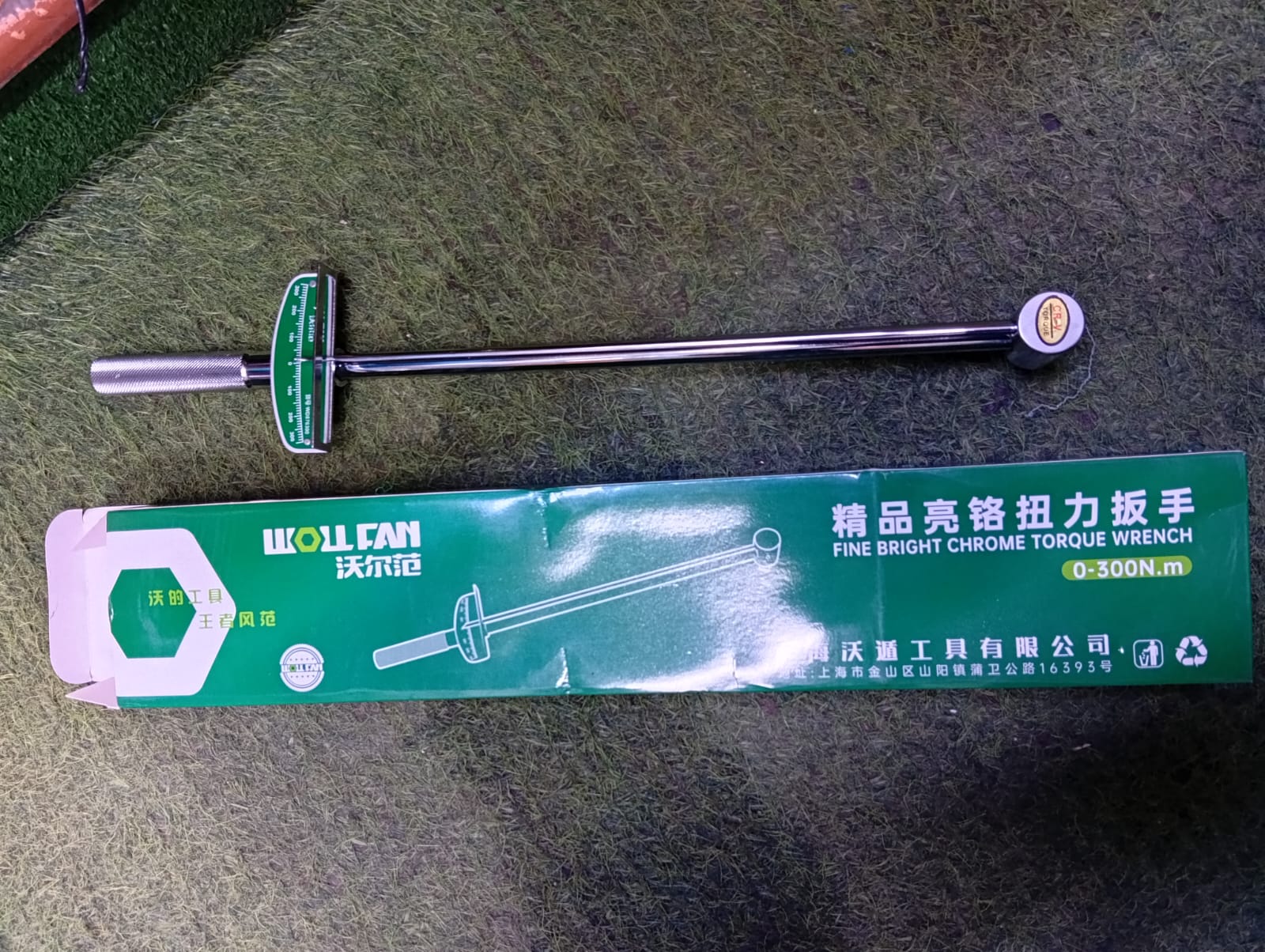
Description

A manual torque wrench is a precision hand tool used to tighten nuts and bolts to a specific torque value. It prevents a fastener from being left too loose or tightened beyond the recommended limit.
The tool is commonly used when servicing vehicles, motorcycles, generators, industrial machines, bicycles, pumps and construction equipment. It is especially important for wheel nuts, engine bolts, cylinder heads, suspension parts and other fasteners that require controlled tightening.
The most common model in Kenyan garages is the 1/2-inch drive click-type torque wrench. A typical version covers approximately 40 to 210 Nm, making it suitable for wheel nuts and many medium-duty automotive repairs. Current local listings include 1/2-inch 40–210 Nm models from brands such as Kendo and Tolsen.
Quick Specifications
| Feature | Typical specification |
|---|---|
| Product name | Manual torque wrench |
| Common type | Adjustable click type |
| Common drive size | 1/2 inch |
| Common torque range | 40–210 Nm |
| Other available ranges | 5–25 Nm, 10–60 Nm, 20–100 Nm, 50–500 Nm |
| Measurement units | Nm, kgf·m, lbf·ft or lbf·in |
| Ratchet direction | Reversible on many models |
| Scale type | Engraved dual scale |
| Common accuracy | Approximately ±3% to ±4% |
| Head type | Ratcheting square drive |
| Construction | Chrome-vanadium or alloy steel |
| Handle | Knurled steel or non-slip grip |
| Storage | Plastic carrying case |
| Main use | Controlled tightening of fasteners |
Specifications vary by model. The correct torque range and drive size should be selected according to the job.
What Is Torque?
Torque is the turning force applied to a nut or bolt.
It is commonly measured in:
- Newton metres, written as Nm
- Pound-feet, written as lbf·ft or ft-lb
- Pound-inches, written as lbf·in
- Kilogram-force metres, written as kgf·m
For example, when a vehicle manufacturer states that a wheel nut should be tightened to 110 Nm, the torque wrench should be adjusted to 110 Nm before final tightening.
Using the correct torque helps produce enough clamping force without stretching, stripping or breaking the bolt.
Main Features of a Manual Torque Wrench
Adjustable torque setting
An adjustable torque wrench allows the user to select the required tightening value.
A common 1/2-inch model may be adjusted between:
- 40 Nm minimum
- 210 Nm maximum
Other models cover different ranges.
Examples include:
| Drive size | Common torque range | Typical use |
|---|---|---|
| 1/4 inch | 2–25 Nm | Bicycles, electronics and small engine bolts |
| 3/8 inch | 10–100 Nm | Motorcycles and medium fasteners |
| 1/2 inch | 40–210 Nm | Wheel nuts and automotive repairs |
| 1/2 inch heavy-duty | 50–500 Nm | Trucks and industrial equipment |
| 3/4 inch | 100–700 Nm or more | Heavy vehicles and large machinery |
A 1/2-inch click wrench with a 40–200 Nm range is a common professional configuration.
Audible and physical click
The click mechanism is one of the most important features.
When the selected torque is reached, the wrench produces:
- An audible click
- A movement or release that can be felt through the handle
The user should stop applying force immediately after the first clear click.
Continuing to pull after the click can overtighten the bolt. Manufacturer instructions for click-type wrenches recommend applying steady pressure and releasing the tool as soon as the click is heard or felt.
Dual measurement scale
Many manual torque wrenches display two measurement systems, such as:
- Nm and lbf·ft
- Nm and kgf·m
- lbf·in and Nm
A dual scale makes the tool suitable for vehicles and machines whose service manuals use different units.
The markings should be:
- Easy to read
- Permanently engraved
- Clearly numbered
- Protected from rapid wear
Micrometre-style adjustment
A click torque wrench normally has two scale sections.
The main body scale shows larger torque steps. The rotating handle or micrometre scale provides smaller adjustments.
To select the torque:
- Unlock the handle.
- Rotate it until the required main scale is reached.
- Continue rotating to align the smaller scale.
- Lock the handle before use.
This arrangement allows more accurate adjustment than estimating tightness with an ordinary ratchet.
Locking handle
The handle normally has a locking mechanism that prevents the setting from changing during use.
Depending on the model, it may use:
- Pull-down locking ring
- Twist lock
- Push-pull collar
- Locking screw
- Spring-loaded knob
Always check that the handle is fully locked before tightening a fastener.
Reversible ratchet head
Most models have a direction lever on the ratchet head.
It allows the socket to turn:
- Clockwise
- Anticlockwise
However, not every torque wrench measures torque accurately in both directions. Some tools are calibrated only for clockwise tightening.
The instructions or calibration certificate should confirm whether the tool can measure in both directions.
Strong square drive
The square drive holds sockets and accessories.
Common drive sizes are:
- 1/4 inch
- 3/8 inch
- 1/2 inch
- 3/4 inch
- 1 inch
A 1/2-inch drive is commonly used for cars, SUVs, pickups and many workshop applications.
Hardened steel construction
Quality torque wrenches are commonly made using:
- Chrome-vanadium steel
- Chrome-molybdenum steel
- Hardened alloy steel
- Heat-treated tool steel
The polished or chrome-plated surface helps resist corrosion and makes cleaning easier.
Comfortable long handle
A long handle provides enough leverage to reach the selected torque without excessive effort.
A standard 1/2-inch torque wrench may be approximately 450 to 500 mm long. Professional higher-torque models are usually longer.
The grip may feature:
- Knurled steel
- Rubber coating
- Bi-material construction
- Textured plastic
Calibration certificate
Selected torque wrenches come with an individual calibration or test certificate.
The document may show:
- Tool serial number
- Tested torque points
- Measured results
- Permitted error
- Test date
- Applicable standard
ISO 6789-1:2017 and ISO 6789-2:2017 cover requirements and calibration procedures for hand torque tools.
Common Types of Manual Torque Wrenches
Click-type torque wrench
This is the most common adjustable manual model.
The internal spring mechanism releases slightly when the selected value is reached.
Advantages include:
- Easy operation
- Clear click
- Adjustable range
- Suitable for workshop use
- No batteries required
- Wide availability
It is commonly used for wheel nuts, brakes, suspension and engine components.
Beam torque wrench
A beam wrench has a long metal beam and pointer scale.
As force is applied, the beam bends and the pointer shows the torque value.
Advantages include:
- Simple construction
- No internal spring
- Low maintenance
- Easy visual reading
Limitations include:
- The scale must be watched during tightening.
- It may be difficult to read in restricted spaces.
- The operator must pull smoothly and stop at the correct value.
Dial torque wrench
A dial torque wrench displays the applied torque on a round gauge.
It is suitable for:
- Inspection
- Torque testing
- Research
- Quality control
- Precision assembly
Dial models are often more expensive than standard click wrenches.
Deflecting-beam torque wrench
This design measures the amount of beam deflection and releases or signals at the selected torque.
It is durable and does not rely on a heavily preloaded internal coil spring.
Preset torque wrench
A preset wrench is adjusted to one specific value.
It is commonly used in production lines where the same bolt is tightened repeatedly.
The setting may require a special adjustment tool to prevent unauthorized changes.
Break-over torque wrench
The handle breaks or pivots noticeably when the set value is reached.
This reduces the risk of continuing to apply torque after the target has been achieved.
Applications of a Manual Torque Wrench
Wheel nut tightening
A torque wrench is widely used for vehicle wheel nuts.
Correct wheel-nut tightening helps:
- Secure the wheel
- Reduce uneven clamping
- Protect wheel studs
- Reduce brake-disc distortion
- Make later removal easier
The required value varies by vehicle. Always use the figure stated in the owner’s or workshop manual.
Engine assembly
A torque wrench is used on:
- Cylinder-head bolts
- Main bearing caps
- Connecting-rod bolts
- Camshaft bearing caps
- Rocker covers
- Intake manifolds
- Exhaust manifolds
- Flywheel bolts
- Crankshaft pulleys
Some modern engine fasteners use a torque-plus-angle procedure. These bolts may first be tightened to a specified Nm value and then turned through an additional angle using a torque-angle gauge.
Suspension repairs
Suitable applications include:
- Control-arm bolts
- Shock-absorber mounts
- Ball-joint fasteners
- Stabilizer links
- Hub nuts
- Subframe bolts
- Leaf-spring mounting bolts
Brake servicing
The tool may be used for:
- Brake caliper bolts
- Caliper brackets
- Disc mounting bolts
- Wheel-cylinder fittings
- Brake hose connections
Brake parts should be tightened to the manufacturer’s exact specification.
Motorcycle maintenance
A smaller 1/4-inch or 3/8-inch wrench is suitable for many motorcycle fasteners.
Applications include:
- Engine covers
- Spark plugs
- Axle clamps
- Brake calipers
- Handlebar mounts
- Sprocket bolts
Bicycle repair
Low-range torque wrenches help protect lightweight bicycle parts, especially carbon-fibre components.
Common bicycle tools cover ranges such as 2.5–25 Nm.
Generator and machine servicing
Manual torque wrenches are useful for:
- Generator engine bolts
- Alternator mounts
- Pump housings
- Compressor heads
- Flange connections
- Bearing housings
- Industrial machine assembly
Solar and electrical work
Selected electrical and solar components have defined terminal torque values.
A low-range torque wrench or torque screwdriver can be used for:
- Battery terminals
- Busbar connections
- Inverter terminals
- Circuit breakers
- Distribution panels
- Solar mounting bolts
How to Use a Manual Torque Wrench
Step 1: Find the correct torque specification
Check the vehicle or equipment manual.
Do not estimate the required torque based only on bolt size. The correct value can depend on:
- Bolt grade
- Thread pitch
- Material
- Lubrication
- Washer type
- Joint design
- Manufacturer requirements
Step 2: Select the correct wrench
The required setting should fall comfortably inside the wrench’s working range.
Avoid using a 40–210 Nm wrench for a fastener requiring only 10 Nm.
Step 3: Inspect the tool
Check for:
- Cracked housing
- Damaged square drive
- Loose ratchet head
- Worn scale markings
- Bent handle
- Faulty lock
- Expired calibration
Step 4: Fit the correct socket
Use a socket that fits the nut or bolt properly.
A loose or worn socket can round the fastener.
Step 5: Tighten the fastener lightly first
Use an ordinary ratchet or spanner to bring the fastener close to its final position.
Do not use the torque wrench to tighten a bolt through many turns unless necessary.
Step 6: Unlock the handle
Release the adjustment lock.
Step 7: Set the required torque
Rotate the handle until the correct reading is shown on the main and micrometre scales.
For example, to set 110 Nm:
- Rotate the handle to the nearest main scale below 110 Nm.
- Continue rotating until the small scale adds the remaining value.
- Align the markings carefully.
- Lock the handle.
Follow the exact scale system supplied with the tool.
Step 8: Position your hand correctly
Hold the wrench at the marked grip area.
Do not hold it near the ratchet head because this may affect the applied torque.
Step 9: Pull smoothly
Apply a slow, steady force at approximately 90 degrees to the wrench handle.
Do not:
- Jerk the handle
- Bounce on it
- Use a pipe extension
- Pull from the middle
- Apply sideways pressure
Step 10: Stop at the first click
Stop pulling immediately when the wrench clicks.
Repeating the click several times may increase the final tightening force.
Step 11: Follow the tightening sequence
Components with several bolts may require a specific pattern.
Examples include:
- Star pattern for wheel nuts
- Criss-cross pattern for cylinder heads
- Centre-outward pattern for covers and flanges
Tightening may also be completed in two or three stages.
Step 12: Return the setting after use
For an adjustable click-type wrench, reduce the setting to the manufacturer’s recommended storage value.
This is normally the lowest marked setting, not below the scale or completely loose.
Common Torque Wrench Mistakes
Using it as a breaker bar
A torque wrench should not normally be used to loosen seized nuts.
The extra force may damage its calibration mechanism.
Use a breaker bar for loosening and the torque wrench for final tightening.
Continuing after the click
The first click means the target setting has been reached.
Repeated pulling can overtighten the fastener.
Using the wrong torque unit
Confusing Nm with lbf·ft can cause serious over-tightening or under-tightening.
For reference:
| Unit | Approximate relationship |
|---|---|
| 1 Nm | 0.738 lbf·ft |
| 1 lbf·ft | 1.356 Nm |
| 1 kgf·m | 9.807 Nm |
Use the scale printed on the tool or a reliable conversion method.
Using adapters incorrectly
Extensions and drive reducers may change the tool setup.
A straight socket extension normally does not change the applied torque significantly. However, an offset crowfoot or special extension changes the effective wrench length and may require a torque calculation.
Setting outside the scale
Do not rotate the handle beyond the marked minimum or maximum values.
Dropping the tool
A hard impact can affect calibration even when there is no visible damage.
The wrench should be inspected or recalibrated after a serious drop.
Storing it at a high setting
Leaving a click wrench compressed at a high value for a long period can affect the internal spring.
Using the wrong drive size
Small-drive tools should not be overloaded using large adapters.
Choose a wrench designed for the required torque.
Manual Torque Wrench Versus Ordinary Ratchet
| Feature | Manual torque wrench | Ordinary ratchet |
|---|---|---|
| Controls tightening torque | Yes | No |
| Adjustable setting | Yes | No |
| Signals target torque | Yes | No |
| Suitable for final tightening | Excellent | Limited |
| Suitable for loosening tight bolts | Usually no | Yes |
| Calibration required | Yes | No |
| Cost | Higher | Lower |
An ordinary ratchet is useful for assembling and loosening. A torque wrench is used for accurate final tightening.
Manual Torque Wrench Versus Impact Wrench
| Feature | Manual torque wrench | Impact wrench |
|---|---|---|
| Power source | Hand operated | Battery, electricity or air |
| Tightening control | High | Limited unless specially controlled |
| Speed | Slower | Fast |
| Final accurate torque | Excellent | Not recommended alone |
| Nut removal | Limited | Excellent |
| Calibration | Required | Normally not used as measuring tool |
| Best use | Final controlled tightening | Fast removal and initial fitting |
An impact wrench can install wheel nuts quickly, but final tightening should be completed using a calibrated torque wrench.
Calibration and Accuracy
Torque wrenches are precision measuring tools.
Their accuracy can be affected by:
- Heavy use
- Overloading
- Dropping
- Corrosion
- Poor storage
- Worn ratchet parts
- Internal spring changes
- Incorrect handling
A professional workshop should follow a documented inspection and calibration schedule.
ISO 6789:2017 separates requirements for torque-tool design and conformity testing from the detailed calibration and measurement-uncertainty procedures.
Some manufacturers recommend recalibration every six months or after a defined number of operating cycles, while the correct interval depends on use, workplace rules and tool condition. Snap-on guidance notes that periodic recalibration is required and references 5,000 cycles as an accuracy-performance benchmark for mechanical click-type tools under an older ASME standard.
Calibration should also be considered after:
- A serious drop
- Accidental overloading
- Repair
- Exposure to water
- Long storage
- Inconsistent clicking
- Questionable tightening results
Maintenance Tips
Clean after use
Wipe the wrench with a clean cloth.
Remove:
- Oil
- Grease
- Brake dust
- Metal particles
- Workshop dirt
Do not soak the tool in cleaning fluid.
Keep it dry
Store the wrench away from:
- Rain
- High humidity
- Battery acid
- Brake fluid
- Corrosive chemicals
Protect the ratchet head
Apply only the lubricant recommended by the manufacturer.
Too much grease may trap dirt.
Return it to the storage setting
Reduce the adjustable setting after use according to the instruction manual.
Store in the carrying case
The case protects the wrench from:
- Impact
- Dust
- Moisture
- Tool-box damage
- Accidental adjustment
Inspect the socket drive
Do not use the wrench when the drive square or socket-retaining mechanism is badly worn.
How to Choose the Best Manual Torque Wrench
Choose the correct torque range
Select a range that covers your common jobs.
For wheel nuts and normal automotive work, 40–210 Nm is a practical range.
For smaller engine and motorcycle fasteners, add a lower-range wrench such as 10–60 Nm.
Choose the right drive size
A 1/2-inch drive is suitable for:
- Wheel nuts
- Suspension bolts
- Engine mounts
- Medium and large automotive fasteners
A 3/8-inch drive is better for medium-sized bolts, while 1/4-inch tools suit small precision work.
Check the accuracy
Many general click-type models claim accuracy around ±4%. Better professional models may offer approximately ±3% or better, depending on direction and torque range.
For example, a documented Teng Tools 40–210 Nm wrench is rated at ±4%, while other modern professional models specify tighter tolerances.
Look for a calibration certificate
A certificate provides greater confidence that the tool was tested before sale.
Check whether the serial number on the certificate matches the wrench.
Check the scale readability
Choose large, clear and permanent markings.
A dark scale that cannot be read easily can lead to incorrect settings.
Confirm clockwise and anticlockwise operation
A reversible ratchet does not always mean the wrench measures torque in both directions.
Check the manufacturer’s instructions.
Inspect the handle lock
The locking mechanism should hold the selected setting firmly.
Check socket availability
Make sure sockets matching the square drive are easy to obtain.
Consider the case quality
A strong carrying case protects the calibration tool during transport and storage.
Manual Torque Wrench Price in Kenya
Current Kenyan listings show standard 1/2-inch manual click torque wrenches at about KSh 5,000 to KSh 6,500. A Kendo 40–210 Nm wrench is listed at KSh 5,850, while a Tolsen 40–210 Nm kit with an extension bar is listed at KSh 6,499.
| Torque-wrench type | Estimated price in Kenya |
|---|---|
| Basic 1/4-inch low-range wrench | KSh 3,500–7,000 |
| Standard 1/2-inch 40–210 Nm wrench | KSh 5,000–8,000 |
| Manual wrench with sockets and extension | KSh 6,500–12,000 |
| Professional calibrated click wrench | KSh 12,000–35,000 |
| Heavy-duty 50–500 Nm wrench | KSh 15,000–45,000 |
| Dial or industrial torque wrench | KSh 25,000–80,000+ |
A Kenyan automotive-tool supplier currently lists calibrated click wrenches in ranges including 10–60 Nm, 20–210 Nm and 50–500 Nm, with listed prices starting around KSh 5,000 depending on the selected model.
Prices vary according to:
- Brand
- Torque range
- Drive size
- Accuracy
- Calibration certificate
- Included sockets
- Extension bar
- Carrying case
- Warranty
- Retailer
- Delivery location
Package Contents
A normal package may include:
- One adjustable manual torque wrench
- Plastic storage case
- Calibration or test certificate
- User instructions
Selected kits may also include:
- Socket extension
- Drive adapter
- Wheel-nut sockets
- Reducer
- Torque-angle gauge
Check the exact package before purchase because accessories differ between brands.
Why Buy a Manual Torque Wrench?
A manual torque wrench helps tighten fasteners accurately instead of relying on guesswork. It reduces the risk of loose wheel nuts, stripped threads, stretched bolts, damaged aluminium parts and uneven clamping.
The tool is useful for garages, tyre centres, mechanics, fleet operators, motorcycle technicians, generator repairers and serious vehicle owners.
A 1/2-inch model covering approximately 40–210 Nm is suitable for many vehicle wheel nuts and medium-duty repairs. Smaller or larger torque ranges should be selected for precision components and heavy machinery.
For dependable results, always use the correct manufacturer torque specification, pull the handle smoothly, stop at the first click and keep the wrench properly calibrated.
Frequently Asked Questions
What is a manual torque wrench used for?
It is used to tighten nuts and bolts to a specified torque value.
What is the best torque wrench for wheel nuts?
A 1/2-inch click-type wrench with a range around 40–210 Nm is suitable for many cars, SUVs and pickups. Always confirm the vehicle’s required torque.
What happens when the correct torque is reached?
A click-type wrench produces a sound and a small physical release that can be felt through the handle.
Should I click a torque wrench several times?
No. Stop after the first clear click. Repeated clicking may apply additional force.
Can a torque wrench loosen bolts?
It should generally not be used as a breaker bar. Use an ordinary ratchet or breaker bar to loosen tight bolts.
Can I use it with impact sockets?
Yes, when the socket fits the drive correctly. However, the torque wrench itself should never be used with an impact gun.
What does 40–210 Nm mean?
It means the wrench can be adjusted to torque values between 40 and 210 Newton metres.
Is a 1/2-inch torque wrench suitable for motorcycles?
It may suit large motorcycle fasteners, but many motorcycle bolts require a smaller 1/4-inch or 3/8-inch low-range tool.
Does an extension bar change the torque?
A straight socket extension normally does not significantly change the torque. An offset crowfoot or angled adapter can change the effective length and may require correction.
How accurate is a manual torque wrench?
Many standard click models are rated around ±3% to ±4% when correctly used and calibrated. Exact accuracy depends on the model and tightening direction.
How often should it be calibrated?
The interval depends on usage, manufacturer instructions and workshop policy. It should also be checked after overloading, dropping or inconsistent operation.
Should I store the wrench at zero?
Follow the manufacturer’s instructions. Adjustable click wrenches are usually stored at their lowest marked setting, not forced below the scale.
Can I use any torque value for wheel nuts?
No. Use the torque stated by the vehicle manufacturer.
What is the difference between torque and impact force?
Torque is controlled rotational force. An impact wrench delivers repeated hammering force and should not replace a calibrated torque wrench for final tightening.
What is the price of a manual torque wrench in Kenya?
A standard 1/2-inch manual torque wrench normally costs about KSh 5,000 to KSh 8,000. Professional calibrated and heavy-duty models cost more. Current Kenyan listings place common 40–210 Nm models around KSh 5,850 to KSh 6,499.
Reviews
There are no reviews yet.