
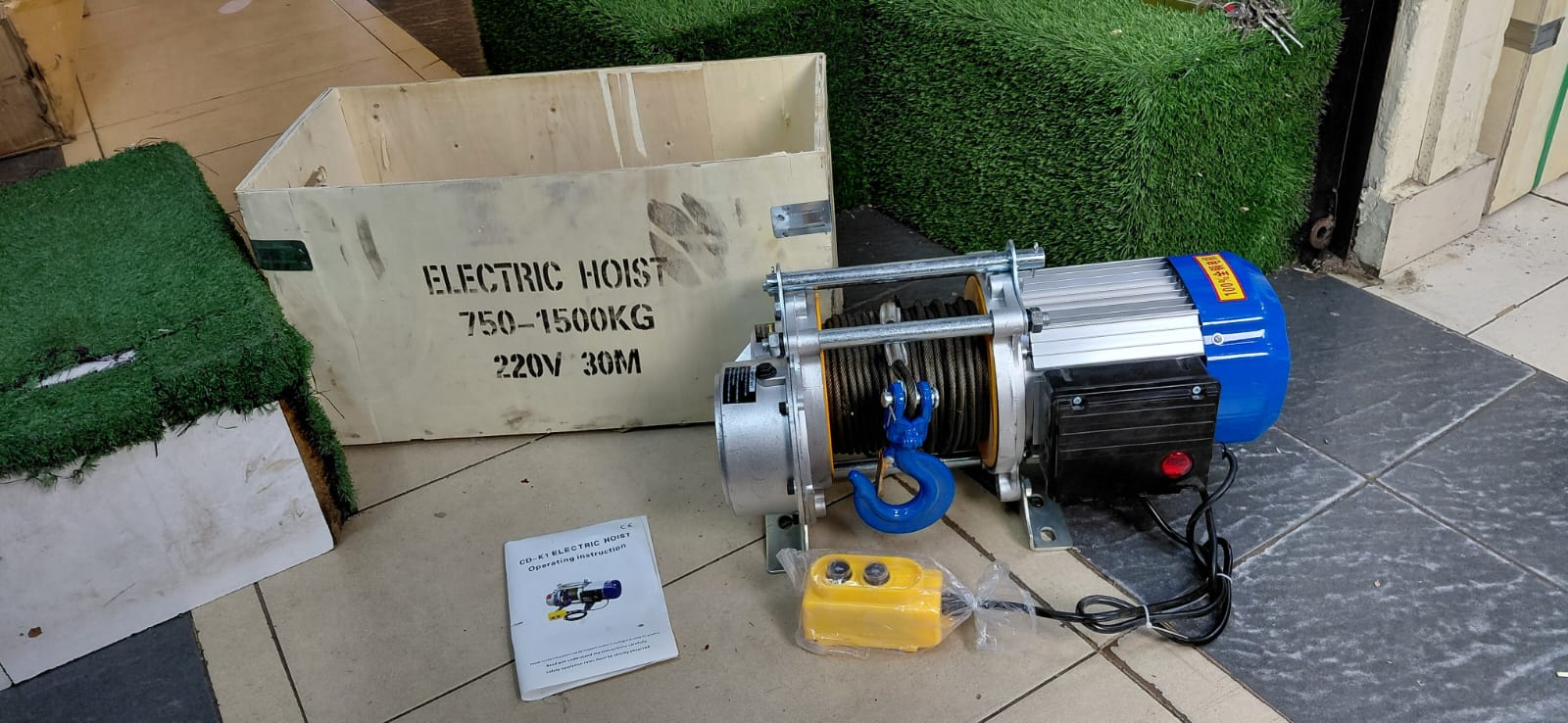
Description
A 1.5 tonne electric chain hoist in Kenya is a powered lifting machine designed to raise and lower loads weighing up to 500kg. It uses a strong load chain, electric motor, lifting hook, braking system and pendant control to make lifting faster and easier than using a manual chain block.
The 500kg electric chain hoist is suitable for garages, workshops, warehouses, factories, fabrication shops and other workplaces where heavy items need to be lifted regularly.
Depending on the exact model, a 0.5 tonne chain hoist can operate on 220V or 230V single-phase electricity, with common lifting heights around 3m to 6m. One current 230V professional model has a 500kg capacity, 6m lifting height, 1.1kW motor, 6.3mm load chain and lifting speeds of 7/2.4m per minute.
0.5 Tonne Electric Chain Hoist Specifications
| Feature | Common Specification |
|---|---|
| Product | Electric Chain Hoist |
| Rated Capacity | 1.5 Tonne / 500kg |
| Hoist Type | Electric Chain Hoist |
| Power Supply | 220V–230V single phase on common models |
| Frequency | 50Hz on reference models |
| Motor Power | About 0.6–1.1kW depending on model |
| Standard Lift | Commonly 3–6m |
| Lifting Speed | About 5–8m/min on selected models |
| Low Speed | About 1.6–2.4m/min on dual-speed models |
| Load Chain | Alloy steel |
| Common Chain Diameter | 6.3mm on selected 500kg models |
| Chain Falls | 1 or model dependent |
| Control | Pendant Up/Down Control |
| Brake | Electromagnetic or mechanical braking system, model dependent |
| Limit Switch | Available on professional models |
| Overload Protection | Available on selected models |
| Mounting | Fixed hook, suspension eye or trolley depending on model |
| Main Application | Vertical material lifting |
These are representative specifications because electric chain hoists differ by manufacturer. Always use the nameplate on the exact machine for its rated capacity, voltage, duty cycle, chain size and lifting height.
500kg Maximum Lifting Capacity
The rated lifting capacity is:
500kg
which is equal to:
1.5 metric tonne.
This means the hoist is designed for loads up to its stated 500kg working load limit when correctly installed and operated.
A current Kenyan electric chain hoist listing confirms a maximum lifting capacity of 500kg.
Do not exceed the rated capacity.
The weight of lifting accessories such as slings, shackles and lifting beams may also need to be considered as part of the suspended load.
True Electric Chain Hoist
An electric chain hoist uses a metal load chain to raise and lower the hook.
Inside the hoist, the motor drives a lifting mechanism that moves the calibrated chain through the machine.
This makes the system suitable for repeated vertical lifting.
The chain is different from ordinary hardware chain. It is manufactured for lifting equipment and must match the hoist’s load wheel and specifications.
Strong Alloy Steel Load Chain
Professional electric chain hoists use high-strength load chains.
One current 500kg/6m electric chain hoist uses a:
6.3mm load chain.
Another 500kg single-phase design specifies a G80 alloy-steel 7.1mm chain, showing why chain diameter should not be assumed from capacity alone.
Never replace the original lifting chain with ordinary chain of a similar diameter.
The replacement must meet the hoist manufacturer’s specifications.
220V to 230V Single-Phase Power
A useful feature of compact 500kg electric chain hoists is the availability of single-phase models.
Current examples operate on:
220V single phase
or:
230V / 50Hz.
This can make them more practical for smaller workshops and garages where three-phase industrial electricity is unavailable.
However, not every 500kg chain hoist is single phase.
Check the voltage plate before connecting the machine.
1.1kW Motor on a Reference Model
Motor power depends on the hoist design.
A current professional 500kg/6m 230V model uses a:
1.1kW electric motor.
Other 500kg designs use smaller motors. Current examples include 0.6kW, 0.75kW and 0.9kW motors.
Therefore, 1.1kW should not be treated as a universal specification for every 0.5 tonne hoist.
Motor design, lifting speed, duty rating and gearing all affect the required power.
Up to 6m Standard Lifting Height
One common 500kg configuration provides:
6 metres maximum lifting height.
This makes it useful in:
- Workshops
- Warehouses
- Garages
- Loading areas
- Fabrication shops
- Production rooms
Other chain lengths are also available.
A current professional 230V 500kg series is offered with 3m, 4m, 5m, 6m and longer lifting heights.
Choose the chain length according to the height of your beam and the required hook travel.
Lifting Speed
Electric operation is one of the main advantages over a manual chain block.
One current 500kg/6m model provides lifting speeds of:
7m/min and 2.4m/min.
Another professional 500kg model offers:
5m/min standard speed.
A different dual-speed model reaches:
7.8m/min high speed
and:
1.6m/min low speed.
The exact lifting speed therefore depends on the hoist.
Dual-Speed Operation
Some electric chain hoists provide two lifting speeds.
The faster setting is useful for moving the load efficiently over a larger distance.
The slower setting improves control when:
- Positioning machinery
- Aligning components
- Installing equipment
- Lowering loads onto supports
- Performing assembly work
For precise workshop lifting, dual-speed operation can be particularly useful.
Pendant Up and Down Control
Electric chain hoists are commonly controlled using a hanging pendant.
The operator presses:
UP
to raise the hook and:
DOWN
to lower it.
A pendant allows the operator to stand away from the suspended load while controlling the hoist.
Selected industrial designs use low-voltage pendant control to reduce the control voltage at the operator’s hands. One current 500kg model specifies a 24V low-voltage pendant circuit.
Electromagnetic Brake
A braking system is essential because the load needs to remain controlled when the motor stops.
Selected 500kg electric chain hoists use an electromagnetic DC brake.
The brake helps hold the load when lifting power is stopped.
Never rely on the brake as permission to work or stand underneath a suspended load.
A suspended load should never be treated as a safe support.
Upper and Lower Limit Switches
Professional electric chain hoists can include upper and lower limit switches.
These switches stop hook travel before the lifting mechanism reaches an unsafe extreme.
One current 500kg model includes mechanical upper and lower limit switches.
Limit switches help protect:
- Chain
- Hook
- Hoist body
- Lifting mechanism
They are safety devices, not normal stopping controls.
The operator should still stop the hoist using the pendant.
Overload Protection
Selected professional electric chain hoists include overload protection or a friction clutch.
A current 500kg industrial model combines electric overload protection, a friction clutch and upper/lower limit switches.
The overload system helps protect the machine when excessive load is applied.
However, it should never be used as a weighing system.
Know the load weight before lifting.
Load Hook
The bottom hook connects the hoist to the load through suitable lifting accessories.
The hook should be inspected for:
- Cracks
- Bending
- Excessive wear
- Throat opening
- Twisting
- Damaged latch
Do not weld or heat a lifting hook to repair it.
A damaged load hook should be removed from service and handled according to the manufacturer’s inspection requirements.
Hook Safety Latch
Many chain hoist hooks have a safety latch.
The latch helps keep a correctly positioned sling or lifting attachment inside the hook.
It does not increase the hoist capacity.
The sling must still sit correctly in the bowl of the hook rather than loading the hook tip.
Compact Overhead Lifting
An electric chain hoist can be mounted above the working area.
This keeps much of the lifting equipment away from the floor.
It can be installed on a suitable:
- Steel beam
- Gantry crane
- Jib crane
- Monorail
- Engineered support structure
The mounting structure must be rated for the loads and forces produced by the hoist.
Do not hang a 500kg hoist from an unverified roof member simply because the member appears strong.
Fixed Hoist vs Hoist with Trolley
A fixed electric chain hoist lifts the load vertically from one position.
A trolley-mounted chain hoist can move along a suitable beam.
| Feature | Fixed Chain Hoist | Trolley Chain Hoist |
|---|---|---|
| Vertical Lifting | Yes | Yes |
| Horizontal Travel | No | Yes |
| Cost | Usually Lower | Usually Higher |
| Installation | Simpler | More involved |
| Loading Bay Use | Good | Excellent |
| Production Line | Good | Better |
If you only need to lift an engine from one fixed work bay, a stationary hoist may be enough.
For moving loads across a workshop, a trolley can be more useful.
Electric Chain Hoist vs Manual Chain Block
| Feature | Electric Chain Hoist | Manual Chain Block |
|---|---|---|
| Lifting Power | Electric Motor | Hand Operated |
| Operator Effort | Low | Higher |
| Lifting Speed | Faster | Slower |
| Repeated Lifting | Excellent | Good |
| Electricity Required | Yes | No |
| Initial Cost | Higher | Lower |
| Remote/Pendant Control | Yes | No |
| Remote Site Use | Limited by power | Excellent |
A manual chain block remains useful where electricity is unavailable.
An electric chain hoist is usually better for repeated lifting in a busy workshop.
Chain Hoist vs Wire Rope Electric Hoist
This difference is important when buying a 0.5 tonne hoist.
| Feature | Electric Chain Hoist | Mini Wire Rope Hoist |
|---|---|---|
| Lifting Medium | Load Chain | Steel Wire Rope |
| 500kg Rating | Direct on a true 500kg model | Often double-line on mini models |
| Repeated Workshop Use | Excellent | Good |
| Compact Lifting | Excellent | Excellent |
| Common 500kg Setup | 500kg chain system | 250/500kg pulley system |
| Maintenance | Chain inspection | Rope inspection |
For example, the TOTAL TLH1952 is not a 500kg chain hoist. It is a wire-rope electric hoist rated for 250kg single line or 500kg double line. It lifts 18m at 10m/min in single-line mode and 9m at 5m/min in double-line mode.
This is a different product from a true 500kg electric chain hoist.
Ideal for Vehicle Workshops
A 500kg electric chain hoist can be useful in vehicle repair workshops for lifting suitable components within its capacity.
Applications can include:
- Engines
- Gearboxes
- Axles
- Workshop equipment
- Fabricated parts
The exact weight of the component must be known before lifting.
Some complete engines and assemblies can exceed 500kg, so never assume that every vehicle engine is within the hoist capacity.
Fabrication Workshops
Metal fabrication shops regularly need to position heavy components.
A 0.5 tonne chain hoist can assist with:
- Steel frames
- Fabricated assemblies
- Machine parts
- Metal sections
- Welding projects
The hoist can raise the component to the required working position while suitable supports are prepared.
Do not weld directly on a suspended load unless the entire lifting procedure and equipment are approved for that work.
Warehouses and Stores
Warehouses can use electric chain hoists for vertical material handling.
Typical applications include:
- Machinery
- Heavy components
- Crated equipment
- Production materials
A trolley system can provide horizontal travel where loads need to move along a beam.
For ordinary pallet movement across a floor, a pallet truck or forklift is normally more appropriate.
Machine Installation
Electric chain hoists are useful when installing or servicing machinery.
The slower speed available on dual-speed models can help with final positioning.
This is important when aligning:
- Motors
- Pumps
- Gearboxes
- Production equipment
- Workshop machinery
The machine should be transferred onto properly rated supports once it reaches its final position.
Farms and Agricultural Workshops
A 500kg electric chain hoist can also be useful in agricultural workshops.
It may assist with suitable:
- Tractor components
- Pumps
- Engines
- Implements
- Machinery parts
A reliable electrical supply and properly engineered mounting structure are required.
For field work without electricity, a manual chain block may be more practical.
1.5 Tonne vs 1 Tonne Electric Chain Hoist
| Feature | 1.5 Tonne | 1 Tonne |
|---|---|---|
| Rated Load | 500kg | 1000kg |
| Size | Smaller | Larger |
| Weight | Lower | Higher |
| Motor | Usually Smaller | Usually Larger |
| Workshop Parts | Excellent | Excellent |
| Heavy Machinery | Limited | Better |
| Purchase Cost | Lower | Higher |
Choose capacity according to the heaviest load you genuinely expect to lift.
Do not buy a 500kg machine if your normal loads are close to or above 500kg.
Electric Chain Hoist Safety
Never exceed:
500kg rated capacity
on a 1.5 tonne hoist.
Also:
- Never stand under a suspended load.
- Never lift people.
- Do not side-pull a load.
- Centre the hoist above the load.
- Use properly rated slings and shackles.
- Inspect the chain before use.
- Check hook condition.
- Confirm the mounting structure.
- Keep the load balanced.
- Keep people clear during lifting.
- Stop operation if the chain jams or twists.
Lifting equipment can cause serious injury if installed or used incorrectly.
Avoid Side Pulling
An electric chain hoist is designed primarily for vertical lifting.
Do not place the hoist to one side and drag the load sideways using the chain.
Side pulling can place unwanted forces on:
- Chain
- Hook
- Chain guide
- Load wheel
- Suspension point
Position the hoist vertically above the load before lifting.
Never Lift People
A standard material-handling electric chain hoist should not be used to lift a person.
Lifting people requires equipment and systems specifically designed and approved for personnel lifting.
The 500kg capacity refers to material loads, not passengers.
Inspect the Load Chain
Before use, inspect the chain for signs of:
- Cracks
- Distortion
- Excessive wear
- Corrosion
- Twisted links
- Damaged links
- Poor lubrication
The chain should feed smoothly through the hoist.
If it jumps, jams or makes unusual noises, stop using the machine and have it inspected.
Chain Lubrication
The load chain requires appropriate lubrication according to the manufacturer’s maintenance instructions.
Correct lubrication can reduce friction and wear.
Do not use grease or oil blindly without checking the recommended lubricant because requirements can vary.
Keep the chain clean enough for inspection.
Check the Pendant Control
Inspect the pendant before each working period.
Check:
- Up button
- Down button
- Emergency stop if fitted
- Cable
- Housing
- Button return
A damaged pendant cable should be repaired correctly before the hoist returns to service.
Do not continue operating a hoist with exposed electrical conductors.
Installation
Installation should be performed on a properly rated supporting structure.
Before operation, confirm:
- Beam capacity
- Suspension point
- Hoist voltage
- Electrical protection
- Earthing
- Chain travel
- Hook travel
- Limit switches
- Pendant operation
- Brake operation
The supporting beam and connection hardware need sufficient rated capacity for the complete lifting system and the forces generated during operation.
How to Choose a 1.5 Tonne Electric Chain Hoist
Before buying, check:
- 500kg rated lifting capacity
- Power supply
- Single-phase or three-phase operation
- Motor power
- Lifting height
- Lifting speed
- Single or dual speed
- Chain grade and size
- Duty rating
- Brake system
- Limit switches
- Overload protection
- Pendant control voltage
- Hook type
- Trolley compatibility
- Spare parts
- Warranty
For a small workshop using normal single-phase electricity, a 500kg 220V–230V chain hoist can be particularly convenient.
For continuous industrial production, also check the hoist’s duty classification rather than choosing only by lifting capacity.
1.5 Tonne Electric Chain Hoist Price in Kenya 2026
Current 1.5 tonne electric chain hoist prices in Kenya vary by design, lift height, motor, safety features and supplier.
A current 500kg electric chain hoist is listed at KSh 18,450, while another exact 1.5 tonne/500kg chain hoist is currently listed at KSh 22,999.
Kenyan marketplace results also show a heavy-duty 500kg electric hoist with 6m lifting height, 6m/min speed and 1000W motor at about KSh 24,500.
| 500kg Hoist Type | Approx. Current Kenya Price |
|---|---|
| 500kg Electric Chain Hoist | KSh 18,450 |
| 1.5 Tonne Electric Chain Hoist | KSh 22,999 |
| Heavy-Duty 500kg Electric Hoist | Around KSh 24,500 |
| General 500kg Electric Chain Hoist Range | About KSh 18,000–30,000 |
Price alone should not determine the choice.
Compare the actual lifting height, chain type, voltage, motor, speed, brake, limit switches and overload protection.
Benefits of a 1.5 Tonne Electric Chain Hoist
A 500kg electric chain hoist can make repetitive lifting much easier.
Main benefits include:
- 500kg lifting capacity
- Electric lifting and lowering
- Less manual effort
- Faster lifting
- Strong load chain
- Compact overhead installation
- Pendant control
- Controlled load positioning
- Brake system
- Limit switches on selected models
- Overload protection on selected models
- Suitable for workshops and warehouses
- Single-phase models available
- Trolley installation possible
For a busy workshop, replacing repeated manual lifting with a correctly installed electric hoist can improve productivity and load control.
Why Buy a 1.5 Tonne Electric Chain Hoist in Kenya?
A 1.5 tonne electric chain hoist in Kenya is a good choice for businesses that regularly need to lift loads up to 500kg.
Unlike a manual chain block, the electric motor performs the lifting work. Unlike a common 250/500kg mini wire-rope hoist, a true 500kg chain hoist uses a dedicated lifting chain and can be designed for a direct 500kg working load.
Current 230V professional models show that 500kg chain hoists can provide 6m lifting height, around 1.1kW motor power and dual lifting speeds of 7/2.4m per minute, although the exact specification varies by model.
For workshops, garages, warehouses and fabrication businesses, the key is to choose a genuine lifting-rated machine with the correct capacity, power supply, chain, brake and safety systems.
Frequently Asked Questions
How much can a 1.5 tonne electric chain hoist lift?
It has a rated lifting capacity of 500kg, provided the exact hoist is correctly installed and operated within its working load limit.
Is 1.5 tonne the same as 500kg?
Yes. 1.5 metric tonne equals 500kg.
Does the hoist use a chain or wire rope?
A true electric chain hoist uses a load chain. Do not confuse it with a 250/500kg mini electric wire-rope hoist.
What voltage does a 500kg electric chain hoist use?
Single-phase models are available at 220V or 230V, while other industrial models may use different power supplies.
What is the lifting height?
It depends on the model. 3m to 6m is common, while longer chain configurations are also available.
How fast does a 500kg chain hoist lift?
It varies. Current professional examples offer around 5–8m/min at high speed, with some dual-speed models providing slower speeds for precise positioning.
What motor size does it use?
Motor power varies. Current 500kg examples range from approximately 0.6kW to 1.1kW depending on the hoist design.
What size chain does a 500kg electric hoist use?
One current 500kg professional model uses a 6.3mm load chain, while another design uses 7.1mm. Always follow the exact manufacturer’s specification.
Does it have an automatic brake?
Professional electric chain hoists commonly have a load braking system. Some current models use an electromagnetic DC brake.
Does it have overload protection?
Selected models do. Current industrial examples include overload protection and friction-clutch systems.
Does it have limit switches?
Many professional models have upper and lower limit switches to stop excessive hook travel.
Can I use it to lift an engine?
Yes, if the engine and all lifting accessories remain within the hoist’s rated capacity and correct lifting procedures are followed.
Can I use it in a garage?
Yes. A 500kg electric chain hoist is useful for vehicle workshops, machinery repair and other garage lifting work.
Can the hoist move sideways?
A fixed hoist only lifts vertically. If horizontal movement is required, the hoist can be paired with a compatible rated beam trolley where the installation permits it.
Can I use an electric chain hoist to lift people?
No. A standard material electric chain hoist should not be used for lifting people.
Can I lift more than 500kg for a short time?
No. Never exceed the rated 500kg working load limit.
What is the difference between a 500kg chain hoist and a 250/500kg wire-rope hoist?
A true 500kg chain hoist uses a load chain and is rated according to its own configuration. A common 250/500kg mini wire-rope hoist may lift 250kg on a single line and only reach 500kg using a double-line pulley arrangement.
What is the price of a 1.5 tonne electric chain hoist in Kenya?
Current 500kg electric chain hoists are listed at around KSh 18,450 to KSh 22,999, with other heavy-duty 500kg electric hoist configurations around KSh 24,500. A practical current market range is approximately KSh 18,000 to KSh 30,000, depending on specifications and supplier.

Reviews
There are no reviews yet.