
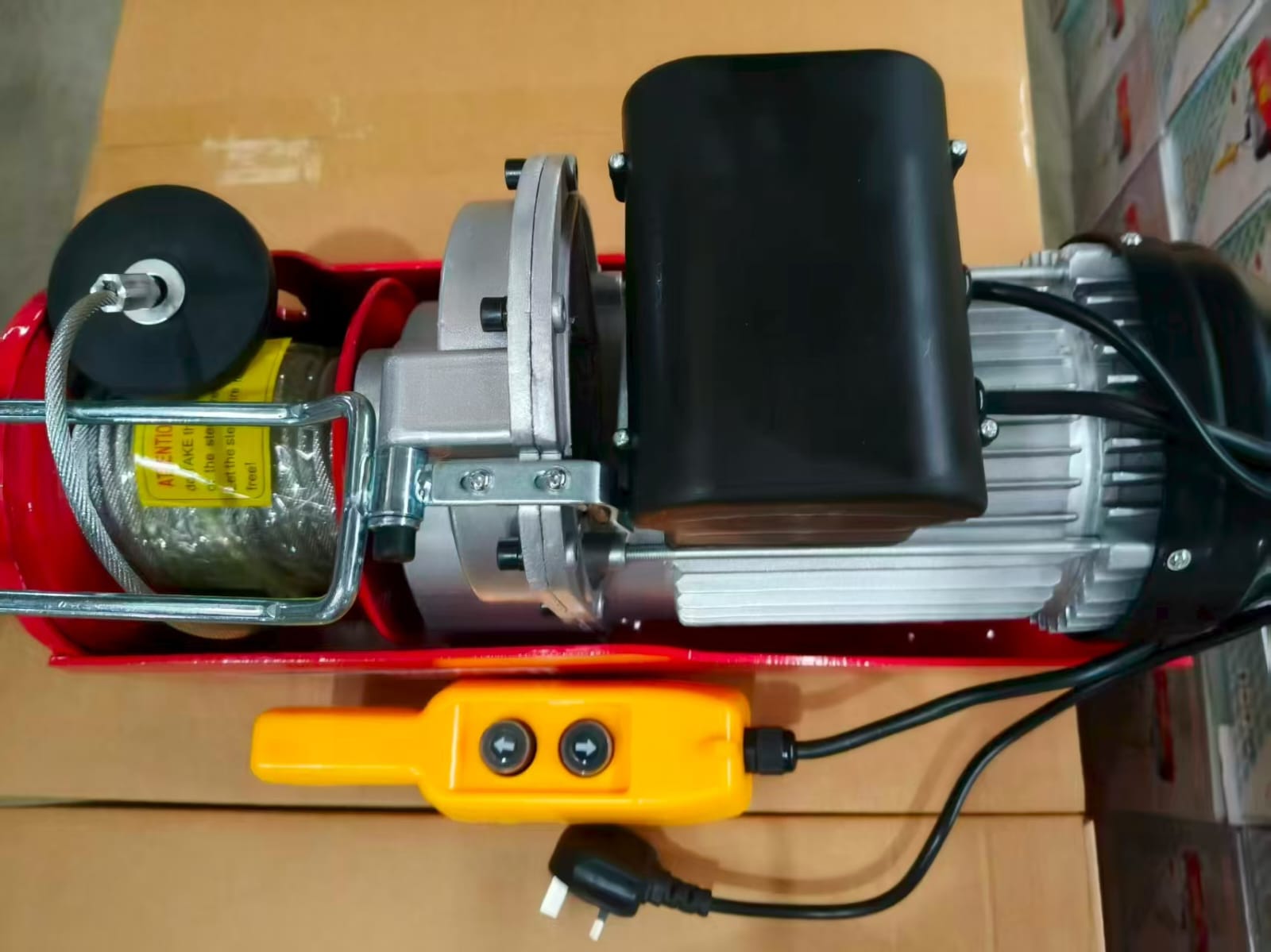
Description
A 1 tonne electric chain hoist with single-phase power and an 18m maximum lifting height is a powered lifting machine used to raise, lower, and position loads weighing up to 1,000kg. It is suitable for workshops, warehouses, construction sites, factories, garages, steel fabrication businesses, agricultural facilities, and equipment installation work.
Unlike a manual chain block, this electric chain hoist uses a motor and gearbox to move the load chain. The operator controls lifting and lowering using a pendant switch. This reduces physical effort and makes repeated lifting faster and more controlled.
The single-phase motor allows the hoist to operate from a suitable 220V to 240V AC supply. This makes it practical for locations that do not have three-phase industrial power. Single-phase electric chain hoists are available in several designs, and representative 1-tonne models use motors ranging from about 1.2kW to 1.8kW. Exact motor power, lifting speed, chain size, duty class, and current requirement must be confirmed from the product nameplate.
Quick Product Specifications
| Feature | Typical specification |
|---|---|
| Product name | 1 tonne electric chain hoist |
| Rated lifting capacity | 1,000kg |
| Maximum lifting height | 18 metres |
| Power supply | 220V to 240V AC |
| Electrical phase | Single phase |
| Frequency | Commonly 50Hz or 50/60Hz |
| Motor power | Approximately 1.2kW to 1.8kW, model dependent |
| Lifting speed | Commonly about 2.3 to 7m/min |
| Load chain | Calibrated alloy-steel chain |
| Typical chain size | Around 7.1mm on selected models |
| Chain arrangement | Single or double fall, depending on design |
| Brake | Electromagnetic or mechanical electric brake |
| Control | Low-voltage pendant control |
| Limit switches | Upper and lower on suitable models |
| Suspension | Top hook or trolley mounted |
| Chain container | Required for the 18m loose chain |
| Main application | Vertical lifting and controlled lowering |
A representative single-phase 1-tonne model uses a 1.6kW motor, 7m/min lifting speed and a 7.1mm load chain. Another 240V model uses a 1.2kW motor, runs at 6m/min and includes a Grade 80 chain. These figures show why the exact specification must be checked for the model being supplied.
Main Features of the 1 Tonne Electric Chain Hoist
1,000kg lifting capacity
The hoist has a rated working load of one tonne or 1,000kg.
It can be used to lift items such as:
- Vehicle engines
- Gearboxes
- Electric motors
- Water pumps
- Small generators
- Steel frames
- Fabricated tanks
- Workshop machinery
- Building materials
- Agricultural equipment
- Pipes and valves
- Industrial components
The 1,000kg rating is the maximum permitted load under correct operating conditions. The total load calculation must include the item being lifted together with slings, shackles, spreader beams, lifting clamps, and other attachments.
The hoist must never be intentionally overloaded.
Maximum lifting height of 18 metres
The long 18m load chain allows the lower hook to travel through a large vertical distance.
This extended lifting height is useful for:
- Multi-storey construction
- Tall warehouses
- High workshop roofs
- Loading and unloading areas
- Tower and mast work
- Deep maintenance pits
- Installing pumps in raised structures
- Lifting materials to upper working levels
- Agricultural storage buildings
- Industrial plants with high overhead beams
The stated 18m lifting height should refer to usable hook travel, not only the physical chain length. Buyers should confirm the actual hook travel, minimum headroom, pendant length, power-cable length, and chain-container capacity before installation.
Single-phase electric motor
The hoist is designed to operate from a single-phase electrical supply, commonly between 220V and 240V.
This provides several benefits:
- Suitable for many commercial buildings
- Easier installation where three-phase power is unavailable
- Convenient for garages and small factories
- Faster lifting than manual chain blocks
- Reduced physical effort
- Simple push-button control
The supply circuit must be sized according to the hoist’s rated current and starting demand. A qualified electrician should confirm the cable size, breaker, isolation switch, earthing, and voltage at the installation point.
A long extension cable or undersized wire can cause voltage drop, overheating, weak motor performance, or failure to start with a heavy load.
Electric lifting motor
The motor supplies the power required to turn the internal reduction gears and lift the load chain.
Depending on the design, a 1-tonne single-phase hoist may use a motor of approximately:
- 1.2kW
- 1.6kW
- 1.8kW
A Kenyan 1-tonne electric chain-hoist listing describes an 1,800W industrial model, while an established 240V unit from another market uses a 1,200W motor.
Motor power alone should not be used to judge quality. The buyer should also consider duty cycle, lifting speed, brake design, chain grade, gearbox quality, thermal protection, certification, and availability of spare parts.
Controlled electric lifting
The operator raises or lowers the load by pressing buttons on the pendant controller.
The pendant normally has:
- Up button
- Down button
- Emergency-stop button on selected models
- Strain-relief cable
- Control cable
The hoist should stop when the operator releases the control button. Professional electric chain-hoist manuals describe this release-to-stop operation for controlled load movement.
Long-load-chain container
An 18m hoist requires a properly sized chain bag or rigid chain container.
The container collects the unloaded chain as the hook rises. This helps prevent the loose chain from:
- Dragging on the floor
- Tangling around equipment
- Swinging into workers
- Collecting dirt
- Entering machinery
- Catching on scaffolding
- Becoming twisted
A chain container must be sized for the full amount of chain. A container made for a 3m or 6m lift may not safely hold an 18m chain.
Electric chain hoists are commonly supplied with a chain bag or container, including locally listed HHB units and established international models.
Calibrated alloy-steel load chain
The load chain is made to match the hoist’s chain wheel accurately.
Representative 1-tonne electric hoists use a load chain around 7.1mm in size. Some quality models use Grade 80 alloy chain or another certified hoisting-chain grade.
The load chain must never be replaced with:
- Ordinary hardware chain
- Vehicle towing chain
- Welded general-purpose chain
- A chain with a different pitch
- A chain with the wrong diameter
Only a chain specified by the hoist manufacturer should be installed.
Electromagnetic load brake
A reliable brake holds the load when the lifting motor stops.
Single-phase industrial hoists may use an electromagnetic DC brake or another approved electric braking system. Elephant’s single-phase SA range, for example, lists an electromagnetic DC brake among its main safety features.
The brake provides:
- Controlled stopping
- Secure load holding
- Reduced downward movement
- Accurate positioning
- Protection during normal power interruption
The suspended load should not drift down after the control button is released.
Upper and lower limit switches
Limit switches stop the hook before it travels too far in either direction.
The upper limit helps prevent the lower hook block from colliding with the hoist body. The lower limit helps stop the chain before unsafe over-extension.
A representative 240V 1-tonne hoist includes both upper and lower limit switches.
Limit switches are safety devices. They should not be used as the normal method for stopping every lift.
Overload protection
Selected professional models include a mechanical or electronic overload limiter.
This feature helps prevent lifting when the load exceeds the permitted capacity. A representative 1-tonne unit includes a weight-overload limiter together with thermal motor protection.
An overload limiter does not remove the operator’s duty to know the load weight.
Thermal motor protection
Thermal protection helps stop or protect the motor when excessive temperature is detected.
Motor overheating may result from:
- Frequent starts
- Excessive operating time
- Overloading
- Low voltage
- Poor ventilation
- A dragging brake
- Incorrect power supply
- High ambient temperature
Allow the motor to cool and investigate the cause before restarting.
Forged hooks with safety latches
The hoist normally has:
- Upper suspension hook
- Lower load hook
- Safety latch on each hook
- Swivel function on selected models
The bottom hook on some professional designs rotates through 360 degrees to help position the load.
The load must sit inside the hook bowl. It should not rest on the hook point or safety latch.
Typical Technical Specifications
| Specification | Typical value |
|---|---|
| Safe working load | 1 tonne |
| Maximum load | 1,000kg |
| Maximum vertical lift | 18m |
| Power | 220V to 240V |
| Phase | Single phase |
| Motor output | Approximately 1.2 to 1.8kW |
| Lifting speed | Approximately 2.3 to 7m/min |
| Load chain | Calibrated alloy steel |
| Typical chain diameter | Approximately 7.1mm |
| Control type | Pendant push-button |
| Brake | Electric or electromagnetic load brake |
| Limit protection | Upper and lower, model dependent |
| Chain container | Long-chain bag or box |
| Suspension | Hook, plain trolley or powered trolley |
| Lifting direction | Vertical |
| Duty rating | Depends on manufacturer |
| Protection class | Must be confirmed from model plate |
These are common market figures rather than guaranteed specifications for every unit. Check the nameplate, manual, test certificate, and supplier quotation before purchase.
Estimated Full-Height Lifting Time
The time required to travel through the full 18m depends on lifting speed.
| Lifting speed | Approximate travel time over 18m |
|---|---|
| 2.3m/min | About 7 minutes 50 seconds |
| 3m/min | About 6 minutes |
| 6m/min | About 3 minutes |
| 7m/min | About 2 minutes 34 seconds |
These are simple travel estimates. Real lifting time may be longer because of load checks, stopping, positioning, duty-cycle limits, and safe operating procedures.
Fixed-Hook and Trolley-Mounted Options
Fixed-hook electric hoist
The top hook hangs from a stationary lifting point.
This version is suitable when loads only need to move vertically.
Common uses include:
- Vehicle engine removal
- Fixed workshop stations
- Pump maintenance
- Machine installation
- Loading through a fixed opening
Plain push trolley
A plain trolley allows the hoist to move manually along an overhead beam.
The operator moves the suspended load by carefully pushing or pulling it with a suitable tag line.
Geared trolley
A geared trolley moves along the beam using a hand chain.
It offers better control than a plain trolley, especially with heavier loads.
Electric trolley
An electric trolley uses a separate motor for horizontal movement.
This creates a more complete overhead lifting system with:
- Powered lifting
- Powered lowering
- Powered left movement
- Powered right movement
The trolley capacity, flange range, motor voltage, and beam dimensions must match the hoist and supporting structure.
Applications
Garages and automotive workshops
The hoist can lift engines, gearboxes, truck components and machinery parts.
Construction projects
The 18m height is useful for lifting tools and building materials to elevated working areas. It should only be used as part of an approved lifting plan.
Warehouses
It can lift stock, machinery, dies, motors and equipment at loading or maintenance stations.
Steel fabrication
Fabricators can use it to position metal frames, beams, tanks, pipes and welded assemblies.
Water-pump installation
It can raise or lower pumps, motors, valves and pipe sections during installation or servicing.
Agricultural businesses
The hoist is useful for repairing tractors, milling equipment, feed-processing machines and other farm machinery.
Manufacturing facilities
Factories can use it for machine maintenance, assembly work, production tooling and component positioning.
Generator installation
A 1-tonne hoist may handle smaller generator sets or generator components, provided the confirmed total load remains below the rated capacity.
Installation Requirements
Certified supporting structure
The beam, gantry, jib crane, monorail or lifting point must be designed to support:
- The hoist’s own weight
- The 1,000kg rated load
- Rigging accessories
- Trolley weight
- Dynamic lifting forces
A structural or lifting-equipment specialist should confirm the support capacity.
Correct electrical supply
The installation should have:
- Stable 220V to 240V supply
- Correct circuit breaker
- Suitable motor protection
- Proper earthing
- Isolator within reach
- Correct cable size
- Weather protection where needed
- No excessive voltage drop
Adequate chain-container clearance
The 18m chain container may be large and heavy when full. It must not strike the load, structure, operator, or nearby equipment.
Correct pendant length
For an 18m lift, the pendant control length should match the operating level. A short pendant may force unsafe operation from an elevated or unsuitable position.
Remote-control operation may be available on some models, but it should include an emergency stop and approved fail-safe control design.
How to Operate the Electric Chain Hoist
- Confirm that the total load is below 1,000kg.
- Inspect the hoist, hooks, chain, pendant and support.
- Check that the chain hangs freely without twists.
- Position the hoist directly above the load.
- Attach a correctly rated sling or lifting accessory.
- Ensure the hook safety latch closes.
- Raise the chain slowly until the sling becomes tight.
- Lift the load a few centimetres.
- Stop and confirm that the brake holds.
- Check that the load is balanced.
- Continue lifting smoothly.
- Stop before reaching an obstruction or limit switch.
- Position the load without standing underneath it.
- Lower it onto a stable support.
- Release the rigging only after the load is fully supported.
Important Safety Rules
- Never lift more than 1,000kg.
- Never stand or work below a suspended load.
- Do not use the hoist to lift people.
- Do not pull a load sideways.
- Do not use the load chain as a sling.
- Do not twist, knot or shorten the chain.
- Do not operate with missing hook latches.
- Do not repeatedly use the limit switch as a normal stop.
- Do not operate during low or unstable voltage.
- Do not leave a suspended load unattended.
- Do not repair a load chain by welding.
- Do not operate in rain unless the hoist is rated for outdoor use.
- Isolate electrical power before maintenance.
- Use a tag line to control long or swinging loads.
- Keep workers clear of the lifting path.
The operating manual should be read before installation, operation, inspection or maintenance. Established hoist manufacturers clearly warn that these activities can create serious hazards when procedures are not followed.
Pre-Use Inspection Checklist
| Item | Inspection point |
|---|---|
| Capacity plate | Must clearly show 1 tonne |
| Load chain | No twists, cracks, heavy wear or rust |
| Upper hook | No bending, spreading or cracks |
| Lower hook | No bending, spreading or cracks |
| Safety latches | Close correctly |
| Pendant | Buttons and emergency stop operate correctly |
| Power cable | No cuts or exposed wires |
| Chain container | Secure and large enough |
| Brake | Holds during a short test lift |
| Limit switches | Operate correctly during inspection |
| Housing | No cracks or missing fasteners |
| Support beam | Approved for the load |
| Slings and shackles | Correct WLL and good condition |
| Work area | Clear of people and obstructions |
Maintenance Tips
- Clean the hoist regularly.
- Lubricate the load chain using the recommended lubricant.
- Do not apply oil to brake surfaces.
- Check chain wear and elongation.
- Inspect hooks and safety latches.
- Keep the motor ventilation openings clean.
- Check the pendant cable for damage.
- Inspect electrical connections.
- Keep the chain container securely mounted.
- Arrange periodic professional inspection.
- Record all repairs and inspections.
- Replace worn components with approved parts.
- Store the hoist in a dry area when not permanently installed.
- Test the brake after servicing.
An 18m chain requires special attention because more chain passes through the load wheel, guide and container during every full-height operation.
Advantages of the 1 Tonne Single-Phase Chain Hoist
Long 18m lifting range
It is suitable for high roofs, elevated floors, tall structures and deep working areas.
Reduced operator effort
The electric motor performs the lifting work.
Single-phase convenience
It can be installed where suitable three-phase power is not available.
Faster repeated lifting
It improves productivity compared with a manual chain block.
Accurate load positioning
Pendant control allows the operator to stop and start the load as required.
Compact lifting mechanism
A chain hoist can provide high lifting capacity without the large drum used by many wire-rope hoists.
Flexible mounting
It can be installed using a fixed hook, plain trolley, geared trolley or electric trolley.
Suitable for many industries
It can serve garages, farms, factories, warehouses, construction companies and fabrication workshops.
Electric Chain Hoist Versus Manual Chain Block
| Feature | Electric chain hoist | Manual chain block |
|---|---|---|
| Rated capacity | 1 tonne | 1 tonne |
| Power | Single-phase electricity | Hand operated |
| Operator effort | Low | Higher |
| Lifting speed | Faster | Slower |
| Repeated lifting | Very suitable | Can be tiring |
| Power-cut operation | Cannot lift electrically | Continues manually |
| Maintenance | Electrical and mechanical | Mainly mechanical |
| Initial cost | Higher | Lower |
| 18m operation | More productive | Slow and physically demanding |
How to Choose the Right 1 Tonne Electric Chain Hoist
Confirm that 18m means actual lifting height
Ask the supplier to confirm the full hook travel, not only the chain supplied.
Verify single-phase voltage
The nameplate should match the local supply, normally 220V to 240V at 50Hz.
Check the duty class
A hoist used occasionally in a garage has different requirements from one used repeatedly in a production factory.
Confirm motor protection
Look for thermal protection, overload protection and a reliable brake.
Check the chain grade
Choose a calibrated lifting chain designed for the specific hoist.
Inspect the chain container
It must hold the full loose chain created during an 18m lift.
Ask about lifting speed
A slow unit offers careful positioning, while a faster unit reduces travel time. Dual-speed models provide both fast travel and slow positioning.
Confirm available spare parts
Important spares include:
- Load chain
- Chain guide
- Brake parts
- Pendant controls
- Contactor
- Motor
- Hooks
- Safety latches
- Limit switches
- Chain container
Request proper documentation
For professional use, ask for:
- Test certificate
- User manual
- Serial number
- Rated-capacity plate
- Electrical diagram
- Inspection details
- Warranty information
Price of a 1 Tonne Electric Chain Hoist in Kenya
Local listings for ordinary 1-tonne electric hoists commonly appear at around KSh 28,000 to KSh 59,000, while one Kenyan retailer lists a 1-tonne electric chain hoist at approximately KSh 38,000. These prices do not necessarily include an 18m lifting chain, trolley, installation, certification or upgraded chain container.
| Product configuration | Estimated Kenya price |
|---|---|
| Basic 1-ton electric hoist with short lift | KSh 28,000–45,000 |
| Better-quality single-phase model | KSh 40,000–70,000 |
| 1-ton hoist upgraded to 18m lift | KSh 55,000–100,000 |
| Certified industrial model with 18m chain | KSh 90,000–200,000+ |
| Hoist with powered trolley | Price on quotation |
The final cost depends on:
- Brand
- Motor rating
- Chain length
- Chain grade
- Lifting speed
- Single or dual speed
- Duty class
- Chain container size
- Pendant length
- Overload protection
- Trolley type
- Certification
- Installation
- Warranty
An 18m model normally costs more than a standard 3m hoist because it requires additional calibrated load chain, a larger container, longer control arrangements and careful capacity checks.
Package Contents
A typical package may include:
- One 1-tonne electric chain hoist
- 18m calibrated load chain
- Upper suspension hook
- Lower swivel hook
- Hook safety latches
- Pendant controller
- Power cable
- Large chain container
- Electric motor and gearbox assembly
- User manual
- Test certificate on selected models
A beam trolley, slings, shackles, beam clamp, gantry, power isolator and installation hardware may be sold separately.
Why Buy a 1 Tonne Electric Chain Hoist with an 18m Lift?
A 1 tonne single-phase electric chain hoist with an 18m maximum lifting height provides a practical solution for lifting loads in tall buildings, workshops, factories, warehouses and construction areas.
Its electric motor reduces physical effort, while the long chain provides access over a much greater vertical distance than a standard 3m model. Features such as an electric brake, calibrated load chain, pendant control, safety hooks, chain container, limit switches and overload protection can improve productivity and lifting control.
For safe operation, the hoist must be installed on a certified support, connected by a qualified electrician, inspected regularly and never loaded above 1,000kg.
Frequently Asked Questions
What is the maximum capacity of this chain hoist?
The rated lifting capacity is 1 tonne or 1,000kg.
What is its maximum lifting height?
The maximum vertical hook travel is 18 metres, subject to confirmation from the supplier and product nameplate.
Does it use single-phase electricity?
Yes. It is designed for a suitable single-phase AC supply, commonly 220V to 240V.
What motor size does it use?
A 1-tonne single-phase electric chain hoist may use approximately 1.2kW to 1.8kW, depending on the model and lifting speed.
How fast does it lift?
Representative models operate from around 2.3m/min to 7m/min. The exact speed must be checked on the nameplate.
How long does it take to lift through 18m?
At 6m/min, full travel takes about three minutes. At 3m/min, it takes about six minutes.
Does it come with a chain container?
An 18m model should include a chain container sized to hold the full loose load chain. Confirm this before buying.
Can it move sideways?
The hoist itself lifts vertically. Horizontal movement requires a compatible plain, geared or electric trolley mounted on a suitable beam.
Can it operate from an ordinary wall socket?
It should only be connected to a circuit rated for the motor’s current and starting demand. A qualified electrician must confirm the socket, wiring, breaker and voltage.
Can I use an extension cable?
Avoid ordinary or undersized extension cables. Long cables can cause voltage drop and motor overheating. Use an installation approved by a qualified electrician.
Can it lift people?
No. A standard electric chain hoist is intended for materials and equipment, not people.
Can I leave a load suspended overnight?
No. Lower the load onto stable support instead of leaving it suspended and unattended.
Can the chain be shortened or repaired by welding?
No. The calibrated load chain must not be welded, knotted, twisted or modified.
What is the price in Kenya?
A standard 1-tonne electric hoist may cost approximately KSh 28,000 to KSh 59,000. A complete single-phase model with an 18m lift may cost around KSh 55,000 to KSh 100,000 or more, depending on its brand, certification and safety features.


Reviews
There are no reviews yet.