
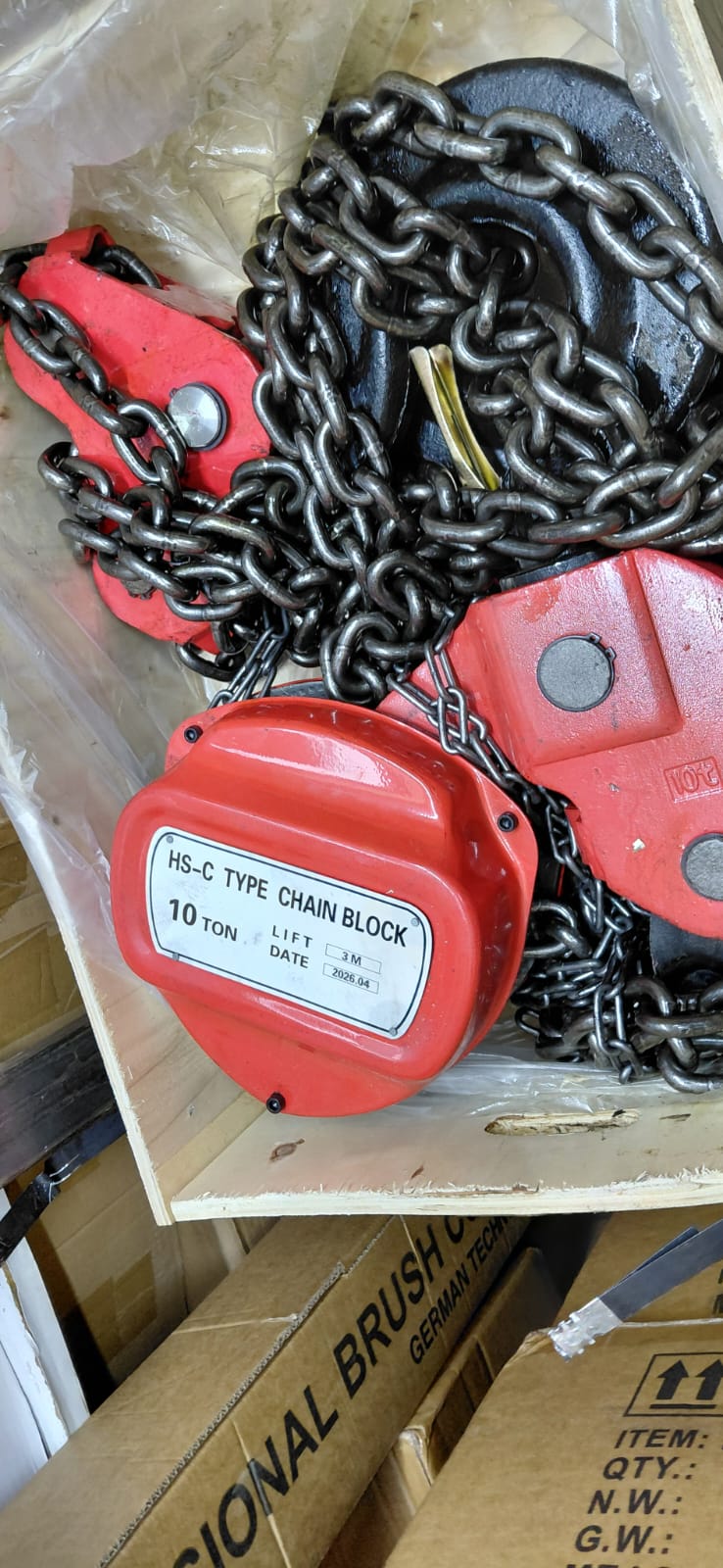
Description

A 10 tonne chain block with a maximum lifting height of 3m is a heavy-duty manual lifting machine designed to raise, lower, and position loads weighing up to 10,000kg. It is also called a 10-ton manual chain hoist, chain pulley block, hand chain hoist, or manual lifting block.
This chain block operates without electricity, fuel, or compressed air. The operator pulls the hand chain to rotate the internal gears, which move the load chain and raise the attached load. A mechanical braking system holds the load when the operator stops pulling.
The 10-tonne capacity makes this chain block suitable for heavy machinery installation, steel fabrication, construction, vehicle maintenance, factories, warehouses, mining operations, and agricultural equipment repair. The 3m lifting height is suitable for workshops and sites where loads must be lifted from ground level to a working or installation position.
Quick Product Summary
| Feature | Typical specification |
|---|---|
| Product name | 10 tonne chain block |
| Lifting capacity | 10,000kg |
| Maximum lifting height | 3 metres |
| Operating method | Manual hand chain |
| Power requirement | None |
| Load chain | Hardened alloy steel |
| Common chain grade | Grade 80 on selected models |
| Load-chain falls | Commonly four, depending on design |
| Load-chain diameter | Approximately 10mm on some models |
| Maximum hand effort | Approximately 380N on a representative model |
| Brake system | Mechanical load brake |
| Hook type | Forged steel swivel hooks |
| Hook safety latch | Included |
| Housing | Heavy-duty steel |
| Typical unit weight | Approximately 65–75kg, depending on model |
| Main use | Vertical lifting and controlled lowering |
The exact chain diameter, number of chain falls, hand effort, weight, test load, and dimensions depend on the manufacturer. One representative 10-ton model uses four load-chain falls, a 10mm load chain, a maximum hand-pulling force of 380N, and weighs about 70kg.
Main Features of the 10 Tonne Chain Block
10,000kg rated lifting capacity
The chain block is rated to lift a maximum working load of 10 tonnes when installed, inspected, and operated correctly.
It can handle heavy items such as:
- Industrial machines
- Diesel engines
- Large generators
- Steel structures
- Vehicle bodies
- Construction equipment
- Agricultural machinery
- Heavy pumps
- Fabricated tanks
- Large motors and gearboxes
The rated capacity should never be treated as a target that can be exceeded. The total suspended weight includes the load, lifting beam, slings, shackles, spreader bars, hooks, and any other rigging equipment.
Maximum lifting height of 3 metres
The supplied load chain provides a maximum vertical lifting distance of approximately 3m.
This height is useful for:
- Lifting machinery onto foundations
- Raising engines from vehicles
- Positioning steel beams
- Loading heavy workshop equipment
- Installing pumps and motors
- Supporting equipment during maintenance
- Lifting loads from the floor to a truck or platform
The available working lift can be affected by the installation height, hook-to-hook distance, sling arrangement, and space below the support beam.
Manual operation
The hoist is operated by pulling a separate hand chain. This turns the internal gear system and moves the load chain.
Manual operation provides several benefits:
- No electricity is required
- Suitable for remote locations
- No fuel expenses
- Controlled lifting speed
- Easy operation during power cuts
- Suitable for indoor and outdoor work
- Lower maintenance than powered hoists
The operator should pull the hand chain smoothly and continuously. Sudden jerking can shock-load the chain, hooks, support structure, and lifting accessories.
Hardened alloy-steel load chain
Heavy-duty chain blocks commonly use calibrated alloy-steel load chains. Grade 80 alloy steel is used on various industrial chain-block models because it combines high strength with wear resistance.
The calibrated links are designed to fit the internal load sheaves correctly. The load chain should not be replaced with an ordinary general-purpose chain.
Multiple load-chain falls
A 10-tonne chain block normally uses several supporting chain falls to distribute the load and reduce the force carried by each chain section.
Some representative 10-ton models use four load-chain falls. The exact arrangement should be confirmed from the identification plate and manufacturer’s manual.
The chains must remain straight and correctly positioned. A twisted load chain can jam, wear unevenly, or fail to enter the chain wheel properly.
Mechanical load brake
The internal brake holds the suspended load when the operator stops pulling the hand chain.
Industrial chain blocks commonly use a mechanical friction brake, with selected designs using a Weston-type system and twin pawls for added holding security. (BTS Tech)
The brake allows the operator to:
- Stop the load at the required height
- Lower it gradually
- Position machinery accurately
- Maintain control during installation
- Prevent uncontrolled descent
A chain block with a slipping, damaged, oily, or contaminated brake must be removed from service immediately.
Precision gear system
The internal reduction gears increase the mechanical advantage, allowing one operator to lift a very heavy load using the hand chain.
Quality gear systems may include:
- Heat-treated gears
- Hardened pinions
- Enclosed bearings
- Chain guides
- Lubricated moving parts
- Reinforced side plates
The gear cover helps protect the internal mechanism from dust, impact, and workshop debris.
Forged swivel hooks
The upper suspension hook attaches the chain block to a certified lifting point, beam clamp, trolley, or supporting structure. The lower hook connects to the load through a sling or suitable lifting accessory.
Heavy-duty models normally use forged hooks that may rotate to assist with positioning. Selected industrial models also provide deformation indicators to help identify stretching or overloading.
Hooks should be loaded through the bowl or saddle, not on the point.
Safety latches
Both the upper and lower hooks normally include safety latches.
The latch helps prevent the supporting fitting or sling from slipping out when the chain becomes temporarily slack. It is not designed to carry the weight of the load.
Do not operate the chain block when:
- A latch is missing
- The latch does not close
- The hook is bent
- The hook opening has increased
- The hook is cracked
- The hook has been welded or repaired without approval
Strong steel housing
The lifting mechanism is protected by a heavy-duty steel casing.
The housing protects the gears, chain wheel, bearings, and brake components while helping maintain correct internal alignment. A protective painted or powder-coated finish helps reduce corrosion.
Typical Technical Specifications
| Specification | Typical value |
|---|---|
| Rated working load | 10 tonnes |
| Equivalent rated load | 10,000kg |
| Maximum lifting height | 3m |
| Operation | Manual |
| Load-chain material | Alloy steel |
| Typical chain grade | G80 on selected models |
| Number of load-chain falls | Four on some models |
| Typical load-chain diameter | About 10mm |
| Typical hand-pull force | Around 380N |
| Hook rotation | 360° on selected models |
| Brake type | Mechanical friction load brake |
| Safety factor | Often 4:1 on certified models |
| Typical net weight | About 70kg |
| Installation | Hook suspension |
| Recommended lifting direction | Vertical |
Some 10-tonne chain blocks are made with a 4:1 design safety factor, but the applicable factor and proof-test requirements depend on the model, certification, and local lifting regulations.
Main Parts of a 10 Tonne Chain Block
Upper suspension hook
The upper hook supports the complete hoist and suspended load. It must be attached to a lifting point that is independently rated for the full load.
Load chain
The load chain supports and moves the load. It passes through the chain wheels and lower hook block.
Hand chain
The hand chain is the lighter chain pulled by the operator. It powers the internal lifting mechanism but does not support the load.
Lower hook block
The lower hook block connects the load chain to the lifting hook. Heavy-capacity models may have several pulley wheels inside this block.
Lower load hook
The lower hook attaches to a suitable sling, shackle, lifting eye, or other rated rigging component.
Gear assembly
The gears multiply the operator’s pulling force and control the movement of the load chain.
Mechanical brake
The brake holds the load and controls lowering.
Chain guide
The guide helps the load chain enter and leave the lifting wheel correctly, reducing the risk of skipping or tangling.
Identification plate
The plate should show essential information such as:
- Rated capacity
- Model
- Manufacturer
- Serial number
- Chain size
- Applicable standard
- Inspection markings
Never use a chain block with a missing or unreadable capacity plate unless it has been properly identified and approved by a competent lifting-equipment specialist.
Applications of a 10 Ton Chain Block
Industrial machinery installation
The chain block can raise motors, compressors, lathes, milling machines, pumps, and processing equipment during positioning and installation.
Construction work
It can assist with lifting:
- Steel beams
- Structural sections
- Heavy formwork
- Preassembled frames
- Pipes
- Construction machinery parts
The supporting structure must be assessed by a qualified person before lifting.
Vehicle and truck workshops
Heavy-duty workshops may use the hoist to remove:
- Truck engines
- Gearboxes
- Axles
- Vehicle bodies
- Heavy suspension assemblies
- Earth-moving equipment components
Steel fabrication
Fabricators can use the chain block to raise, rotate, or position large steel assemblies before welding and installation.
Loads must be controlled with suitable tag lines where necessary. Workers should not use their hands or feet to stop a swinging load.
Generator installation
Large diesel generators can be raised for mounting, repositioning, or maintenance when the correct lifting points and rigging accessories are used.
Water-pump and borehole projects
The chain block may assist with installing or removing large pumps, motors, pipes, and related pumping equipment.
Warehouses
It can be used at a fixed lifting station to raise heavy equipment, containers, machine components, or packaged materials.
Mining and quarry work
Heavy chain blocks are commonly used for machinery maintenance, equipment positioning, and component replacement in demanding work environments.
Agricultural machinery maintenance
The hoist is suitable for working on tractors, harvesters, engines, implements, and large farm machines.
How the Chain Block Works
The upper hook is attached to a strong overhead support, while the lower hook connects to the load through certified rigging equipment.
When the operator pulls one side of the hand-chain loop:
- The hand wheel rotates.
- The internal gear system multiplies the pulling force.
- The load wheel moves the calibrated load chain.
- The lower hook rises.
- The mechanical brake holds the load when pulling stops.
Pulling the opposite side of the hand chain releases the brake in a controlled way and lowers the load.
The operator should never pull the hand chain using a motor, forklift, vehicle, lever extension, or other powered device.
Correct Installation
Confirm the load weight
Know the actual load weight before lifting. Do not estimate a large industrial load by appearance alone.
Inspect the supporting structure
The beam, gantry, trolley, beam clamp, tripod, or lifting point must be rated for the full suspended load.
For a 10-tonne lift, the support must carry more than the hoist’s rated load because the chain block itself, rigging accessories, and dynamic forces add to the total load.
Position the hoist directly above the load
A standard manual chain block is mainly intended for a straight vertical lift. Side pulling can place damaging forces on the housing, chain guide, hook, and support.
Check hook alignment
Both hooks should be loaded through their saddles. Do not place the load on the hook point or latch.
Select suitable lifting accessories
Use properly rated:
- Chain slings
- Webbing slings
- Wire-rope slings
- Shackles
- Lifting eyes
- Spreader beams
Every accessory must have an adequate working load limit.
Remove twists from the chain
The load chain must hang freely without twists, knots, kinks, or crossed sections.
Carry out a test lift
Raise the load a few centimetres and stop.
Check that:
- The brake holds
- The load is balanced
- The rigging is seated correctly
- The support is stable
- The chain enters the block smoothly
- The work area remains clear
How to Operate the 10 Tonne Chain Block
- Inspect the chain block and rigging equipment.
- Confirm the total load is below 10 tonnes.
- Install the upper hook on a rated support.
- Position the hoist vertically above the load.
- Attach the lower hook using the correct sling or lifting point.
- Close all safety latches.
- Remove slack from the load chain.
- Carry out a short test lift.
- Pull the hand chain smoothly to raise the load.
- Stop at the required height.
- Complete the positioning or maintenance work safely.
- Pull the opposite side of the hand chain to lower the load.
- Lower it onto a firm support.
- Remove the rigging only after the load is fully stable.
Important Safety Rules
Never exceed 10 tonnes
The safe working load is 10,000kg. Never use extra operators, lever extensions, or powered equipment to force the hoist when it becomes difficult to operate.
Do not stand below a suspended load
No person should walk, stand, sit, or work below a load held by the chain block.
Use it for vertical lifting
Unless a specific model is certified for angled pulling, operate the chain block only in a straight vertical line. Standard hand-operated chain pulley blocks are designed for vertical lifting rather than horizontal pulling.
Do not use the chain as a sling
Never wrap the load chain around an object and connect it back to the hook. Use a certified lifting sling.
Do not lift people
A standard chain block is designed for materials and equipment, not for carrying or supporting people.
Avoid shock loading
Do not jerk, snatch, drop, or bounce the load. Sudden movement can create forces much higher than the static load weight.
Keep the chain straight
Do not operate the hoist with a twisted, knotted, or kinked load chain.
Never operate a damaged hoist
Remove it from service if there is:
- Brake slipping
- Chain stretching
- Cracked housing
- Bent hooks
- Missing latches
- Unusual grinding noise
- Stiff hand-chain movement
- Damaged identification plate
- Heavy rust
- Previous unauthorised welding
Do not leave the load unattended
Lower the load onto stable supports whenever possible rather than leaving it suspended for a long period.
Pre-Use Inspection Checklist
Before every lifting operation, inspect:
| Component | What to check |
|---|---|
| Capacity plate | Clear and readable |
| Upper hook | No cracks, bending, or stretching |
| Lower hook | No cracks, bending, or spreading |
| Safety latches | Close fully |
| Load chain | No wear, twists, rust, or damaged links |
| Hand chain | Runs freely without knots |
| Brake | Holds during test lift |
| Housing | No cracks or loose fasteners |
| Chain guide | Chain enters smoothly |
| Rigging accessories | Correct rating and good condition |
| Supporting structure | Adequate capacity and stability |
| Work area | Clear of workers and obstructions |
A competent person should perform detailed periodic inspections according to usage frequency, site conditions, legal requirements, and the manufacturer’s instructions.
Load Chain Inspection
The chain is one of the most important safety components.
Look for:
- Elongated links
- Reduced link diameter
- Deep scratches
- Bent links
- Cracks
- Corrosion
- Weld damage
- Heat discoloration
- Stiff links
- Excessive wear between links
Do not attempt to repair a damaged load chain by welding, heating, bending, or joining it with an ordinary link.
Replacement chain must match the manufacturer’s specified size, pitch, grade, and calibration.
Brake Inspection
The brake should hold the load without slipping.
Warning signs include:
- Load lowering when the hand chain stops
- Irregular lowering
- Excessive free movement
- Grinding sounds
- Heat around the brake housing
- Oil or grease contamination
- Jerky operation
Brake work should be carried out by a trained technician using approved replacement parts.
Maintenance Tips
- Clean dirt and dust from the chain block after use.
- Keep the load chain lightly lubricated using the recommended lubricant.
- Do not allow excess oil to enter the brake mechanism.
- Protect the unit from rain and corrosive chemicals.
- Store it while suspended or on a clean, dry surface.
- Do not leave it lying in mud, sand, or standing water.
- Inspect hooks and chains regularly.
- Tighten loose external fasteners only according to the manual.
- Replace damaged safety latches.
- Arrange professional servicing after heavy use.
- Record inspections and repairs.
- Use only genuine or approved spare parts.
Hand-operated chain blocks should not be stored on the ground where they can collect dirt and moisture.
Advantages of the 10 Tonne Chain Block
No electrical power required
It can work at remote construction sites, farms, mines, and workshops without electricity.
High lifting capacity
The 10,000kg rating is suitable for major machinery and structural work.
Controlled load movement
The hand-chain system allows slow and accurate lifting or lowering.
Compact lifting equipment
Although it has a high capacity, the chain block is more compact than many powered lifting machines.
Suitable for temporary or permanent stations
It can be installed on a fixed beam or used with a compatible geared or plain trolley.
Lower operating costs
There is no fuel, electricity, or battery charging cost.
Strong industrial construction
The steel housing, alloy chain, forged hooks, gears, and mechanical brake are designed for demanding lifting work.
Easy transportation between projects
The chain block can be moved between sites, although its heavy weight means proper handling equipment may be required.
10 Tonne Chain Block Compared with Smaller Models
| Capacity | Common use | Typical lift |
|---|---|---|
| 1 tonne | Small engines and workshop parts | 3m |
| 2 tonnes | Vehicle repair and light machinery | 3m |
| 3 tonnes | Construction and fabrication | 3m |
| 5 tonnes | Heavy machinery and steel work | 3m |
| 10 tonnes | Industrial machines and major structures | 3m |
The 10-tonne model should be chosen only when the support structure, rigging equipment, and site procedures are suitable for heavy lifting.
How to Choose a 10 Tonne Chain Block
Confirm the rated capacity
The identification plate must clearly state 10 tonnes or 10,000kg.
Verify the 3m lifting height
Confirm that the model provides a full 3m vertical lift, not merely a 3m hand-chain length.
Check certification
Look for a tested model made to a recognised lifting-equipment standard. Examples used by different manufacturers include BS EN 13157 and AS 1418.2.
Check the chain grade
A calibrated Grade 80 alloy-steel load chain is a common professional specification.
Inspect the brake design
Choose a unit with a reliable mechanical load brake and accessible spare parts.
Confirm hook construction
Look for forged hooks with working safety latches and clear deformation or inspection points where available.
Consider hand effort
A well-designed gear system lowers the pulling effort required to lift the rated load. One representative 10-ton model specifies a maximum hand-pulling force of about 380N.
Check local spare-part support
Confirm availability of:
- Load chain
- Hand chain
- Hook latches
- Brake discs
- Pawls
- Bearings
- Chain guides
- Hook assemblies
Ask for inspection documentation
For professional lifting work, request the test certificate, serial number, manual, and inspection record.
10 Tonne Chain Block Price in Kenya
The price depends on the manufacturer, chain grade, certification, lifting height, safety features, warranty, and supplier.
| Product type | Estimated Kenya price |
|---|---|
| Basic 10-ton chain block, 3m lift | KSh 23,000–30,000 |
| Better-quality heavy-duty model | KSh 30,000–50,000 |
| Certified industrial model | KSh 50,000–100,000+ |
| Premium branded hoist with overload protection | Price on quotation |
A current Kenyan listing advertises a 10-tonne chain block with a 3m lift at approximately KSh 23,500, while another supplier lists an HS-C 10-ton model at about KSh 30,000.
Prices may change according to:
- Brand
- Country of manufacture
- Certification
- Chain length
- Overload protection
- Warranty
- Delivery location
- Exchange rates
- Availability of spares
Confirm whether the quoted price includes VAT, delivery, inspection certification, and installation accessories.
Package Contents
A standard package may include:
- One 10-tonne manual chain block
- 3m calibrated load chain
- Hand-chain loop
- Upper suspension hook
- Lower load hook assembly
- Safety latches
- Product identification plate
- User manual
- Test certificate on selected models
Slings, shackles, beam clamps, lifting trolleys, and support structures are normally sold separately unless stated otherwise.
Why Buy a 10 Tonne Chain Block with a 3m Lift?
A 10 tonne chain block with a maximum lifting height of 3m is a practical solution for lifting large machines, steel structures, vehicle parts, generators, pumps, and other heavy equipment.
It offers controlled manual lifting without requiring electricity or fuel. Its compact body, strong alloy load chain, mechanical brake, forged hooks, and high load capacity make it suitable for workshops, construction sites, warehouses, factories, mines, farms, and fabrication businesses.
For safe use, the chain block must be installed on a properly rated support, operated in a straight vertical line, inspected regularly, and never loaded above 10,000kg.
Frequently Asked Questions
What is the lifting capacity of this chain block?
It has a maximum rated lifting capacity of 10 tonnes or 10,000kg.
What is the maximum lifting height?
The maximum vertical lifting height is 3 metres.
Does the chain block require electricity?
No. It is operated manually by pulling the hand chain.
How many people are needed to operate it?
A properly functioning model is generally designed for manual operation by one person. Difficulty pulling the hand chain may indicate overload, poor alignment, damage, or the need for inspection.
Can I use it to pull a load horizontally?
A standard chain block should normally be used for vertical lifting only. Horizontal or angled pulling can damage the unit unless the specific model is certified for that purpose.
Can it lift a 10-tonne vehicle?
It may lift a load weighing up to its rated capacity, but only when the actual weight is known and the support, slings, shackles, lifting points, and procedures are all correctly rated.
What type of chain is used?
Many industrial models use a calibrated Grade 80 alloy-steel load chain. The exact chain grade and dimensions must be confirmed from the product plate or manual.
What is the purpose of the hand chain?
The hand chain is pulled by the operator to turn the internal gears and raise or lower the load. It does not directly support the suspended load.
Can the chain block remain outdoors?
It may be used outdoors where permitted, but it should be protected from rain, mud, corrosive chemicals, and prolonged exposure to moisture. Store it in a clean, dry area after use.
Can I wrap the load chain around the load?
No. Use a properly rated sling or lifting attachment. The load chain must not be used as a sling.
Can it be used to lift people?
No. A standard chain block is designed for lifting materials and equipment, not people.
How often should it be inspected?
Carry out a visual inspection before every use. Detailed inspections should be performed by a competent person at intervals based on usage, working conditions, manufacturer guidance, and applicable lifting regulations.
What is the price of a 10 tonne chain block in Kenya?
A basic 10-tonne chain block with a 3m lift is currently advertised by Kenyan suppliers at approximately KSh 23,500 to KSh 30,000. Certified professional models may cost substantially more.


Reviews
There are no reviews yet.