
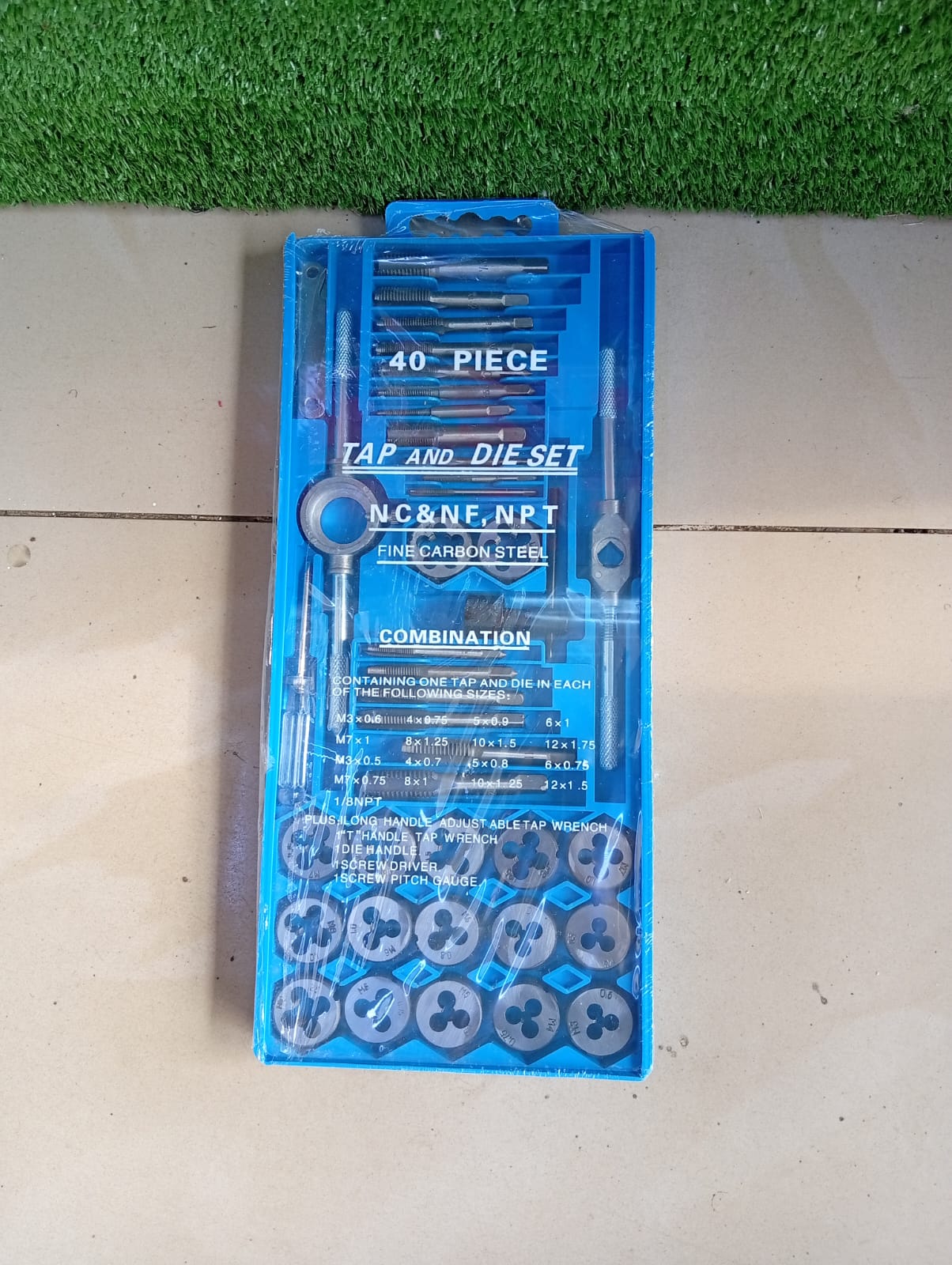
Description
A 40 pieces tap and die set is a complete hand-tool kit used to create, clean and repair screw threads on bolts, nuts, metal rods and drilled holes. It is an important kit for mechanics, machinists, plumbers, fabricators, electricians, motorcycle technicians and general workshop users.
The taps are used to cut or restore internal threads inside a drilled hole or nut. The dies cut or repair external threads on bolts, studs, pipes and metal rods.
A common 40-piece metric tap and die set covers sizes from M3 to M12. Many kits include 17 taps, 17 round dies and six supporting tools, including tap wrenches, a die holder, thread-pitch gauge, screwdriver and storage case.
The kit is suitable for light and medium workshop jobs involving mild steel, aluminium, brass, copper and other machinable materials. The exact material capacity depends on whether the taps and dies are made from carbon steel, alloy steel or high-speed steel.
Quick Specifications
| Feature | Typical specification |
|---|---|
| Product name | 40 Pieces Tap and Die Set |
| Main function | Cutting and repairing screw threads |
| Measuring system | Metric |
| Common size range | M3 to M12 |
| Number of taps | 17 |
| Number of dies | 17 |
| Common thread types | Metric coarse and fine |
| Additional thread | 1/8-inch NPT on selected kits |
| Tap holders | Adjustable tap wrench and T-handle wrench |
| Die holder | Adjustable round die stock |
| Measuring tool | Thread-pitch gauge |
| Material | Carbon steel, alloy steel or bearing steel |
| Storage | Plastic blow case or metal box |
| Applications | Automotive, fabrication, plumbing and maintenance |
A typical professional 40-piece metric kit includes 17 taps and 17 dies covering coarse and fine thread sizes between M3 and M12. Some kits also include a 1/8-27 NPT tap and die for small pipe-thread work.
What Is a Tap and Die Set?
A tap and die set contains cutting tools used to manufacture or restore screw threads.
What is a tap?
A tap cuts threads inside a hole.
It can be used to prepare:
- Threaded holes in metal plates
- Bolt holes in machinery
- Threaded holes in engine parts
- Nut threads
- Mounting holes in brackets
- Threads inside aluminium components
The tap has cutting flutes that remove small amounts of metal as it is turned into the prepared hole.
What is a die?
A die cuts threads around the outside of a round workpiece.
It can be used on:
- Bolts
- Threaded rods
- Studs
- Metal shafts
- Small pipes
- Damaged screw threads
A round die is fitted into a die stock or die holder and turned around the workpiece.
What is thread chasing?
Thread chasing means cleaning or repairing an existing thread without cutting a completely new one.
A tap can chase damaged internal threads, while a die can repair damaged external threads.
Thread chasing is useful when:
- A bolt no longer enters smoothly
- Rust has formed inside a threaded hole
- Paint is blocking the thread
- The first thread has become flattened
- Dirt or metal particles are inside the thread
- A stud has minor thread damage
Typical Contents of a 40-Piece Tap and Die Set
Many 40-piece metric kits include:
- 17 metric taps
- 17 metric round dies
- One large adjustable tap wrench
- One T-handle tap wrench
- One round die stock
- One thread-pitch gauge
- One screwdriver
- One storage case
This arrangement gives a total of 40 pieces.
Common Tap and Die Sizes
| Metric size | Common thread pitch |
|---|---|
| M3 | 0.5mm and selected fine pitch |
| M4 | 0.7mm and selected fine pitch |
| M5 | 0.8mm and selected fine pitch |
| M6 | 1.0mm and 0.75mm |
| M7 | 1.0mm and 0.75mm |
| M8 | 1.25mm and 1.0mm |
| M10 | 1.5mm and 1.25mm |
| M12 | 1.75mm and 1.5mm |
| Pipe thread | 1/8-inch NPT on selected sets |
One documented 40-piece kit includes M3, M4, M5, M6, M7, M8, M10 and M12 taps and dies in several coarse and fine pitches, plus a 1/8-inch NPT set. The exact size list varies between manufacturers, so the case markings should be checked before purchase.
Main Features of the 40 Pieces Tap and Die Set
Wide M3 to M12 working range
The M3 to M12 range covers many common fasteners used in:
- Motorcycles
- Cars
- Generators
- Pumps
- Power tools
- Furniture
- Agricultural machines
- Electrical equipment
- Metal fabrication
The smaller sizes are useful for light machinery, electronics housings and small brackets. Larger M10 and M12 sizes are common in automotive, construction and workshop applications.
Coarse and fine thread options
Many 40-piece kits include both coarse and fine thread pitches.
Coarse threads
Coarse threads have a larger distance between each thread.
They are generally:
- Faster to cut
- Easier to start
- More tolerant of dirt
- Common in general machinery
- Suitable for softer materials
Fine threads
Fine threads have a smaller distance between each thread.
They may provide:
- Finer adjustment
- More threads in a short distance
- Better holding in selected applications
- Reduced loosening under some conditions
- More precise assembly
The replacement thread must match the original bolt, nut or component. A similar diameter with the wrong pitch will damage the workpiece.
Carbon or alloy-steel construction
Basic tap and die sets are commonly made from carbon steel. Other kits use hardened alloy steel, bearing steel or high-speed steel.
A Kenyan 40-piece listing describes heat-treated 45# steel taps and alloy-steel dies, while other available sets use hardened alloy or bearing steel.
Carbon steel
Carbon-steel sets are suitable for:
- General repairs
- Thread cleaning
- Light workshop use
- Aluminium
- Brass
- Mild steel
Alloy steel
Alloy-steel tools normally provide improved strength and wear resistance for more regular use.
High-speed steel
High-speed steel taps and dies are normally preferred for demanding professional work because they can provide better edge retention and cutting performance.
Tool material alone does not determine performance. Correct lubrication, alignment and cutting method are also important.
Adjustable tap wrench
The large adjustable tap wrench holds taps securely during hand threading.
It normally has two handles that provide balanced turning force. The wrench should grip the square end of the tap firmly without slipping.
It is used for:
- Larger taps
- New internal threads
- Deep holes
- Workshop repairs
- Controlled hand tapping
T-handle tap wrench
The smaller T-handle tap wrench is suitable for small taps and restricted areas.
Benefits include:
- Better control
- Easy use in narrow spaces
- Balanced turning pressure
- Reduced risk of side loading
- Suitable for small M3, M4 and M5 taps
The operator should avoid using excessive force because small taps can break easily.
Round die stock
The die stock holds round threading dies.
It normally has:
- Two long handles
- A central die opening
- Retaining screws
- Adjustment screws on selected models
- Strong steel construction
The long handles help the operator turn the die evenly around a bolt or rod.
Thread-pitch gauge
A thread-pitch gauge helps identify the distance between threads.
To use it:
- Select one gauge blade.
- Place the teeth against the thread.
- Check whether the blade fits without gaps.
- Try another blade when it does not match.
- Read the pitch marking on the correct blade.
The pitch gauge helps avoid selecting an incorrect tap or die.
Storage case
The kit is normally supplied in a plastic blow-moulded case or metal storage box.
The case:
- Keeps sizes organised
- Protects cutting edges
- Reduces loss of small parts
- Makes transport easier
- Helps the user identify missing tools
A professional 40-piece set may be supplied in a blow case measuring about 330mm by 220mm by 48mm, although dimensions vary by brand.
Applications of a 40 Pieces Tap and Die Set
Automotive repair
The set can repair threads used on:
- Engine covers
- Battery brackets
- Alternator mounts
- Water pumps
- Gearbox housings
- Brake components
- Exhaust brackets
- Suspension fittings
- Motorcycle engine cases
Care is required when working on aluminium engine parts because the threads can be damaged by excessive force.
Machinery maintenance
The kit helps restore threaded holes and bolts used in:
- Generators
- Water pumps
- Welding machines
- Air compressors
- Concrete mixers
- Lawn mowers
- Power saws
- Agricultural equipment
- Industrial machines
Metal fabrication
Fabricators use taps and dies when making:
- Metal frames
- Brackets
- Equipment stands
- Machine guards
- Tool holders
- Gates
- Workbenches
- Custom bolts
- Threaded mounting points
Plumbing
Selected kits include a small NPT tap and die for pipe-thread applications.
The tool may be useful for:
- Small fittings
- Air-line fittings
- Grease nipples
- Pressure fittings
- Workshop pipe connections
A standard metric die should not be used to create a tapered pipe thread.
Electrical installation
The set can repair mounting threads in:
- Electrical panels
- Motor housings
- Generator control boxes
- Inverter brackets
- Distribution-board frames
- Machine terminal enclosures
Home and DIY work
A tap and die set is useful when repairing:
- Furniture bolts
- Garden machines
- Bicycles
- Shelving brackets
- Door hardware
- Workshop tools
- Metal appliances
How to Cut a New Internal Thread Using a Tap
Step 1: Select the thread size
Choose the required metric thread, such as M6 × 1.0.
The first number is the thread diameter. The second number is the distance between threads.
Step 2: Select the correct tapping drill
The hole must be drilled to the correct tapping size.
A hole that is too small places excessive pressure on the tap. A hole that is too large produces weak or incomplete threads.
Common approximate tapping-drill sizes include:
| Required thread | Common tapping drill |
|---|---|
| M3 × 0.5 | 2.5mm |
| M4 × 0.7 | 3.3mm |
| M5 × 0.8 | 4.2mm |
| M6 × 1.0 | 5.0mm |
| M8 × 1.25 | 6.8mm |
| M10 × 1.5 | 8.5mm |
| M12 × 1.75 | 10.2mm |
Always confirm the required drill size using a reliable tap-drill chart.
Step 3: Drill the hole straight
Secure the workpiece using a bench vice or clamp.
Drill the hole perpendicular to the surface. A crooked hole makes accurate tapping difficult.
Step 4: Chamfer the opening
Create a small chamfer at the top of the hole using a countersink or suitable drill bit.
The chamfer helps the tap start more easily.
Step 5: Apply cutting oil
Apply suitable cutting oil to the tap and hole.
Lubrication:
- Reduces friction
- Improves surface finish
- Helps remove chips
- Reduces heat
- Extends tool life
Different materials may require different cutting fluids.
Step 6: Fit the tap into the wrench
Secure the square end of the tap in the correct tap wrench.
Make sure it is centred and tight.
Step 7: Start the tap straight
Place the tap into the drilled hole and keep it at 90 degrees to the surface.
Turn slowly while checking alignment from two directions.
Step 8: Break the metal chips
A common hand-tapping method is:
- Turn forward approximately half to one full turn.
- Turn backwards about a quarter turn.
- Continue forward.
- Repeat until the required depth is reached.
The reverse movement helps break chips and clear the cutting edges.
Step 9: Remove and clean the tap
Turn the tap anticlockwise until it leaves the hole.
Clean the tap and remove chips from the new thread.
Step 10: Test the thread
Insert the correct clean bolt by hand.
The bolt should enter smoothly without forcing.
How to Cut an External Thread Using a Die
Step 1: Prepare the rod or bolt
The rod diameter should match the intended thread size.
Clean rust, paint and burrs from the surface.
Step 2: Chamfer the rod end
File or grind a small chamfer around the end.
The chamfer helps the die start without cross-threading.
Step 3: Install the die
Fit the correct die into the die stock.
The starting side normally has a wider lead-in.
Secure it using the die-stock screws.
Step 4: Apply cutting oil
Lubricate the rod and cutting edges.
Step 5: Align the die
Place the die square to the rod.
Incorrect alignment produces crooked or damaged threads.
Step 6: Turn the die
Turn the die clockwise for a normal right-hand thread.
After moving forward, reverse it slightly to break and release chips.
Step 7: Continue to the required length
Apply more cutting oil when necessary.
Do not rush or use excessive force.
Step 8: Remove the die
Turn it anticlockwise until it comes off the rod.
Clean and inspect the new thread.
Step 9: Test with a nut
Run a matching nut along the thread by hand.
It should move smoothly without excessive looseness.
Common Tap and Die Problems
Tap is difficult to turn
Possible causes include:
- Hole is too small
- Wrong tap size
- Insufficient cutting oil
- Hard workpiece material
- Chips blocking the flutes
- Tap is not straight
- Cutting edges are worn
Stop and correct the problem before the tap breaks.
Tap breaks inside the hole
This may happen because of:
- Excessive force
- Side pressure
- Poor alignment
- Blocked flutes
- Small tapping hole
- Worn or low-quality tap
- Failure to reverse and break chips
Removing a broken hardened tap can be difficult. Work slowly, especially with small sizes.
Die produces a loose thread
Possible causes include:
- Wrong die size
- Rod diameter is too small
- Worn die
- Incorrect adjustment
- Too much material removed
Thread is rough
A rough thread may result from:
- Poor lubrication
- Blunt cutting edges
- Incorrect speed
- Dirty workpiece
- Failure to clear chips
- Hard or unsuitable material
Tap starts at an angle
Remove it before cutting deeply.
Correct the alignment and restart. Continuing at an angle can damage the hole and break the tap.
Safety Precautions
- Wear safety glasses.
- Clamp the workpiece securely.
- Use the correct tap, die and pitch.
- Confirm the tapping-drill size.
- Keep the tool square to the workpiece.
- Apply suitable cutting fluid.
- Never add long pipes to the handles.
- Do not force a jammed tap.
- Keep hands away from sharp metal chips.
- Use a brush instead of fingers to remove swarf.
- Replace cracked or chipped tools.
- Do not use taps or dies as punches.
- Keep cutting tools away from children.
- Clean oil from handles to prevent slipping.
Maintenance Tips
Clean after every use
Remove:
- Metal chips
- Cutting oil
- Grease
- Dust
- Rust particles
Use a small brush to clean the flutes.
Apply rust protection
Wipe the taps and dies with a lightly oiled cloth before storage.
Inspect the cutting teeth
Do not use tools with:
- Broken teeth
- Cracks
- Heavy corrosion
- Bent shanks
- Rounded cutting edges
Keep the case organised
Return every tool to its correct position after use.
This protects the cutting edges and helps identify missing parts.
Avoid dropping taps
Taps are hard but can be brittle. A fall onto concrete may chip or crack the cutting edges.
Use the correct lubricant
Cutting oil helps protect the tools and improves the finished thread.
Tap and Die Set Versus Thread Repair Kit
| Feature | Tap and die set | Thread repair insert kit |
|---|---|---|
| Cuts new threads | Yes | Prepares hole for insert |
| Repairs light thread damage | Yes | Yes |
| Repairs badly stripped holes | Limited | Excellent |
| Includes external dies | Yes | Normally no |
| Adds threaded insert | No | Yes |
| Best use | General threading | Severely damaged internal threads |
A tap can repair a slightly damaged hole. A thread-insert system may be needed when the original threads have been completely stripped.
Carbon-Steel Versus High-Speed-Steel Sets
| Feature | Carbon steel | High-speed steel |
|---|---|---|
| Price | Lower | Higher |
| Light repairs | Suitable | Suitable |
| Frequent professional use | Moderate | Better |
| Edge retention | Basic | Better |
| Harder materials | Limited | More suitable |
| General DIY | Excellent value | More than many users require |
A carbon-steel 40-piece set is practical for routine repair and occasional threading. Professional users cutting many new threads may benefit from high-speed-steel tools.
How to Choose the Best 40 Pieces Tap and Die Set
Confirm metric or imperial sizes
A metric set uses markings such as:
- M3
- M4
- M5
- M6
- M8
- M10
- M12
An imperial set uses sizes such as:
- 1/4 inch
- 5/16 inch
- 3/8 inch
- 1/2 inch
Buy the system used by the machines and vehicles you normally repair.
Check the complete size list
Do not rely only on the words “40 pieces.”
Confirm:
- Number of taps
- Number of dies
- Thread diameters
- Thread pitches
- NPT sizes
- Included holders
- Thread gauge
Check the tool material
Choose hardened alloy or high-speed steel for regular workshop use.
Carbon steel is suitable for lighter jobs and thread restoration.
Inspect the markings
Every tap and die should have clear size and pitch markings.
Poor markings increase the risk of choosing the wrong tool.
Check the case quality
A strong metal or blow-moulded case protects the tools and keeps all 40 pieces organised.
Confirm coarse and fine threads
A set containing both coarse and fine pitches provides greater versatility.
Consider spare availability
Individual taps may break or become worn. Choose a set using standard sizes that can be replaced locally.
40 Pieces Tap and Die Set Price in Kenya
A current Kenyan listing prices a 40-piece metric tap and die set at approximately KSh 5,000, reduced from KSh 7,000. Another Kenyan supplier lists a similar heavy-duty 40-piece M3 to M12 metric and inch threading kit, although its price may depend on current stock and seller terms.
| Type of tap and die set | Estimated price in Kenya |
|---|---|
| Basic 20-piece set | KSh 2,000–4,000 |
| Standard 40-piece carbon-steel set | KSh 4,500–7,500 |
| Heavy-duty alloy-steel 40-piece set | KSh 7,000–12,000 |
| Branded professional 40-piece set | KSh 12,000–30,000+ |
| Large 110-piece metric and SAE set | KSh 20,000–30,000+ |
A locally listed 110-piece metric and SAE kit is priced around KSh 20,000 on offer, showing the large price difference between standard 40-piece kits and extensive professional sets.
Prices may vary according to:
- Brand
- Tool material
- Metric or SAE sizes
- Number of fine pitches
- Case quality
- Warranty
- Retailer
- Delivery location
- Current stock
Package Contents
A standard package may include:
- 17 metric taps
- 17 metric dies
- One adjustable tap wrench
- One T-handle tap wrench
- One round die holder
- One thread-pitch gauge
- One screwdriver
- One storage case
The case should be inspected to confirm all 40 pieces are present before use.
Why Buy a 40 Pieces Tap and Die Set?
A 40 pieces tap and die set gives a workshop the tools needed to create, clean and repair common metric threads.
It can restore damaged bolts, prepare new threaded holes and produce threads on metal rods. This can save the cost of replacing machinery parts because of minor thread damage.
The M3 to M12 range covers many common fasteners used in cars, motorcycles, generators, water pumps, agricultural machines, furniture and fabrication projects. The included tap wrenches, die holder and pitch gauge make the kit practical for both repair work and new thread cutting.
For the best results, use the correct size, apply cutting oil, maintain straight alignment and reverse the cutting tool regularly to clear metal chips.
Frequently Asked Questions
What is a 40 pieces tap and die set used for?
It is used for cutting new internal and external threads and repairing damaged threads on nuts, bolts, holes, rods and studs.
What is the difference between a tap and a die?
A tap cuts threads inside a hole. A die cuts threads around the outside of a rod, bolt or stud.
What sizes are included in a 40-piece metric set?
Most standard kits cover common sizes from M3 to M12, with coarse and fine pitches. Some also include a 1/8-inch NPT tap and die.
How many taps and dies are normally included?
A common arrangement includes 17 taps and 17 dies, plus six accessories.
Can the set repair damaged bolt threads?
Yes. The correct die can clean and restore lightly damaged external threads.
Can it repair a stripped threaded hole?
It may repair light damage. A completely stripped hole may require drilling to a larger size or installing a thread-repair insert.
Can I use a tap without drilling first?
Only when cleaning an existing thread. A new threaded hole must first be drilled to the correct tapping size.
Do I need cutting oil?
Yes. Cutting oil reduces friction, clears chips, improves the thread finish and helps protect the cutting tool.
Can it cut stainless steel?
Some high-quality alloy or high-speed-steel tools can cut selected stainless steel, but basic carbon-steel kits may wear or break. Use correct lubrication and follow the tool manufacturer’s material rating.
Can I use a power drill to turn the tap?
Hand tapping is safer for most general repair work. A power drill can easily misalign or break the tap unless the user has proper equipment and experience.
Why should I turn the tap backwards?
Turning it backwards slightly breaks the metal chip and helps clear the cutting flutes.
Can the same die make coarse and fine threads?
No. Each die cuts one specific diameter and thread pitch.
How do I know the thread pitch?
Use the thread-pitch gauge supplied with the set and match its teeth to the existing thread.
Is the set metric or imperial?
Many common 40-piece kits are metric from M3 to M12. Imperial 40-piece kits are also available, so check the markings before buying.
What is the price of a 40 pieces tap and die set in Kenya?
A standard 40-piece set generally costs about KSh 4,500 to KSh 7,500, while professional alloy or branded sets can cost more. One current Kenyan listing advertises a 40-piece metric set at KSh 5,000.

Reviews
There are no reviews yet.