
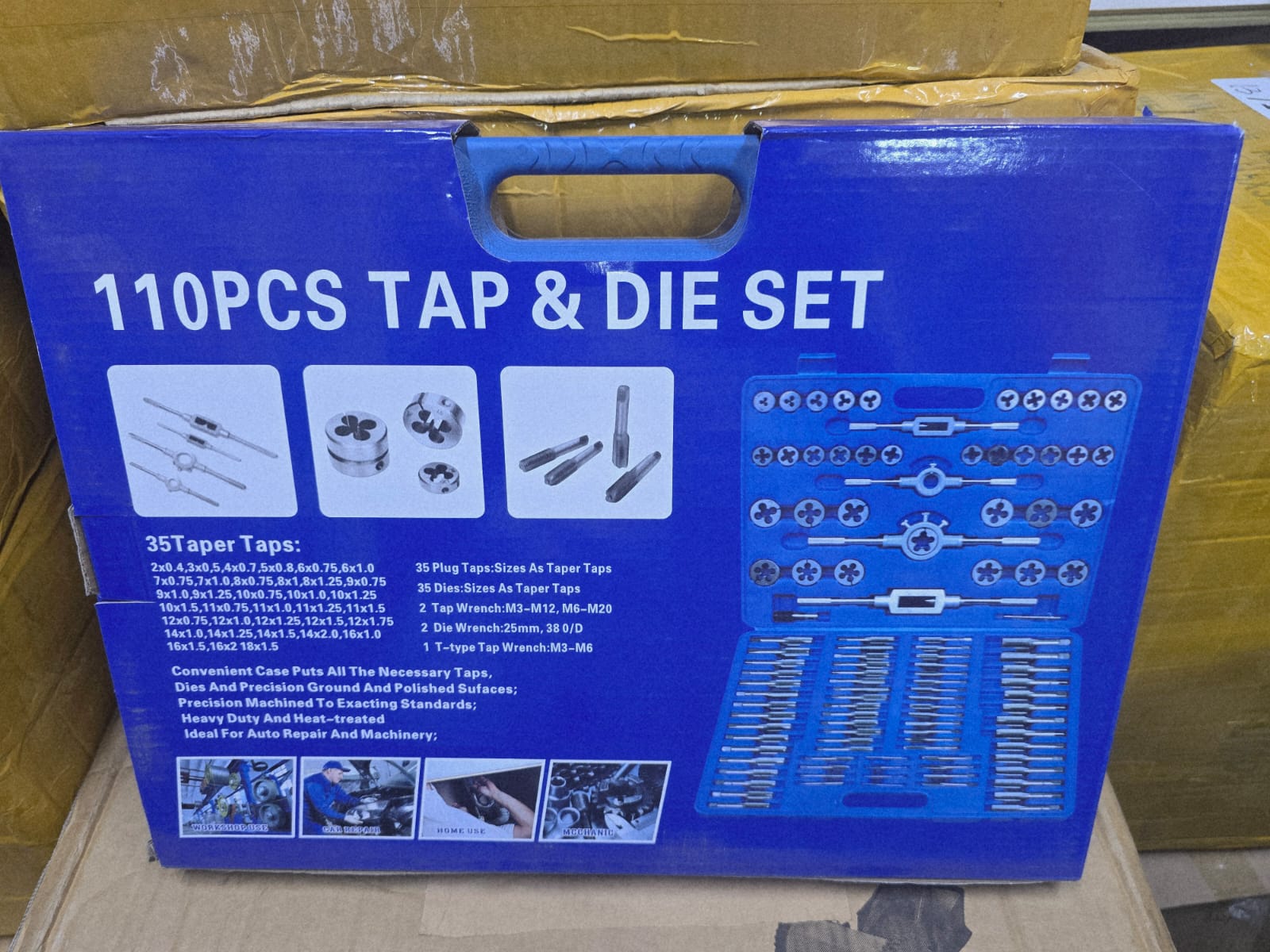
Description
A 110 pieces tap and die set is a complete hand-tool kit used to cut, clean, restore, and repair internal and external screw threads. It is suitable for mechanics, engineers, metal fabricators, plumbers, technicians, automotive workshops, machine repair businesses, maintenance teams, and serious home users.
The taps are used to create or repair internal threads inside drilled holes. Dies are used to cut or restore external threads on bolts, rods, shafts, and studs.
Most 110-piece sets contain 35 thread sizes. Each size normally includes two taps and one matching die. The two taps may be described as a taper tap and plug or bottoming tap, depending on the manufacturer. The remaining pieces are tap holders, die holders, and a T-handle wrench.
The kit is commonly supplied in either:
- A full metric configuration covering approximately M2 to M18
- A mixed metric and SAE configuration
- A titanium-coated or tungsten-alloyed finish
- A moulded plastic or metal carrying case
Because different brands arrange the 110 pieces differently, buyers should check the printed size chart before purchasing.
Quick Product Specifications
| Feature | Typical specification |
|---|---|
| Product name | 110 pieces tap and die set |
| Main purpose | Cutting and repairing threads |
| Common thread systems | Metric, SAE, UNC, UNF, UNS and NPT |
| Metric range | Commonly M2 to M18 on full metric kits |
| Number of taps | Usually 70 |
| Number of dies | Usually 35 |
| Tap holders | Two |
| Die holders | Two |
| T-handle tap wrench | One |
| Tool material | Tungsten-alloy steel, high-speed steel or heat-treated carbon steel |
| Surface finish | Plain, polished or titanium coated |
| Case | Moulded plastic or metal storage case |
| Typical packaged weight | About 6.5kg to 9.5kg, model dependent |
| Main applications | Automotive, fabrication, plumbing and machinery repair |
One common 110-piece arrangement contains 70 taps, 35 dies, two tap wrenches, two die holders and one T-type tap wrench.
What Is a Tap and Die Set?
A tap and die set contains matching tools for producing screw threads.
Tap
A tap cuts the female thread inside a hole.
Taps are used when making or repairing threaded holes for:
- Bolts
- Screws
- Studs
- Grease nipples
- Drain plugs
- Machine covers
- Engine parts
- Metal brackets
Die
A die cuts the male thread around the outside of a rod, stud, pipe fitting or bolt.
Dies can be used to:
- Make a new threaded rod
- Repair a damaged bolt
- Clean rust from threads
- Correct a crushed thread
- Extend an existing thread
- Prepare a replacement stud
Using the matching tap and die creates compatible internal and external threads.
Typical Contents of the 110-Piece Set
A standard 110-piece kit commonly includes:
| Component | Typical quantity |
|---|---|
| Taper or starter taps | 35 |
| Plug or finishing taps | 35 |
| Matching round dies | 35 |
| Adjustable tap wrenches | 2 |
| Die holders | 2 |
| T-handle tap wrench | 1 |
| Total | 110 pieces |
This arrangement is confirmed across several 110-piece sets, although some brands may include slightly different holders or accessories.
Common Metric Sizes
Full metric 110-piece kits commonly cover sizes from M2 to M18, with both coarse and fine pitches included.
Typical sizes may include:
- M2 × 0.4
- M3 × 0.5
- M4 × 0.7
- M5 × 0.8
- M6 × 0.75
- M6 × 1.0
- M7 × 0.75
- M7 × 1.0
- M8 × 0.75
- M8 × 1.0
- M8 × 1.25
- M9 × 0.75
- M9 × 1.0
- M9 × 1.25
- M10 × 0.75
- M10 × 1.0
- M10 × 1.25
- M10 × 1.5
- M11 × 0.75
- M11 × 1.0
- M11 × 1.25
- M11 × 1.5
- M12 × 0.75
- M12 × 1.0
- M12 × 1.25
- M12 × 1.5
- M12 × 1.75
- M14 × 1.0
- M14 × 1.25
- M14 × 1.5
- M16 sizes on selected kits
- M18 × 1.5
The exact pitch selection varies. One published metric kit lists 35 sizes from M2 × 0.4 through M18, including several coarse and fine options for M6, M8, M10, M11, M12 and M14.
Common SAE and Imperial Sizes
A mixed metric and SAE kit may include thread standards such as:
- UNC coarse threads
- UNF fine threads
- UNS special threads
- NPT pipe threads
- Metric coarse threads
- Metric fine threads
Common imperial sizes may include:
- 4-40 UNC
- 6-32 UNC
- 8-32 UNC
- 10-24 UNC
- 10-32 UNF
- 12-24 UNC
- 1/4-20 UNC
- 1/4-28 UNF
- 5/16-18 UNC
- 5/16-24 UNF
- 3/8-16 UNC
- 3/8-24 UNF
- 7/16-14 UNC
- 7/16-20 UNF
- 1/2-13 UNC
- 1/2-20 UNF
- 9/16-12 UNC
- 9/16-18 UNF
- 5/8-11 UNC
- 5/8-18 UNF
- 3/4-10 UNC
- 3/4-16 UNF
- 1/8-27 NPT
- 1/4-18 NPT
These sizes are found in representative mixed 110-piece metric and imperial sets.
Main Features of the 110 Pieces Tap and Die Set
Wide thread-size coverage
The large size selection allows one kit to handle many common bolts, nuts, studs, fittings and threaded holes.
This is useful in workshops that repair different machines and vehicles because the technician may meet several thread sizes during one job.
Taper and finishing taps
Most sizes include two matching taps.
The first tap begins the thread gradually and helps the tool enter the drilled hole correctly. The second tap cuts the thread deeper or finishes the lower part of the hole.
A two-stage process reduces the amount of cutting force placed on one tap. It also helps produce cleaner threads than forcing a finishing tap into an unthreaded hole.
Matching round dies
Each thread size normally has a corresponding round die.
The die can be used to:
- Cut a new external thread
- Restore damaged bolt threads
- Clean painted threads
- Remove light corrosion
- Prepare replacement studs
- Match a newly tapped hole
Adjustable tap wrenches
The two tap holders are normally sized for small and larger taps.
Representative 110-piece kits may include holders covering approximately:
- 3mm to 12mm
- 5mm to 20mm
Exact holder capacities differ by brand.
The adjustable jaws grip the square end of the tap and allow the user to turn it evenly using both handles.
T-handle tap wrench
The small T-handle is useful in restricted spaces where a long two-handle wrench cannot turn freely.
It is suitable for:
- Small taps
- Blind holes
- Engine compartments
- Machinery recesses
- Close work near other components
Two die holders
The die holders secure the round dies during external threading.
Different holder sizes are included because smaller and larger dies have different outside diameters. A representative kit includes 1-inch and 1½-inch die holders.
Heat-treated cutting tools
Tap-and-die sets are commonly made from heat-treated steel. Depending on the brand, the product may be described as:
- Tungsten steel
- Tungsten-alloyed steel
- High-speed ground steel
- Heat-treated 45 steel
- Titanium-coated cutting steel
Published 110-piece products use several different materials, so “tungsten steel” or “HSS” should not be assumed unless it appears on the case, product plate or supplier specification.
Titanium-coated options
Selected premium or mid-range kits have a gold-coloured titanium coating.
The coating can help reduce friction and surface wear, but the underlying steel quality, heat treatment, cutting geometry and correct lubrication remain important.
A professional 110-piece metric set from Brilliant Tools is described as titanium coated and designed for producing internal and external threads to DIN 352 and DIN 223.
Clearly marked sizes
Each tap and die should have its size and pitch engraved or stamped on it.
Clear markings help prevent the user from combining:
- The wrong tap and die
- Coarse and fine pitches
- Metric and imperial threads
- Similar-looking thread sizes
The case should also provide a labelled position for every piece.
Strong storage case
A fitted carrying case protects the cutting tools and makes missing pieces easier to notice.
One professional 110-piece set has package dimensions of about 467 × 378 × 73mm and a gross weight of approximately 6.53kg. Other complete kits may weigh around 7.5kg or more, depending on the tool material and case.
Applications of the 110 Pieces Tap and Die Set
Automotive repair
Mechanics can use the set to repair threads on:
- Engine components
- Gearbox casings
- Drain-plug holes
- Wheel studs
- Exhaust fittings
- Alternator brackets
- Starter-motor mounts
- Suspension components
- Motorcycle parts
- Tractor components
The technician must confirm the original thread size before cutting. Using the wrong pitch can permanently damage the component.
Machinery maintenance
The kit is useful for maintaining:
- Pumps
- Generators
- Compressors
- Milling machines
- Lathes
- Welding machines
- Agricultural equipment
- Processing machinery
- Industrial motors
Metal fabrication
Fabricators can create threaded holes in:
- Flat bars
- Steel plates
- Aluminium sections
- Brackets
- Frames
- Machine guards
- Workbenches
Plumbing and pipe repair
Sets that include NPT taps and dies may assist with selected threaded pipe fittings.
NPT threads are tapered and are not the same as straight metric or UNC threads. The correct sealant and fitting standard must also be used.
Construction equipment repair
The tools can restore threads on mixers, compactors, lifting machines, generators, pumps and other site equipment.
Home workshop projects
Home users can make threaded parts, restore damaged bolts and repair furniture, gates, tools and small machines.
Materials That Can Be Threaded
Depending on tap quality and correct cutting technique, the set may work on:
- Mild steel
- Low-alloy steel
- Cast iron
- Aluminium
- Brass
- Copper
- Bronze
- Plastic
- Some stainless steels
Published 110-piece kits are promoted for carbon steel, cast iron, aluminium, brass, copper and stainless steel. However, stainless steel is harder to thread and requires better cutting tools, correct lubricant, lower speed and careful chip control.
Basic carbon-steel kits are better suited to thread restoration and occasional work in softer metals. For frequent production threading or hard stainless steel, professional HSS or cobalt tools may be more suitable.
Difference Between Coarse and Fine Threads
Coarse thread
A coarse thread has fewer threads over a given length.
Benefits include:
- Faster assembly
- Better resistance to dirt
- Lower risk of cross-threading
- Good performance in softer materials
- Easier starting
Examples include M10 × 1.5 and 1/2-13 UNC.
Fine thread
A fine thread has more threads over the same distance.
Benefits include:
- Finer adjustment
- Greater clamping control
- Lower risk of loosening in some applications
- More useful wall thickness in thin parts
- Common use in automotive and precision machinery
Examples include M10 × 1.0 and 1/2-20 UNF.
Always match the original thread pitch.
How to Select the Correct Tap or Die
Read the original marking
Look for a marking on the bolt, drawing, machine manual or original component.
Measure the outside diameter
Use a vernier caliper or micrometer to measure the bolt or threaded rod.
Measure the thread pitch
Use a metric or imperial thread-pitch gauge.
Test with a matching nut or bolt
A known original fastener may help identify the size, but it should turn freely by hand without force.
Do not guess
Sizes such as M10 × 1.5 and 3/8-16 may appear similar but are not interchangeable.
How to Tap an Internal Thread
Step 1: Choose the thread size
Select the required tap size and pitch.
Step 2: Determine the tapping-drill size
Drill the hole using the recommended tapping-drill diameter.
The hole must be smaller than the finished thread but large enough to leave room for the tap.
Step 3: Secure the workpiece
Hold the material in a strong vice or approved clamp.
Step 4: Apply cutting fluid
Use a lubricant suitable for the material.
Step 5: Align the tap
Place the taper tap straight into the drilled hole.
Incorrect alignment can produce a crooked thread or break the tap.
Step 6: Turn slowly
Rotate the wrench clockwise to cut a short distance.
Step 7: Reverse to break chips
After a partial turn, rotate slightly backwards to break and clear the metal chips.
Step 8: Continue gradually
Add more lubricant as required.
Step 9: Use the finishing tap
Use the second tap where a deeper or more complete thread is needed.
Step 10: Clean and test
Remove chips and test the new thread using a correct bolt.
How to Cut an External Thread with a Die
- Select the correct die size and pitch.
- Secure the rod or bolt in a vice.
- File a small chamfer on the rod end.
- Place the die in the matching holder.
- Confirm that the starting side faces the workpiece.
- Apply cutting fluid.
- Hold the die square to the rod.
- Turn it forward slowly.
- Reverse slightly to break chips.
- Continue until the required thread length is reached.
- Remove the die.
- Clean and inspect the thread.
- Test it using the correct nut.
Thread Repair Versus New Thread Cutting
Thread repair
Thread repair removes rust, paint, dirt and small deformations from an existing thread.
Less metal should be removed during repair.
New thread cutting
New threading forms a complete thread in a drilled hole or plain rod.
It requires:
- Correct drill size
- Accurate alignment
- Cutting lubricant
- More cutting force
- Proper chip removal
A low-cost set may perform well for cleaning existing threads but may wear faster during frequent new-thread production.
Benefits of a 110 Pieces Tap and Die Set
Large size selection
One kit replaces many separately purchased taps and dies.
Metric and imperial options
Mixed kits are useful for workshops that service both modern metric machines and older imperial equipment.
Repairs expensive components
A damaged thread may sometimes be restored without replacing the full machine part.
Creates custom threaded parts
Fabricators can make studs, brackets, rods and threaded holes for special projects.
Organised case
The fitted case keeps each size visible and reduces tool loss.
Suitable for mobile technicians
The complete kit can be transported to repair sites.
Saves workshop time
The technician can quickly select a matching size instead of waiting for a single replacement tool.
Common Tap-and-Die Mistakes
Using the wrong pitch
A tap may begin turning in the wrong hole but destroy the original thread after a few turns.
Failing to drill the correct hole size
A hole that is too small can overload and break the tap. A hole that is too large produces a weak, shallow thread.
Starting at an angle
A crooked tap or die creates poor threads and may break.
Turning continuously without reversing
Metal chips can pack into the cutting flutes and jam the tool.
Working without lubricant
Dry cutting increases heat, friction and wear.
Applying too much force
When a tap becomes tight, stop and identify the cause. Forcing it may snap the tool inside the workpiece.
Using damaged tools
Chipped or blunt cutting teeth produce rough threads and increase breakage risk.
Mixing metric and SAE parts
A metric bolt must not be forced into a similar imperial thread.
Maintenance and Storage
- Clean every tap and die after use.
- Remove metal chips from the flutes.
- Wipe the tools with a lightly oiled cloth.
- Keep the holders clean and dry.
- Return each piece to its labelled position.
- Replace broken or badly worn pieces.
- Do not throw taps loosely into a toolbox.
- Store the case in a dry place.
- Protect the set from rain and humidity.
- Use a soft brush to clean cutting teeth.
- Check holder jaws and screws regularly.
- Do not sharpen taps without specialist equipment.
Safety Tips
- Wear safety glasses.
- Clamp the workpiece firmly.
- Keep hands away from sharp cutting edges.
- Remove metal chips using a brush.
- Do not clear chips with bare fingers.
- Do not extend tap-wrench handles using pipes.
- Stop when the tap begins to bind.
- Use the correct cutting fluid.
- Keep the work area well lit.
- Dispose of sharp metal chips safely.
- Do not use a cracked tap or die.
- Wear gloves when handling rough stock, but keep loose gloves away from rotating machinery.
How to Choose the Best 110 Pieces Tap and Die Set in Kenya
Choose metric or mixed sizing
A metric M2 to M18 set is suitable for many modern vehicles, machines and fabrication jobs.
A mixed metric and SAE kit is better for a workshop that repairs imported, older or American-standard equipment.
Check the tool material
For occasional thread repair, heat-treated carbon or tungsten-alloy steel may be sufficient.
For frequent professional use, consider ground HSS or a reputable titanium-coated set.
Confirm the included thread sizes
Do not buy based on the 110-piece count alone. Read the complete size list.
Check whether each size has two taps
A kit containing taper and finishing taps provides better control during new-thread cutting.
Inspect the holders
The tap and die holders should grip the tools firmly without excessive play.
Look for clear markings
Sizes and pitches should be easy to read.
Check the case quality
A weak case may allow heavy dies to fall out or become mixed.
Ask about replacement pieces
It should be possible to replace a broken common tap without buying another full set.
Check the intended material
A set designed mainly for thread cleaning may not be ideal for regular stainless-steel production work.
110 Pieces Tap and Die Set Price in Kenya
Current Kenyan listings vary widely by brand, tool material and seller.
One Nairobi listing advertises a 110-piece set at about KSh 7,000, while marketplace listings show examples around KSh 15,000 to KSh 16,500. Imported professional or branded sets may cost more.
| Set type | Estimated price in Kenya |
|---|---|
| Basic 110-piece general-purpose set | KSh 7,000–10,000 |
| Better tungsten-alloy set | KSh 10,000–17,000 |
| Titanium-coated set | KSh 15,000–25,000 |
| Professional branded HSS set | KSh 25,000–50,000+ |
The price may depend on:
- Metric-only or mixed sizing
- Tool material
- Surface coating
- Brand
- Case quality
- Thread-size range
- Warranty
- Seller location
- Delivery charges
Buyers should confirm that all 110 pieces are present before leaving the shop or accepting delivery.
Package Contents
A typical package includes:
- 35 taper or starter taps
- 35 plug or finishing taps
- 35 matching dies
- Two adjustable tap wrenches
- Two round die holders
- One T-handle tap wrench
- One fitted carrying case
Some sets may also include a screwdriver, thread-pitch gauge or other small accessory, so the exact package should be checked before purchase.
Why Buy a 110 Pieces Tap and Die Set?
A 110 pieces tap and die set is a valuable workshop kit for cutting new threads and restoring damaged ones.
Its wide selection of coarse and fine thread sizes makes it suitable for automotive repairs, machine maintenance, metal fabrication, plumbing, construction-equipment servicing and general engineering.
With matching taps, dies, holders and a storage case, the kit gives technicians the main tools required to work on many common threaded parts without purchasing each size separately.
Frequently Asked Questions
What is a 110-piece tap and die set used for?
It is used to cut new internal and external threads or repair damaged threads on bolts, rods, nuts, fittings and machine components.
How many taps are included?
A common set includes 70 taps, consisting of two taps for each of 35 thread sizes.
How many dies are included?
Most standard 110-piece kits include 35 matching round dies.
What metric sizes are available?
A full metric set commonly covers approximately M2 to M18, with coarse and fine pitches.
Does it include both metric and imperial sizes?
Some sets are metric only. Others combine metric, UNC, UNF, UNS and NPT sizes. Check the size chart before buying.
Can it repair damaged bolt threads?
Yes. A matching die can clean and restore lightly damaged external threads.
Can it repair a damaged threaded hole?
Yes. A matching tap can clean or restore an internal thread, provided the hole is not badly enlarged or cracked.
Can I use it on stainless steel?
Selected higher-quality tools can cut stainless steel, but proper cutting fluid and careful technique are required. Basic sets are better suited to softer metals and thread restoration.
What is the difference between a tap and a die?
A tap cuts an internal female thread inside a hole. A die cuts an external male thread around a rod or bolt.
Why are there two taps for each size?
The first tap starts the thread gradually. The second tap deepens or finishes it.
Must I use cutting oil?
Yes. Cutting oil reduces friction, heat and tooth wear while improving the thread finish.
Can I use a power drill to turn the tap?
Hand operation is safer for a general workshop tap set. A power drill can apply too much torque and break the tap unless a proper tapping system is used.
How do I know the correct thread pitch?
Use a thread-pitch gauge, machine manual, technical drawing or known matching bolt.
What is the price of a 110 pieces tap and die set in Kenya?
Basic sets may start near KSh 7,000, while better-quality sets commonly cost around KSh 10,000 to KSh 17,000. Professional sets may cost considerably more.

Reviews
There are no reviews yet.