
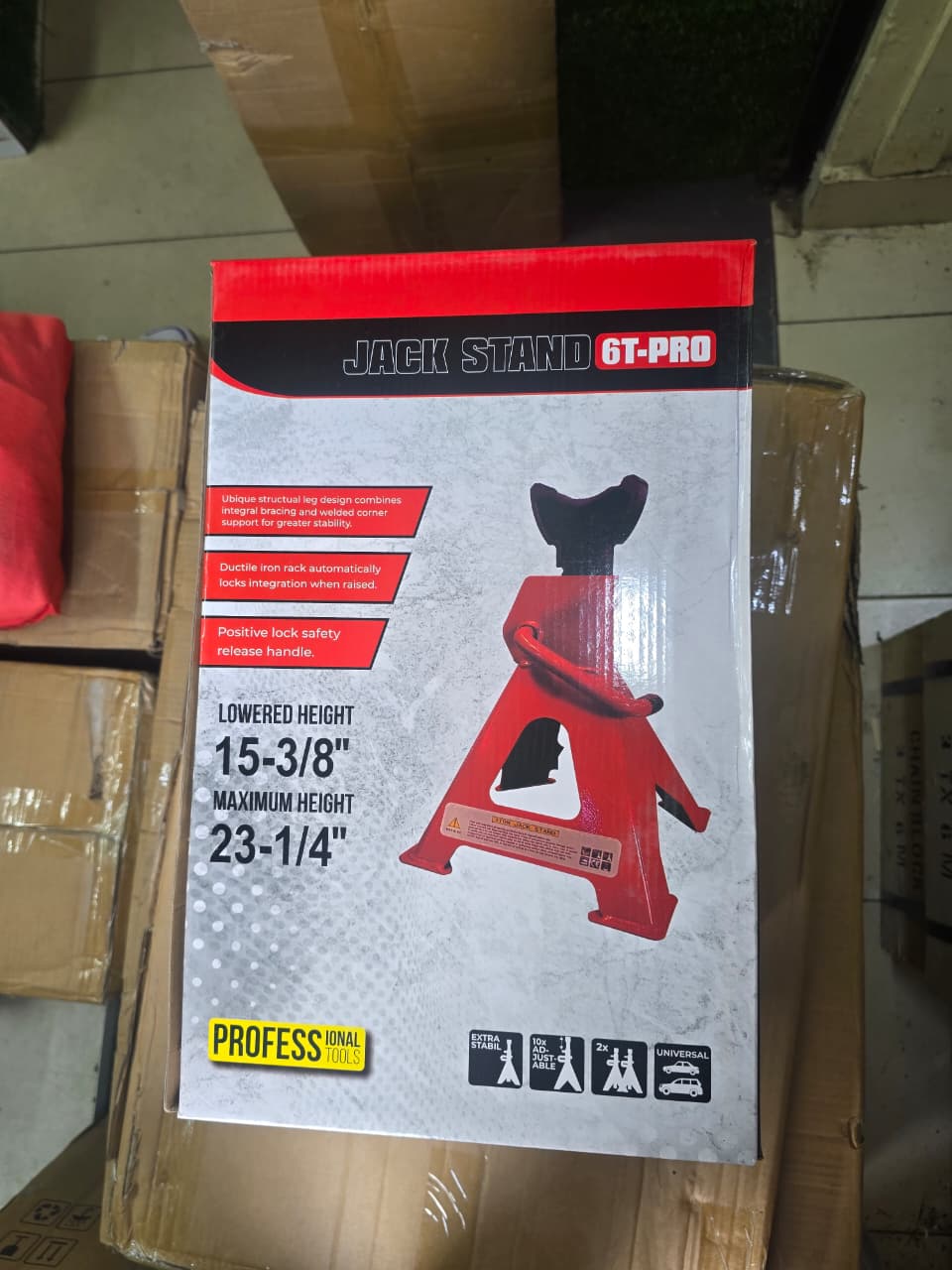
Description

A 6 ton jack stand is a heavy-duty vehicle support tool used to hold a raised vehicle securely during tyre changes, brake repairs, suspension work and underbody inspection. It is also called a 6 ton axle stand, vehicle support stand or garage jack stand.
A jack stand does not lift a vehicle. A hydraulic trolley jack, bottle jack or vehicle lift raises the vehicle first. The jack stands are then positioned below approved support points before the vehicle is lowered onto them.
Most 6-ton stands have a strong welded-steel base, an adjustable ratchet post and a wide saddle. Double-locking models combine the ratchet mechanism with a separate safety pin. Common 6-ton stands adjust from approximately 391mm to 620mm, although the exact range varies by brand and design.
A major point to check is whether the advertised capacity applies to each stand or the pair. Some manufacturers rate a 6-ton set at 6 tons per pair, while other listings describe each individual stand as having a 6-ton capacity. Always follow the rating printed on the actual product and its manual. US Jack, for example, states that its listed capacity applies to the pair and that its stands are intended to be used together.
Quick Specifications
| Feature | Typical specification |
|---|---|
| Product name | 6 ton jack stand |
| Other names | Axle stand, support stand, garage stand |
| Rated capacity | 6 tons, rating basis varies by manufacturer |
| Equivalent common rating | 12,000lb or about 5,443kg |
| Quantity | Usually sold as a pair |
| Minimum height | About 381–406mm |
| Maximum height | About 595–645mm |
| Height adjustment | Ratchet bar or locking pin |
| Locking system | Ratchet, double lock or pin lock |
| Main body | Welded heavy-gauge steel |
| Ratchet post | Ductile iron or forged steel |
| Saddle | Wide curved or V-shaped support |
| Base | Four-leg pyramid or wide square base |
| Finish | Painted or powder-coated |
| Main use | Supporting raised vehicles |
| Suitable vehicles | Cars, SUVs, pickups and light commercial vehicles |
Exact dimensions, loading limits and certification should be confirmed before use.
Main Features of a 6 Ton Jack Stand
Heavy-duty 6-ton capacity
The high load rating makes the stand suitable for supporting larger vehicles when the correct jacking and support points are used.
Common applications include:
- SUVs
- Pickup trucks
- Double-cab vehicles
- Delivery vans
- Four-wheel-drive vehicles
- Large saloon cars
- Light commercial vehicles
- Farm vehicles
- Trailers
- Selected workshop machinery
A six-ton rating does not automatically mean the stand is suitable for every heavy vehicle. The vehicle’s total weight, weight distribution, loading condition and manufacturer-approved support locations must all be checked.
Adjustable working height
The adjustable post allows the stand to support vehicles with different ground clearances.
Common examples include:
- Torin 6-ton stands: approximately 391mm to 605mm
- Stronghold-style stands: approximately 400mm to 619mm
- US Jack 6-ton stands: approximately 406mm to 648mm
- Selected double-locking imported models: approximately 396mm to 594mm
These figures show why the exact model should be checked before purchase. Some stands provide a lower entry height, while others offer greater extension for high-clearance vehicles.
Ratchet height adjustment
Many 6-ton axle stands use a toothed ratchet post.
To adjust the height:
- Pull the ratchet post upward.
- Position the saddle close to the vehicle’s support point.
- Allow the locking pawl to engage one of the teeth.
- Confirm that the post cannot move down.
- Insert the secondary safety pin where provided.
The ratchet system allows quick adjustment without removing a separate main support pin at every height.
Double-locking safety system
A double-locking stand normally uses:
- A self-locking ratchet handle
- A separate steel safety pin
The ratchet carries and controls the adjustable post, while the pin provides a second locking point. This reduces dependence on only one mechanism.
Torin, Omega and Stronghold-type stands are available with double-locking designs that combine a handle lock with an additional pin.
The safety pin should always be fully inserted through the correct opening. Never replace it with a screwdriver, nail, bolt or welding rod.
Strong steel base
The lower body is commonly made from welded steel formed into a pyramid or four-legged structure.
A wide base helps:
- Spread the vehicle load
- Reduce tipping
- Improve side-to-side stability
- Keep the stand upright
- Reduce sinking on suitable workshop floors
Representative 6-ton models have bases around 275mm by 241mm, while some US-made stands use an approximately 279mm by 279mm square base.
Jack stands should still be used only on a firm, flat and level surface. A wide base cannot make loose soil, gravel or sloping ground safe.
Wide supporting saddle
The saddle is the upper part that contacts the vehicle.
Depending on the model, it may be:
- Curved
- V-shaped
- Flat with raised edges
- Covered with a removable rubber pad
- Designed for chassis rails or axle housings
A larger saddle distributes the force over a wider area and may improve contact with the support point. Some imported models include rubber pads to protect the vehicle and improve grip.
The saddle must match the shape of the support point. Never balance a narrow or rounded component on an unsuitable saddle.
Ductile-iron or steel ratchet bar
The adjustable centre post carries the saddle.
Quality designs may use:
- One-piece ductile iron
- Forged steel
- Hardened steel
- Cast steel
Torin describes its adjustable post as a one-piece multi-position ductile ratchet bar intended to provide strength and quick adjustment.
Inspect every tooth before use. A chipped, rounded or cracked ratchet bar should be removed from service.
Carrying and release handle
The side handle often serves two purposes:
- Releasing the ratchet mechanism
- Carrying the jack stand
Some designs also secure the handle so that it cannot accidentally release when the stand is loaded.
The release handle should never be tied open or modified.
Powder-coated finish
Many heavy-duty jack stands have a painted or powder-coated finish.
This helps protect the steel against:
- Moisture
- Grease
- Workshop dirt
- Surface corrosion
- Minor scratches
US Jack uses powder coating on the stand and extension bar to improve finish durability.
Paint does not protect deeply damaged or rusty steel. Inspect exposed metal and welds regularly.
Typical Technical Specifications
| Specification | Typical value |
|---|---|
| Rated capacity | 6 tons |
| Common load marking | 12,000lb |
| Minimum height | 381–406mm |
| Maximum height | 594–648mm |
| Adjustment range | Approximately 210–242mm |
| Locking system | Ratchet with optional secondary pin |
| Base design | Four-leg pyramid or square |
| Base width | About 240–320mm |
| Body material | Welded steel |
| Post material | Ductile iron or heavy steel |
| Saddle type | Wide curved support |
| Finish | Powder-coated or painted |
| Typical set quantity | Two stands |
| Recommended surface | Hard, flat and level concrete |
These figures are a general guide and should not replace the specifications printed on the selected model.
Main Parts of a 6 Ton Axle Stand
Supporting saddle
The saddle contacts the approved point below the vehicle.
Adjustable ratchet post
The post changes the working height and carries the saddle.
Ratchet teeth
The teeth provide several locking positions.
Locking pawl
The pawl engages the ratchet teeth and prevents the post from moving downward.
Release handle
The handle controls the locking pawl when adjusting or lowering the post.
Secondary safety pin
Double-locking stands use a steel pin as an extra safety device.
Steel frame
The frame transfers the vehicle load from the saddle to the base.
Welded legs
The legs create a wide footprint and help maintain stability.
Base feet
The feet contact the workshop floor and spread the load.
Capacity label
The label identifies the rated load, warnings and operating instructions.
Never use a stand with a missing or unreadable capacity label unless its correct rating can be verified through the manufacturer.
Common Types of 6 Ton Jack Stands
Ratchet-type jack stand
This is the most common garage design.
It offers:
- Fast height adjustment
- Several locking positions
- Easy one-person setup
- Wide availability
- Good suitability for vehicles of different heights
Choose a model with strong teeth and a properly engaging pawl.
Double-locking jack stand
This design combines a ratchet with a safety pin.
It is preferred by many garages because the second lock provides extra protection against accidental release.
Pin-lock axle stand
A pin-lock stand has an extension column with several holes.
The user raises the post and inserts a heavy steel pin through the selected height.
Advantages include:
- Simple design
- Clear mechanical locking
- No ratchet teeth
- Strong support when correctly positioned
The pin must match the original specification and must pass fully through the stand.
Screw-adjusting jack stand
This type uses a threaded centre column.
It allows fine height adjustment and is common in some professional and industrial stands.
Advantages include:
- Precise height setting
- Strong mechanical support
- Controlled adjustment
It may be slower to set up than a ratchet stand.
High-reach jack stand
High-reach stands are designed for vehicles with greater ground clearance.
They may have a minimum height near 500mm and extend close to 760mm, depending on the model. They are useful for raised pickups, commercial vehicles and workshop lifts, but may be too tall for ordinary cars.
Applications of a 6 Ton Jack Stand
Tyre changing
The stands can support a raised vehicle while tyres are removed and fitted.
Brake repair
They provide stable support during work on:
- Brake pads
- Brake discs
- Brake drums
- Calipers
- Wheel cylinders
- Brake hoses
Suspension maintenance
Jack stands are important when replacing or inspecting:
- Shock absorbers
- Leaf springs
- Coil springs
- Control arms
- Ball joints
- Stabilizer links
- Wheel bearings
Some suspension components remain under spring tension. Proper repair procedures and additional support may be required.
Underbody inspection
The stands allow safer access for checking:
- Exhaust systems
- Oil leaks
- Gearbox leaks
- Steering components
- Fuel lines
- Brake lines
- Chassis damage
- Rust
Oil and transmission service
They may provide extra working clearance when changing fluids, provided the vehicle remains level enough for the service procedure.
Fleet maintenance
Six-ton stands are practical for garages working on a mixture of cars, vans, SUVs and pickups.
Vehicle restoration
They can support a vehicle during longer repair projects. However, the floor, stands and vehicle condition must be checked regularly.
How to Use 6 Ton Jack Stands Safely
Step 1: Choose a suitable work area
Park on a hard, flat and level surface.
Concrete is usually the preferred surface.
Do not work on:
- Loose soil
- Sand
- Gravel
- Mud
- Grass
- Sloping ground
- Cracked paving
- Soft asphalt in hot weather
Step 2: Secure the vehicle
Apply the parking brake.
Place an automatic vehicle in park or a manual vehicle in gear.
Use strong wheel chocks on the wheels that will remain on the ground.
Step 3: Check the vehicle weight
Confirm the vehicle’s weight and understand how the stand’s rating is stated.
Check whether the rating applies to:
- One stand
- A pair
- A complete set
Never assume that two stands automatically provide twice the printed capacity.
Step 4: Read the vehicle manual
Find the approved:
- Jacking points
- Axle-stand support points
- Chassis support areas
- Differential support points, where allowed
- Axle housing support points, where allowed
Do not place the stand below thin body panels, exhaust pipes, fuel tanks or unsupported floor sections.
Step 5: Inspect the stands
Check both stands for:
- Bent legs
- Cracked welds
- Rust damage
- Twisted bases
- Damaged saddles
- Rounded ratchet teeth
- Faulty handles
- Missing pins
- Loose components
- Unreadable labels
Do not mix damaged and undamaged stands.
Step 6: Raise the vehicle
Use a correctly rated hydraulic jack.
Lift only from an approved jacking point.
Raise the vehicle high enough to position the stands, but avoid unnecessary height.
Step 7: Adjust both stands equally
Set the ratchet posts or locking pins to the same height.
Confirm that both locking mechanisms are fully engaged.
Step 8: Position the stands
Place the stands under the approved support points.
The saddles should be:
- Centred
- Fully seated
- Stable
- At equal heights
- Positioned on matching points
Step 9: Lower the vehicle slowly
Open the jack’s release valve gradually.
Watch both stands as the vehicle settles.
Stop if either stand:
- Tilts
- Moves
- Sinks
- Contacts the wrong area
- Fails to remain centred
Raise the vehicle and correct the position before continuing.
Step 10: Confirm stability
Once the full load rests on the stands:
- Check that all feet touch the floor.
- Confirm both saddles remain centred.
- Verify that the locks and pins are engaged.
- Gently test vehicle stability without using excessive force.
- Keep the lifting jack near the jacking point as a secondary precaution where it does not interfere with the work.
The hydraulic jack must not replace the axle stands.
How to Remove Jack Stands
- Clear all tools and people from below the vehicle.
- Position the lifting jack at the approved point.
- Raise the vehicle slightly above the stands.
- Remove both stands.
- Lower their adjustable posts before storage.
- Lower the vehicle slowly to the ground.
- Remove the wheel chocks only after the vehicle is fully stable.
Never attempt to pull a loaded stand from below the vehicle.
Important Safety Rules
- Never work under a vehicle supported only by a hydraulic jack.
- Use jack stands in matching pairs unless the manufacturer and vehicle procedure state otherwise.
- Do not exceed the marked capacity.
- Confirm whether the rating applies per stand or per pair.
- Use only on a hard and level surface.
- Use wheel chocks.
- Support the vehicle only at approved points.
- Insert all safety pins fully.
- Keep the two stands at equal heights.
- Do not place blocks on top of the saddle.
- Do not weld, drill or modify a stand.
- Do not use bent or rusty stands.
- Do not place the stands on bricks or loose timber.
- Never enter or rock a vehicle while it is supported.
- Do not start the engine unless the repair procedure specifically allows it.
- Keep people away while raising and lowering.
- Never use axle stands for lifting.
- Do not use one stand where two are required.
Jack-Stand Inspection Checklist
| Part | What to inspect |
|---|---|
| Saddle | Cracks, bending and excessive wear |
| Ratchet post | Damaged or rounded teeth |
| Locking pawl | Full engagement and free movement |
| Safety pin | Correct size, straight and undamaged |
| Release handle | Correct movement and locking |
| Main frame | Bending, twisting and severe corrosion |
| Welds | Cracks, gaps and separation |
| Feet | Full floor contact |
| Paint finish | Damage hiding rust |
| Capacity label | Clear and readable |
| Pair match | Same capacity, type and height |
| Stability | No rocking on a level floor |
Any stand that has been overloaded, dropped heavily or involved in a vehicle fall should be removed from service until professionally assessed.
Common Problems
Stand rocks on the floor
Possible causes include:
- Bent base
- Uneven floor
- Damaged foot
- Twisted steel frame
- Debris below the stand
Do not use it until the cause is corrected.
Ratchet post does not lock
Possible causes include:
- Damaged teeth
- Dirt in the mechanism
- Bent handle
- Worn pawl
- Incorrect assembly
Replace or repair the stand before use.
Safety pin does not enter
Possible causes include:
- Misaligned holes
- Bent centre post
- Wrong pin
- Load already pressing on the mechanism
- Manufacturing damage
Never force a random substitute through the hole.
Stand leans after loading
The saddle may not be centred, the support point may be unsuitable or the floor may be uneven.
Raise the vehicle again and reposition the stand.
Vehicle slides on the saddle
The contact point may be curved, oily or incompatible with the saddle shape.
Use a correctly designed saddle adapter only when approved for both the stand and vehicle.
Maintenance of a 6 Ton Jack Stand
Clean after use
Remove:
- Grease
- Mud
- Oil
- Road dirt
- Brake dust
- Metal particles
Inspect the locking mechanism
Make sure the ratchet, pawl and safety pin move properly.
Do not apply heavy grease that may prevent proper locking or collect dirt.
Protect exposed steel
Apply a light rust-prevention coating to unpainted areas.
Keep lubricant away from the supporting saddle where it could cause slipping.
Check the welds
Examine welds around the:
- Legs
- Centre collar
- Base
- Handle mounting point
Cracked welds are a reason to stop using the stand.
Store indoors
Store the stands:
- Fully lowered
- In matching pairs
- On a dry floor
- Away from rain
- Away from corrosive chemicals
- With safety pins attached
6 Ton Jack Stand Versus 3 Ton Jack Stand
| Feature | 6 ton stand | 3 ton stand |
|---|---|---|
| Capacity | Higher | Lower |
| Typical minimum height | About 390mm | Often about 280mm |
| Typical maximum height | About 600mm | Often about 430mm |
| Base size | Larger | Smaller |
| Weight | Heavier | Lighter |
| Low cars | May be too tall | Usually better |
| SUVs and pickups | Very suitable | Model dependent |
| Portability | Moderate | Easier |
| Workshop duty | Heavy-duty | Light to medium |
A 3-ton stand may be easier to use on a low car. A 6-ton model often provides better height and capacity for pickups, vans and SUVs.
Jack Stand Versus Trolley Jack
| Feature | Jack stand | Trolley jack |
|---|---|---|
| Main function | Supports the vehicle | Lifts the vehicle |
| Hydraulic system | No | Yes |
| Suitable for working underneath | Yes, when correctly used | No |
| Height adjustment | Ratchet, pin or screw | Hydraulic lifting arm |
| Mobility | Normally stationary | Rolls on wheels |
| Used in pairs | Usually | Normally one jack |
| Load holding | Mechanical | Hydraulic |
| Safe long-term support | Designed for support | Not recommended |
A complete garage setup needs both a lifting jack and correctly rated stands.
Jack Stand Versus Solid Axle Stand
| Feature | Ratchet jack stand | Solid fixed-height stand |
|---|---|---|
| Height adjustment | Several positions | Fixed |
| Setup speed | Fast | Simple |
| Moving parts | Yes | Few or none |
| Vehicle versatility | High | Limited |
| Maintenance | Requires mechanism checks | Lower |
| Common garage use | Very common | More specialised |
How to Choose the Best 6 Ton Jack Stand
Confirm how capacity is rated
This is the most important buying check.
Ask whether 6 tons applies to:
- Each stand
- Both stands together
- The complete package
US Jack clearly states that its rated capacity is per pair, illustrating why the buyer should not rely on product names alone.
Check the minimum height
Measure the height of the vehicle’s support point after lifting.
A stand with a minimum height of 400mm may not fit below some low cars.
Check the maximum height
For SUVs and raised pickups, choose enough extension to reach the support point without extending beyond the approved range.
Prefer a secondary locking pin
A double-locking model provides another mechanical safety feature in addition to the ratchet.
Inspect the base size
A larger base generally offers better stability, but the floor must still be hard and level.
Check the saddle shape
Choose a saddle suitable for the vehicle’s:
- Chassis rail
- Axle tube
- Pinch weld
- Subframe
- Approved support pad
Some vehicles require a specific rubber adapter.
Check construction quality
Look for:
- Thick steel
- Clean welds
- Straight legs
- Strong ratchet teeth
- Smooth locking action
- Clear capacity markings
- A secure safety pin
Check compliance information
Selected professional stands are manufactured to standards such as ASME PASE for portable automotive service equipment. US Jack states that its stands comply with ASME PASE-2014, while Stronghold listings also reference this standards.
Certification does not remove the need for correct use and inspection.
Buy a matching pair
Avoid combining stands with different:
- Capacities
- Heights
- Saddle shapes
- Locking systems
- Base sizes
- Brands or conditions
6 Ton Jack Stand Price in Kenya
Current Kenyan listings show a pair of locally available 6-ton heavy-duty axle stands at about KSh 9,000. An imported double-locking pair is listed around KSh 8,790, although shipping, duties and delivery fees may increase the final cost.
| Jack-stand type | Estimated price in Kenya |
|---|---|
| Basic 3-ton pair | KSh 5,500–8,000 |
| Standard 6-ton pair | KSh 8,500–13,000 |
| Double-locking 6-ton pair | KSh 10,000–18,000 |
| Branded professional 6-ton pair | KSh 18,000–45,000+ |
| High-reach industrial pair | KSh 25,000–60,000+ |
Prices depend on:
- Brand
- Capacity-rating method
- Height range
- Base size
- Double-locking mechanism
- Material thickness
- Saddle design
- Safety certification
- Warranty
- Import charges
- Delivery location
Before paying, confirm whether the listed price covers one stand or a pair.
Package Contents
A normal package may contain:
- Two 6-ton jack stands
- Two adjustable ratchet posts
- Two locking handles
- Two secondary safety pins on double-locking models
- Two saddle pads on selected models
- User instructions
A hydraulic lifting jack and wheel chocks are normally sold separately.
Why Buy a 6 Ton Jack Stand?
A 6 ton jack stand provides strong mechanical support for raised cars, SUVs, pickups and light commercial vehicles. It is suitable for garages, tyre centres, fleet workshops, farm workshops and serious vehicle owners.
Its wide steel base improves stability, while the adjustable post makes it possible to support vehicles at several working heights. A double-locking model adds a separate safety pin to the main ratchet mechanism.
The stand must always be used with a correctly rated lifting jack, wheel chocks and approved vehicle support points. Correct capacity selection is essential because some 6-ton ratings apply to a complete pair rather than each individual stand.
Frequently Asked Questions
What is a 6 ton jack stand used for?
It is used to support a vehicle after it has been raised using a hydraulic jack or vehicle lift.
Does a jack stand lift the vehicle?
No. A jack stand supports a raised load. A trolley jack, bottle jack or workshop lift raises the vehicle.
Are 6 ton jack stands sold as a pair?
Most garage models are sold as a pair, but package quantities vary. Confirm before buying.
Does each stand hold 6 tons?
Not always. Some manufacturers rate the capacity per pair, while other sellers state a per-stand rating. Follow the printed label and manual supplied with the product.
What is the normal height range?
Many standard models adjust from approximately 381–406mm at minimum height to about 594–648mm at maximum height.
Can 6 ton stands support a Toyota Land Cruiser?
They may support an approved section of a Land Cruiser when the stand rating, height and saddle match the vehicle. Always use the support points specified by the vehicle manufacturer.
Are they suitable for pickups?
Yes. Six-ton stands are commonly selected for pickups because they normally have a wider base and greater working height than smaller stands.
Can I work underneath a vehicle on jack stands?
Yes, but only when the vehicle is correctly supported on undamaged stands placed on approved points over a hard, level surface.
Can I use only one jack stand?
Vehicle work normally requires a matching pair. Use the number and positioning required by the vehicle service procedure and stand manufacturer.
What is double locking?
Double locking normally combines a ratchet mechanism with a separate safety pin.
Can I place timber under the stands?
Do not place the stands on loose, split or unstable timber. Use them directly on a strong, level surface unless a manufacturer-approved support system is provided.
Can I place a block on top to gain more height?
No. Adding bricks, timber or loose blocks above the saddle can make the vehicle unstable.
Can I use jack stands on asphalt?
Asphalt may soften, sink or become uneven, especially in hot weather. A hard concrete workshop floor is safer.
How do I know whether a jack stand is damaged?
Do not use it if it has bent legs, cracked welds, damaged teeth, severe rust, a missing pin or an unreadable capacity label.
Can I use two different jack-stand brands together?
A matching pair with the same capacity, height and saddle design is safer and easier to position evenly.
What is the price of 6 ton jack stands in Kenya?
A standard pair commonly costs about KSh 8,500 to KSh 13,000. Current local listings include a pair near KSh 9,000, while branded or double-locking models may cost more.
Reviews
There are no reviews yet.