
Description

A low profile 4 tonne trolley jack is a heavy-duty hydraulic lifting tool designed for garages, tyre centres, vehicle owners, fleet maintenance teams and professional mechanics. It combines a low entry height with a strong lifting capacity of up to 4,000kg, making it useful for lifting both low-clearance cars and heavier vehicles.
The long, flat chassis can slide under vehicles that cannot accommodate a tall bottle jack. Once correctly positioned, the operator pumps the handle to build hydraulic pressure and raise the lifting saddle.
Many modern 4-tonne low-profile jacks include a twin-piston or dual-pump system. This system raises the saddle to the vehicle’s lifting point faster than a conventional single-pump jack. Representative 4-ton models offer minimum heights between about 75mm and 100mm and maximum lifting heights between approximately 505mm and 533mm.
This jack is intended for lifting only. A raised vehicle must be supported with correctly rated axle stands before anyone works underneath it.
Quick Specifications
| Feature | Typical specification |
|---|---|
| Product name | Low profile 4 tonne trolley jack |
| Maximum capacity | 4 tonnes or 4,000kg |
| Equivalent rating | About 8,800lb |
| Operating system | Manual hydraulic |
| Pump type | Single or twin hydraulic pump |
| Minimum saddle height | About 75–100mm |
| Maximum saddle height | About 505–533mm |
| Frame material | Heavy-duty welded steel |
| Saddle | Wide rotating lifting saddle |
| Wheels | Two fixed front wheels and two rear swivel castors |
| Handle | Long detachable two-piece steel handle |
| Release mechanism | Handle-operated universal joint |
| Safety system | Overload or bypass valve on selected models |
| Main applications | Cars, SUVs, pickups, vans and workshop equipment |
| Power requirement | None |
| Recommended support | Heavy-duty axle stands |
A commonly advertised twin-pump model has a lifting range of 100mm to 533mm, while another low-profile industrial model offers a range of 75mm to 505mm. Exact measurements should be confirmed from the label or manual supplied with the jack.
Main Features of the Low Profile 4 Tonne Trolley Jack
4,000kg lifting capacity
The jack has a rated lifting capacity of up to four tonnes under proper operating conditions.
This makes it suitable for lifting one end or one corner of many:
- Saloon cars
- SUVs
- Pickup trucks
- Double-cab vehicles
- Vans
- Minibuses
- Light commercial vehicles
- Farm vehicles
- Workshop machines
The four-tonne rating does not mean every 4,000kg vehicle can be lifted from any location. The vehicle weight distribution, manufacturer-approved lifting points and stability must always be considered.
Low entry height
The low-profile body is one of the main advantages of this jack.
Some models can enter below lifting points as low as approximately 75mm. Others begin around 100mm. This allows the jack to work with a wider variety of vehicles, including cars with low bumpers, side skirts or reduced ground clearance.
A low-profile design is useful for:
- Sports-style cars
- Modern saloon cars
- Lowered vehicles
- Vehicles with low suspension
- Cars fitted with body kits
- Workshop lifting points positioned deep below the chassis
Measure the ground clearance before buying. The jack must slide under the vehicle while leaving enough space for the lifting saddle.
High maximum lifting height
Depending on the model, the jack may raise the saddle to approximately 505mm or 533mm.
A higher lift provides enough working space to:
- Install axle stands
- Remove large tyres
- Service suspension systems
- Access brake components
- Work on vehicles with high ground clearance
- Raise SUVs and pickup trucks
A representative 4-ton dual-pump model provides a lifting range from 100mm to 533mm.
Twin hydraulic pump
Selected models have two hydraulic pump pistons instead of one.
The twin-pump arrangement moves more hydraulic oil during each handle stroke. This raises the saddle quickly when it is not yet carrying the full vehicle load.
Benefits include:
- Faster contact with the lifting point
- Reduced pumping time
- Improved workshop productivity
- Less operator effort
- Faster tyre and service work
One locally advertised twin-system model is described as reaching the required lifting position in only a few pump strokes, although actual performance depends on the load and model.
Strong welded steel construction
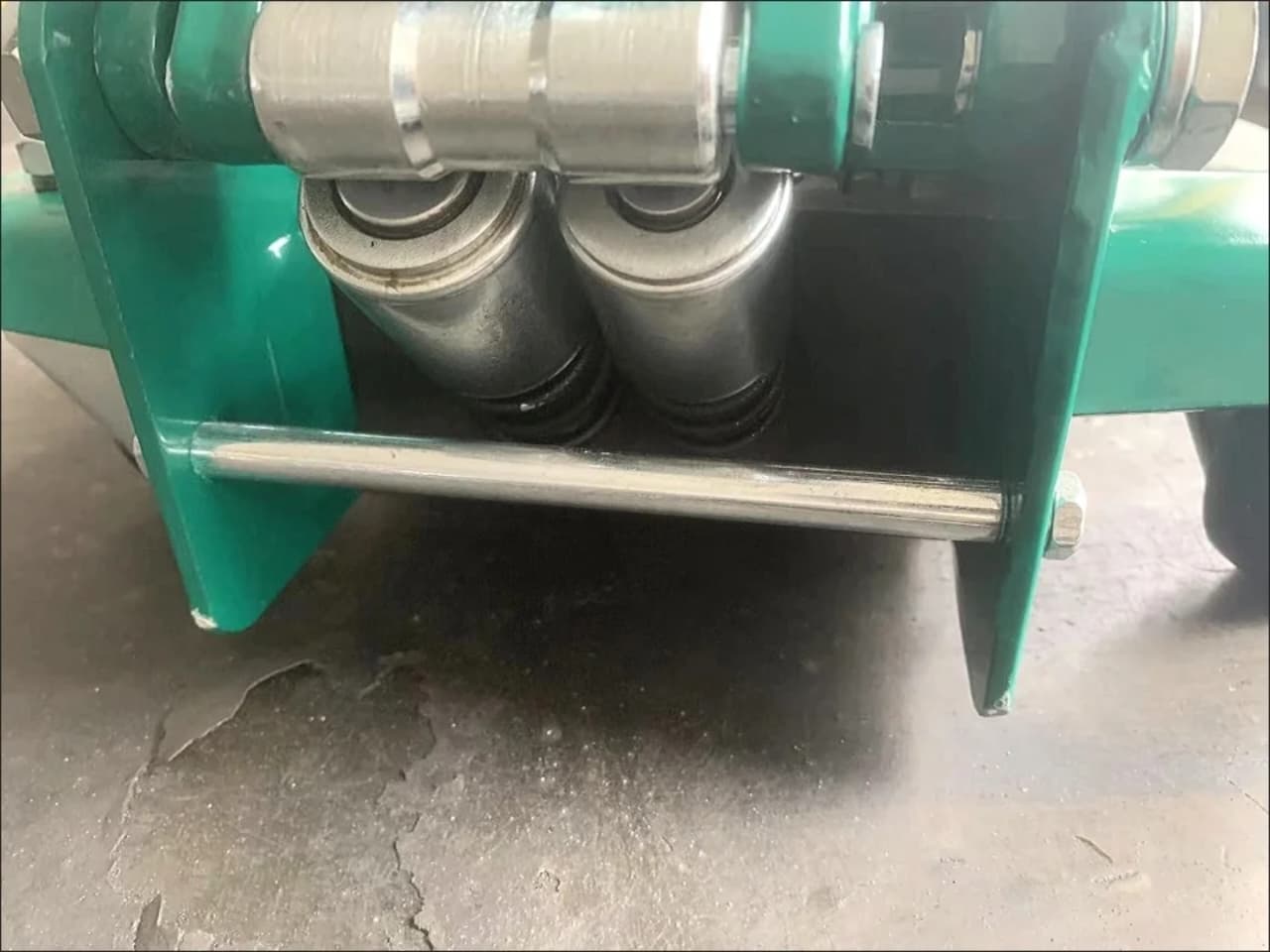
The jack is commonly manufactured from heavy-gauge steel with reinforced side plates and strong pivot points.
The frame supports:
- The hydraulic cylinder
- Lifting arm
- Saddle
- Pump mechanism
- Front wheels
- Rear castors
- Handle socket
Some professional models use high-carbon steel side plates and wide steel wheels to improve chassis strength and stability.
Long steel operating handle
A long handle provides better leverage when lifting heavy vehicles.
Many models use a two-piece handle that can be separated for storage or transport. A textured or padded grip helps the operator maintain control when pumping.
The handle is normally used for two functions:
- Pumping the hydraulic system
- Opening and closing the release valve
A representative model uses a handle measuring approximately 1,320mm.
Controlled release mechanism
The release valve allows the vehicle to be lowered gradually.
Many heavy-duty models use a universal-joint release system operated by turning the main handle. This provides better control than reaching under the vehicle to operate a separate valve.
The valve should always be opened slowly. A fast release may cause the vehicle to descend suddenly.
Wide lifting saddle
The saddle is the round section that contacts the vehicle’s lifting point.
A wide saddle helps distribute the load and improve stability. Some models have:
- Rubber saddle pads
- Textured contact surfaces
- Removable pads
- Rotating saddle heads
- Raised outer edges
A suitable rubber pad can protect painted lifting points and reduce metal-to-metal contact. It must fit securely and must not make the load unstable.
Heavy-duty front wheels
The front wheels carry much of the load during lifting.
Wide steel wheels improve stability and allow the jack to move slightly as the lifting arm changes position. This movement is necessary because the saddle travels in an arc.
Swivel rear castors
The two rear castors rotate to help position the jack accurately below the vehicle.
Good castors should:
- Rotate freely
- Roll smoothly
- Remain securely attached
- Support the frame without leaning
- Operate on a hard, level floor
Do not use a trolley jack on loose stones, mud or soft soil because the wheels may sink or become unstable.
Overload protection
Quality models may include a hydraulic safety bypass valve.
The valve limits excessive pressure when the jack is overloaded. It protects the hydraulic system, but it does not replace correct load selection.
Never depend on the overload valve as a method of checking vehicle weight.
Typical Technical Specifications
| Specification | Typical value |
|---|---|
| Rated capacity | 4 tonnes |
| Maximum load | 4,000kg |
| Minimum height | 75–100mm |
| Maximum height | 505–533mm |
| Pump mechanism | Manual hydraulic |
| Pump arrangement | Twin piston on quick-lift models |
| Frame | Welded steel |
| Handle type | Detachable two-piece handle |
| Handle length | Up to approximately 1,320mm on selected models |
| Saddle | Wide rotating saddle |
| Front wheels | Fixed heavy-duty steel wheels |
| Rear wheels | Swivel castors |
| Lowering control | Universal-joint release |
| Surface | Painted or powder-coated |
| Suitable floor | Hard, smooth and level |
The actual specifications vary by manufacturer. Check the identification plate before using the jack.
Main Parts of a 4 Tonne Trolley Jack
Hydraulic cylinder
The cylinder converts hydraulic oil pressure into lifting force.
Pump pistons
The pump pistons move hydraulic oil when the handle is operated.
Twin-pump versions have two pistons to increase the speed of the initial lift.
Oil reservoir
The reservoir stores the hydraulic jack oil used by the lifting system.
Lifting arm
The lifting arm rises as pressure builds in the hydraulic cylinder.
Saddle
The saddle contacts the approved jacking point below the vehicle.
Chassis
The chassis holds all the jack components together and provides a stable base.
Return springs
Return springs help pull the lifting arm down when the release valve is opened.
Release valve
The valve controls the flow of oil back into the reservoir during lowering.
Pump handle
The handle provides leverage for pumping and release-valve control.
Wheels and castors
The wheels allow the jack to move into position and adjust slightly as the vehicle rises.
Vehicles Suitable for a 4 Tonne Trolley Jack
A low-profile four-tonne jack can be used with many:
- Toyota Land Cruiser models
- Toyota Hilux pickups
- Nissan Navara pickups
- Ford Ranger pickups
- Isuzu D-Max pickups
- Mitsubishi L200 pickups
- SUVs
- Passenger cars
- Delivery vans
- Light commercial vehicles
Suitability should not be decided by the vehicle name alone. Always check:
- Kerb weight
- Loaded weight
- Approved lifting point
- Ground clearance
- Required maximum lifting height
- Jack condition
The jack should have enough reserve capacity above the actual load placed on it.
Applications
Tyre changing
The jack raises the vehicle to allow removal of flat, worn or damaged tyres.
Its higher lifting height is useful when removing large SUV and pickup tyres.
Brake servicing
Mechanics can use it before inspecting or replacing:
- Brake pads
- Brake discs
- Brake calipers
- Brake drums
- Brake hoses
- Wheel cylinders
Suspension repairs
The jack helps provide access for work on:
- Shock absorbers
- Coil springs
- Leaf springs
- Ball joints
- Control arms
- Stabilizer links
- Wheel hubs
The vehicle must be supported on axle stands before repairs start.
Vehicle inspection
Garages can raise one side or end of a vehicle to inspect:
- Oil leaks
- Bushes
- Exhaust systems
- Steering components
- Wheel bearings
- Underbody damage
Fleet maintenance
The four-tonne capacity makes the jack practical for fleet operators servicing cars, SUVs, pickups and light vans.
Farm and construction equipment
It may assist in lifting suitable sections of:
- Tractors
- Trailers
- Small construction equipment
- Farm machinery
- Generators
- Workshop equipment
The load must remain stable and within the rated capacity.
How to Use a Low Profile 4 Tonne Trolley Jack
Step 1: Select a safe working area
Park the vehicle on a firm, flat and level surface.
Good surfaces include:
- Smooth concrete
- Strong workshop floors
- Level industrial paving
Avoid:
- Loose gravel
- Mud
- Grass
- Slopes
- Broken paving
- Wet or oily floors
Step 2: Secure the vehicle
Apply the parking brake.
Place an automatic transmission in park. Place a manual transmission in gear.
Use wheel chocks on the wheels that will remain on the ground.
Step 3: Confirm the load
Check the vehicle’s weight and confirm that the jack is suitable.
Never exceed the 4,000kg rating.
Step 4: Find the correct lifting point
Use the jacking point recommended by the vehicle manufacturer.
Common lifting points may include:
- Reinforced sill positions
- Front crossmember
- Rear differential housing where approved
- Axle housing where approved
- Chassis lifting pads
Never guess the lifting point.
Step 5: Inspect the jack
Check for:
- Oil leakage
- Bent frame
- Loose wheels
- Cracked saddle
- Damaged handle
- Missing bolts
- Poor hydraulic operation
Do not use a damaged jack.
Step 6: Close the release valve
Turn the handle clockwise until the release valve is closed.
Do not use excessive force.
Step 7: Position the jack
Roll the jack below the vehicle and centre the saddle under the approved lifting point.
The saddle must make full and even contact.
Step 8: Pump the handle
Use smooth full strokes until the saddle reaches the lifting point.
Pause and confirm that the jack remains correctly positioned.
Step 9: Raise the vehicle
Continue pumping until the required height is reached.
Do not lift higher than necessary.
Step 10: Install axle stands
Place correctly rated axle stands under approved support points.
For a heavy vehicle, use stands with sufficient capacity. The stand rating and method of rating should be checked carefully.
Step 11: Lower onto the stands
Open the release valve slowly and lower the vehicle until its weight rests securely on the axle stands.
Step 12: Confirm stability
Carefully check that the vehicle is stable before working underneath it.
How to Lower the Vehicle Safely
- Remove all tools from underneath the vehicle.
- Confirm that no person is below or beside the vehicle.
- Close the release valve.
- Raise the vehicle slightly to free the axle stands.
- Remove the stands.
- Slowly turn the handle to open the release valve.
- Lower the vehicle smoothly.
- Allow the saddle to return to its lowest position.
- Remove the jack after the tyres are fully on the ground.
Never open the release valve suddenly.
Important Safety Rules
- Never exceed the 4-tonne rating.
- Use the jack only on a firm and level floor.
- Read the vehicle manufacturer’s lifting instructions.
- Use wheel chocks before lifting.
- Keep the saddle centred under the lifting point.
- Never work below a vehicle supported only by a jack.
- Use correctly rated axle stands.
- Do not push or enter the vehicle while it is raised.
- Do not place hands near the lifting arm or pivot points.
- Do not use bricks or loose timber to increase the lifting height.
- Never alter the hydraulic safety valve.
- Do not use the jack if it leaks hydraulic oil.
- Do not use extensions on the pumping handle.
- Never lift people.
- Do not use the jack as permanent support.
- Keep children and untrained users away.
Pre-Use Inspection Checklist
| Component | What to check |
|---|---|
| Frame | Bending, cracks or severe corrosion |
| Saddle | Damage, looseness or wear |
| Hydraulic unit | Oil leaks or damaged seals |
| Lifting arm | Smooth movement and proper alignment |
| Pump handle | Bending or poor connection |
| Release valve | Smooth and controlled operation |
| Front wheels | Damage and secure mounting |
| Rear castors | Free rotation and strong attachment |
| Springs | Correct return action |
| Nuts and bolts | Loose or missing fasteners |
| Capacity label | Clear and readable |
| Test operation | Raises, holds and lowers correctly |
Remove the jack from service if it cannot hold a test load properly.
Common Problems and Possible Causes
Jack does not lift
Possible causes include:
- Release valve is open
- Hydraulic oil level is low
- Air is trapped in the system
- Load exceeds capacity
- Pump seals are worn
- Internal valve is dirty
Jack lifts slowly
Possible causes include:
- Air in the hydraulic circuit
- Low oil level
- Cold or incorrect hydraulic oil
- Worn pump seals
- Excessive load
Jack does not reach full height
This may be caused by:
- Low hydraulic oil
- Air in the system
- Overloading
- Internal leakage
- Incorrect setup
Jack lowers under load
Possible causes include:
- Release valve is not fully closed
- Damaged hydraulic seals
- Dirty valve seat
- Internal leakage
Stop using the jack until it is inspected and repaired.
Handle feels soft
A soft or spongy handle may indicate air inside the hydraulic system.
Follow the bleeding instructions in the manufacturer’s manual.
Oil leaks from the filler plug
Possible causes include:
- Overfilled reservoir
- Incorrect storage position
- Loose filler plug
- Damaged seal
Use only suitable hydraulic jack oil when topping up.
Maintenance of a 4 Tonne Trolley Jack
Clean after use
Wipe away:
- Grease
- Dust
- Mud
- Metal filings
- Brake fluid
- Water
Lubricate moving parts
Apply light lubricant to:
- Wheels
- Castor bearings
- Pivot pins
- Handle socket
- Lifting arm joints
Do not apply grease to the saddle contact surface where it could cause slipping.
Check hydraulic oil
Lower the saddle fully before checking the oil level.
Use only hydraulic jack oil recommended for the model. Do not use engine oil, brake fluid, transmission fluid or cooking oil.
Bleed trapped air
Air may enter the system during transport or storage.
Use the manufacturer’s approved bleeding procedure because the method can vary between models.
Inspect the frame
Look for cracks, bent steel, damaged welds and loose fasteners.
Do not weld or straighten a damaged load-bearing part unless the repair is approved and completed by a qualified specialist.
Store correctly
Store the jack:
- Indoors
- On a level surface
- With the saddle fully lowered
- Away from rain
- Away from corrosive chemicals
- With the handle secured
- In a clean, dry area
Low Profile 4 Tonne Jack Versus Standard 4 Tonne Jack
| Feature | Low-profile jack | Standard-height jack |
|---|---|---|
| Minimum height | About 75–100mm | Usually higher |
| Low cars | Very suitable | May not fit |
| SUVs and pickups | Suitable with enough maximum lift | Suitable |
| Chassis length | Often longer | May be shorter |
| Weight | Usually heavier | May be lighter |
| Workshop use | Excellent | Good |
| Price | Often higher | Usually lower |
A low-profile model is more versatile when the garage handles both low cars and high-clearance vehicles.
4 Tonne Trolley Jack Versus Bottle Jack
| Feature | Trolley jack | Bottle jack |
|---|---|---|
| Entry height | Low | Usually high |
| Base width | Wide | Narrow |
| Positioning | Rolls easily | Must be carried |
| Workshop speed | Fast | Moderate |
| Storage size | Large | Compact |
| Best use | Garage servicing | Emergency and high-clearance vehicles |
| Stability | Better on smooth floors | Depends heavily on base position |
| Maximum lift | Wide lifting range | Model dependent |
A trolley jack is normally more convenient in a professional garage. A bottle jack is more compact for transport.
4 Tonne Jack Versus 2 Tonne Jack
| Feature | 4 tonne jack | 2 tonne jack |
|---|---|---|
| Rated capacity | 4,000kg | 2,000kg |
| Suitable vehicles | Cars, SUVs, pickups and vans | Mainly cars and compact SUVs |
| Frame size | Larger | Smaller |
| Weight | Heavier | Lighter |
| Lifting height | Often higher | Usually lower |
| Portability | Moderate | Easier |
| Workshop duty | Heavy-duty | Light to medium |
| Price | Higher | Lower |
A four-tonne jack is the better option for garages that regularly work on pickups, vans and larger SUVs.
How to Choose the Best Low Profile 4 Tonne Trolley Jack
Confirm the minimum height
Choose a jack that can enter below the lowest vehicle you service.
A 75mm entry height offers better access than a 100mm model for very low vehicles.
Check the maximum lift
A maximum height above 500mm is useful for pickups and SUVs.
Select a twin-pump model
Twin pumps reduce the time needed to bring the saddle to the load.
This feature is valuable in busy garages and tyre shops.
Inspect the chassis
Look for:
- Reinforced steel side plates
- Strong welds
- Wide wheels
- Thick lifting arm
- Stable saddle
- Quality castors
Check the lowering system
A universal-joint release gives the operator better control from the main handle.
Ask about spare parts
Confirm the availability of:
- Hydraulic seals
- Pump assembly
- Castors
- Wheels
- Handle
- Saddle pad
- Return springs
- Hydraulic oil
Check the jack’s own weight
Heavy steel jacks are stable but can be difficult to move between sites.
A carrying handle or strong rolling wheels improve mobility.
Check warranty and support
Buy from a supplier who can provide maintenance advice, parts and warranty assistance.
Price of a Low Profile 4 Tonne Trolley Jack in Kenya
Current Kenyan listings show four-tonne trolley jacks at approximately KSh 25,900 to KSh 35,000, depending on the brand, lifting range and hydraulic system. One Kenyan machinery seller lists a heavy-duty four-tonne model at KSh 30,000, while a twin-hydraulic rapid-lift model is listed near KSh 25,900.
| Jack type | Estimated price in Kenya |
|---|---|
| Standard 4-tonne trolley jack | KSh 25,000–32,000 |
| Low-profile 4-tonne jack | KSh 28,000–40,000 |
| Twin-pump rapid-lift model | KSh 30,000–45,000 |
| Professional branded workshop jack | KSh 45,000–90,000+ |
The price may depend on:
- Brand
- Minimum lifting height
- Maximum lifting height
- Single or twin pump
- Frame strength
- Jack weight
- Saddle size
- Wheel construction
- Warranty
- Availability of spare parts
- Delivery location
Confirm the exact specifications and package before purchasing.
Package Contents
A typical package may contain:
- One low-profile 4-tonne hydraulic trolley jack
- Two-piece operating handle
- Wide lifting saddle
- Four fitted wheels
- User manual
- Saddle rubber pad on selected models
Axle stands and wheel chocks are normally sold separately unless clearly included.
Why Buy a Low Profile 4 Tonne Trolley Jack?
A low profile 4 tonne trolley jack offers a useful combination of high capacity, low vehicle access and a wide lifting range.
It can slide below many low-clearance cars while still lifting SUVs, pickups and vans high enough for tyre, brake and suspension work. A twin hydraulic pump makes lifting faster, while the long handle and universal-joint release provide better control.
The heavy steel frame, wide wheels and rotating saddle make it suitable for demanding garage work. When combined with correctly rated axle stands and proper lifting procedures, it becomes an important tool for professional mechanics, tyre centres, fleet workshops and serious vehicle owners.
Frequently Asked Questions
What is the capacity of a 4 tonne trolley jack?
It has a maximum rated lifting capacity of 4,000kg, which is approximately 8,800lb.
What does low profile mean?
Low profile means the front section and saddle can fit below vehicles with limited ground clearance.
What is the minimum lifting height?
Depending on the model, it may be approximately 75mm to 100mm.
What is the maximum lifting height?
Many models reach between approximately 505mm and 533mm.
Can it lift a Land Cruiser or pickup?
It can lift one approved section of many Land Cruisers and pickups, provided the load on the jack remains within four tonnes and the correct lifting point is used.
Can it lift a lorry?
It is not suitable for heavy commercial lorries that exceed its capacity or require specialised lifting equipment.
Does it use electricity?
No. The operator pumps the handle manually to create hydraulic pressure.
What is a dual-pump trolley jack?
It has two pump pistons that move the saddle upward faster during the initial lifting stage.
Can I work under a vehicle supported by the jack?
No. A trolley jack is a lifting device, not a permanent support. Use correctly rated axle stands before working underneath the vehicle.
Can it be used on soil or gravel?
No. It should be used on a strong, flat and level surface, preferably concrete.
Can I add engine oil to the hydraulic system?
No. Use only approved hydraulic jack oil.
Why does the jack lower by itself?
It may have a release-valve problem, damaged seal or internal hydraulic leak. Stop using it and arrange inspection.
How should it be stored?
Store it indoors with the saddle fully lowered and protected from moisture and dirt.
What is the price of a low profile 4 tonne trolley jack in Kenya?
Most general and twin-pump models cost approximately KSh 25,900 to KSh 40,000, while premium professional units may cost more.

Reviews
There are no reviews yet.