
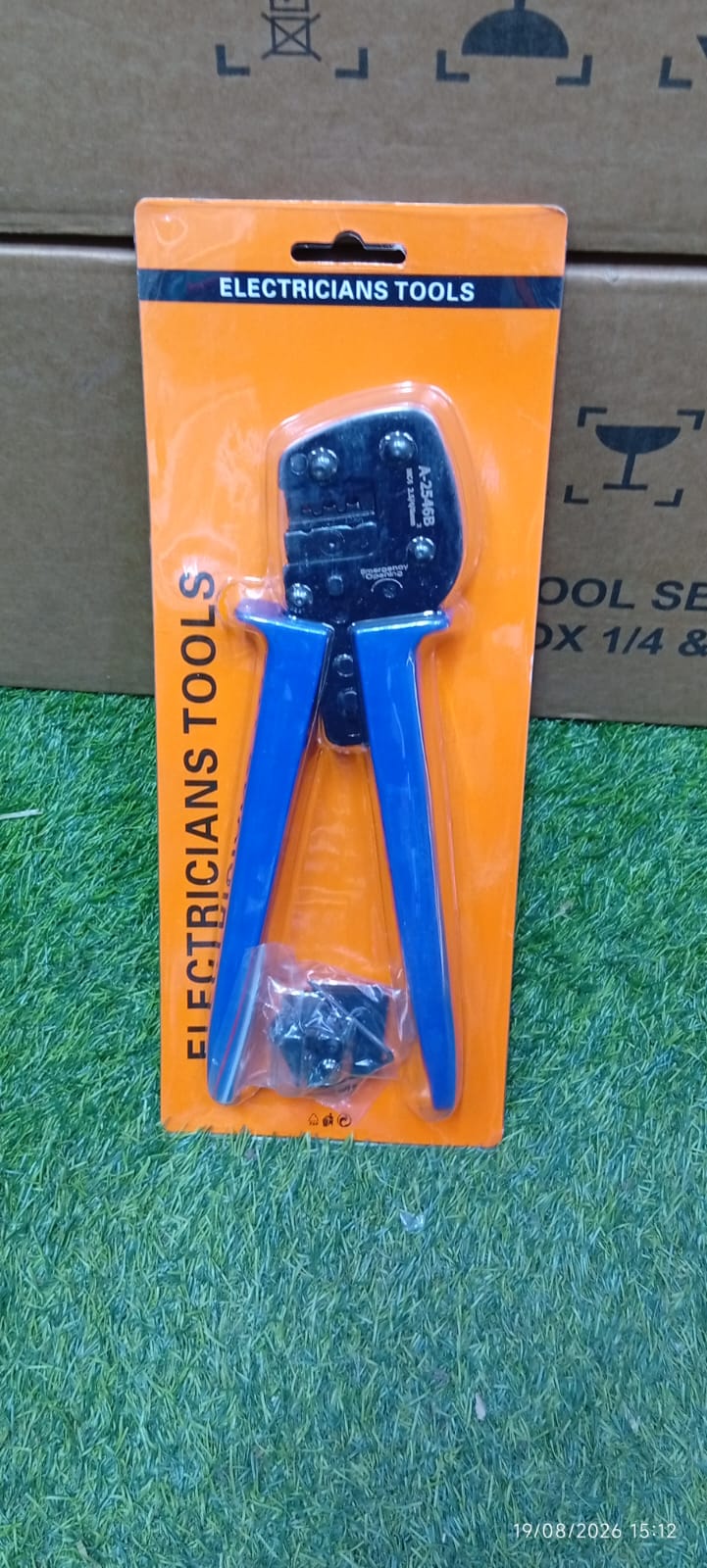
Description
Professional Solar PV Crimper for 2.5mm², 4mm² and 6mm² Solar Cables


An MC4 Crimping Tool is a specialized hand tool used to attach metal contacts to solar PV cables before the contacts are fitted into MC4-type connector housings. It is an essential tool for solar installers because a properly made crimp provides a strong mechanical connection and low-resistance electrical contact.
A standard professional MC4 crimper works with 2.5mm², 4mm² and 6mm² solar cable, equivalent to approximately 14, 12 and 10 AWG. Professional tools from Wiha, KNIPEX and other manufacturers use these same common PV cable sizes.
Unlike a normal electrical crimper, an MC4 tool has dies shaped specifically for photovoltaic contacts. Better models also include a ratchet mechanism, pressure control, emergency release and terminal locator to improve crimp consistency.
Quick Specifications
| Feature | Typical Specification |
|---|---|
| Product Name | MC4 Crimping Tool |
| Application | Solar PV Cable Termination |
| Cable Sizes | 2.5 / 4 / 6mm² |
| AWG Range | 14–10 AWG |
| Connector Type | MC4 / compatible PV contacts |
| Mechanism | Ratchet Crimping |
| Die Profiles | 3 |
| Tool Material | Carbon or Hardened Steel |
| Handle | Non-Slip Ergonomic Grip |
| Locator | Available on professional models |
| Emergency Release | Common on ratchet models |
| Typical Length | About 208–270mm |
| Main Users | Solar Installers and Electricians |
A current professional MC4 tool, for example, is 208mm long and weighs 378g, while another Kenyan-market professional model is 270mm long and weighs 855g. Tool size therefore varies considerably by design.
2.5mm², 4mm² and 6mm² Crimping Range
The three most important die positions on a standard MC4 crimper are:
- 2.5mm²
- 4mm²
- 6mm²
These correspond approximately to:
| Metric Cable Size | AWG Equivalent |
|---|---|
| 2.5mm² | 14 AWG |
| 4mm² | 12 AWG |
| 6mm² | 10 AWG |
This 2.5–6mm² or 14–10 AWG range is specified by professional PV tool manufacturers including Wiha and KNIPEX.
Designed Specifically for Solar PV Connections
A solar crimper is different from a standard terminal crimper.
The jaws are designed to compress the metal contact around stranded PV cable in a controlled shape.
This helps produce:
- Strong cable retention
- Consistent electrical contact
- Reduced contact resistance
- Reliable connector assembly
- Better long-term PV performance
A poor crimp can create resistance at the connection. In a high-current DC solar system, poor connections can lead to voltage loss, excessive heating and eventual connector failure.
Ratchet Crimping Mechanism
One of the most important features is the ratchet mechanism.
Once crimping starts, the ratchet guides the jaws through a controlled crimping cycle. This helps prevent the operator from releasing the tool too early.
A professional MC4 crimper specification describes a ratchet system with a blocking device for precise work.
Benefits include:
- More consistent pressure
- Repeatable crimps
- Less operator guesswork
- Better terminal compression
- Faster installation
Automatic Pressure Control
Higher-quality MC4 crimpers control the pressure applied to the contact.
Wiha’s professional MC4 crimper, for example, uses automatically adjusted pressure force to help produce consistent crimps.
This is useful when terminating many connectors during large solar installations.
Emergency Release
A ratchet is designed not to open halfway through a normal crimp.
But what happens if you insert the wrong contact?
Professional tools may include an emergency unlocking mechanism that allows the jaws to be released before completing the full cycle. Wiha specifically provides manual emergency unlocking on its MC4 crimper.
Precision Terminal Locator
Selected professional MC4 tools include a locator that holds the metal contact in the correct position inside the die.
A Kenyan-market LEADER solar crimper, for example, specifies a precision locator, 2.5/4/6mm² capacity and carbon-steel construction.
The locator helps:
- Position the terminal correctly
- Reduce crooked crimps
- Improve repeatability
- Speed up connector assembly
This is especially valuable when making many solar extension cables.
Carbon Steel Construction
MC4 crimping requires considerable pressure, so the tool body must be strong.
Professional models commonly use carbon steel or other hardened steel construction.
One current MC4 crimper uses a carbon-steel body with a black painted finish, while another uses carbon steel with black oxide treatment.
Ergonomic Non-Slip Handles
Long solar installation jobs can involve crimping dozens or even hundreds of connectors.
Good handles improve comfort and leverage.
Professional MC4 crimpers can use two-component ergonomic handles designed to improve grip and force transmission.
This reduces the effort required to complete each crimp.
MC4 Crimping Tool Applications
Solar Panel Installation
The main application is preparing PV cables connecting solar panels into strings.
Solar Pump Installation
Useful when wiring:
- Solar borehole pumps
- Solar Surface pumps
- Pump controllers
- Solar pumping inverters
Solar Inverter Installation
MC4-type connectors are commonly found in the DC side of solar installations between PV arrays and compatible inverter equipment.
Solar Battery Systems
The crimper may be used on MC4-type PV connections feeding solar charge equipment. Battery-terminal cables themselves normally require different cable lugs and crimping tools.
Solar Street Lights
Useful where PV modules use compatible MC4-type connections.
Solar Farms
Professional ratchet crimpers are especially useful for repetitive PV cable termination.
MC4 Crimper vs Normal Electrical Crimper
| Feature | MC4 Crimping Tool | Normal Electrical Crimper |
|---|---|---|
| PV Contact Dies | Yes | Usually No |
| 2.5/4/6mm² Solar Cable | Yes | Model Dependent |
| Ratchet Mechanism | Common | Model Dependent |
| Terminal Locator | Selected Models | Rare |
| MC4 Installation | Excellent | Not Recommended Unless Correctly Rated |
| General Terminals | Limited | Excellent |
Using the correct tool is important. A normal electrical crimper may physically squeeze an MC4 contact but may not produce the correct crimp geometry.
MC4 Crimping Tool vs Hydraulic Crimper
| Feature | MC4 Crimper | Hydraulic Crimper |
|---|---|---|
| Main Application | Solar PV Contacts | Larger Cable Lugs |
| Typical Cable Range | 2.5–6mm² | Much Larger |
| MC4 Contacts | Yes | Generally No |
| Portability | Excellent | Moderate |
| Speed | Fast | Slower Setup |
| Solar Installation | Essential | Useful for Larger Battery/Inverter Cables |
Solar technicians often need both tools. The MC4 crimper handles PV connectors, while a hydraulic crimper handles larger copper lugs.
MC4 Crimping Tool vs MC4 Spanner
These tools perform different jobs.
The crimper attaches the metal contact to the solar cable.
The MC4 spanner helps tighten or release the connector housing.
A complete solar installation toolkit should ideally have both.
How to Crimp an MC4 Connector
Step 1: Switch Off and Isolate the Circuit
Do not crimp a cable connected to an energized PV circuit.
Remember that solar panels can produce DC voltage whenever sufficient light reaches them.
Step 2: Cut the Solar Cable
Use a sharp cable cutter to create a clean, square cut.
Step 3: Strip the Cable
Remove the amount of insulation specified by the connector manufacturer.
Do not cut or remove conductor strands.
Step 4: Identify the Correct Metal Contact
Choose the contact supplied for that exact connector and cable size.
Step 5: Select the Correct Crimp Die
Use the die marked for:
- 2.5mm²
- 4mm²
- 6mm²
depending on the cable.
Step 6: Position the Contact
Place the metal contact correctly in the die or locator.
Step 7: Insert the Stripped Cable
Make sure all conductor strands enter the crimp barrel.
Step 8: Complete the Crimp
Close the handles until the ratchet completes its full cycle and releases.
Step 9: Perform a Pull Check
Gently check that the conductor is securely retained.
Step 10: Assemble the Connector Housing
Insert the crimped contact into the correct connector housing until it locks according to the manufacturer’s instructions.
Then tighten the cable gland using the correct assembly tool.
Why Correct Cable Size Matters
Using the wrong die can produce a poor connection.
Die Too Large
The contact may remain loose around the conductor.
Possible results include:
- Poor electrical contact
- Higher resistance
- Heating
- Cable pull-out
Die Too Small
Excessive compression can:
- Damage conductor strands
- Deform the contact
- Prevent correct housing assembly
Always match the contact, cable and crimp die.
Do Not Mix Connector Components Carelessly
“MC4” is often used as a general market term for solar connectors, but genuine MC4 is a registered trademark of Stäubli.
Different connector brands can look similar without necessarily being approved for mating with one another.
For reliable PV installations, use compatible contacts, housings and tools according to the connector manufacturer’s instructions.
Solar Connector Ratings
The crimping tool itself does not determine the voltage or current rating of the finished connection.
Those ratings depend on the connector, cable and complete installation.
As an example, one current PV connector range for 2.5, 4 and 6mm² cable is specified up to 1500V DC, with IP68 protection on the connector.
Never assume every MC4-compatible connector has the same rating. Check the exact connector specifications.
MC4 Crimping Tool with Connector Kit
Some kits include much more than the crimper.
A complete package can contain:
- MC4 crimping pliers
- Wire stripper
- Cable cutter
- MC4 assembly spanners
- Male connector housings
- Female connector housings
- Male contacts
- Female contacts
- Carrying case
A complete kit is convenient for new solar installers because the essential termination tools are stored together.
How to Choose the Best MC4 Crimping Tool
Look for:
- 2.5/4/6mm² capacity
- 14–10 AWG compatibility
- Ratchet mechanism
- Emergency release
- Strong steel construction
- Precision dies
- Terminal locator
- Comfortable handles
- Adjustable crimp pressure
- Replaceable dies where available
For professional installation work, a ratcheting model with a terminal locator is usually a better choice than the cheapest basic crimper.
Common MC4 Crimping Mistakes
Avoid:
- Using ordinary pliers
- Selecting the wrong die
- Cutting conductor strands
- Leaving strands outside the terminal
- Crimping over insulation incorrectly
- Using the wrong contact size
- Mixing incompatible connector parts
- Failing to fully seat the contact
- Leaving the cable gland loose
- Working on energized PV wiring
A connector may look correct from outside while still having a poor crimp inside.
Safety When Working with Solar PV
Solar DC requires care because PV modules can remain energized whenever exposed to light.
Always:
- Isolate the PV circuit correctly.
- Follow the inverter and module manufacturer’s procedures.
- Use properly rated test equipment.
- Keep connectors dry during assembly.
- Do not disconnect loaded DC connectors unless the system is designed and isolated for it.
- Use suitable PPE.
- Have high-voltage PV work completed by a qualified installer.
MC4 Crimping Tool Maintenance
After use:
- Remove small wire strands from the jaws.
- Wipe the dies clean.
- Keep the ratchet mechanism free of dirt.
- Check the locator.
- Inspect the handles.
- Apply suitable light lubrication to moving joints when required.
- Store the tool somewhere dry.
Do not grind or reshape the crimp dies because this can change the finished crimp dimensions.
MC4 Crimping Tool Price in Kenya
Current Kenyan prices vary depending on brand, build quality and whether you buy the crimper alone or a complete solar installation kit.
A current LEADER solar MC4 crimper is listed at KSh 6,000, while another MC4 LY-25 crimping tool is listed at KSh 4,999. A more complete LEADER solar MC4 connector crimping kit is currently listed at KSh 11,900.
| MC4 Tool Type | Current/Typical Kenya Price |
|---|---|
| Basic MC4 Crimper | Around KSh 3,000–5,000 |
| Better Ratchet MC4 Crimper | Around KSh 5,000–7,000 |
| MC4 Crimper with Locator | Around KSh 6,000+ |
| Complete MC4 Installation Kit | Around KSh 10,000–12,000+ |
Prices vary by seller, brand and accessories.
Why Buy an MC4 Crimping Tool?
An MC4 Crimping Tool in Kenya is an important investment for anyone installing solar panels professionally.
The tool is designed specifically for 2.5mm², 4mm² and 6mm² PV cables, allowing solar technicians to produce strong and consistent connector crimps. Professional versions add a ratchet, locator and controlled pressure to improve repeatability.
For solar panel installation, solar pumping, inverter wiring and PV maintenance, using the correct crimper is far better than trying to terminate solar contacts with ordinary pliers.
Frequently Asked Questions
What is an MC4 Crimping Tool used for?
It is used to crimp metal PV contacts onto solar cable before those contacts are inserted into MC4-type connector housings.
What cable sizes can it crimp?
A standard MC4 crimper handles 2.5mm², 4mm² and 6mm², approximately 14–10 AWG.
Can I use it for 4mm² solar cable?
Yes. 4mm² PV cable is one of the standard sizes supported by common MC4 crimping tools.
Can it crimp 6mm² solar cable?
Yes. Standard professional models commonly support cable up to 6mm² or approximately 10 AWG.
Does it have a ratchet?
Quality models normally use a ratcheting mechanism to provide more consistent crimp pressure.
What is a terminal locator?
It holds the metal PV contact in the correct position inside the crimping jaws. Selected professional tools include a locator to improve accuracy.
Can I use normal pliers instead?
Normal pliers are not designed to create the correct MC4 contact crimp. A purpose-made PV crimper is recommended.
Does an MC4 crimper cut and strip solar cable?
Some complete kits include separate cutting and stripping tools, but the dedicated MC4 crimper’s main job is crimping the metal contact. Check the exact model before purchase.
Is an MC4 spanner the same as an MC4 crimper?
No. The crimper secures the metal terminal to the conductor. The spanner is used during connector housing assembly or disassembly.
Is MC4 a general connector name?
MC4 is a registered trademark of Stäubli Electrical Connectors. Many similar solar connectors are commonly described in the market as MC4-type or MC4-compatible connectors.
What is the price of an MC4 Crimping Tool in Kenya?
Current Kenyan listings show individual MC4 crimpers at around KSh 4,999 to KSh 6,000, while a complete professional MC4 crimping and connector kit can cost around KSh 11,900.
Reviews
There are no reviews yet.