
Description

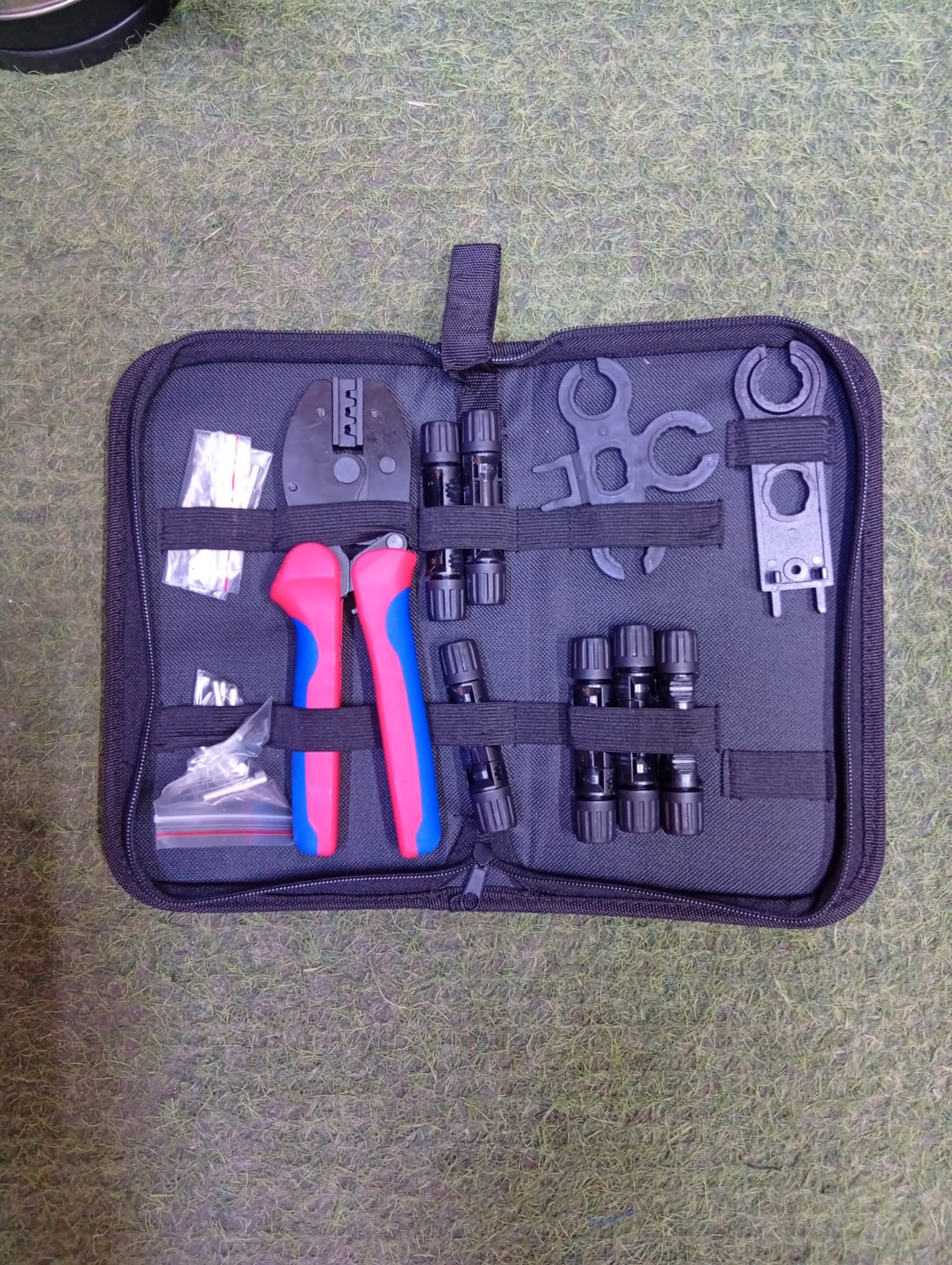
An MC4 crimping tool with connectors is a complete hand-tool kit used to prepare secure connections on solar-panel cables. It is suitable for installing solar panels, extending photovoltaic cables, replacing damaged connectors and making custom battery or solar-array cable runs.
The main tool uses a ratchet mechanism and shaped crimping dies to compress a metal terminal firmly around the copper strands of a solar cable. The finished terminal is then inserted into the male or female connector housing before the cap is tightened.
Most general-purpose MC4 crimping kits support 2.5mm², 4mm² and 6mm² solar cables, which are approximately equal to 14, 12 and 10 AWG. These sizes cover many small and medium residential, commercial and solar-pumping installations.
A complete package may include the crimping pliers, male and female connector housings, metal contacts, MC4 spanners and a storage bag. Some larger kits also include a cable cutter and wire stripper.
Quick Specifications
| Feature | Typical specification |
|---|---|
| Product name | MC4 crimping tool with connectors |
| Application | Solar PV cable termination |
| Cable range | 2.5mm², 4mm² and 6mm² |
| Equivalent cable sizes | Approximately 14 to 10 AWG |
| Tool mechanism | Ratcheting crimp system |
| Jaw type | Precision solar-terminal dies |
| Tool material | Hardened or high-carbon steel |
| Handle | Non-slip insulated grip |
| Connector type | Male and female solar connectors |
| Contact material | Usually tin-plated copper |
| Additional tools | MC4 assembly spanners |
| Common package size | 5, 6, 10 or 20 connector pairs |
| Recommended users | Solar technicians, electricians and installers |
| Storage | Carrying pouch or moulded case, depending on kit |
The exact quantity of connectors and accessories varies by package. Buyers should confirm whether the advertised number refers to individual connectors or complete male-and-female pairs.
Main Features of the MC4 Crimping Tool Kit
Ratcheting crimp mechanism
The ratchet system guides the tool through a full crimping cycle. Once the handles begin closing, the mechanism normally prevents them from opening until sufficient pressure has been applied.
This helps produce:
- Consistent crimps
- Strong cable retention
- Even compression around the conductor
- Reduced risk of loose terminals
- Better electrical contact
Many tools also have an emergency release lever. This allows the jaws to open when the wrong terminal or cable has been inserted.
Three common crimping sizes
A standard solar crimping tool usually has separate jaw positions for:
- 2.5mm² cable
- 4mm² cable
- 6mm² cable
The correct die position must match the cable and terminal size. A terminal crimped in an oversized jaw may remain loose. Using a die that is too small can damage the terminal or cut the conductor strands.
A locally listed professional model specifies a crimping range of 2.5, 4 and 6mm², a carbon-steel body and a locator for accurate terminal positioning.
Precision locator
Selected MC4 crimping tools include a locator that holds the metal contact in the correct position inside the jaws.
The locator helps:
- Keep the contact straight
- Position the crimp wings correctly
- Reduce uneven crimping
- Improve repeatability
- Speed up installation
Stäubli’s connector instructions also emphasize placing the contact in the correct cross-section position before crimping.
Hardened steel construction
The tool body is commonly made from carbon steel or hardened steel. This gives the jaws enough strength to compress copper terminals repeatedly without bending.
A black-oxide or similar finish may be used to improve resistance to surface rust and workshop wear.
Ergonomic non-slip handles
The handles are normally covered with rubber or moulded plastic grips. This improves comfort and control during repeated cable preparation.
A good handle design helps reduce hand fatigue when making many solar connections in one installation.
Male and female solar connectors
The kit usually includes matching male and female connector housings. Each connector requires a suitable metal pin or socket contact.
A complete pair is used to join two solar cables while maintaining correct polarity.
The connector housings commonly have:
- Locking clips
- Threaded compression caps
- Internal seals
- Cable glands
- Polarity markings
- Weather-resistant insulation
Original MC4 connectors use a crimp connection and tin-plated copper contacts. When correctly mated, selected original models carry IP65 and IP68 protection ratings under specified test conditions.
Generic connectors may use different materials and ratings. The ratings printed on the actual product should therefore be checked before installation.
MC4 tightening and unlocking spanners
Most complete kits include two plastic spanners.
They are used to:
- Hold the connector body
- Tighten the cable gland
- Loosen the cap during repair
- Release the connector locking tabs
- Prevent damage caused by using pliers
The official Stäubli open-end spanner set is designed for pre-tightening, loosening connector caps and releasing compatible connector locking systems.
Portable storage case
Some sets come in a zipped fabric case or moulded toolbox. The case keeps the terminals, connectors, spanners and crimper organized.
This is useful for technicians moving between rooftops, farms, workshops and solar-pump installations.
Common Package Contents
A standard MC4 crimping tool set may contain:
- One ratcheting MC4 crimping tool
- Male connector housings
- Female connector housings
- Male metal contacts
- Female metal contacts
- Two MC4 spanners
- Carrying pouch
- Instruction guide
A larger package may also include:
- Wire stripper
- Cable cutter
- Extra connector pairs
- Spare seals
- Replacement terminals
- Solar connector release tools
Connector quantities may range from five pairs to twenty pairs or more. For example, complete online kits are offered with 10 or 20 connector pairs, crimping pliers and assembly spanners.
What Is an MC4 Crimping Tool Used For?
Installing solar panels
The tool is used to prepare cable connectors between solar panels, combiner boxes, isolators, charge controllers and inverters.
Extending solar cables
When the original solar-panel leads are too short, installers can prepare extension cables using suitable PV cable and matching connectors.
Solar water-pumping systems
It is useful when wiring solar panels to pumping controllers, solar pump inverters and DC pump systems.
Replacing damaged connectors
Connectors affected by heat, corrosion, broken locks or poor previous crimping should be replaced rather than reused.
Building custom solar leads
Technicians can make cables of the required length instead of relying only on pre-assembled extensions.
Solar maintenance work
The kit can be carried to service sites for cable replacement, fault correction and array rewiring.
Technical Details of Solar Connectors
Cable cross-section
General kits commonly support 2.5mm² to 6mm² cable. Original MC4 product families include options for larger cross-sections, with selected open-crimp models supporting up to 10mm². The connector and crimp tool must match the cable size.
Contact material
Quality metal contacts are normally made from copper with a tin-plated surface.
Copper supports good electrical conductivity, while tin plating helps protect the surface against oxidation.
Voltage rating
Many modern photovoltaic connectors are designed for high-voltage DC systems. Selected original barrel-contact MC4 products are rated up to DC 1500V, but this rating only applies when the correct connector, cable, terminal, assembly method and compatible mating parts are used.
Do not assume every generic connector has the same voltage rating.
Current rating
The safe current depends on:
- Cable cross-section
- Connector design
- Contact quality
- Ambient temperature
- Installation method
- Certification
- Correct crimping
One official MC4 barrel-contact range lists current ratings from 30A for 14 AWG up to 50A for 10 AWG under its specified standard and configuration.The ting on the supplied connector must always be followed.
Weather protection
Correctly assembled outdoor solar connectors are designed to resist dust and water. Weather resistance depends heavily on using the correct cable diameter, seal, tightening torque and compatible connector pair.
A loose cap or undersized cable can allow moisture to enter the connector.
How to Crimp an MC4 Solar Connector
Step 1: Switch off and isolate the system
Turn off the relevant DC isolators and disconnect power sources according to safe installation procedures.
Solar panels can produce voltage whenever exposed to light. Covering panels or working at low light does not automatically make the circuit safe.
Step 2: Confirm polarity
Identify the positive and negative cables before fitting the connectors.
Incorrect polarity can damage equipment or create a dangerous short circuit.
Step 3: Slide the connector parts onto the cable
Before crimping, pass the following parts over the cable:
- Compression cap
- Cable seal
- Connector back section
Missing this step means the terminal may have to be cut off and replaced.
Step 4: Strip the solar cable
Remove only enough insulation to expose the conductor length required by the terminal.
Avoid:
- Cutting copper strands
- Leaving too much exposed conductor
- Damaging the insulation
- Twisting the cable excessively
Use a wire stripper suitable for the cable size.
Step 5: Insert the conductor into the contact
Push all copper strands fully into the metal terminal.
No strands should remain outside the contact barrel.
Step 6: Select the correct crimping die
Match the die to the cable size, such as 2.5, 4 or 6mm².
Step 7: Position the terminal
Place the metal contact into the tool locator or the correct jaw section.
The terminal must face the correct direction according to the crimper design.
Step 8: Complete the crimp
Close the handles until the ratchet releases.
Do not stop halfway because a partly compressed terminal may create high resistance.
Step 9: Perform a pull test
Hold the cable and contact firmly and pull them in opposite directions.
The contact should remain secure without sliding off.
Step 10: Insert the terminal into the housing
Push the crimped terminal into the connector housing until it clicks or locks into position.
Pull gently to confirm that it cannot come out.
Step 11: Tighten the cap
Position the seal correctly and tighten the cap using the two MC4 spanners.
The cap should be secure without damaging the housing.
Step 12: Check the finished cable
Confirm:
- Correct polarity
- Full connector engagement
- Tight cable gland
- No exposed copper
- No loose parts
- Correct male and female arrangement
Why Correct Crimping Matters
A poor crimp can create electrical resistance. Resistance causes heat, and excessive heat may damage the connector, melt insulation or start a fire.
Common causes of poor solar connections include:
- Wrong jaw size
- Incorrect terminal size
- Damaged copper strands
- Loose gland nut
- Mixed connector brands
- Incomplete crimping
- Reused contacts
- Moisture entry
- Connector not fully locked
A properly made crimp creates firm mechanical retention and reliable electrical contact between the conductor and terminal.
MC4 Crimping Tool Compared with Ordinary Pliers
| Feature | MC4 crimping tool | Ordinary pliers |
|---|---|---|
| Crimp profile | Designed for solar terminals | Uneven compression |
| Ratchet mechanism | Yes | No |
| Cable-size positions | Clearly marked | Not available |
| Terminal locator | Available on selected models | No |
| Crimp consistency | High when used correctly | Unreliable |
| Suitable for PV connectors | Yes | No |
| Risk of loose connection | Lower | High |
| Professional installation | Recommended | Not acceptable |
Ordinary pliers should not be used to crimp solar connector terminals. They can flatten the contact unevenly and leave gaps around the copper conductor.
Benefits of Buying the Complete Kit
Ready for installation
The tool, terminals, connector housings and spanners are supplied together.
Saves purchasing time
The installer does not need to source each small component separately.
Suitable for site work
The carrying case makes it easier to transport and organize the tools.
Supports repairs and extensions
Extra connector pairs can be used for new cable runs or replacing damaged ends.
Produces professional connections
The correct ratchet tool gives better and more repeatable results than general hand pliers.
Useful for different solar projects
The kit supports rooftop installations, solar lighting, off-grid systems, irrigation pumps, battery charging and commercial PV projects.
How to Choose an MC4 Crimping Kit in Kenya
Check the cable range
Choose a tool that matches the PV cables you normally install.
A 2.5, 4 and 6mm² tool covers many common solar applications.
Check the connector quantity
For small repairs, five pairs may be enough. For installation work, a kit with 10 or 20 pairs offers better convenience.
Look for a ratchet mechanism
A ratcheting tool provides more consistent pressure than a basic non-ratcheting crimper.
Choose a model with a locator
A locator makes it easier to hold the contact accurately.
Inspect the connector quality
Check for:
- Firm locking tabs
- Thick insulation
- Proper sealing rings
- Good-quality contacts
- Clear polarity markings
- Smooth threads
Confirm connector compatibility
Avoid mixing connectors from different manufacturers or product families unless compatibility is clearly approved.
Connectors may look similar but have different tolerances, materials and locking designs.
Check the included accessories
A better kit may include:
- Two spanners
- Wire stripper
- Cable cutter
- Carrying bag
- Spare terminals
- Multiple connector pairs
Confirm local replacement availability
Choose connectors and contacts that can be replaced easily when additional cables are required.
MC4 Crimping Tool with Connectors Price in Kenya
Current Kenya listings show different prices depending on the package size and tool quality.
| Product type | Estimated price in Kenya |
|---|---|
| Basic MC4 crimping tool only | KSh 4,000 to KSh 6,000 |
| Crimper with a few connector pairs | KSh 4,500 to KSh 8,000 |
| Complete kit with connectors and spanners | KSh 6,000 to KSh 12,000 |
| Professional solar installation tool kit | KSh 12,000 and above |
A Nairobi listing currently advertises an MC4 crimping tool at about KSh 4,500, while another Kenyan supplier lists a 2.5, 4 and 6mm² solar crimping tool at KSh 6,000. Larger complete kits on Kenyan marketplaces are listed at approximately KSh 11,900 to KSh 12,999.
Prices depend on:
- Brand
- Connector quantity
- Crimping range
- Tool material
- Included wire stripper
- Carrying case
- Certification
- Warranty
- Supplier
Maintenance Tips
- Wipe the tool after every installation.
- Keep sand and dust away from the ratchet mechanism.
- Apply a small amount of suitable lubricant to moving joints.
- Do not grind or reshape the crimping dies.
- Store terminals in a sealed container.
- Keep connector seals clean and dry.
- Avoid dropping the tool from rooftops or ladders.
- Use the emergency release only when necessary.
- Check that the jaws align correctly before use.
- Replace damaged connectors instead of repairing them with tape.
Safety Tips
- Never work on energized solar conductors unless the procedure requires it and proper precautions are in place.
- Use insulated tools where required.
- Wear eye protection and suitable gloves.
- Confirm polarity before connecting equipment.
- Never disconnect loaded DC connectors because arcing may occur.
- Do not use cracked, burnt or discoloured connector housings.
- Keep cable ends dry during assembly.
- Follow the connector manufacturer’s assembly instructions.
- Use correctly rated PV cable.
- Test the completed connection before commissioning the system.
Why Buy an MC4 Crimping Tool with Connectors?
An MC4 crimping tool with connectors is an essential kit for anyone installing or repairing solar-panel systems. It makes it possible to prepare secure, weather-resistant and professional cable connections using the correct solar terminals.
The tool is especially useful for:
- Solar installers
- Electricians
- Borehole-pump technicians
- Solar-water-pump installers
- CCTV and backup-power technicians
- Off-grid system installers
- Home solar users
- Maintenance companies
Buying the complete kit provides the crimper, connectors and assembly spanners needed for immediate solar cable work.
Frequently Asked Questions
What cable sizes can an MC4 crimping tool handle?
Most standard tools support 2.5mm², 4mm² and 6mm² solar cable, equal to approximately 14 to 10 AWG.
Does the kit include male and female connectors?
Yes. Most complete packages include matching male and female housings, metal contacts and seals. The number of connector pairs varies.
Can I use ordinary pliers instead of an MC4 crimper?
No. Ordinary pliers do not create the correct crimp shape or pressure and can produce a loose, high-resistance connection.
What are the blue or black plastic spanners used for?
They are used to hold the connector, tighten the cable gland and release compatible locking clips.
Can the tool crimp battery cable lugs?
Not usually. It is designed for small photovoltaic connector contacts. Large battery lugs require a heavy-duty cable-lug crimper.
Can I reuse an old MC4 terminal?
A crimped metal terminal should not be reused. Cut it off and install a new terminal and connector where necessary.
Are all solar connectors compatible?
No. Similar-looking connectors from different manufacturers may not be fully compatible. Use matching connectors from the same approved product family.
How many connector pairs come with the kit?
Common packages contain 5, 6, 10 or 20 pairs. Always confirm whether the stated quantity means pairs or individual pieces.
What is the price of an MC4 crimping tool with connectors in Kenya?
A basic tool may cost about KSh 4,000 to KSh 6,000, while complete sets with connectors, spanners and a storage case generally range from KSh 6,000 to KSh 12,999, depending on the package.
Is an MC4 crimping kit suitable for solar-pump installation?
Yes. It can be used to prepare solar-array cables for compatible solar-pumping controllers and inverters, provided the connector and cable ratings match the system.
Reviews
There are no reviews yet.