
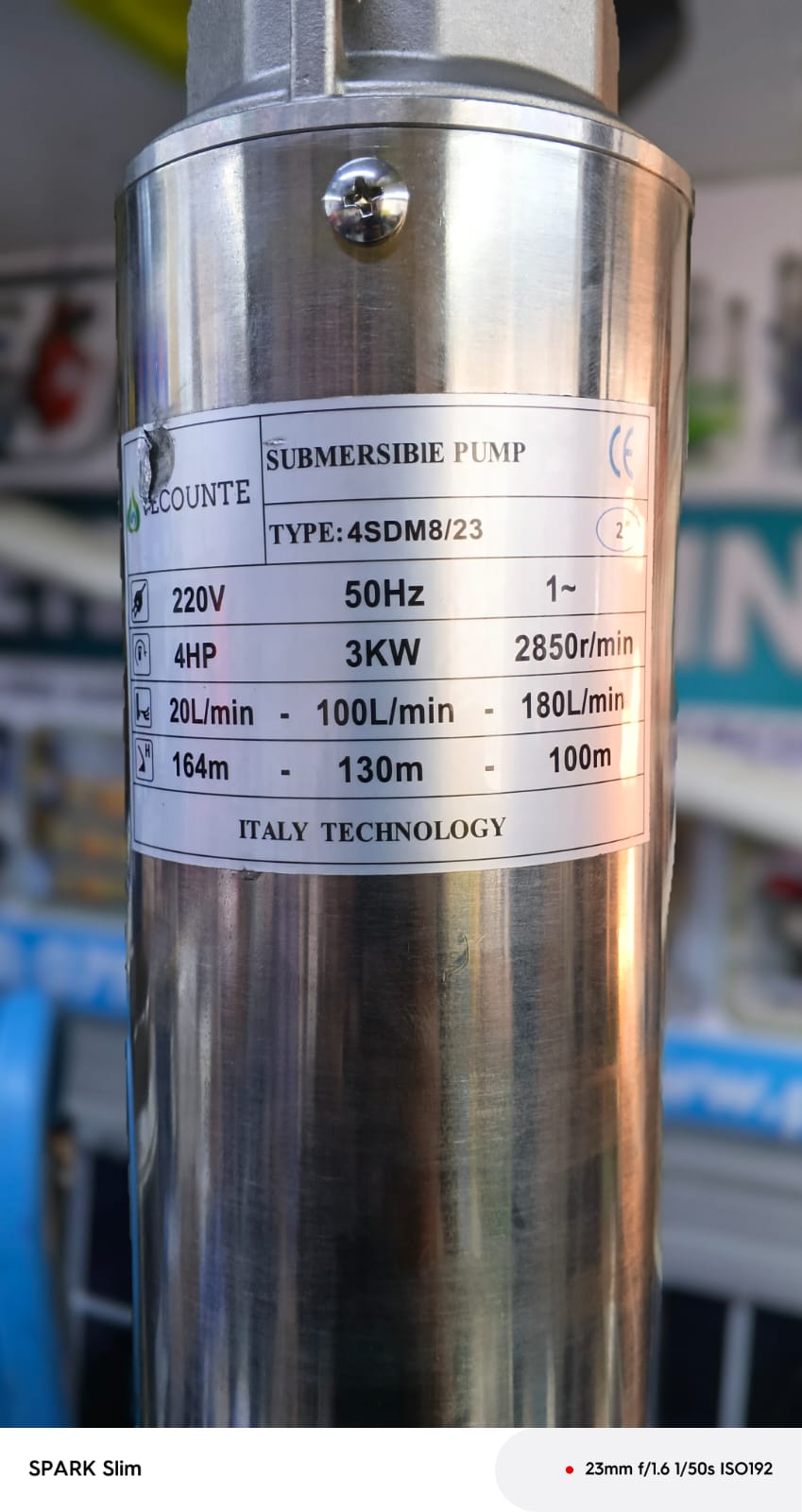
Description
The 4HP Vecounte submersible pump is a heavy-duty electric borehole pump designed for deep-water pumping, farm irrigation, elevated tank filling, livestock projects, institutions and commercial water supply. It has a powerful 4HP motor, a maximum head of 164 metres, a 23-metre-long cable and a controller box.
A 4HP motor is approximately 3kW or 3000W. Pumps in this power class are built for demanding borehole applications where smaller pumps may not provide enough flow or pressure. Comparable 4HP submersible motors are also rated at 3kW.
4HP Vecounte Submersible Pump Specifications
| Specification | Details |
|---|---|
| Brand | Vecounte |
| Pump Type | Electric submersible borehole pump |
| Motor Power | 4HP |
| Approx. Motor Power | 3kW / 3000W |
| Maximum Head | 164 metres |
| Maximum Head in Feet | Approx. 538 ft |
| Cable Length | 23 metres |
| Controller Box | Included |
| Installation | Submerged installation |
| Pumping Design | Multi-stage centrifugal |
| Main Use | Deep boreholes and high-head water supply |
| Applications | Farms, homes, irrigation, tanks and commercial projects |
The 164m maximum head, 23m cable and controller box are specifications supplied for this Vecounte model. The exact voltage, flow rate, outlet size, phase and pump diameter should be confirmed from the pump nameplate before installation.
Powerful 4HP Motor
The Vecounte uses a 4HP electric motor, equivalent to approximately 3kW or 3000W.
This larger motor makes the pump suitable for demanding installations that need considerable water-lifting power. Current 4HP borehole motors are commonly rated at 3kW, but they can be manufactured for either single-phase or three-phase electricity.
For this reason, do not assume the Vecounte is single-phase or three-phase without checking its controller and motor nameplate.
Maximum Head of 164 Metres
The maximum head of 164m, approximately 538 feet, gives this Vecounte pump strong vertical lifting capacity.
This makes it suitable for deep boreholes and installations where water must be pumped to elevated storage tanks.
However, 164m is maximum head, not recommended borehole depth.
At maximum head, a centrifugal pump normally delivers very little water. The useful working point will be at a lower head where the pump can provide the required flow.
23-Metre-Long Cable
This Vecounte model comes with a 23m submersible electrical cable.
The extra cable is useful during installation because the pump must operate below the borehole water level.
If the installation requires a longer cable, the additional cable must be correctly sized. Cable selection depends on motor current, voltage and total cable length because an undersized cable can cause excessive voltage drop.
Submersible cable is specifically designed to operate in wet borehole conditions and carry the pump’s starting and running current.
Controller Box Included
The 4HP Vecounte submersible pump comes with a controller box, which is an important part of the electrical installation.
A properly matched controller handles motor starting and control. Depending on its design, it may also provide electrical protection.
For example, some 3kW/4HP borehole control boxes include over-current, over-voltage and under-voltage protection.
These features should not automatically be assumed for the Vecounte controller. Check the actual controller label to identify its protection functions and required input voltage.
Designed for Deep Borehole Pumping
The 4HP Vecounte is designed to operate underwater.
Unlike a surface pump that must pull water through a suction pipe, the submersible pump is lowered below the water level and pushes water upward through the rising main.
This design makes high-head submersible pumps suitable for:
- Deep boreholes
- Elevated tank filling
- Farm water supply
- Irrigation projects
- Livestock watering
- Hotels and institutions
- Apartment water systems
- Schools and hospitals
- Commercial properties
- Large domestic water systems
A 4HP motor can be paired with different hydraulic pump bodies, which means two 4HP pumps can have very different flow and head ratings.
Multi-Stage Pumping System
High-head submersible pumps normally use a multi-stage centrifugal design.
Inside the pump are several impeller and diffuser stages. Instead of producing all the pressure with one impeller, water passes through several stages.
Each stage increases the water pressure.
This design allows a narrow borehole pump to generate enough pressure to move water through a long rising main.
It also explains why horsepower alone cannot tell you how high a pump will lift water.
4HP Does Not Automatically Mean Higher Head
An important feature of the Vecounte range is that a larger motor does not necessarily mean a proportionally higher maximum head.
Pump performance depends on:
Motor power + impeller design + number of stages + pump diameter + intended flow rate.
For example, current 3kW/4HP pumps on the market vary enormously. One high-flow model has only a 70m maximum head while another 4HP model reaches 270m.
This is why the Vecounte’s 164m head should be treated as the specification of this particular hydraulic design, not a general specification for every 4HP pump.
Understanding Maximum Head and Flow
Maximum head and maximum flow are different measurements.
When the pump has little resistance, it can normally deliver more water. As the required pumping height and pressure increase, flow decreases.
For example, one 4HP pump can produce up to 21m³/hr but has only a 70m maximum head, while another 4HP pump is designed for much higher head but substantially lower flow.
This shows why I would not assign an unverified flow rate to the Vecounte 4HP pump.
Its performance curve is required to know the actual flow at 50m, 100m, 120m, 140m or 160m head.
Suitable for Irrigation
The 4HP Vecounte submersible pump can be a strong option for farm irrigation where borehole water must be lifted from considerable depth.
It can supply water to a storage tank or, where pressure and flow are correctly matched, feed an irrigation system directly.
Possible applications include drip irrigation, greenhouse water supply, livestock watering and other farm water systems.
However, irrigation design should begin with the required litres per hour and pressure, not just pump horsepower.
Good for Elevated Water Tanks
The 164m maximum head also makes this pump useful where the borehole and storage tank have a significant difference in elevation.
Suppose the dynamic water level is 85m below ground and your tank inlet is 20m above ground.
Your basic vertical lift is:
85m + 20m = 105m
You then need to add friction losses through the delivery pipe, bends, valves and fittings.
If additional outlet pressure is required, that must also be added.
This combined figure is known as Total Dynamic Head (TDH).
How to Calculate the Required Head
A useful simplified formula is:
TDH = Dynamic Water Level + Tank Height + Required Pressure + Friction Losses
For example:
| Requirement | Example |
|---|---|
| Dynamic Water Level | 90m |
| Tank Height | 15m |
| Required Pressure | 10m |
| Estimated Pipe Loss | 10m |
| Total Dynamic Head | 125m |
You would then need to check the Vecounte pump curve to determine how much water the 4HP pump delivers at approximately 125m head.
That figure is more useful than simply knowing that maximum head is 164m.
Pressure-Rated Pipes Are Important
A high-head pump can generate substantial pressure.
As a rough conversion, 10 metres of water head is approximately 1 bar. Therefore, a 164m water column represents roughly 16 bar of static pressure under ideal conditions.
This does not mean every part of the installation continuously operates at 16 bar.
However, it shows why high-head borehole systems need correctly selected HDPE pipes, fittings, non-return valves and other components.
Do not use low-pressure pipes simply because they are cheaper.
Cable Selection for a 4HP Pump
Cable selection becomes particularly important with a 3kW motor.
The supplied 23m cable may need extending when the pump is lowered deep into a borehole.
For longer installations, calculate cable size using:
Motor current, supply voltage, total cable length and acceptable voltage drop.
Guidance for submersible pump cables recommends sizing based on the motor’s full-load current and complete cable run rather than horsepower alone.
A qualified electrician or pump installer should therefore select the extension cable.
4HP Vecounte vs Smaller Vecounte Pumps
| Model | Approx. Motor Power | Maximum Head | Supplied Cable |
|---|---|---|---|
| Vecounte 0.75HP | 0.55kW | 65m | Model dependent |
| Vecounte 1HP | 0.75kW | 94m | 20m |
| Vecounte 2HP | 1.5kW | 159m | 20m |
| Vecounte 3HP | 2.2kW | 146m | 20m |
| Vecounte 4HP | 3kW | 164m | 23m |
The 4HP model has the largest motor in this group and a high 164m maximum head.
Notice that maximum head does not rise evenly with horsepower. This happens because each pump can use a different impeller and stage configuration.
Benefits of the 4HP Vecounte Submersible Pump
Powerful 4HP motor: Approximately 3kW of motor power makes it suitable for demanding water-supply applications.
164m maximum head: Provides strong lifting capacity for deep-water installations.
23m cable included: Offers more supplied cable than the 20m provided with several smaller Vecounte models.
Controller box included: Reduces the number of separate components required when setting up the pump.
Heavy-duty borehole application: Suitable for farms, institutions, commercial properties and larger domestic water projects.
Quiet operation: Because the motor operates underwater, noise around the borehole is much lower than with many surface-pump installations.
Suitable for elevated tanks: Its high head makes it useful where the tank is positioned well above the pumping water level.
Installation Recommendations
Install the Vecounte pump below the dynamic water level but safely above the bottom of the borehole.
Leaving adequate clearance above the bottom helps prevent sand and sediment from entering the pump.
Never suspend the pump using the electrical cable. Use the correct delivery pipe and approved support arrangement.
A high-head 4HP installation should also have a correctly rated non-return valve, pressure-rated rising main, properly sized electrical cable and suitable motor protection.
Dry-run protection is worth considering, especially where borehole yield changes during dry seasons. Professional 4HP installation guidance also recommends suitable overload and dry-run protection.
How to Choose the Correct Vecounte Pump
Before buying the 4HP Vecounte submersible pump, obtain your borehole report where possible.
You should know the total borehole depth, static water level, dynamic water level, tested borehole yield, casing diameter and recommended pump installation depth.
Also determine how much water you need each day and the height and distance to the storage tank.
These figures allow the installer to match the pump’s performance to your actual water requirements instead of choosing only by horsepower.
Frequently Asked Questions
What is the maximum head of the 4HP Vecounte submersible pump?
The maximum head is 164 metres, approximately 538 feet.
How many kilowatts is a 4HP submersible pump?
A 4HP motor is approximately 3kW or 3000W. Comparable 4HP borehole motors use this 3kW rating.
Does the Vecounte 4HP come with a controller box?
Yes. This model comes with a controller box.
How long is the cable?
It comes with a 23-metre-long cable.
Can I use it for a deep borehole?
Yes. Its 164m maximum head makes it suitable for many deep-borehole applications, but the correct choice depends on dynamic water level, required flow, tank elevation and pipe losses.
Is the 4HP Vecounte suitable for irrigation?
Yes. It can be used for irrigation, farm water supply and livestock projects when its actual flow at the required operating head matches the water demand.
What is the flow rate of the Vecounte 4HP pump?
The exact flow rate should be taken from the Vecounte pump curve or nameplate. It should not be estimated from horsepower because different 4HP pumps can have very different flow rates. For example, current 3kW/4HP pumps range from high-head, lower-flow models to pumps capable of more than 20m³/hr at lower heads.
Can a 164m-head pump be installed in a 160m-deep borehole?
Possibly, but borehole depth is not the same as pumping head. You need to know the dynamic water level, tank elevation, pipe friction and required pressure before selecting the pump.
What voltage does the Vecounte 4HP use?
Check the exact pump and controller nameplate before connection. 4HP/3kW borehole motors are available in both single-phase and three-phase versions, so it would be unsafe to assume the Vecounte voltage without its electrical specifications.


Reviews
There are no reviews yet.